In D.C. during ASIL Annual Meeting this week, Georgia Law scholars on panels at ASIL and at Brookings Institution

Scholars at the University of Georgia School of Law are taking part on panels during this week’s 116th Annual Meeting of the American Society of International Law, the theme of which is “Privatizing International Governance.”

The annual meeting opened yesterday and runs through Saturday – in person, in Washington, D.C., for the first time in a couple years. Indeed, the meeting is hybrid, with registration available for online viewers – including, at ASIL Academic Partners like Georgia Law, free registration for students.

Georgia Law representation includes these panels:

10:30-11:30 a.m., Friday, April 8: Privatizing International Governance

Melissa J. “MJ” Durkee, who is Associate Dean for International Programs, Director of the Dean Rusk International Law Center, and Allen Post Professor (pictured above left), will serve as moderator for a panel entitled “Privatizing International Governance,” part of the meeting’s International Law Beyond the State track.

Here’s the panel description:

“The 2030 Agenda for Sustainable Development and the UN Guiding Principles on Business and Human Rights both encourage engaging business groups as partners in developing global governance agendas. Such multi-stakeholder and public-private partnerships are increasingly common and seen as essential to the future of international business regulation. The participation of affected groups brings expertise, promotes engagement and buy-in, and secures funding. At the same time, critics have raised alarms about industry capture of the UN climate change bodies, global financial governance institutions, and international public health standard-setting efforts. In response, institutions like the World Health Organization and the Food and Agriculture Organization are implementing reforms to prevent mission-distortion by business groups. At a time when multilateral cooperation is at an ebb, public-private partnerships are indispensable, and yet the danger of undue influence is real. The time is therefore ripe to consider how to productively engage business groups in global governance. This roundtable of experts will discuss cutting-edge efforts by international organizations to capture the benefits of business participation while reducing the harms. The roundtable will consider access rules, existing and proposed reforms, and how past experience may offer lessons for future challenges.”

Panelists will be: Patricia Kameri-Mbote, United Nations Environment Programme; Nora Mardirossian, Columbia Center on Sustainable Investment; Suzy Nikièma, Lead, Sustainable Investment, International Institute for Sustainable Development; and Nancy Thevenin, United States Council for International Business.

3-4:30 p.m., Friday, April 8: Fourth Annual International Law Review Editors-in-Chief Roundtable

Harlan G. Cohen, who is Gabriel M. Wilner/UGA Foundation Professor in International Law and Faculty Co-Director of the Dean Rusk International Law Center at Georgia Law (above right), will serve as a panelist in the “Fourth Annual International Law Review Editors-in-Chief Roundtable,” an online session that is part of the meeting’s Professional and Academic Development track.

Here’s the panel description:

“In recognition of the important role that student-edited international law journals play in the dissemination of international legal scholarship, the Society hosts an annual International Law Review Editor Roundtable. This Roundtable will discuss key issues around legal scholarship, including: selecting great topics that might be more relevant to the various audiences of law journals, including scholars and practitioners; how international law journals can be more effective at soliciting and/or selecting relevant pieces of international legal scholarship; and how to work with authors (who may have different cultural perspectives) to successfully publish their pieces. The Roundtable will be facilitated by international law experts as well as sitting editors-in-chief of law student-run international law journals. The Society invites current students and recent graduates interested in the process of scholarship and publication in international law to connect with their peers and distinguished scholars and practitioners.”

Joining Professor Cohen on the panel will be Colorado Law Professor James Anaya and Vanderbilt Law Professor Ingrid Wuerth.

Additionally:

11 a.m.-1 p.m. Friday, April 8: Eighth Annual Justice Stephen Breyer Lecture on International Law, Brookings Institution

Diane Marie Amann, who is Regents’ Professor of International Law, Emily & Ernest Woodruff Chair in International Law, and Faculty Co-Director of our Center (above second from left), will serve on a panel to be held after Philippe Sands, a barrister and University College London law professor now visiting at Harvard Law, delivers a lecture entitled “Crimes Against Humanity, Genocide, and Ecocide: of Rights, Responsibilities, and International Order.” Other panelists will be Georgetown Law Professor Jane Stromseth and George Washington University Law Professor Sean D. Murphy. Online registration is still available here for this event.

Georgia Law professors also are taking part in ASIL leadership meetings during the annual conference, which is supported by four volunteer Georgia Law students: 1Ls John Carter and Jack Schlafly and LLMs Veronika Grubenko and Agustina Figueroa Imfeld.
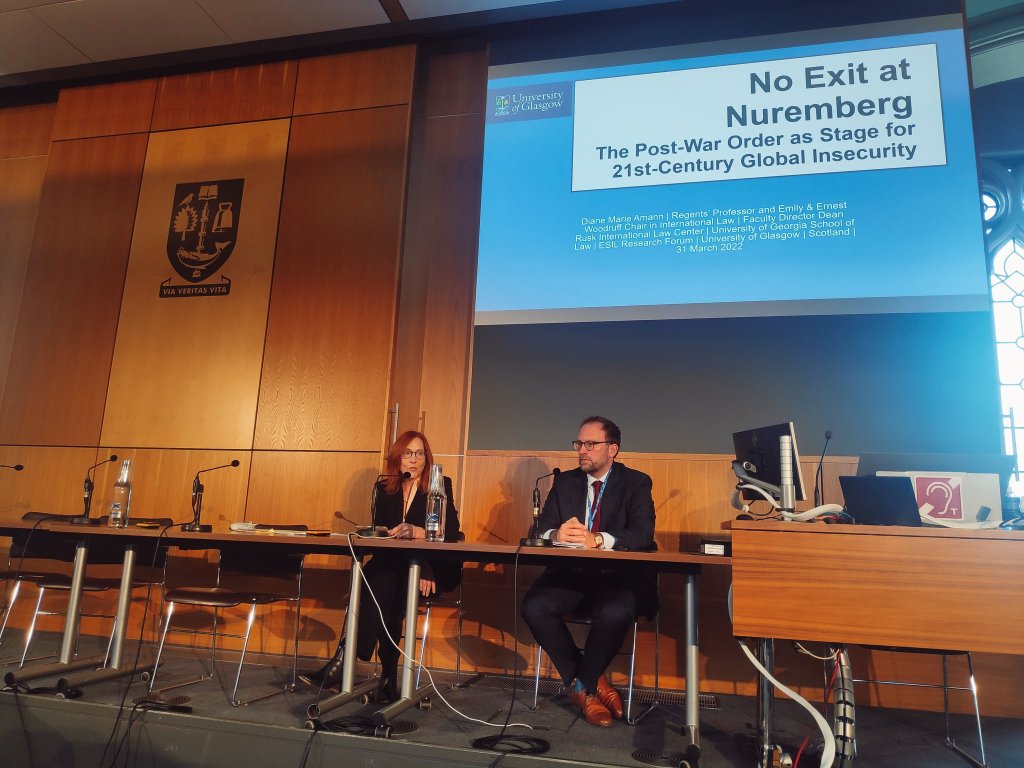
Georgia Law Professor Diane Marie Amann keynotes 2022 ESIL Research Forum in Glasgow, Scotland

No Exit at Nuremberg: The Postwar Order as Stage for 21st-Century Global Insecurity” is the title of the keynote address that University of Georgia School of Law Professor Diane Marie Amann delivered Thursday at the University of Glasgow, Scotland, thus opening the 2022 Research Forum of the European Society of International Law. Her topic dovetailed with the forum’s overall theme, “International Law an Global Security: Regulating an Illusion?”

Introducing Amann – who is Regents’ Professor of International Law, Emily & Ernest Woodruff Chair in International Law, and Faculty Co-Director of the Dean Rusk International Law Center – was Glasgow Law Professor Christian J. Tams, Director of the Glasgow Centre for International Law & Security.

Amann framed her talk around two artefacts of the period immediately after World War II, when the 1945-46 Trial of Major War Criminals was unfolding before the International Military Tribunal at Nuremberg, Germany: the play that Jean-Paul Sartre entitled Huis Clos but that is known in English as Vicious Circle or No Exit; and the front page of a French newspaper that referred not only to that play, but also to food shortages, the East-West threat spurred by the advent of nuclear weapons, and the IMT trial. She then linked the military, economic, political, and human security threads these artefacts raised to current events including conflicts in Ukraine and elsewhere.

Georgia Law Professor Amann post proposes considering new war crimes commission to investigate in Ukraine

Referring to Russia’s invasion last month of Ukraine, as well as the brutal attacks that followed, Georgia Law Professor Diane Marie Amann published “Time for a New War Crimes Commission?” Friday at Articles of War, the blog of the Lieber Institute for Law & Warfare, U.S. Military Academy West Point.

Amann, who is Regents’ Professor of International Law, Emily & Ernest Woodruff Chair in International Law, and Faculty Co-Director of the Dean Rusk International Law Center here at the University of Georgia School of Law, began by outlining the limitation that international law rules place on existing tribunals, such as the International Criminal Court, International Court of Justice, and European Court of Human Rights, as well as a proposed special tribunal on the crime of aggression. Having thus identified gaps in accountability, she wrote:

“Now and going forward, accountability could be enhanced by setting up a clearinghouse for gathering, cataloging, and preserving evidence, with an aim to eventual prosecutions in multiple national, regional, and international systems. The idea is not new; indeed, a useful model may be found in a Second World War-era institution known as the United Nations War Crimes Commission (UNWCC).”

Her post proceeded to sketch the history of this 1943-1948 commission, as well as its strengths and weaknesses. She concluded by calling for a body that would be empowered to carry out the UNWCC’s “core function”:

“specifically, the conduct of investigations aimed at preserving evidence and facilitating criminal prosecutions of suspects at all levels, for all potential offenses, and before any number of national, regional, and international systems willing and able to afford the persons they accuse a full and fair trial.”

The full Articles of War post is here.

Dean Rusk International Law Center hosts “International Law and the Ukraine-Russia Conflict,” featuring Georgia Law Professors Amann, Cohen, and Durkee

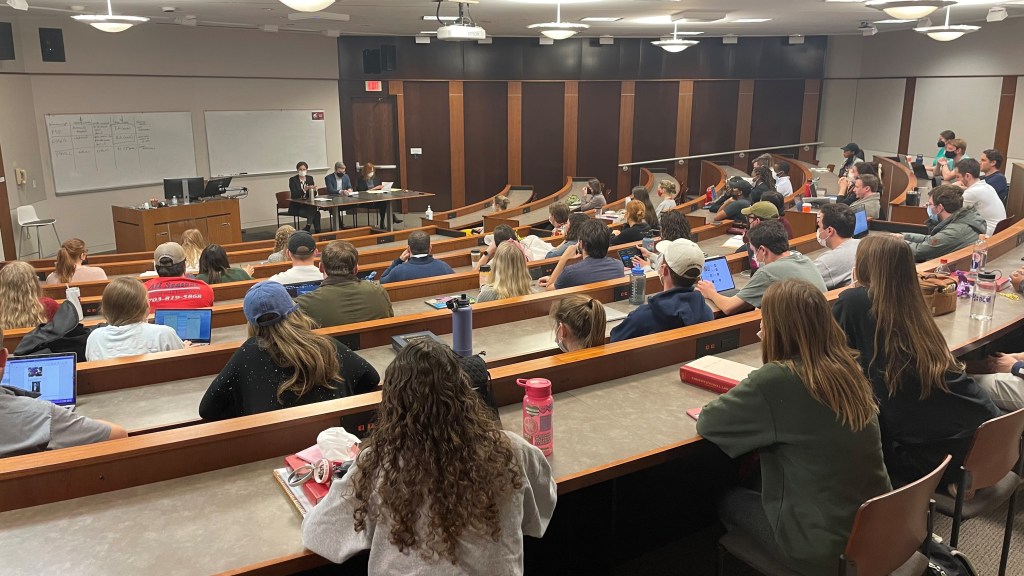
Nearly a hundred members of the University of Georgia School of Law community took part Wednesday in “International Law and the Ukraine-Russia Conflict,” a forum hosted by our Dean Rusk International Law Center and presented by three international law experts on the law school’s faculty.

The armed conflict began on February 24, 2022, when Russian military troops invaded the neighboring state of Ukraine, entering the latter country at points on its northern, eastern, and southern borders. At this writing just a week later, thousands of persons, civilians and combatants alike, reportedly had been killed, and, according to UN High Commissioner for Refugees Filippo Grandi, more than a million Ukrainians had been forcibly displaced.

At Wednesday’s forum, each of the three Georgia Law professors first offered a brief overview of a particular aspect of the armed conflict:

  • Our Center’s Director, Melissa J. “MJ” Durkee, who is also Associate Dean for International Programs and Allen Post Professor, began by outlining the international rules that have outlawed aggressive war – that is, one country’s unjustified invasion of another – since the adoption of the 1945 Charter of the United Nations. She explained why reasons that Russia has put forward do not constitute legally valid justifications for the invasion, and further emphasized the threat that Russia’s actions place on the international rules-based order that came into being after the Allied victory in World War II. In so doing, Durkee cited a UN General Assembly resolution, adopted Wednesday by a huge majority of votes, which condemned Russia’s actions as violative of this order.
  • Next came Harlan Grant Cohen, who is Gabriel M. Wilner/UGA Foundation Professor in International Law and one of our Center’s 2 Faculty Co-Directors. Cohen focused on economic sanctions that have been levied against Russia in the last week, by individual countries including the United States and also by international organizations including the European Union. While noting that these types of economic actions had been developed in response to Iran’s nuclear program, Cohen stressed that the extent and impact of the sanctions already imposed against Russia is unprecedented.
  • Then followed our Center’s other Faculty Co-Director, Diane Marie Amann, who is also Regents’ Professor of International Law and Emily & Ernest Woodruff Chair in International Law. She addressed international humanitarian law, the body of law concerned with the ways that armies and armed groups actually conduct the war. She underscored that this body of law concerns itself with all sides of the conflict, regardless of who started the conflict: fighters on either side may be found liable for violations, and thus charged with war crimes. Amann concluded with a look at forums already engaged to review legal issues arising out of the war, among them the European Court of Human Rights, International Criminal Court, and International Court of Justice.

The forum concluded with a lively and wide-ranging question-and-answer period.

Georgia Law Professor Cohen publishes introduction to AJIL Unbound symposium

Harlan Grant Cohen, who is Gabriel M. Wilner/UGA Foundation Professor in International Law and Faculty Co-Director of the Dean Rusk International Law Center here at the University of Georgia School of Law, published “Introduction to the Symposium on Gregory Shaffer, ‘Governing the Interface of U.S.-China Trade Relations'” in 116 AJIL Unbound 38 (2022).

Professor Cohen also helped organize and edit the symposium, in which numerous scholars offer commentary on a 2021 American Journal of International Law article by Shaffer, who is Chancellor’s Professor of Law and Political Science at the University of California-Irvine, and President-Elect of the American Society of International Law.

Georgia Law team places 2d in US championship, preparing for upcoming international rounds in Jessup Moot

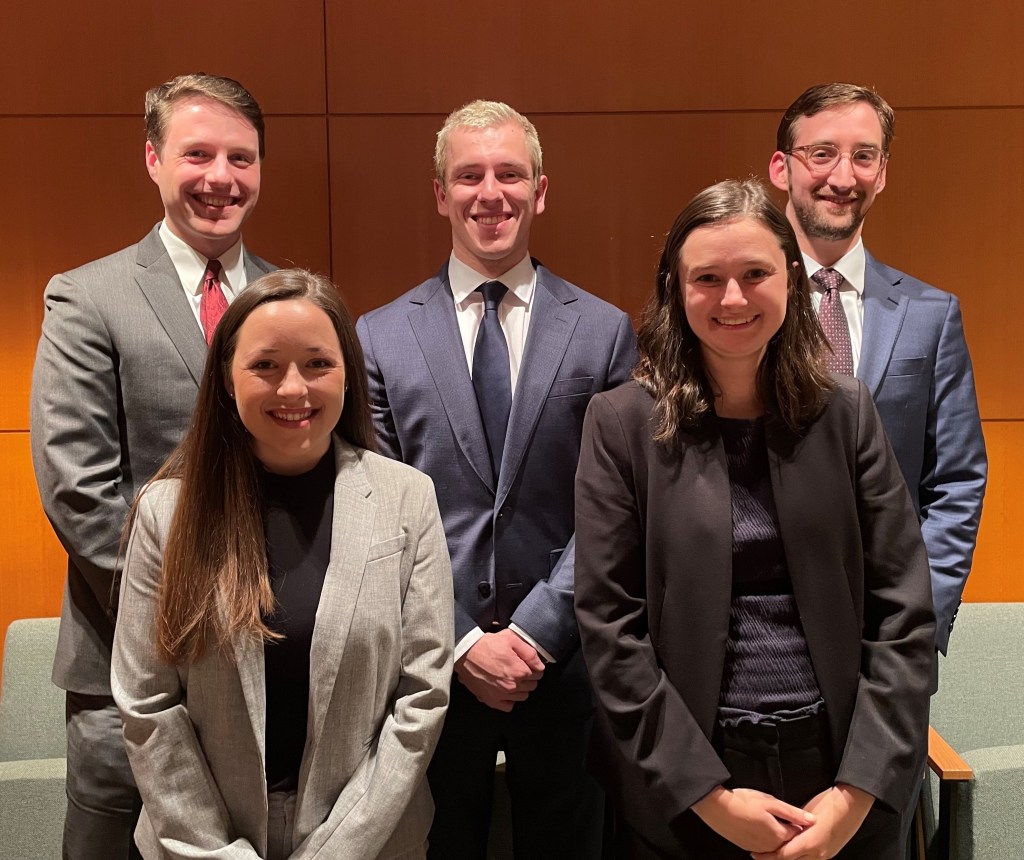
Proud to announce that a team of talented University of Georgia School of Law students competed Sunday in the US National Championship of the Philip C. Jessup International Law Moot Court Competition. Although it lost to Harvard after having defeated many others among the 84 American teams that competed, the team’s success earned it an invitation to compete in the International Rounds set to begin in late March.

The team members are 2Ls Millie Price, Courtney Robinson, Caleb Grant, James Stewart, and Alex Krupp (pictured above, clockwise from lower right). Robinson won recognition as the 4th best overall oralist, and Stewart as the 14th best, in the US tournament. Leading the team were 3L coach Courtney Hogan and faculty advisor/coach Anna White Howard, both themselves former Jessup advocates.

The team benefited from moots and other assistance by many members of the Georgia Law community, including: Professor Melissa J. “MJ” Durkee, Associate Dean for International Programs and Director of the law school’s Dean Rusk International Law Center, and Professors Diane Marie Amann and Harlan Grant Cohen, the Center’s Faculty Co-Directors; Georgia Law Dean Peter B. “Bo” Rutledge; Kellie Casey, Director of Advocacy; Anne Burnett, Foreign and International Law Librarian; Professors Nathan S. Chapman, Rob McNiff, and Lori A. Ringhand; and alums, Judge Ben Cheesbro, Ellen Clarke, and Erik Chambers.

The Jessup is the world’s largest moot court competition, with upwards of 3,500 students, from more than a hundred countries, competing. Their teams prepare briefs and give oral arguments as if they were appearing before the International Court of Justice, the judicial arm of the United Nations which adjudicates international law disputes between sovereign nation-states. The Washington, D.C.-based International Law Students Association is the primary host, with the law firm of White & Case sponsoring the International Rounds as well as some national competitions.

Georgia Law coursework begins for inaugural class of students seeking Graduate Certificate in International Law

Graduate Certificate in International Law students tour Hirsch Hall at the University of Georgia School of Law Friday, in anticipation of the new semester beginning this week.

This New Year marks the arrival of the inaugural class of Graduate Certificate in International Law students here at the University of Georgia School of Law.

Through the initiative of the law school’s Dean Rusk International Law Center, postgraduate students from other disciplines within the university will earn this academic certificate following their successful completion, in classes alongside J.D., LL.M., and M.L.S. students, of fifteen credit hours chosen from among the law school’s rich comparative, transnational, and international law curriculum; courses include Public International Law, International Human Rights, International Trade Law, Immigration Law, International Law Colloquium, and Global Governance.

The seven students comprising the first class include:

  • Four doctoral students: from the School of Public and International Affairs, Alma Bajramović, a Ph.D. candidate who is researching conflict and conflict resolution, with a focus on the Balkans; from the Mary Frances Early College of Education, Leslyn Beckles, candidate for a Ph.D. in Learning, Leading, and Organization Development, whose research concentrates on women political leaders in the Caribbean; and from the Franklin College of Arts and Sciences, Isaac Torres, a Ph.D. candidate in Bioinformatics who examines artificial intelligence and statistical models to address complex biology problems, and Jasmine Underwood, a Ph.D. candidate in Sociology interested in gender, development and social change, and political sociology.
  • Three master’s students, all from the School of Public and International Affairs: Megan Gerken and Nelson Millan Nales, both pursuing Master of Public Administration degrees, and Michael Sway, a candidate for the Master of International Policy degree.

Details on application of and matriculation toward the Graduate Certificate in International Law are available here and by contacting the initiative’s administrator, Sarah Quinn, Associate Director for Global Practice Preparation at the Dean Rusk International Law Center, squinn[at]uga.edu.

Georgia Law Professor Amann joins Wisconsin historian Hirsch in “Understanding Nuremberg” podcast

“Understanding Nuremberg” is the title of a new podcast with Professor Diane Marie Amann, a Faculty Co-Director of our Dean Rusk International Law Center here at the University of Georgia School of Law, and University of Wisconsin Professor Francine Hirsch.

Their conversation appears as Episode 53 of Asymmetrical Haircuts: Your International Justice Podcast, hosted by the Hague-based journalists Janet Anderson and Stephanie van den Berg. To quote the hosts, Amann and Hirsch discussed

“what we think we know (and what we don’t) about Nuremberg trials.”

Amann, who also is Regents’ Professor of International Law and the Emily & Ernest Woodruff Chair in International Law here at Georgia Law, is writing Nuremberg Women, a book about the roles that lawyers and other women professionals played at the first post-World War II war crimes trial, before the International Military Tribunal composed of judges and prosecutors from 4 Allied countries: France, Great Britain, the United States, and the Soviet Union.

Hirsch, who is the Vilas Distinguished Achievement Professor of History at the University of Wisconsin-Madison, published an account of the work of that last country in 2020. Her award-winning book is called Soviet Judgment at Nuremberg: A New History of the International Military Tribunal After World War II.

Their full podcast conversation about these previously understudied participants, and about how including their stories may challenge conventional understandings of the Nuremberg trials and their legacy, is here.

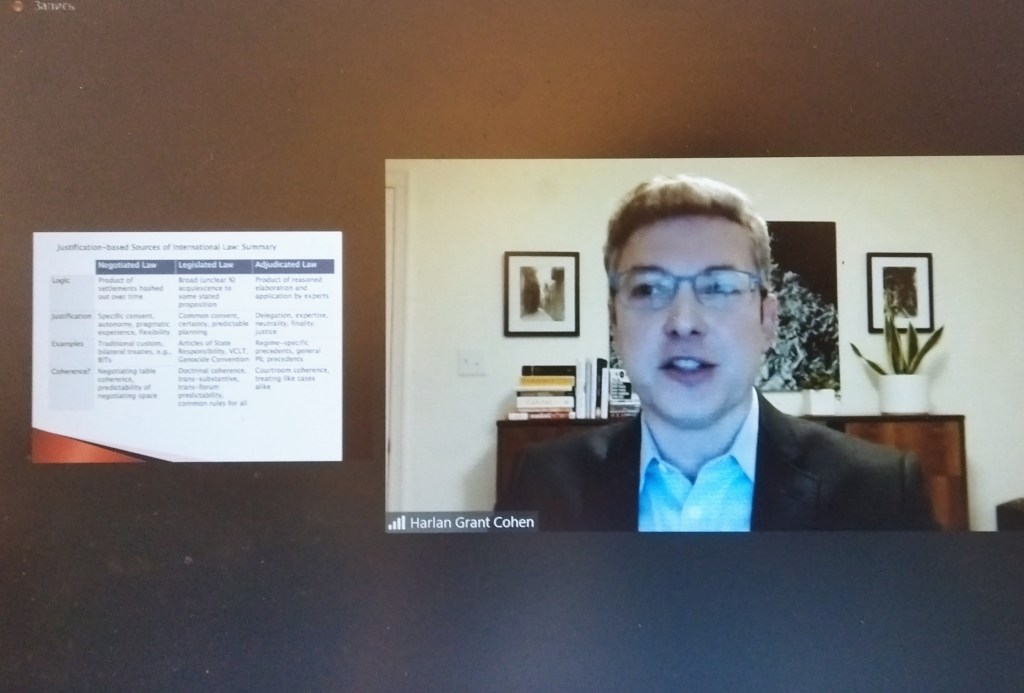
Georgia Law Professor Cohen presents “Court-Custom Paradox” in conference on customary international law

“Coherence in the interpretation of CIL is a process, not an outcome!” Professor Cohen stated, as reported in a TRICI-Law live tweet.

Harlan Cohen, who is Gabriel M. Wilner/UGA Foundation Professor in International Law and Faculty Co-Director of the Dean Rusk International Law Center here at the University of Georgia School of Law, presented Friday on “The Court-Custom Paradox” as part of “Interpretation of CIL: Methods, Interpretative Choices and the Role of Coherence,” a 2-day global conference.

Hosting the online gathering was TRICI-Law (“The Rules of Interpretation of Customary International Law”), a 5-year European Research Council Starting Grant project. Co-organizers were the PluriCourts-Centre for the Study of the Legitimate Roles of the Judiciary in the Global Order at the University of Oslo, Norway, and the Department of Transboundary Legal Studies at the University of Groningen in the Netherlands.

In addition to Professor Cohen, the conference featured Judge Liu Daqun of the International Residual Mechanism for Criminal Tribunals as well as scholars based in Austria, Canada, France, Germany, Greece, Italy, the Netherlands, Norway, Singapore, Switzerland, and the United Kingdom.

Georgia Law Associate Dean MJ Durkee, our Center’s Director, gives online webinar to law students in Bangladesh

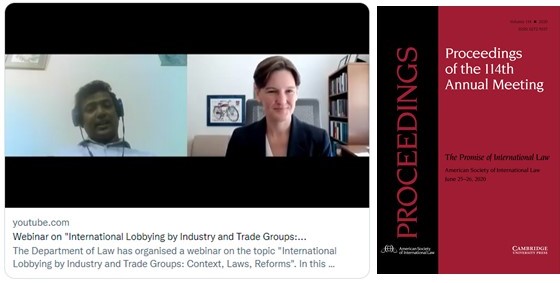
Melissa J. “MJ” Durkee, who is Associate Dean for International Programs, Director of the Dean Rusk International Law Center, and Allen Post Professor here at Georgia Law, gave an online presentation on Friday, entitled “International Lobbying by Industry and Trade Groups: Context, Laws, Reforms,” to students at the Department of Law of North South University in Dhaka, Bangladesh.

She delivered the webinar by invitation of North South Law Professor Md. Rizwanul Islam, whose own scholarship includes examinations of the operation of international economic law in South Asia.

In her presentation, Durkee observed that COP26, the 2-week international climate change conference just concluded in Glasgow, Scotland, spotlighted difficulties in designing rules and processes that welcome nongovernmental organizations and business groups into global governance. She explored the adequacy vel non of conceptualizations of this challenge, and further considered possible designs for reform.

The webinar built on “Welcoming Participation, Avoiding Capture: A Five-Point Framework,” remarks that Durkee published in the Proceedings of the American Society of International Law Annual Meeting of 2020, available here.

Video of last Friday’s webinar may be found here.