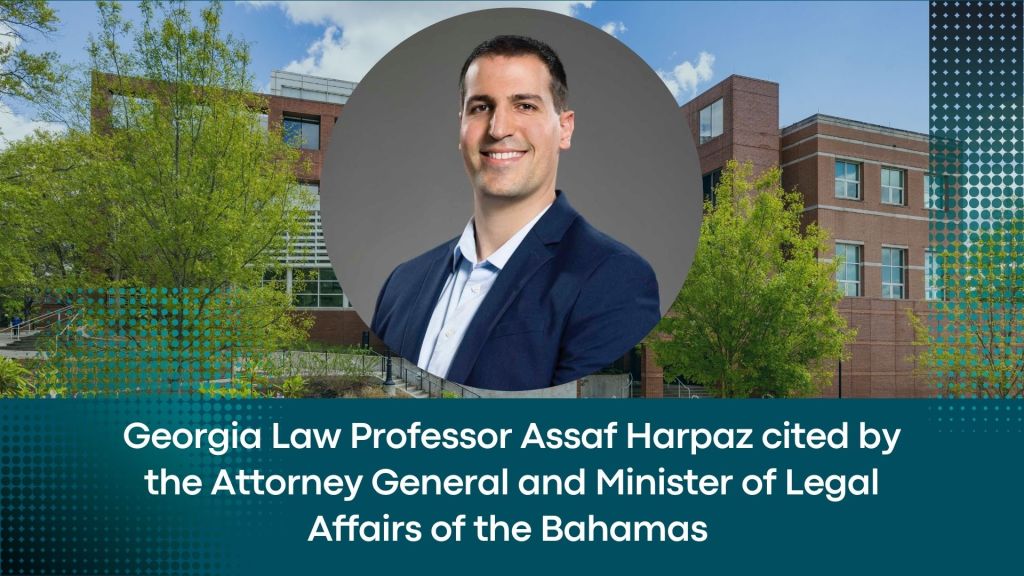
Georgia Law Professor Assaf Harpaz cited by the Attorney General and Minister of Legal Affairs of the Bahamas

University of Georgia School of Law Professor Assaf Harpaz’s article “International Tax Reform: Who Gets a Seat at the Table?” was recently quoted by Senator the Hon. Leo Ryan Pinder, Attorney General and Minister of Legal Affairs of the Bahamas, during the STEP LATAM Conference Remarks on The UN Convention on Global Tax Cooperation.

Below is an abstract of the article:

The international tax framework relies on early-twentieth-century principles and favors the interests of the Global North, which created it. It bases taxing rights on a corporation’s physical presence and mostly allocates profits to the country of residence. Moreover, it has been slow to adapt to modern business practices. In the digital economy, companies shift profits with relative ease and often do not require a physical presence in the location of their consumers. International taxation needs reform, but leading proposals do not reflect meaningful input from the Global South and are unlikely to serve the needs of developing countries.

In 2021, the Organisation for Economic Co-operation and Development (OECD), known informally as the “World Tax Organization,” introduced new rules for the cross-border taxation of multinational enterprises. The new rules intend to address the tax challenges of digitalization and profit-shifting, and they are likely the most significant change to international taxation in several decades. However, the OECD does not represent the interests of developing economies, and the proposed reform has not remedied the historic imbalance which disfavors the Global South.

This Article highlights the shortcomings of the OECD’s multilateral efforts in the context of taxation and digitalization. It analyzes the political lawmaking of the OECD and presents the new rules as a compromise that fails to address inequities in cross-border taxation. The Article argues that the reform undermines tax sovereignty and that the current international tax regime overlooks the involvement of the world’s developing countries. It asserts that attempts to promote inclusivity within the OECD have largely been expressive and that the international tax framework inherently disadvantages developing countries and their interests. The Article proposes steps to promote the equal-footed participation of developing countries in future international tax policy initiatives. First, it recommends expanding voting rights for non-members within the OECD. Second, it supports the creation of a new intergovernmental framework within the United Nations that is better positioned to revisit traditional international tax norms through a genuinely inclusive process.

Assaf Harpaz joined University of Georgia School of Law as an assistant professor in summer 2024 and teaches classes in federal income tax and business taxation. Harpaz’s scholarly focus lies in international taxation, with an emphasis on the intersection of taxation and digitalization. He explores the tax challenges of the digital economy and the ways to adapt 20th-century tax laws to modern business practices.

Georgia Law Professor Assaf Harpaz presents at SEC Workshop

University of Georgia School of Law Professor Assaf Harpaz presented his draft paper “Global Tax Wars in the Digital Era” at the University of Alabama School of Law as part of the Junior/Senior SEC Workshop.

Below is an abstract of the paper:

Current debates in international taxation often center on how to fairly allocate taxing rights among different jurisdictions. When an enterprise earns income abroad, the country of residence (where the taxpayer resides) and the country of source (where income is generated) have legitimate, competing claims to tax that income. The question is further complicated in a digital economy where profit shifting practices are abundant and businesses no longer require a physical presence in the location of their online consumers.

The international tax system has traditionally favored residence-based taxation. Now, international taxation is at a crossroads with intergovernmental organizations battling to redefine the principles of cross-border taxation. The regime has been dominated by the Global North through the Organisation for Economic Co-operation and Development (OECD), which has drawn backlash due to its undemocratic procedure and unfavorable outputs for developing countries. The United Nations has held a relatively peripheral role in global tax governance, which is poised to change with an upcoming UN Framework Convention on International Tax Cooperation – an initiative overwhelmingly supported by developing countries.

This article explores the “tax wars” surrounding the leadership for global tax governance, contrasting the taxing powers and interests of the OECD-led Global North with those of the UN-backed Global South. It highlights the distortive outcomes created by outdated international tax principles and argues for a shift toward source-based taxation. To do so, it proposes revisiting the permanent establishment standard in model treaty language, creating an opportunity for broader taxation of business profits in the source country. This transition will address longstanding disparities and is increasingly warranted in a digital economy that does not rely on physical presence.

Assaf Harpaz joined University of Georgia School of Law as an assistant professor in summer 2024 and teaches classes in federal income tax and business taxation. Harpaz’s scholarly focus lies in international taxation, with an emphasis on the intersection of taxation and digitalization. He explores the tax challenges of the digital economy and the ways to adapt 20th-century tax laws to modern business practices.

Georgia Law Professor Walter Hellerstein presents on crypto-assets at OECD

Distinguished Research Professor & Shackelford Distinguished Professor in Taxation Law Emeritus Walter Hellerstein co-presented as part of the VAT/GST Treatment of Activities Involving Crypto-Assets at the Organization for Economic Cooperation and Development Technical Advisory Group to Working Party No. 9 on Consumption Taxes meeting in Paris, France, in October.

The Working Party No. 9 on Consumption Taxes is a forum for the discussion of consumption tax policy and administration, working with both Members and non-Members of the OECD to develop appropriate and effective taxation outcomes. To read more about Professor Hellerstein’s previous presentation at the OECD, click here.

Hellerstein, a recipient of the National Tax Association’s Daniel M. Holland Medal for outstanding lifetime contributions to the study and practice of public finance, is widely regarded as the nation’s leading academician on state and local taxation. He has authored numerous books, textbooks, and law review articles, and has practiced extensively in the field. Hellerstein is currently a Visiting Professor at the Vienna University of Economics and Business, and he remains actively involved in his scholarship, consulting, and, in particular, his work as an academic advisor to the OECD.

Georgia Law Professor Assaf Harpaz publishes article on the U.N. Framework Tax Convention

University of Georgia School of Law assistant professor Assaf Harpaz published an article titled “The U.N. Framework Tax Convention: Can It Bridge the North-South Divide?” in the tax publication Tax Notes International.

In this article, Harpaz explains the key issues being addressed in the U.N. framework convention on international tax cooperation, including the global north-south divide and its role in the multilateral process.

The article’s abstract is as follows:

The United Nations recently concluded the second session of negotiations on terms of reference for a framework convention on international tax cooperation. The framework convention presents an opportunity to multilaterally address pressing global tax issues. Its goal is to “strengthen international tax cooperation and make it fully inclusive and more effective.”

The extensively negotiated terms of reference make several substantive commitments, including the fair allocation of taxing rights; tax evasion and avoidance by high-net worth individuals; sustainable development; mutual administrative assistance in tax matters; tax-related illicit financial flows; and prevention and resolution of tax disputes.

The ongoing multilateral effort brings the promise of a more equitable international tax regime. However, support for the U.N.’s work and the substantive issues identified has been sharply divided along global north-south lines. A successful U.N. process will need to acquire legitimacy from both the developed superpowers and the developing countries that have historically been excluded from international tax policymaking decisions.

The article explains the key issues being addressed in the U.N. framework convention on international tax cooperation, including the global north-south divide and its role in the multilateral process.

Assaf Harpaz joined University of Georgia School of Law as an assistant professor in summer 2024 and will teach classes in federal income tax and business taxation. Harpaz’s scholarly focus lies in international taxation, with an emphasis on the intersection of taxation and digitalization. He explores the tax challenges of the digital economy and the ways to adapt 20th-century tax laws to modern business practices.

Georgia Professor Assaf Harpaz selected as laureate at the Journal of International Economic Law Junior Faculty Forum

University of Georgia School of Law assistant professor Assaf Harpaz has been selected as a laureate to present his paper titled “Global Tax Wars and the Shift to Source-Based Taxation” at the Journal of International Economic Law Junior Faculty Forum (JIEL JFF).

Below is an abstract of the paper:

Current debates in international taxation often focus on how to fairly allocate taxing rights between jurisdictions. When an enterprise earns income abroad, both the country of residence (where the taxpayer resides) and the country of source (where income is generated) have legitimate, competing claims to tax that income. The issue is further complicated in a digital economy where tax avoidance and profit shifting practices are abundant.

Income tax treaties have traditionally favored residence-based taxation. Now, the international tax framework is at a crossroads with intergovernmental organizations battling to redefine the principles of cross-border taxation. The regime has been dominated by the Global North through the Organisation for Economic Co-operation and Development (OECD), which has drawn backlash due to its undemocratic procedure and unfavorable outcomes for developing countries. The United Nations has held a relatively peripheral role in global tax governance, yet this could change with an upcoming UN Framework Convention on International Tax Cooperation – an initiative overwhelmingly supported by developing countries. This article conceptualizes the international tax discourse as “tax wars,” contrasting the taxing powers and interests of the OECD-led Global North with those of the UN-backed Global South. It highlights the distributive effects of tax treaties and argues for a shift toward source-based taxation. To do so, it proposes revisiting the permanent establishment standard in model treaty language, creating an opportunity for broader taxation of business profits in the source country. This transition will address longstanding disparities and is increasingly warranted in a digital economy that does not rely on physical presence

Assaf Harpaz joined University of Georgia School of Law as an assistant professor in summer 2024 and will teach classes in federal income tax and business taxation. Harpaz’s scholarly focus lies in international taxation, with an emphasis on the intersection of taxation and digitalization. He explores the tax challenges of the digital economy and the ways to adapt 20th-century tax laws to modern business practices.

Georgia Law Professor Assaf Harpaz presents at International Roundtable on Taxation and Tax Policy

University of Georgia School of Law professor Assaf Harpaz presented his draft paper “Global Tax Wars and the Shift to Source-Based Taxation” and chaired the “Jurisprudence and Enforcement” panel at the 8th International Roundtable On Taxation And Tax Policy during July.

Below is an abstract from the draft paper:

Current debates in international taxation frequently engage with the concept of global tax fairness, relating to the equitable allocation of taxing rights between jurisdictions. These questions emerge within an international tax framework at a critical juncture. In a rapidly evolving digital economy, intergovernmental organizations are battling to shape the cross-border tax agenda. Global North economies have dominated this regime through the Organisation for Economic Co-operation and Development (OECD), which has drawn backlash due to its undemocratic procedure and unfavorable outcomes for developing countries. Meanwhile, the United Nations has occupied a relatively peripheral role in global tax governance. However, its role could change with the establishment of a new Framework Convention on International Tax Cooperation – an initiative overwhelmingly supported by the world’s developing countries.

The article conceptualizes the contemporary international tax discourse as “tax wars,” contrasting the taxing powers and interests of the OECD-led Global North with those of the UN-backed Global South. It explores the standards and preferences that have underpinned the regime since its inception, focusing on residence and source taxation. The article argues for a shift towards source-based taxation, drawing on procedural and distributive justice principles. To do so, the article proposes expanding the permanent establishment standard in model treaty language, creating an opportunity for broader taxation of business profits in the source country. This transition will address longstanding disparities and is increasingly warranted in a digital economy that does not rely on physical presence.

Assaf Harpaz joined University of Georgia School of Law as an assistant professor in summer 2024 and will teach classes in federal income tax and business taxation. Harpaz’s scholarly focus lies in international taxation, with an emphasis on the intersection of taxation and digitalization. He explores the tax challenges of the digital economy and the ways to adapt 20th-century tax laws to modern business practices.

Georgia Law Professor Assaf Harpaz presents at Junior International Law Scholars Association Workshop

University of Georgia School of Law professor Assaf Harpaz workshopped “Global Tax Wars and the Shift to Source-Based Taxation” at the Junior International Law Scholars Association summer workshop during August.

Assaf Harpaz joined University of Georgia School of Law as an assistant professor in summer 2024 and will teach classes in federal income tax and business taxation. Harpaz’s scholarly focus lies in international taxation, with an emphasis on the intersection of taxation and digitalization. He explores the tax challenges of the digital economy and the ways to adapt 20th-century tax laws to modern business practices.

Georgia Law Professor Harpaz presents paper at University of Wisconsin School of Law

Junior Tax Wisconsin

University of Georgia School of Law professor Assaf Harpaz recently presented his draft paper, “Global Tax Wars and the Shift to Cross-Border Taxation”, at the Junior Tax Workshop, held at the University of Wisconsin Law School. Harpaz also served as a discussant at the workshop.

Below is an abstract from the draft paper:

International taxation is at a crossroads. In a rapidly evolving digital economy, intergovernmental organizations are battling to shape the cross-border tax agenda. Global North economies have dominated this regime through the Organisation for Economic Co-operation and Development (OECD), which has drawn backlash due to its undemocratic procedure and unfavorable outcomes for developing countries. Meanwhile, the United Nations has occupied a relatively peripheral role in global tax governance. Nonetheless, in 2023, developing countries overwhelmingly supported the establishment of a new Framework Convention on International Tax Cooperation within the UN. The unprecedented initiative marks a novel challenge to the Global North’s hegemony in international tax policymaking.

This article conceptualizes the contemporary international tax discourse as “tax wars.” It contrasts the taxing powers and interests of the OECD-led Global North with those of the UN-backed Global South. The article argues for a shift towards source-based taxation, drawing on procedural and distributive justice principles. To do so, the article proposes expanding the permanent establishment standard in model treaty language, creating an opportunity for broader taxation of business profits in the source country. This transition will address longstanding disparities and is increasingly warranted in a digital economy that does not rely on physical presence.

Assaf Harpaz joined University of Georgia School of Law as an assistant professor in summer 2024 and will teach classes in federal income tax and business taxation. Harpaz’s scholarly focus lies in international taxation, with an emphasis on the intersection of taxation and digitalization. He explores the tax challenges of the digital economy and the ways to adapt 20th-century tax laws to modern business practices.
Georgia Law Professor Hellerstein presents on crypto-assets at OECD

Distinguished Research Professor & Shackelford Distinguished Professor in Taxation Law Emeritus Walter Hellerstein co-presented “Global Summary of Jurisdictions’ VAT/GST Treatment of Services Connected to the Trade in Crypto-Assets” at a meeting of the Organization for Economic Cooperation and Development’s Working Party No. 9 on Consumption Taxes in Paris, France, during June.

The Working Party No. 9 on Consumption Taxes is a forum for the discussion of consumption tax policy and administration, working with both Members and non-Members of the OECD to develop appropriate and effective taxation outcomes.

Hellerstein, a recipient of the National Tax Association’s Daniel M. Holland Medal for outstanding lifetime contributions to the study and practice of public finance, is widely regarded as the nation’s leading academician on state and local taxation. He has authored numerous books, textbooks, and law review articles, and has practiced extensively in the field. Hellerstein is currently a Visiting Professor at the Vienna University of Economics and Business, and he remains actively involved in his scholarship, consulting, and, in particular, his work as an academic advisor to the OECD.

Georgia Law Professor Harpaz submits comments for a UN framework convention on international tax cooperation

University of Georgia School of Law professor Assaf Harpaz recently submitted comments on the Zero Draft Terms of Reference for a United Nations Framework Convention on International Tax Cooperation.

Harpaz’s comments (available here), together with all other inputs, have been published on the Ad Hoc Committee’s website in preparation for its second session.

Assaf Harpaz joined University of Georgia School of Law as an assistant professor in summer 2024 and will teach classes in federal income tax and business taxation. Harpaz’s scholarly focus lies in international taxation, with an emphasis on the intersection of taxation and digitalization. He explores the tax challenges of the digital economy and the ways to adapt 20th-century tax laws to modern business practices.