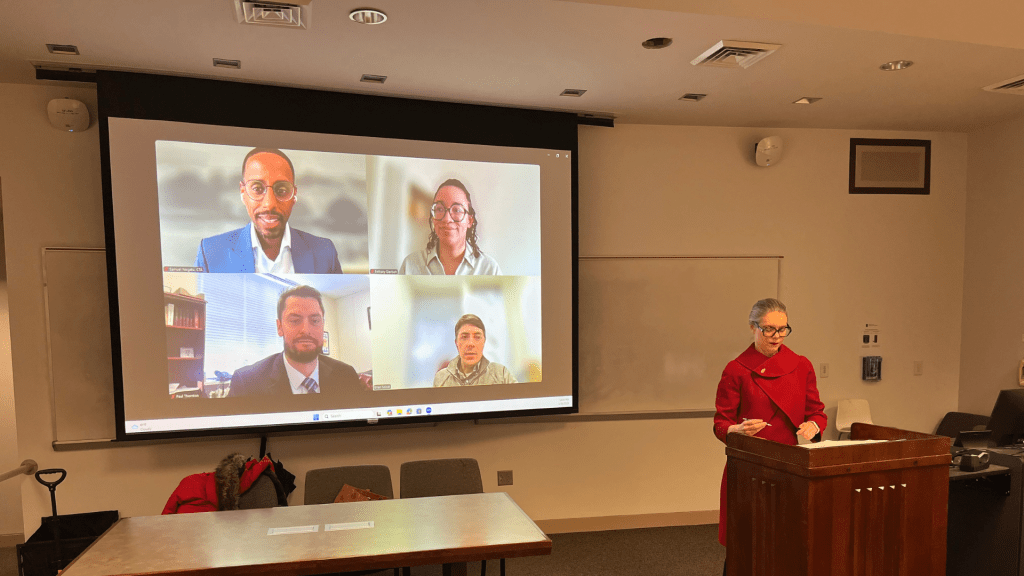
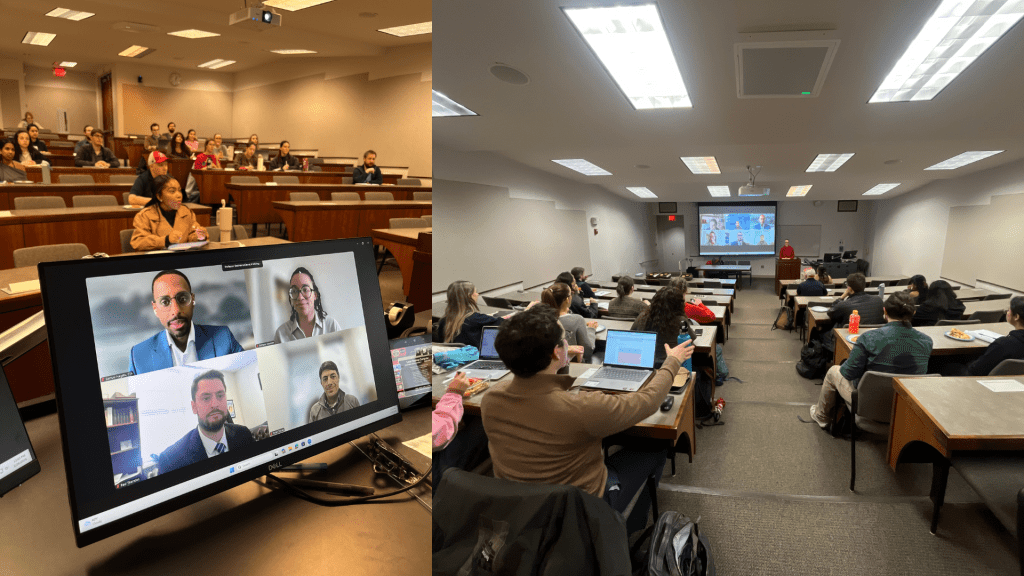
The University of Georgia School of Law partnered with the Washington International Trade Association (“WITA”) to present a second annual webinar about careers in international trade and law. This webinar was part of WITA Academy’s ongoing Pathways to Opportunity Series: Careers in International Trade & Law, through which law students and undergraduates are able to learn about career opportunities in international trade and law from law firms and trade professionals.
Moderated by Georgia Law Professor Desirée LeClercq, this year’s panel included:
Introductions from Diego Añez, Executive Director, WITA Academy; Managing Director
A panel discussion featuring:
Bethany Davison, Associate, Mowry & Grimson (B.S. Georgia State University; J.D. Georgia State University College of Law)
Samuel Negatu, Director, Government Affairs, Consumer Technology Association; former Senior Advisor, U.S. House of Representatives; former Assistant General Counsel, Office of the U.S. Trade Representative (B.A. University of California, Santa Barbara; J.D. Washington University in Saint Louis)
Brian Soiset, Attorney, U.S. International Trade Commission; former International Attorney, U.S. Department of Commerce (B.A. University of Georgia; J.D. William & Mary University; LL.M. Queen Mary University of London)
Paul Thornton, Attorney, Office of the Chief Counsel for Trade Enforcement and Compliance, U.S. Department of Commerce (B.A. Hampden-Sydney College; J.D. American University Washington College of Law)
During the panel discussion, students were able to gain insights from trade law experts, engage with policymakers and legal practitioners, and explore career opportunities in international trade law from government, companies, and law firms. Students gained a unique perspective on the wide-ranging career paths available in the trade law and policy community, creating connections with key players across both the public and private sectors.
A recording of the panel is available to WITA members. To join, email: events@wita.org
LeClercq joined the University of Georgia School of Law in 2024 as an assistant professor. She teaches Contracts, International Trade and Workers Rights, International Labor Law, U.S. Labor Law, and Public International Law. She also serves as a faculty co-director of the Dean Rusk International Law Center and as the faculty adviser for the Georgia Journal of International and Comparative Law and the Labor and Employment Student Association.
LeClercq joined the University of Georgia School of Law in 2024 as an assistant professor. She teaches Contracts, International Trade and Workers Rights, International Labor Law, U.S. Labor Law, and Public International Law. She also serves as a faculty co-director of the Dean Rusk International Law Center and as the faculty adviser for the Georgia Journal of International and Comparative Law and the Labor and Employment Student Association.
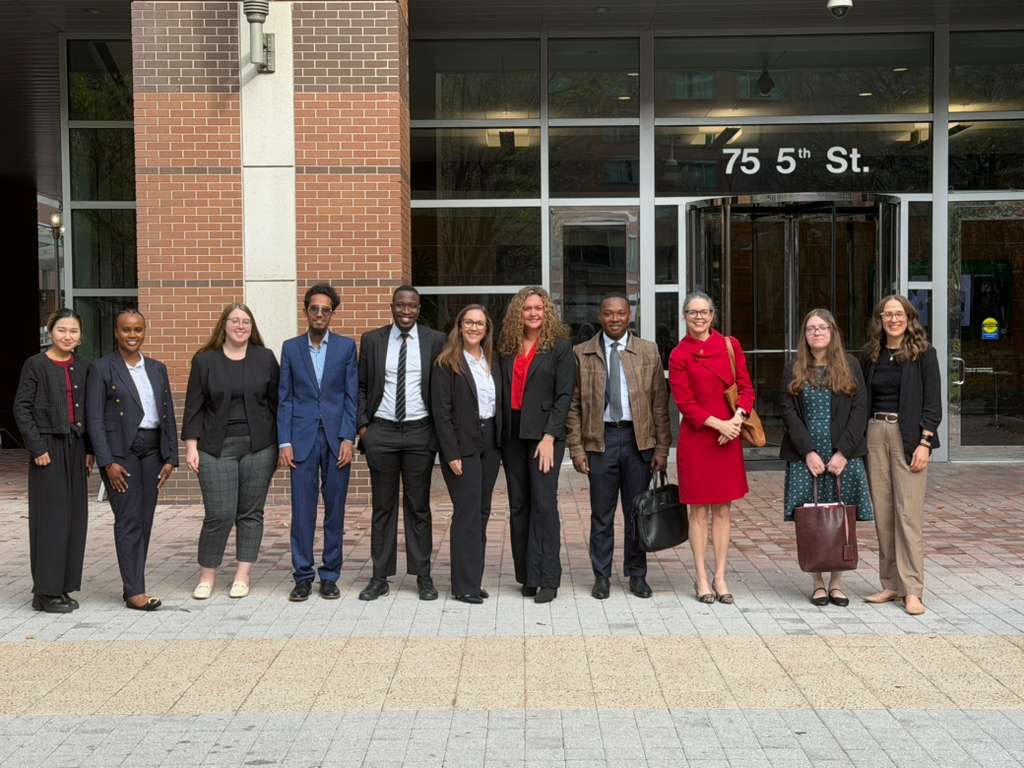
In November, University of Georgia School of Law Professor Desirée LeClercq traveled to Atlanta with a group of students as the culmination of their semester-long exploration of international trade.
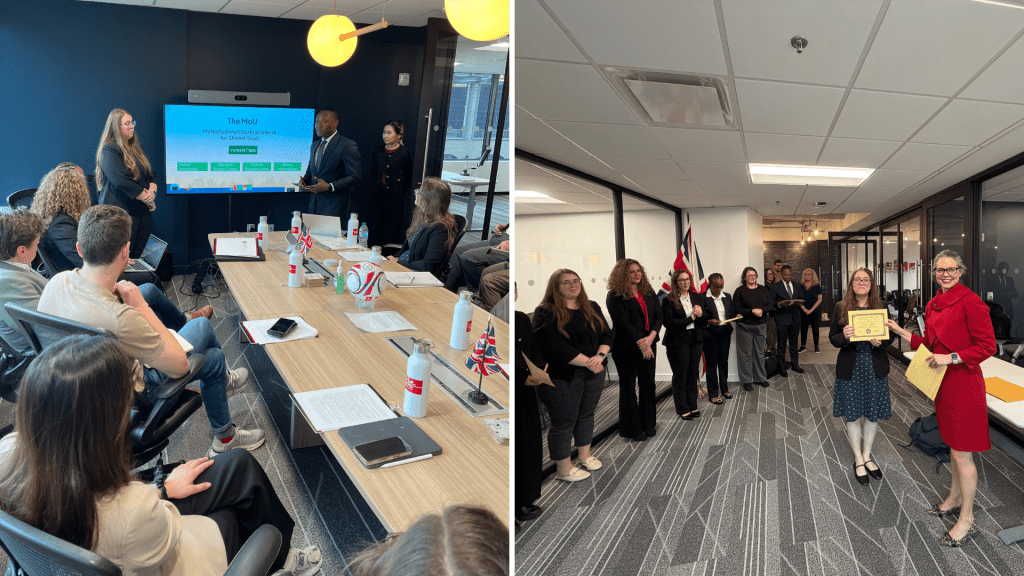
15 students, including J.D., LL.M., and Graduate Certificate in International Law students, spent the semester examining potential trade and investment opportunities between the State of Georgia and the United Kingdom from an interdisciplinary perspective. They researched and wrote a paper examining key export and import sectors in Georgia and the United Kingdom, and then prepared a hypothetical Memorandum of Understanding (MoU) between the two. The students spent the day in Atlanta presenting to, and fielding technical questions from, three different audiences: representatives from the state of Georgia, transactional and international lawyers from Eversheds Sutherland, and foreign diplomats from the U.K. consulate.
Georgia Department of Economic Development
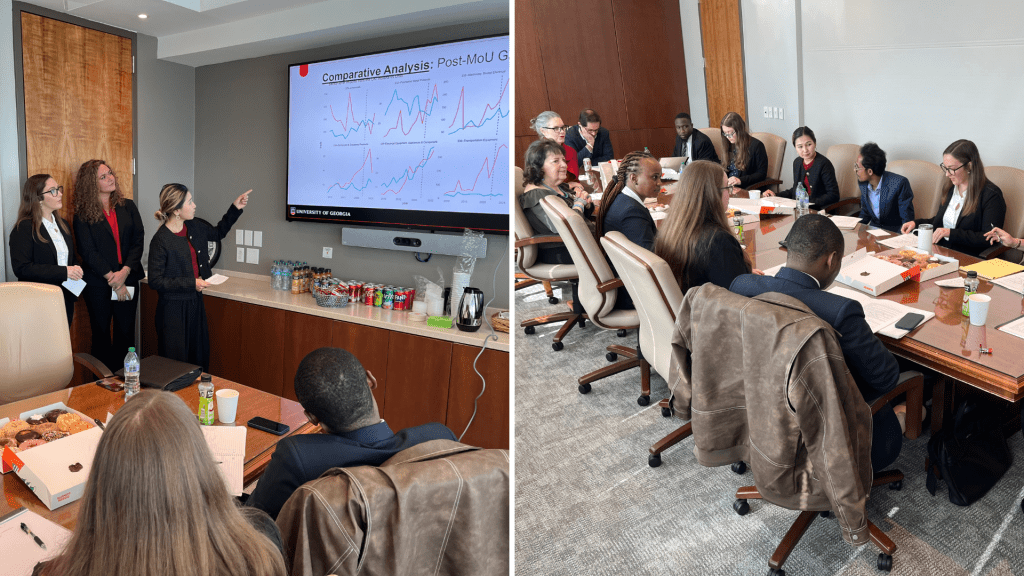
The group’s first stop of the day was hosted by the Georgia Department of Economic Development (GDEcD), the state’s sales and marketing arm, and had in attendance other state representatives.
At the GDEcD, Madina Bekisheva (GCIL student), Sutton Eady (J.D. ’27), Md. Asaduzzaman Jabin (GCIL student), and Jalyn Ross (J.D. ’27) worked together to present their portion of the hypothetical legal instrument. In their presentation, the group argued for greater collaboration and synergies between the state and the United Kingdom to attract, facilitate, and potentially grow trade. Their arguments centered on export and import data from similarly situated states and novel predictive models they had built demonstrating how enhanced collaborations with the United Kingdom could increase trade and job opportunities in Georgia. The students used the model to identify specific sectors in industry, renewable energy, commerce, and agriculture, among others, where Georgia’s economy and workers could benefit.
Eversheds Sutherland
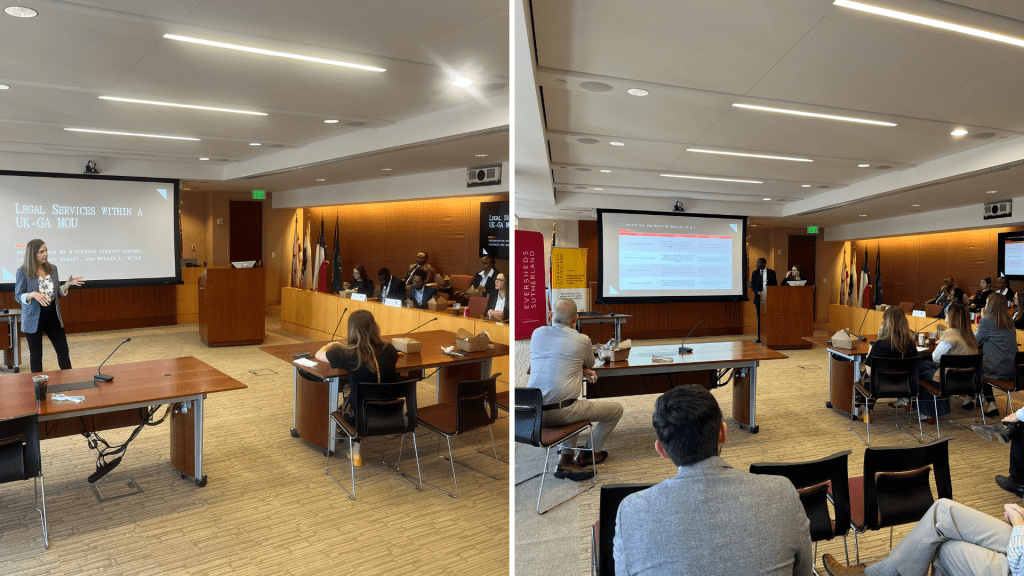
The group’s second stop of the day was the Atlanta office of Eversheds Sutherland, a global law firm specializing in corporate, energy, litigation, tax, and real estate. This firm has a meaningful relationship with the UK, as it is where the Eversheds law firm originated prior to their 1988 merger with Sutherland. The firm’s global headquarters is located in London, and its historic ties to the country are evident in their presence throughout the British legal market. Students Leighlee Mahony (J.D. ’26) and N’Guessan “Clement” Kouame (LL.M. ’24, J.D. ’26) presented. Both students argued that enhanced trade and investment collaboration between Georgia and the United Kingdom could offer reciprocity in sectors, including legal services.
The students were hosted by Jenny Lambert, Partner, and attended by several practicing attorneys in transactional and international work. The students benefitted both from the lunch that Eversheds Sutherland generously provided, as well as in-depth and vigorous questioning by the firm’s attorneys.
British Consulate General Atlanta
The group’s third and final stop of the day was the British Consulate General Atlanta. Students Maya Roper (J.D. ’27), Victor Azure (LL.M. ’26), Wambui Kamau (LL.M. ’26), and Madina Bekisheva (GCIL student) presented the group’s data and modeling to U.K. diplomats and officials. The group again walked the audience through specific trade and industry sectors, with a special focus on battery production for electric vehicles, the Georgia aerospace industry’s advantage, and veterinary medicine.
Student Reflections
“Coming from a non-law background in Computer Science, I learned that successful trade and partnerships do not thrive on innovation alone. They must be shaped by policy and political realities, economic conditions, population needs, national interests, and stakeholder relationships. The Atlanta trip made this clear by showing how quickly trade negotiations can shift based on context, not on the brilliance of the technology or business itself.” – Md. Asaduzzaman Jabin (GCIL student)
“This course was a great blend of theory and practice, requiring intensive and insightful legal research to understand and gather the materials, as well as concise, precise, and clear drafting of the MoU. The most significant site visit for me was the visit to the Georgia Department of Economic Development. It was a great experience to compare our findings with the department’s work and its vision for improvement. It was also interesting to know that people at the GDDE were doubtful about the use of models for the prediction of growth or value from MoUs. It shows how sometimes new technology may face skepticism for its implementation and convince people to advance or improve their old methods.” – N’Guessan “Clement” Kouame (LL.M. ’24, J.D. ’26)
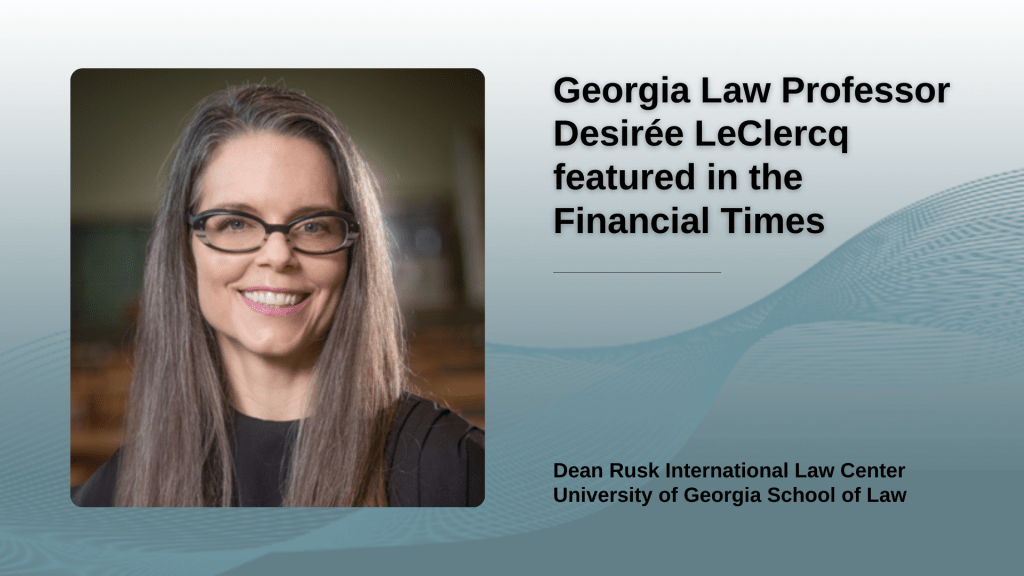
University of Georgia School of Law Professor Desirée LeClercq was featured in Inside U.S. Trade regarding rapid-response mechanism petitions under the U.S.-Mexico-Canada Agreement. The article titled “RRM ‘black boxing’ spurs solidarity among tri-national labor reps” was written by Margaret Spiegelman and published 10/14/25.
LeClercq joined the University of Georgia School of Law in 2024 as an assistant professor. She teaches Contracts, International Trade and Workers Rights, International Labor Law, International Law and U.S. Labor Law, and Public International Law. She also serves as a faculty co-director of the Dean Rusk International Law Center and as the faculty adviser for the Georgia Journal of International and Comparative Law.
Today, we welcome a guest post by Daniel “Tripp” Vaughn, a member of the University of Georgia School of Law class of 2025. Vaughn participated in a semester-long international externship in spring 2025. The semester-long externships overseas initiative is an extension of the Center’s existing Global Externships Overseas and is offered jointly between the Center and the law school’s Clinical and Experiential Program. Vaughn’s post describes his experience as a legal extern with Van Bael & Bellis, a law firm working on EU and national competition law, EU trade and customs law, regulatory law, as well as Belgian business law. Vaughn was based in Brussels, Belgium, where he worked under Georgia Law alumnus Porter Elliott (J.D. ’96).This was Vaughn’s third Global Externship Overseas during his time at Georgia Law. He is now living in Leuven, Belgium, where he is pursuing a Master of Laws (LL.M.) degree at KU Leuven.
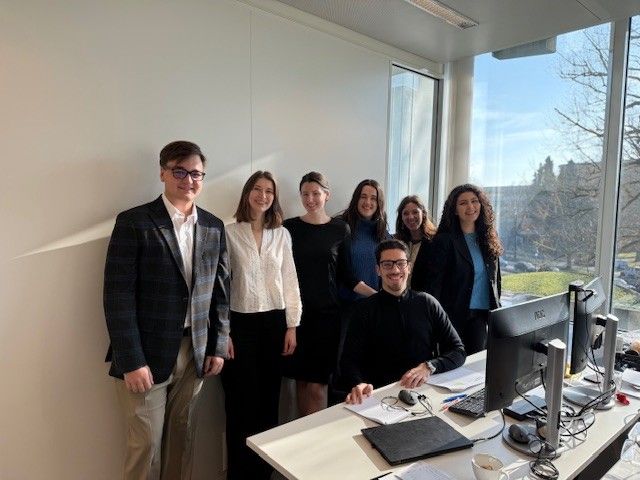
Last spring, I spent my final semester of law school working as a legal extern at Van Bael & Bellis (VBB), a Belgian law firm consisting of three offices in London, Brussels, and Geneva. VBB specializes in European and international legal work across three main categories: trade, antitrust, and corporate regulatory compliance. The firm’s composition truly represents its international focus, employing attorneys from more than 20 different countries. Just my office alone was shared with interns from Belgium, France, Ireland, Italy, Germany, and Spain.
This international diversity, strongly reminiscent of the city of Brussels itself, created a uniquely open-minded and welcoming atmosphere at the firm. Every day, whether through work projects or casual conversations, I learned more about countries and legal systems all across the world. The sheer breadth of nationalities, experiences, and perspectives held by VBB’s attorneys ensured that everyone in the office was still expanding their understanding of business and law. In this context, it was clear throughout the firm that questions were not only expected but also encouraged. As an extern, this atmosphere afforded me an incredible opportunity to add to my knowledge and experience before graduating law school.
This open mentality compounded the impact from my involvement in VBB’s extremely varied legal work, spanning from sanctions compliance and antidumping investigations to client alerts on upcoming legislation and updating internal materials on EU antitrust laws. I gained firsthand experience working on US-EU and EU-China trade disputes, including assessing tariffs and determining the correct classifications for products. When the EU proposed new legislation, I researched its impacts and together with expert attorneys wrote alerts for specifically affected clients as well as general takeaways. As part of my externship I also assisted many other tasks as well, including me in projects in over 20 different countries with different legal systems and approaches to corporate law.
However, of these many fascinating projects I had the opportunity to work on during my externship, sanctions compliance proved to be the most impactful and enduring. This work included researching involved parties of proposed transactions to ensure that the actions contemplated would pose minimal compliance risks from a sanctions perspective. While simple in concept, sanctioned parties would often go to great lengths to disguise their presence in transactions through strings of shell companies across the globe and the suppression of any information related to their ownership. Further complications often arose from the differences between UK, US, and EU sanction regimes, including the scope of sanctions, the jurisdiction of corresponding regulatory agencies, and the applicable penalties for noncompliance.
Despite these challenges, I began to increasingly enjoy the research and analysis required. Tracking down the ownership and control of various companies, which is often not openly disclosed information, consisted of sifting through media articles, social media posts, NGO reports, and other publicly accessible data such as ship transponders and locations. This process often felt like solving a particularly difficult puzzle, piecing together various clues to get a clearer picture of the involved parties and sanctions risks. Due to the lack of available information, many times the ownership or control of involved parties could not be definitively determined. However, it was incredibly satisfying when hours or days of research and seemingly unrelated shreds of information finally came together and yielded important conclusions.
I am extremely grateful for the experiences and opportunities given to me by Van Bael & Bellis. My time with the many talented attorneys at the firm opened my eyes to fields and career opportunities in international law that I never would have believed existed. As I am currently returning to Belgium for my Master of Laws (LL.M.) degree at KU Leuven, I am confident that my time with VBB will prove invaluable to me.
***
Applications are open for spring 2026 semester-long Global Externships Overseas (GEOs). All current 2Ls and 3Ls are invited to submit an application by September 15. For more information and the application, please email: ruskintlaw@uga.edu
University of Georgia School of Law Professor Desirée LeClercq recently organized and funded (through a grant won at Cornell University) a transnational conference of U.S., Mexican, and Canadian labor unions and leaders at Flacso Mexico in Mexico City. Patricia Campos-Medina (WI-ILR Cornell University), Alex Covarrubias (El Colegio de Sonora), and Cirila Quintero (El Colegio de la Frontera Norte) served as conference co-organizers.
This one-day transnational labor conference solicited the views of labor unions, non-governmental organizations (NGOs), organizers, and workers on the United States-Mexico-Canada Agreement (USMCA)’s Rapid Response Mechanism (RRM) in light of current geopolitical dynamics. Participants identified current challenges in filing petitions under the RRM, aligned strategic approaches to the 2026 re-negotiation of the USMCA, and discussed ways to work together notwithstanding current tensions in politics and trade. The conference was structured to first discuss the RRM on a technical level before broadening to account for political tensions and joint transnational strategies. It concluded with ways participants could remain organized and collaborate in the future.
LeClercq joined the University of Georgia School of Law in 2024 as an assistant professor. She teaches International Trade and Workers Rights, International Labor Law, International Law and U.S. Labor Law. She also serves as a faculty co-director of the Dean Rusk International Law Center and as the faculty adviser for the Georgia Journal of International and Comparative Law.
University of Georgia School of Law Professor Desirée LeClercq recently delivered a presentation on the future of multilateralism, trade, and worker rights to World Trade Organization officials and researchers in Geneva, Switzerland.
LeClercq received financial support to attend this workshop from the Dean Rusk International Law Center as a Rusk Scholar-in-Residence, an initiative promoting international opportunities for Georgia Law faculty that advance the mission of the Center.
LeClercq joined the University of Georgia School of Law in 2024 as an assistant professor. She teaches International Trade and Workers Rights, International Labor Law, International Law and U.S. Labor Law. She also serves as a faculty co-director of the Dean Rusk International Law Center and as the faculty adviser for the Georgia Journal of International and Comparative Law.
Convened by the Remaking Trade Project (RTP) and co-hosted by the Centre for Trade and Economic Integration (CTEI), this workshop brought together a diverse range of researchers, economists, legal experts and policy advocates to explore the creation of a dedicated research stream as part of the RTP. Their stated goal is “…to continue strengthening the intellectual foundations of the trade-sustainability agenda, while also responding to a rapidly changing trade landscape in ways that are agile, inclusive, and impactful.”
Over twenty-five colleagues joined the day of interactive roundtables, from over 20 global institutions and/or countries, drawing from participants of the RTP’s work to date.
LeClercq received financial support to attend this workshop from the Dean Rusk International Law Center as a Rusk Scholar-in-Residence, an initiative promoting international opportunities for Georgia Law faculty that advance the mission of the Center.
LeClercq joined the University of Georgia School of Law in 2024 as an assistant professor. She teaches International Trade and Workers Rights, International Labor Law, International Law and U.S. Labor Law. She also serves as a faculty co-director of the Dean Rusk International Law Center and as the faculty adviser for the Georgia Journal of International and Comparative Law.
In March, the University of Georgia School of Law partnered with the Washington International Trade Association (“WITA”) to present a webinar about careers in international trade and law. This webinar was part of WITA Academy’s ongoing Pathways to Opportunity Series: Careers in International Trade & Law, through which law students and undergraduates are able to learn about career opportunities in international trade and law from law firms and trade professionals. This webinar featured alumni/ae from Georgia Law and the university.
The webinar included:
Introductions from Diego Añez, Executive Director, WITA Academy; Managing Director, Washington International Trade Association and Kenneth I. Levinson, Chief Executive Officer, Washington International Trade Association
A panel discussion featuring:
Nancy Fischer, Global Head of Regulatory Practices, International Trade Partner, Pillsbury Winthrop Shaw Pittman LLP (B.B.A. The University of Georgia; J.D. Syracuse University College of Law)
Eric Heath, Senior Attorney Advisor, U.S. International Trade Commission (B.A. Lipscomb University; J.D. University of Georgia School of Law, LL.M. University of Edinburgh Law School)
Tina Termei, Director & Associate General Counsel, Amazon | Global Trade, Transportation, Logistics, & Supply Chain (B.A. Emory University; J.D. The University of Georgia School of Law)
Panel moderation from: Desirée LeClercq, Assistant Professor, University of Georgia School of Law and Faculty Co-Director, Dean Rusk International Law Center
During the panel discussion, students were able to gain insights from trade law experts, engage with policymakers and legal practitioners, and explore career opportunities in international trade law from government, companies, and law firms. Students gained a unique perspective on the wide-ranging career paths available in the trade law and policy community, creating connections with key players across both the public and private sectors. All attendees received a free one-year membership to WITA.
A recording of the panel is available to WITA members. To join, email: events@wita.org



 exchange of notes