
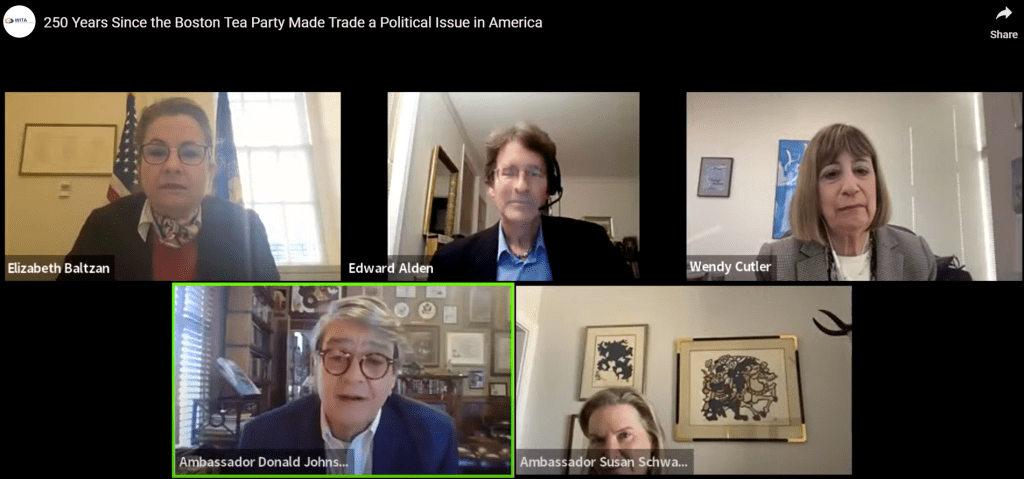
Director Emeritus Johnson presents in WITA panel discussion on the past, present, and future of U.S. Trade Policy

The Washington International Trade Association (WITA) hosted two panels last month to discuss changing attitudes toward trade in the 250 years since the Boston Tea Party. Taking part in the panel was University of Georgia School of Law alumnus and Director Emeritus of the law school’s Dean Rusk International Law Center, Ambassador C. Donald Johnson.

The two panels addressed the evolution of trade policy, trade’s present and future, and the role of the United States as a leader in global trade. The first panel (recording here), moderated by Edward Alden, Ross Dist Visiting Professor at Western Washington University and Bernard L. Schwartz senior fellow at the Council on Foreign Relations (CFR), featured the following speakers:

  • Elizabeth Baltzan, Senior Advisor, Office of the United States Trade Representative
  • Wendy Cutler, Vice President, Asia Society Policy Institute (ASPI), and Managing Director of the Washington, D.C. office; former Acting Deputy United States Trade Representative
  • Ambassador Donald Johnson, Director Emeritus, Dean Rusk Center for International Law and Policy, University of Georgia; former Chief Textile Negotiator, Office of the United States Trade Representative
  • Ambassador Susan Schwab, Strategic Advisor, Mayer Brown; former U.S. Trade Representative

Johnson’s comments contextualized the attitude towards trade during the era of the Boston Tea Party. He discusses the historical conflict between trade and labor, with roots in the Jefferson and Hamilton political philosophies, and moves through the industrialization of the 19th century.

Johnson’s book The Wealth of a Nation: a History of Trade Politics in America (Oxford University Press 2018) presents a history of trade politics from the 1790s through the Trump administration. He received the 2019 Certificate of Merit for High Technical Craftsmanship and Utility to Lawyers and Scholars (Honorable Mention) at the 113th American Society of International Law Annual Meeting, detailed in our previous post here.

Johnson served from 1998 to 2000 as Ambassador in the Office of the United States Trade Representative, and then specialized in international trade law as a partner at the Washington law firm Patton Boggs. Additionally, while serving from 1993 to 1995 as a U.S. Representative on behalf of Georgia’s 10th District, Johnson focused on national security and international economic policy, including legislation implementing North Atlantic Free Trade Agreement and the World Trade Organization. Johnson served as an Articles Editor for that journal while a student at the University of Georgia School of Law, from which he earned his J.D. in 1973. Thereafter, he studied at the London School of Economics and Political Science, earning an LL.M. degree in International Economic Law and International Relations.

UGA Law Professor Cohen Speaks with International Law Society

Gabriel M. Wilner/UGA Foundation Professor in International Law & Faculty Co-Director of the Dean Rusk International Law Center Harlan Grant Cohen spoke to International Law Society (ILS) members in late September as part of an ongoing brown bag lunch series with international law faculty at UGA Law.

Cohen provided the students in attendance with an introduction to his current research. He then outlined his path into academia and offered students insight into the spectrum of professional opportunities within the field of international law, noting fast-growing sectors like export controls, CFIUS issues, and space law. He also offered some reflections on the changing nature of the field, including the recent trend of withdrawal from international organizations and treaties; the emergence of new centers of power that challenge norms in international law; and increasing economic competition influencing international law through mechanisms such as trade rules and sanctions. Cohen encouraged student questions to drive the majority of the conversation, providing career and networking advice throughout the discussion. He recommended that students interested in international law enroll in the spring Public International Law course, attend conferences and get involved in international law organizations, and try to learn a second language if possible.

ILS President, 2L Madison Graham, spearheaded this series with the intention of orienting new law students towards the international law faculty. She hopes to expand the student body’s definition of what international law means and to bring their attention to the academic achievements of the international law faculty here at UGA Law.

ILS is the student chapter of the International Law Students Association, a Washington, D.C.-based organization that for decades has provided students with opportunities to study, research, and network in the international law arena through conferences, publications, and administration of the Philip C. Jessup International Law Moot Court Competition. At UGA Law, ILS hosts events and projects designed to stimulate and advance understand of international, comparative, foreign, and transnational law and institutions. ILS’ faculty advisor is Diane Marie Amann, Regents’ Professor of International Law, Emily & Ernest Woodruff Chair in International Law, Faculty Co-Director of the Dean Rusk International Law Center.

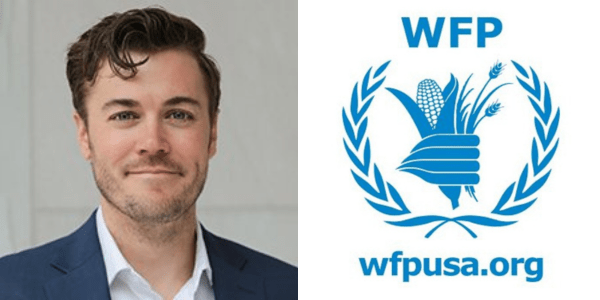
Chase Sova, senior director of Public Policy and Research at World Food Program USA, speaks at UGA Law

Senior director of Public Policy and Research at World Food Program USA (WFP USA) Chase Sova spoke to students about the intersection of international law and policy as it relates to the global challenge of food insecurity Monday here at the University of Georgia School of Law.

Sova began his talk by explaining the relationship between WFP USA, a US-based non-profit organization, and the United Nations World Food Programme, which the WFP USA works to support stateside. He then discussed the global food insecurity landscape and how it is driven primarily by climate change, conflict, and economic disruptions, or shocks. Sova established links between international trade law and food insecurity, especially in the context of recent global events like the COVID-19 pandemic and the Russian invasion of Ukraine. He introduced students to the current debates about whether policies resulting in extreme food insecurity and starvation could be violations of international human rights law. Students were able to ask Sova questions about his educational background, his advice to those seeking careers in public service, and job opportunities for students interested in the work of the WFP USA.

Before his current position with WFP USA, Sova worked with the United Nations Food and Agriculture Organization (FAO), International Center for Tropical Agriculture (CIAT) and the CGIAR Research Program on Climate Change, Agriculture and Food Security (CCAFS). He has consulted with the World Bank, Johns Hopkins, and Tufts University. Interested in the intersection of food insecurity and conflict, humanitarian assistance, climate change, and sustainable agriculture, Sova has worked on food systems in 15 developing countries across Latin America, sub-Saharan Africa and South Asia. He has led several major research initiatives including WFP USA’s Winning the Peace: Hunger and Instability flagship report. Sova has served as an expert witness at the Senate Foreign Relations Committee, his writing has been featured extensively in peer-reviewed journals, and he regularly lectures on food insecurity at Universities in Washington, D.C. He delivered a TEDx talk on “Winning the Long Game in the Fight to End Hunger” in 2018. Sova earned his Ph.D. from Oxford University.

This event was part of a visit organized by the UGA Office of Global Engagement under the leadership of the Associate Provost for Global Engagement, Martin Kagel, as part of the FYOS Global Citizenship Cluster series. It was cohosted by the Terry College of Business.