“Crimmigration as Paradigmatic Migration Control in the United States: Exploring the Impact on Communities, Courts, and Attorneys” November 7 Georgia Journal of International and Comparative Law and Georgia Criminal Law Review annual conference

This year’s annual conference of the Georgia Journal of International and Comparative Law will present “Crimmigration as Paradigmatic Migration Control in the United States: Exploring the Impact on Communities, Courts, and Attorneys“. The conference will be offered jointly by the GJICL and the Georgia Criminal Law Review.

The daylong conference will take place on Friday, November 7 in the Larry Walker Room of Dean Rusk Hall at the University of Georgia School of Law. CLE credit is available for both in-person and virtual attendance. Registration information can be found on the conference webpage.

Sponsoring along with GJICL, a student-edited journal established more than 50 years ago, is the law school’s Dean Rusk International Law Center. GJICL Editor in Chief, Casey Smith (J.D. ’26) and Executive Conference Editor Kellianne Elliot (J.D. ’26) worked Georgia Criminal Law Review Editor in Chief Kerolls Gadelrab (J.D. ’26); Professor Jason A. Cade, J. Alton Hosch Professor of Law & Community Health Law Partnership Clinic Director; Center staff Sarah Quinn, Director; Catrina Martin, Global Practice Preparation Assistant; Taher S. Benany, Center Associate Director; and with the GJICL’s Faculty Advisor, Professor Desirée LeClercq, who is Assistant Professor of Law & Faculty Co-Director of the Dean Rusk International Law Center.

Below is the concept note of the conference:

Political and legal developments have precipitated a convergence of the fields of criminal law and immigration law. Now commonly referred to as crimmigration, this merger of previously distinct practice areas already has profoundly reshaped the legal and social terrain for migrants in the United States. While entry and removal decisions remain essentially administrative, enforcement practices and rhetoric increasingly embrace the punitive logic and carceral reach of the criminal legal system, but with fewer due process protections. As new legislation vastly expands detention authorization and other enforcement resources, it seems apparent that the rhetoric and mechanics of crimmigration will continue to dominate immigration policy in the United States for the foreseeable future. 

This symposium, jointly sponsored by the Dean Rusk International Law Center, the Georgia Journal of International and Comparative Law, and the Georgia Criminal Law Review, invites scholars, immigration attorneys and judges to engage with these developments. We hope panelists will collectively address a number of important questions, such as the following: How does the new crimmigration landscape impact immigrants and communities in the Southeast and beyond? What new burdens does it put on the judiciary, and what role do federal courts have today in determining and upholding constitutional and statutory protections for migrants? Does the durability and continued expansion of crimmigration pose new challenges for immigration and criminal law attorneys; and, if so, how are the immigration and criminal law bars responding to those challenges? As crimmigration tactics expand, what new legal threats face U.S. citizens, including family members, employers, and immigrant advocates? Does the crimmigration paradigm contend with or obscure the structural forces that drive migration, particularly from the global south? Are there reasons to hope or expect the emergence of alternatives to crimmigration as the governing paradigm for the regulation of immigrants in the United States? 

These conversations will occur through three panels and a lunchtime keynote speaker. 

The day’s events are as follows:

9:30am | Opening Remarks

Usha Rodrigues, Dean, University Professor & M.E. Kilpatrick Chair of Corporate Finance and Securities Law

9:35am | Panel 1: Introduction to Crimmigration & the Current State of Affairs

  • Abel Rodríguez, Assistant Professor of Law, Wake Forest Law
  • Shalini Ray, Associate Professor of Law and Director of Faculty Research, Alabama Law
  • Gracie Willis, Attorney, National Immigration Project
  • Moderator: Christian Turner, Associate Professor of Law, University of Georgia School of Law

10:35am | Break

10:45am| Panel 2: The Impact of Crimmigration Policies on Communities and Advocates 

  • Jessica Vosburgh, Senior Staff Attorney, Center for Constitutional Rights
  • Jenny R. Hernandez, Lead Senior Attorney at Immigration Defense Unit, City of Atlanta Office of the Public Defender
  • Carolina Antonini, Founding Partner, Antonini & Cohen Immigration Law
  • Moderator: Elizabeth Taxel, Clinical Associate Professor & Criminal Defense Practicum Director, University of Georgia School of Law

12:00pm | Keynote Introduction

Jason A. Cade, J. Alton Hosch Professor of Law & Community Health Law Partnership Clinic Director, University of Georgia School of Law

12:05     Keynote Address

Judge Ana C. Reyes, United States District Court, District of Columbia

1:00pm | Panel 3: Challenging the Legality of Migration Controls & Envisioning Reform

  • Daniel I. Morales, Associate Professor of Law; Dwight Olds Chair, The University of Houston Law Center
  • Rebecca A. Sharpless, Associate Dean for Experiential Learning, Professor of Law, Director, Immigration Clinic, University of Miami School of Law
  • Emily Torstveit Ngara, Director of Clinical Programs, Associate Clinical Professor and Director, Immigration Clinic, Center for Access to Justice, Immigration Law Clinic, Georgia State University College of Law
  • Moderator: Jason A. Cade J. Alton Hosch Professor of Law & Community Health Law Partnership Clinic Director, University of Georgia School of Law

2:00 | Closing Remarks

Casey Smith, Editor in Chief, Georgia Journal of International and Comparative Law

Georgia Law’s Community HeLP Clinic wins asylum case for long-time client

The University of Georgia School of Law’s Community Health Law Partnership Clinic recently secured asylum for a long-time client.

Under the supervision of Director & Hosch Professor Jason A. Cade and Staff Attorney Kristen Shepherd, Elizabeth M. “Beth” Boland (J.D. ’26) and third-year student Lauren R. Harter (J.D. ’25) represented the client at her most recent hearing in Arlington, Virginia, marking the end of nine years of advocacy. Clinic Paralegal Sarah Ehlers served as interpreter.   

Other students who worked on the case, which included litigation before the 11th Circuit Court of Appeals, Board of Immigration Appeals, and the Federal District Court for the Northern District of Georgia, were Carolina Mares (J.D. ’25), Hope Skypek (J.D. ’24), Anna T. Ratterman (J.D. ’24), Ariane C. “Ari” Williams (J.D. ’22), Thomas A. Evans (J.D. ’22) and Frederick King (J.D. ’21). 

Georgia Law Professor Jason Cade cited by U.S. Court of Appeals for the Ninth Circuit 

University of Georgia School of Law Associate Dean & Hosch Professor Jason A. Cade’s article “Deporting the Pardoned” was recently cited by the U.S. Court of Appeals for the Ninth Circuit in the case Lopez v. Garland.

Below is an excerpt from the article:

Federal immigration laws make noncitizens deportable on the basis of state criminal convictions. Historically, Congress implemented this scheme in ways that respected the states’ sovereignty over their criminal laws. As more recent federal laws have been interpreted, however, a state’s decision to pardon, expunge, or otherwise set aside a conviction under state law will often have no effect on the federal government’s determination to use that conviction as a basis for deportation. While scholars have shown significant interest in state and local laws regulating immigrants, few have considered the federalism implications of federal rules that ignore a state’s authority to determine the continuing validity of its own convictions. This Article contends that limitations on the preclusive effect of pardons, expungements, appeals, and similar post-conviction processes undermine sovereign interests in maintaining the integrity of the criminal justice system, calibrating justice, fostering rehabilitation, and deciding where to allocate resources. In light of the interests at stake, Congress should be required to clearly express its intent to override pardons and related state post-conviction procedures. A federalism-based clear statement rule for statutory provisions that restrict generally applicable criminal processes would not constrain the federal government’s power to set immigration policy. Congress remains free to make its intent clear in the statute. But the rule would ensure that Congress, rather than an administrative agency, has made the deliberative choice to upset the usual constitutional balance of federal and state power.

Jason A. Cade is Associate Dean for Clinical Programs and Experiential Learning, J. Alton Hosch Professor of Law & Community Health Law Partnership Clinic Director. In addition to overseeing the law school’s 11 in-house clinics and 7 externship programs, Cade teaches immigration law courses and directs the school’s Community Health Law Partnership Clinic (Community HeLP), in which law students undertake an interdisciplinary approach to immigrants’ rights through individual client representation, litigation, and project-based advocacy before administrative agencies and federal courts.

Additional information about the Community HeLP Clinic can be found here.

Georgia Law Professor Cade featured in The Atlanta Journal-Constitution

University of Georgia School of Law Associate Dean & Hosch Professor Jason A. Cade was recently featured in The Atlanta Journal-Constitution regarding the Southern Poverty Law Center’s Southeast Immigrant Freedom Initiative. The article titled “For migrants in Georgia, fighting deportation will become harder. Here’s why.” was written by Lautaro Grinspan and published 6/26/24. 

As stated in the article:

“Detained immigrants in Georgia tend to be held in remote areas, cut off from society, making it really difficult for them to access representation or have contact with family. [The Southern Poverty Law Center’s Southeast Immigrant Freedom Initiative] was essentially the only resource that existed to help them, and they did excellent work,” said Jason Cade, a professor at the University of Georgia School of Law, in a statement.

Jason A. Cade is Associate Dean for Clinical Programs and Experiential Learning, J. Alton Hosch Professor of Law & Community Health Law Partnership Clinic Director. In addition to overseeing the law school’s 11 in-house clinics and 7 externship programs, Cade teaches immigration law courses and directs the school’s Community Health Law Partnership Clinic (Community HeLP), in which law students undertake an interdisciplinary approach to immigrants’ rights through individual client representation, litigation, and project-based advocacy before administrative agencies and federal courts.

Read the full article here. Additional information about the Community HeLP Clinic can be found here.

Georgia Law Professor Cade featured in The Atlanta Journal-Constitution

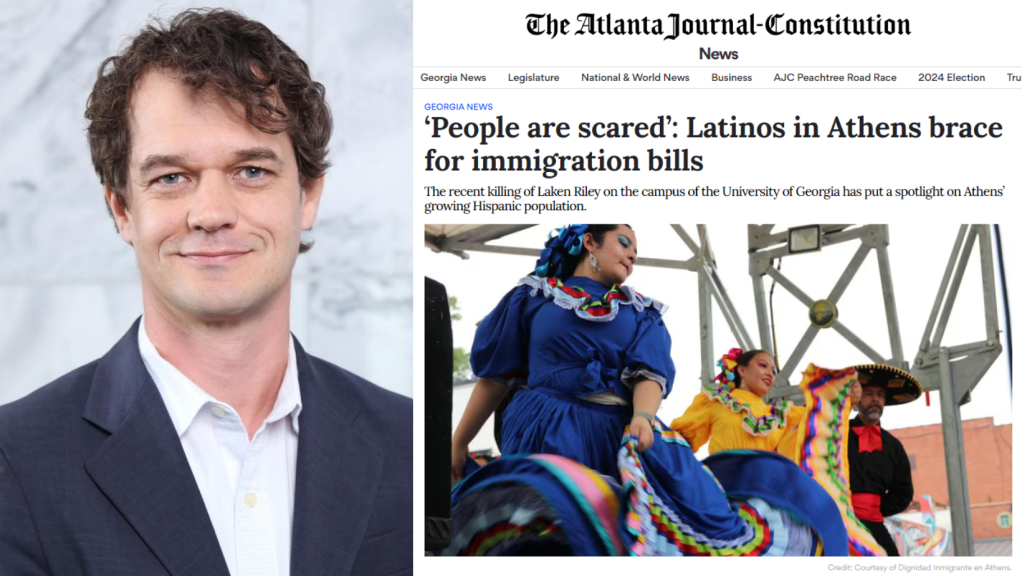
Professor Jason A. Cade was recently featured in The Atlanta Journal-Constitution regarding the University of Georgia School of Law’s Community Health Law Partnership Clinic, (“Community HeLP Clinic”). The article titled “‘People are scared’: Latinos in Athens brace for immigration bills” was written by Lautaro Grinspan and centered around the legislative consequences of the recent loss of Laken Riley on the University of Georgia campus, which put a spotlight on the growth of Athens’ Hispanic population. 

As stated in the article:

“The growth of the community has created significant demand for legal services to help with immigration cases. Those with limited means have only one pro-bono provider to turn to: a legal clinic at the University of Georgia School of Law, run by Professor Jason Cade.”

The Community HeLP Clinic focuses on interdisciplinary advocacy at the intersection of immigration status and health, including humanitarian and family-based immigration benefits, advocacy on behalf of noncitizen workers and detainees, and public education.

In reference to the Clinic within the article, Professor Cade said:

“We have the U.S. citizen children of the families that we serve very much in mind and are trying to do what we can to kind of reduce stress and stigma from their lives.”

Jason A. Cade is Associate Dean for Clinical Programs and Experiential Learning, J. Alton Hosch Professor of Law & Community Health Law Partnership Clinic Director. In addition to overseeing the law school’s 11 in-house clinics and 7 externship programs, Cade teaches immigration law courses and directs the school’s Community Health Law Partnership Clinic (Community HeLP), in which law students undertake an interdisciplinary approach to immigrants’ rights through individual client representation, litigation, and project-based advocacy before administrative agencies and federal courts.

To read the full article, please click here. To learn more about the Clinic, please click here.

Community HeLP Clinic receives pledge from Thorpe family

The University of Georgia School of Law has announced the creation of the Community Health Law Partnership Clinic Fund. The Thorpe family, which includes 2014 alumnus Benjamin W. “Ben” Thorpe and his mother Dr. Barbara Williams, has pledged $350,000 to enable the clinic to build on its tradition of interdisciplinary advocacy at the intersection of immigration status and health.

Under the direction of Associate Dean for Clinical Programs and Experiential Learning and J. Alton Hosch Associate Professor of Law Jason A. Cade, more than 100 individuals received legal services from the clinic last year. This included clients who were granted asylum, secured immigration relief, and those challenging the abuses they endured while in U.S. immigration detention.

The clinic’s first post-graduate fellow, Thomas Evans, will join the Community HeLP team in July, 2024. Evans is a 2022 magna cum laude graduate of the law school who participated in both the Community HeLP clinic and the Jane Wilson Family Justice Clinic and received the Ellen Jordan Award for Outstanding Public Interest Student. He is currently a staff attorney in the pro se office at the 11th Circuit Court of Appeals.

To learn more about the Community HeLP Clinic and their advocacy work in immigration, click here.