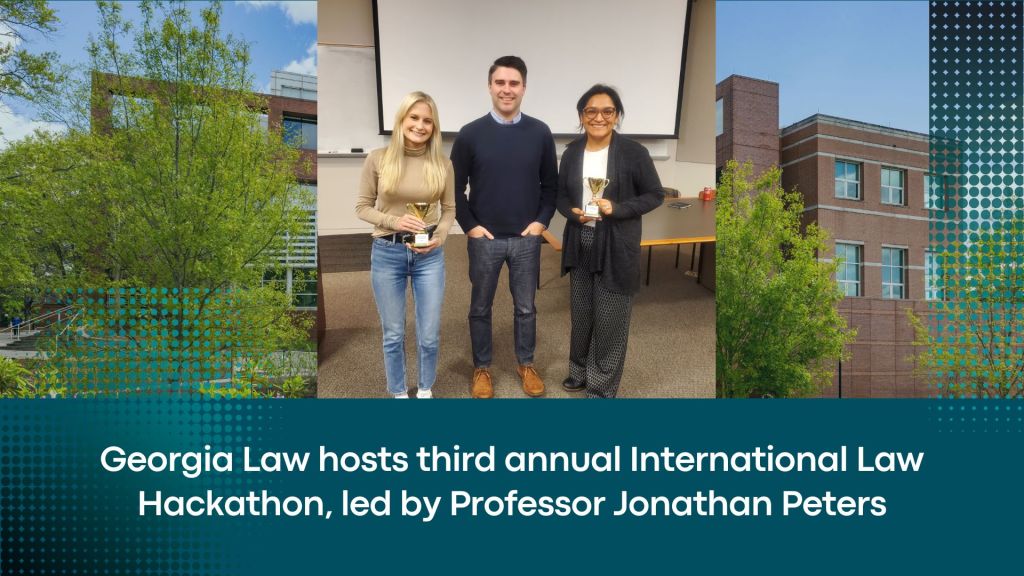
Georgia Law hosts third annual International Law Hackathon, led by Professor Jonathan Peters

The University of Georgia School of Law hosted its third annual International Law Hackathon, led by Jonathan Peters, a media law scholar and the head of UGA’s Department of Journalism in the Grady College of Journalism and Mass Communication. Peters also holds a courtesy faculty appointment in the law school.

The International Law Hackathon is a one-credit course offered for J.D., LL.M, and graduate students participating in the Graduate Certificate in International Law. This year’s Hackathon focused on social media and the implications of privately governing speech in a globally networked society. Over the span of six weeks, students discussed content moderation and free speech principles, as well as the biggest content challenges that platforms are confronting, such as misinformation and disinformation, bullying and harassment, depictions of violence, and sexual exploitation and abuse.

The Hackathon concluded Saturday, February 15th with student presentations on the challenges posed by regulating speech on social media platforms. Then, working in groups, students proposed updates to General Comment No. 34 of the International Covenant on Civil and Political Rights (ICCPR) drafted by the United Nations Human Rights Committee. (General Comment No. 34 is an interpretive commentary on the ICCPR provision guaranteeing the freedoms of opinion and expression.) Each group delivered a presentation to a panel of judges outlining the proposed updates and how the changes would impact social media.

This year’s winning team included Zulma Perez (LL.M. ’25) and Brandtley Grace Vickery (J.D. ’25). Their proposal focused on how to reduce the presence of hate speech on YouTube.

The panel of judges included: John B. Meixner, Assistant Professor of Law; Clare R. Norins, Clinical Associate Professor & First Amendment Clinic Director; and Christina Lee, a Legal Fellow in the First Amendment Clinic.

Georgia Law Professor Clare Norins presents to U.S. State Department leadership program

Clinical Associate Professor & First Amendment Clinic Director Clare R. Norins presented on Georgia’s Open Meetings Act and Open Records Act to journalists from 17 countries participating in the U.S. Department of State’s International Visitor Leadership Program during June.

The International Visitor Leadership Program (IVLP) is the U.S. Department of State’s premier professional exchange program. Through short-term visits to the United States, current and emerging foreign leaders in a variety of fields experience this country firsthand and cultivate lasting relationships with their American counterparts.

Clare R. Norins is a clinical associate professor and the inaugural director of the University of Georgia School of Law’s First Amendment Clinic, which represents clients in federal and state court on a range of First Amendment and media law issues. Representative matters include challenges to jail censorship, social media blocking by government officials, retaliatory arrest, defending the right to record, opposing unconstitutional permit requirements, and defamation defense/anti-SLAPP.

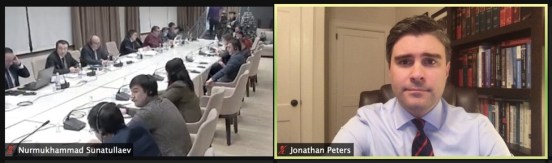
University of Georgia Professor Jonathan Peters, of Grady College and School of Law, presents on press freedom to court personnel and journalists in Uzbekistan

Pleased today to welcome a contribution from Jonathan Peters, an associate professor who has faculty appointments in the Grady College of Journalism and Mass Communication and the School of Law here at the University of Georgia. Professor Peters teaches and researches in the area of media law and policy, and his post here discusses his participation December 3 in an online training event hosted in Uzbekistan.

I was delighted recently to deliver two virtual presentations to court personnel and journalists in Uzbekistan, as part of a project facilitated by the United Nations Development Programme and supported by the United States Agency for International Development and the Supreme Court of the Republic of Uzbekistan.

The purpose of the project, called the “Rule of Law Partnership in Uzbekistan,” is to strengthen public access to the nation’s judicial system as well as public trust in it. One related priority has been to improve citizen knowledge of the courts and to encourage collaboration between court personnel and journalists. This has enabled the local media to tour Uzbekistan’s regional courts and to learn about international practices in court-journalist relations.

To those ends, I delivered presentations to a group of journalists and court personnel, including members of the Supreme Court of the Republic of Uzbekistan, on U.S. rights of access to courts and how American journalists cover legal issues. First, I discussed the tension between the First and Sixth Amendments and the various reasons that U.S. courts have generally protected media rights of access to judicial proceedings and records.

For example, the U.S. Supreme Court has observed repeatedly the historical importance of public trials and has reasoned that openness improves a trial’s functioning, that it has therapeutic value by “providing an outlet for community concern, hostility and emotion,” and that it enhances the public’s acceptance that justice is being done.

Moreover, in significant part, American journalists exercise their First Amendment rights as surrogates of the public when reporting on courts. As Justice Lewis F. Powell put it in Saxbe v. Washington Post Co., in his dissent: “For most citizens, the prospect of personal familiarity with newsworthy events is hopelessly unrealistic. In seeking out the news, the press therefore acts as an agent of the public at large. It is the means by which the people receive the … information and ideas essential to intelligent self-government.”

Then, in my second presentation, on how American journalists cover legal issues, I explored how the rule of law is preserved partly by public knowledge of court decisions and activities, and thus the media is a critical link between the judiciary and the public. So it is democratically important for journalists to explain what courts are doing and why—and to convey the implications (if any) for the public.

That means the journalists must be able to translate legal terms and concepts for a lay audience, and they must be able to distill into a short news story a complex legal action. It is also helpful for them to develop sources in the court system, while appreciating and respecting the ethical limits within which judges, lawyers, and court aides usually work.

After these remarks, the Q&A session opened up conversations among the journalists and court personnel in attendance, allowing us to have a dialogue on some of the issues most pressing for them. I hope the ultimate result is a more open judiciary and a freer press in Uzbekistan.