Amann is Regents’ Professor of International Law, Emily & Ernest Woodruff Chair in International Law, and a Faculty Co-Director of our Dean Rusk International Law Center here at Georgia Law. During her current research-intensive semester, she is an Affiliate Academic at University College London Faculty of Laws.
Her chapter appears in The Oxford Handbook on Women and International Law, co-edited by Professors J. Jarpa Dawuni (Howard University), Nienke Grossman (University of Baltimore), Jaya Ramji-Nogales (Temple University), and Hélène Ruiz Fabri (Université Paris 1 Panthéon-Sorbonne). The thirty-five-chapter volume spans many topics – topics that its four dozen authors explore through a variety of methods, including substantive legal analysis, legal history, and global critical race feminism.
Amann’s chapter draws from research that she had presented online as part of “In/ex-clusiveness of the Legal Construction of Justice,” a panel of the 17th Annual Conference of the European Society of International Law, held in 2022 at Utrecht University in The Netherlands.
Women seldom surface in conventional accounts of the many war crimes trials that took place after World War II. Yet as this chapter shows, hundreds of women lawyers and other professionals were present, thus helping to lay the foundations of an international criminal justice project that continues to this day. Combining methodologies of narrative with theories sounding in global legal history and feminist scholarship and discussing what it reveals as dances of absence-presence, visible-invisible, and inclusion-exclusion, this chapter first examines how and why women were absented and then surfaces their contributions. It concludes with a look at contemporary international legal practice.
University of Georgia School of Law Professor Laura Phillips-Sawyer participated in the Business History Conference in Atlanta, Georgia earlier this year. She was one of several speakers in the Harvard Business School Workshop entitled “Globalization, Multinationals, and Institutions.” Additionally, she chaired the panel “Trust and Antitrust: Standard Oil and the Creation of the Global Economy.”
Phillips-Sawyer is an expert in U.S. antitrust law and policy. Broadly, she is interested in questions of economic regulation, which intersect with legal history, economic thought, business strategy and structure, and political organization. She currently holds the Jane W. Wilson Associate Professorship in Business Law at the University of Georgia School of Law.
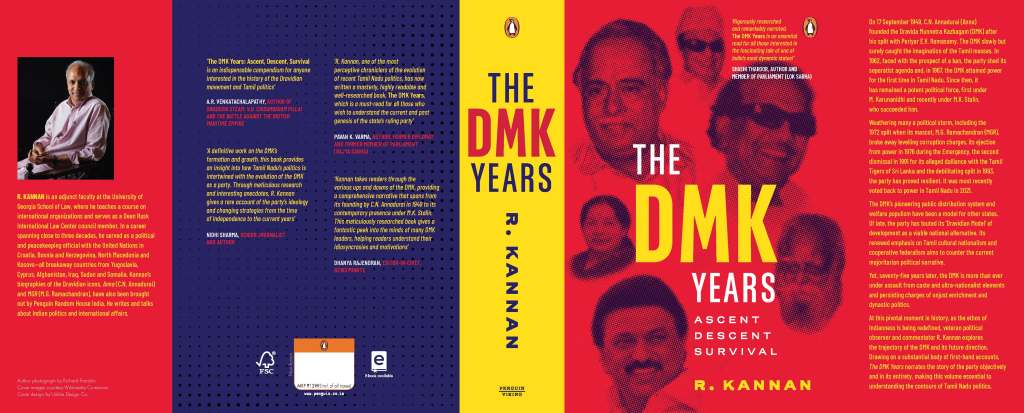
University of Georgia School of Law alumnus and adjunct professor Kannan Rajarathinam (LL.M. ’88) was interviewed in Hindustan Times about his new book, The DMK Years: Ascent, Descent, Survival (India Viking, 2024). The book will be available for purchase on November 15, 2024 in the United States.
Political commentator and author R. Kannan recently launched his book, ‘The DMK Years: Ascent, Descent, Survival’ which is [an] account of the DMK’s journey, from its foundation in 1949 by CN Annadurai to its present-day prominence under Tamil Nadu Chief Minister MK Stalin. In an interview with Hindustan Times, the author speaks on the DMK’s 75th founding day and the Hindu assertion of the BJP that has forced the DMK to hold a conference for Murugan, the Hindu deity. Chief Minister Stalin’s son Udhayanidhi’s real test is a post-Stalin-phase, he says, adding that DMK’s strength is in its [organizational] base and a divided opposition, but if actor Vijay were to join forces with AIADMK or others, the ruling party might be in trouble for the 2026 assembly polls.
The University of Georgia School of Law’s Dean Rusk International Law Center is hosting a book talk on Tuesday, November 19th for Rajarathinam. The conversation will be co-facilitated by Professor Laura Phillips-Sawyer of Georgia Law and Dr. Laura Zimmermann of the School of Public and International Affairs. This event is part of International Education Week, a joint initiative of the U.S. Department of State and the U.S. Department of Education, an effort to promote programs that prepare Americans for a global environment and celebrate the benefits of international education.
Kannan Rajarathinam is an adjunct professor at the University of Georgia School of Law teaching a course on International Organizations. Between 1993 and 2022, he served the United Nations in various capacities, including senior political affairs officer, head of office, senior planning and coordination officer, chief civil affairs officer, and legal officer from Afghanistan to Bosnia and Herzegovina. Before joining the UN, he briefly taught at the University of Madras in India as a guest faculty member and junior professor and practiced law. Presently, he serves on the Dean Rusk International Law Center Advisory Council.
University of Georgia School of Law alumnus and adjunct professor Kannan Rajarathinam (LL.M. ’88) recently published a book, The DMK Years: Ascent, Descent, Survival (India Viking, 2024). The ‘DMK Years’ tells the story of how India’s democracy has accommodated the cultural nationalist aspirations of the Tamils. It also tells the seventy-five-year story of the DMK and the state of Tamil Nadu, once separatist but now India’s second-most prosperous state.
Below is a full description of the book:
India has twenty states and eight union (federal territories). In April 2023, it became the world’s most populated country. It has 22 official languages, numerous ethnicities and people of all faiths.
Uniting a country as vast and diverse as India is a herculean task. However, India’s democracy, which was adopted after the 1947 Partition, has shown remarkable resilience. The country’s quasi-federal constitution was designed with unity in mind, recognizing and valuing the diverse population as a key component of its unity.
Yet, India’s unity has not been without its challenges. The restive border states of Kashmir and Punjab are well known. However, there have been other less well-known challenges to the Indian Union. One such was from Tamil Nadu, the southernmost state where the sub-nationalist Dravida Munnetra Kazhagam (DMK) or Dravidian Progressive Federation espoused separation since its founding in 1949.
As the DMK grew into a significant political force, the Indian Centre brought forward the Sixteenth Amendment to the Constitution in 1962, banning any secessionist advocacy—even by peaceful means. The DMK dropped its demand and, in five years, became the ruling party in the state of Tamil Nadu. Since then, it has alternated in power there with its breakaway party, the All India Anna DMK, and has been part of the federal coalition for eighteen years.
The ‘DMK Years’ tells the story of how India’s democracy has accommodated the cultural nationalist aspirations of the Tamils. It also tells the seventy-five-year story of the DMK and the state of Tamil Nadu, once separatist but now India’s second-most prosperous state.
Kannan Rajarathinam is an adjunct professor at the University of Georgia School of Law teaching a course on International Organizations. Between 1993 and 2022, he served the United Nations in various capacities, including senior political affairs officer, head of office, senior planning and coordination officer, chief civil affairs officer, and legal officer from Afghanistan to Bosnia and Herzegovina. Before joining the UN, he briefly taught at the University of Madras in India as a guest faculty member and junior professor and practised law. Presently, he serves on the Dean Rusk International Law Center Advisory Council.
Kalyani Ramnath, Assistant Professor in the Department of History at the Franklin College of Arts & Sciences and Assistant Professor (by courtesy) at the University of Georgia School of Law, recently discussed her first book (detailed in previous post here) at an event organized by the Dean Rusk International Law Center. Joining Ramnath in conversation about Boats in a Storm: Law, Migration, and Decolonization in South and Southeast Asia, 1942–1962 (Stanford University Press, 2023) were Diane Marie Amann, Regents’ Professor, Emily & Ernest Woodruff Chair in International Law, and Co-Director of the Dean Rusk International Law Center, and Laura Phillips-Sawyer, Jane W. Wilson Associate Professor in Business Law.
Drawing on archival materials from India, Sri Lanka, Myanmar, London, and Singapore, Kalyani Ramnath narrates how former migrants battled legal requirements to revive prewar circulations of credit, capital, and labor, in a postwar context of rising ethno-nationalisms that accused migrants of stealing jobs and hoarding land. Ultimately, Ramnath shows how decolonization was marked not only by shipwrecked empires and nation-states assembled and ordered from the debris of imperial collapse, but also by these forgotten stories of wartime displacements, their unintended consequences, and long afterlives.
Ramnath received her Ph.D. in history from Princeton University in 2018, and was a Prize Fellow in Economics, History, and Politics at the Center for History and Economics at Harvard University from 2018 – 2021. She also holds a bachelor’s degree in arts and law (B.A., LL.B. (Hons.) (JD equivalent) from the National Law School of India University (NLSIU) and a master’s degree in law (LL.M.) from the Yale Law School.
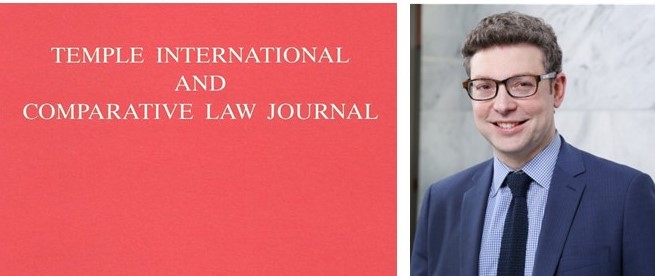
Harlan Grant Cohen, who is Gabriel M. Wilner/UGA Foundation Professor in International Law and Faculty Co-Director of the Dean Rusk International Law Center here at the University of Georgia School of Law, has contributed to a special symposium issue containing essays on International Law and the Politics of History, a book published in 2021 by Cambridge University Press and written by Melbourne Law School Professor Anne Orford.
The issue developed out of a spring 2022 workshop at Temple University Beasley School of Law in Philadelphia, organized by Temple Law Professor Jeffrey L. Dunoff. As described by Dunoff, Cohen’s essay appears in the issue’s “final cluster of papers,” which consider “disciplinary identities and the politics of the encounter between law and history. ” Dunoff continued:
“Cohen’s highly creative contribution takes the form of a dialogue between study partners attempting to understand a fragmentary portion of a text that purports to describe a conflict between a historian and a legal scholar. This dialogue — which both expressly refers to and is reminiscent of a hevrutah, or partner-based form of studying religious texts common in Jewish communities — defies efforts at summary.
“Suffice to say that it touches on a dazzlingly wide range of issues, including disciplinary identity, different forms of knowledge, competing theories of meaning, the limits of language, and the possibility of plural truths, among other topics.”
Contributing to the special symposium issue — in addition to Cohen, Dunoff, and Orford — were Natasha Wheatley, Afroditi Giovanopoulou, Kunal M. Parker, Morten Rasmussen, Megan Donaldson, Francisco-José Quintana and Sarah M.H. Nouwen, David Schneiderman, Karen J. Alter, Lauri Mälksoo, Oliver Diggelmann, and Steven Ratner.
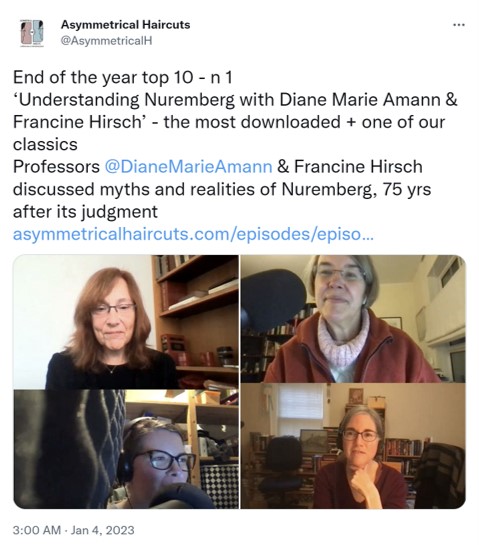
As quoted in a prior post, the hosts, Hague-based journalists Janet Anderson and Stephanie van den Berg, described the podcast (available here) as a discussion of “what we think we know (and what we don’t) about Nuremberg trials.”
Amann, Regents’ Professor of International Law and Emily & Ernest Woodruff Chair in International Law here at Georgia Law, is writing Nuremberg Women, a book about the roles that lawyers and other women professionals played at the post-World War II trial before the International Military Tribunal. Hirsch, the Vilas Distinguished Achievement Professor of History at the University of Wisconsin-Madison, is author of the award-winning Soviet Judgment at Nuremberg: A New History of the International Military Tribunal After World War II (202o).
The Deutschland Rundfunk Kultur broadcast by Caspar Dohmen – entitled “Aufstieg und Zerschlagung des Rockefeller-Konzerns,” or “Rise and breakup of the Rockefeller corporation” – profiled John D. Rockefeller (1839-1937), an American magnate of the so-called Gilded Age, and, in Dohmen’s words, “the first billionaire.”
Rockefeller, along with Henry M. Flagler and others, founded Standard Oil Co., a corporation that figured in precedent-setting U.S. Supreme Court antitrust litigation. This history figures in to Phillips-Sawyer’s book, and she is quoted at length in the broadcast. Some examples:
“The Gilded Age was a time of massive technological change. … There were new big players, but also horizontal mergers where different manufacturers got together and said: Let’s solve the problem of price competition by coordinating and either fixing prices or dividing markets. Partly they were looking for stability in this time of rapid technological change. …”
“If you look at Standard Oil and what Rockefeller and Flagler and his house attorney S.C. Dodd did: A lot of it was creative destruction and smart business strategy! … The oil company also built up a fleet of tankers, first for rail and later for road. … [T]hey made all sorts of innovations that were beneficial to consumers. But then there were moments when they crossed a line and tried to crush their competitors. This is when we need police, surveillance and regulation. You have to enforce the law to keep a market functioning.”
“It took a long time for the case law to change to allow the federal government to intervene in interstate commerce. … A great deal of uncertainty remained about the answer to this question until the New Deal period in the 1930s.”
University of Georgia scholars’ presentations were as follows:
► Professor Diane Marie Amann (pictured above left) gave an online talk entitled “Absent at the Creation? Women and International Criminal Justice” as part of a Saturday hybrid session exploring “In/Ex-clusiveness of the Legal Construction of Justice.” The presentation drew on her research into the experiences of women professionals at post-World War II international criminal trials. Amann is Regents’ Professor of International Law, Emily & Ernest Woodruff Chair in International Law, and Faculty Co-Director of the Dean Rusk International Law Center here at the University of Georgia School of Law; additionally, she serves on the Coordinating Committee of ESIL’s Interest Group on International Criminal Justice. Also participating on this agora session were scholars from the Netherlands’ University of Amsterdam and Erasmus University, and also from the Irish Centre for Human Rights at the National University of Ireland-Galway.
► Professor Harlan Grant Cohen (second from left), who is Gabriel M. Wilner/UGA Foundation Professor in International Law and Faculty Co-Director of the Dean Rusk International Law Center here at the University of Georgia School of Law, presented twice:
He asked “What’s in a Name?” in his presentation at “De-formalizing the International Judiciary,” a Wednesday workshop hosted by ESIL’s Interest Group on International Courts & Tribunals. The talk highlighted Judicialization and Public Support for Compliance with International Commitments, Cohen’s experimental work with Ryan Powers, an Assistant Professor at our university’s School of Public & International Affairs, and anticipated their future work on how various audiences respond to international “courts.” Also taking part in the session were scholars from: National Academy of Legal Studies and Research University of Law, in Hyderabad, India; University of Toronto, Canada; Humboldt University Berlin; and Leiden University, the Netherlands.
On Thursday, Cohen presented “Why Study International Precedent” at “‘Connecting Social Practices to Legal Outcomes,” the workshop of the ESIL Interest Group on Social Sciences & International Law. In his talk, Cohen outlined how international legal theory would change if the emergence of precedent were made the core case of international law, rather than an anomaly. Presenting as well at this session, entitled “Precedent,” was a scholar from the European University Institute, Italy.
► Professor Melissa J. “MJ” Durkee (center), who is Associate Dean for International Programs, Director of the Dean Rusk International Law Center, and Allen Post Professor here at the University of Georgia School of Law, likewise gave two presentations at the ESIL conference:
She presented “The Technology of Inclusion in International Climate Law,” a talk that drew from her forthcoming Yale Journal of International Law article The Pledging World Order, at a Wednesday workshop session entitled “Just Energy Transition – the International Human Rights Law Perspective.” The workshop’s overall title was “In/Ex-clusiveness in the Energy Transition and Climate Action”; host was the ESIL Interest Group on International Environmental Law. Also on Durkee’s panel were scholars from Leiden University in the Netherlands and from the China Institute of Boundary & Ocean Studies and Research Institute of Environmental Law of Wuhan University, China.
Durkee explored “The Logics of Inclusion and Exclusion in International Participatory Structures,” at a Thursday workshop entitled “International Organizations, Elites, and Masses: Perspectives on In/Exclusion,” and sponsored by the ESIL Interest Group on International Organizations. Her talk concerned an early-stage project that organizes perspectives on the inclusion and exclusion of nonstate actors in the activities of international organizations. Presenting other papers were scholars from the University of Hong Kong, the University of Melbourne in Australia, Max Planck Institute for Comparative Public Law & International Law in Germany the University of Hamburg in Germany, and the Guangdong University of Foreign Studies in China.
Meanwhile, Professor Tim R Samples (second from right), Associate Professor of Legal Studies at the University of Georgia Terry College of Business who has a courtesy appointment at Georgia Law, took part in three presentations.
Professor Samples and Dr. Katie Ireland (right), who recently joined the university’s DigiLab, spoke at two ESIL workshops along with their co-author, Caroline Kraczon, a Georgetown University Law Center 3L who earned her first degrees at the University of Georgia. Their paper, “Terms of Use Agreements and Social Platforms,” discusses their interdisciplinary project based on an original dataset of 75 digital platforms’ terms-of-use and core policies. The trio presented this research at the Wednesday workshop of the International Law & Technology Interest Group, on “Algorithmic and Technological Modes of In-/Exclusion: International Legal Method and Critique,” and also at “‘In/Ex-clusiveness through the Lens of International Business and Human Rights’” the Thursday workshop of the International Business & Human Rights Interest Group.
In addition, Samples co-presented Investment Law’s Transparency Gap, an article forthcoming in Cornell International Law Journal, with co-author Sebastian Puerta, a Ph.D. student in Economics at the University of California-Berkeley who earned his first degrees at the University of Georgia. Their work uses predictive modeling to estimate missing claims and awards in investment treaty arbitration. They spoke at a session of ESIL’s International Economic Law Interest Group, “In/ex-cluding Civil Society in Investment Law-making and Arbitration.” Also taking part in this session were scholars from the Institute of International Relations in Czechoslovakia, Ghent University and Université Libre de Bruxelles in Belgium, University of Vienna in Austria, University of Trento in Italy, and Carleton University in Canada.
Her talk, entitled “No Exit at Nuremberg: The Postwar Order As Stage for 21st-Century Global Insecurity” (video here) drew upon her research on participants at the post-World War II International Military Tribunal, as well as an existentialist play written toward the end of that long war. The talk investigated the relationship of international criminal justice to security with particular reference to the ongoing Ukraine-Russia conflict.
Amann is Regents’ Professor of International Law, Emily & Ernest Woodruff Chair in International Law, and Faculty Co-Director of the Dean Rusk International Law Center here at the University of Georgia School of Law (she is pictured above at the right of the table). Chairing her talk in London yesterday, and moderating questions from in-person and online attendees was Dr. Martins Paparinskis (above left), a Reader in Public International Law at UCL who recently was elected to an upcoming term on the United Nations’ International Law Commission.






 exchange of notes