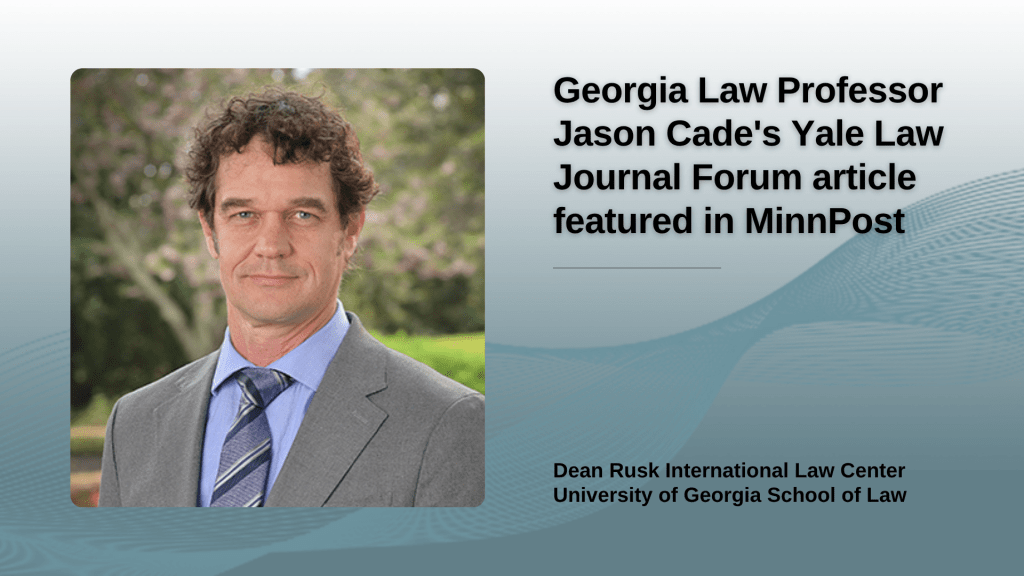
University of Georgia School of Law Professor Jason A. Cade and his Yale Law Journal Forum article regarding the Board of Immigration Appeals were featured by MinnPost. The article titled “Asylum approvals plummet at Fort Snelling immigration court as case numbers soar” was written by Shadi Bushra and published 5/26/26.
The abstract of Cade’s March 2026 article entitled “Welcome to the Trump Administration’s Board of Immigration Appeals. The Immigrant Always Loses” can be found below:
The first 100 opinions in Volume 29 of the Board of Immigration Appeals’ precedential decisions—issued at more than three times the historical pace—constitute a project. The Trump administration has used the Attorney General’s self-referral power and a reconstituted, ideologically aligned Board to engineer a body of precedents that reliably produces one result: removal. This Essay organizes these decisions, catalogued in a full Appendix, into five main categories: (1) narrowing relief for noncitizens alleging persecution; (2) expanding mandatory detention while narrowing discretionary release; (3) maximizing the immigration consequences of criminal history and related grounds while foreclosing the relief mechanisms Congress created to mitigate them; (4) tightening the exceptional and extremely unusual hardship standard governing non-LPR cancellation of removal, including by converting the Board’s own institutional delay into a legal basis for denying relief already granted; and (5) tightening the procedural rules governing immigration court proceedings, including the mechanisms through which noncitizens can preserve congressionally-created pathways to status. A parallel set of rule changes, partially vacated by a federal court but now being reissued through notice-and-comment rulemaking, seeks to insulate most deportation orders from meaningful appellate review. The Essay identifies three implications for federal courts. First, Loper Bright’s elimination of Chevron deference, combined with the Board’s institutional redesign and the uniformity of its outcomes, undermines any claim to persuasive weight, and many decisions should not survive de novo review, provided courts do not find reasons to dilute scrutiny of agency action in the immigration context. Second, the exhaustion doctrine’s justifications collapse when the administrative body to be exhausted has been rebuilt to foreordain a result. Third, the Board’s selective deployment of the civil/criminal distinction, invoked to deny protections when it benefits the government and to exclude favorable criminal-law developments when it benefits the noncitizen, is a doctrinal choice that post-Loper Bright courts should examine without deference.
Cade is J. Alton Hosch Professor of Law and served as associate dean for clinical programs and experiential learning from 2020 to 2025. Cade teaches immigration law courses and directs the school’s Community Health Law Partnership (Community HeLP), an intensive clinic in which law students undertake an interdisciplinary approach to immigrants’ rights through individual client representation, litigation, and project-based advocacy before administrative agencies and federal courts. His research examines how nonfederal actors and institutions shape the modern immigration system, the intersections of immigration enforcement and criminal law, questions of legitimacy and proportionality within immigration adjudication, and the legal frameworks governing immigration policy protest.
 exchange of notes