Georgia Law student attends 2026 ASIL Annual Meeting through professional development scholarship

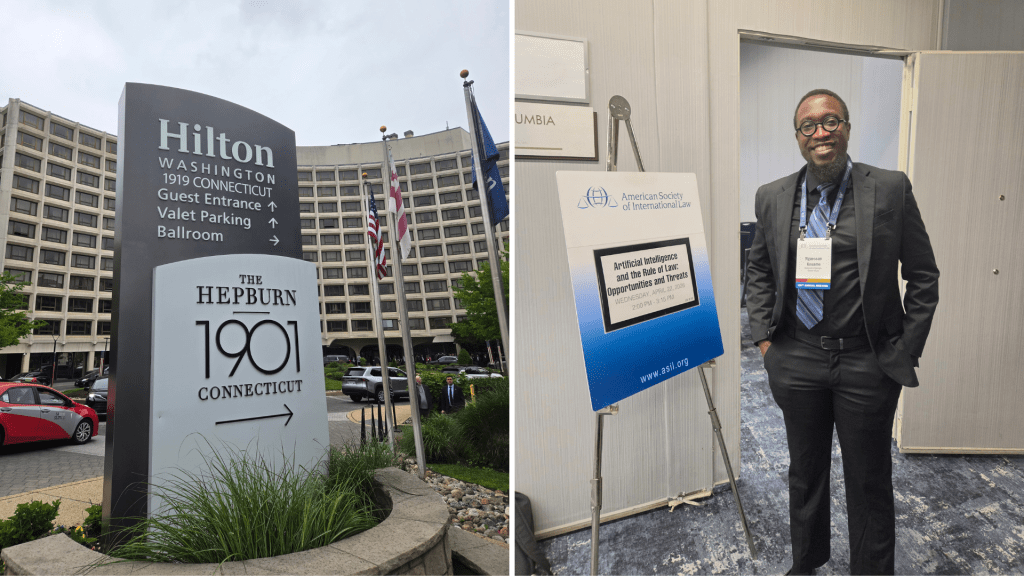
This year, University of Georgia School of Law student N’Guessan (“Clement”) Kouame (LL.M. ’24, J.D. ’26) attended the 120th Annual Meeting of the American Society of International Law in Washington, D.C. This year’s ASIL Annual Meeting convened with the theme “Advancing and Defending The Rule of Law.”

Kouame received a Louis B. Sohn Professional Development Fellowship to support his attendance of this conference. Awarded by the law school’s Dean Rusk International Law Center, Sohn Fellowships enable students to attend professional development opportunities related to international law.

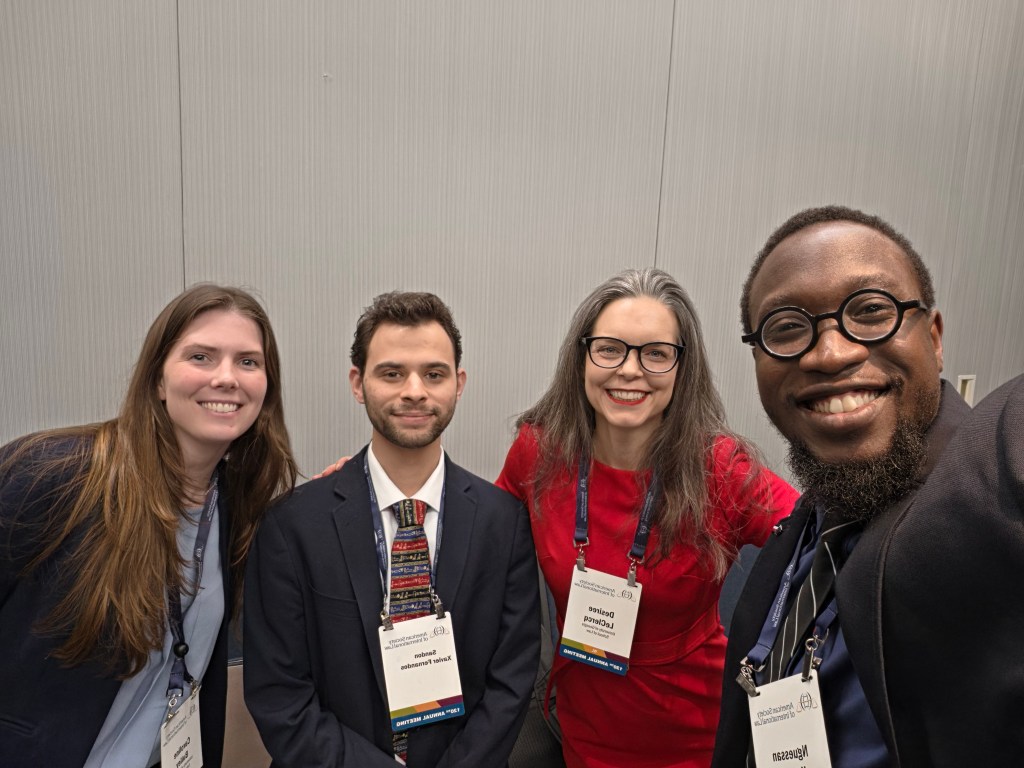
Kouame attended numerous panel discussions addressing a range of topics in international law. He met with D.C.-based Georgia Law alumni, including Caroline Bailey (J.D. ’24) and Sandon Fernandes (J.D. ’24), both pictured above with Georgia Law Professor Desirée LeClercq, also in attendance.

Reflecting on the conference, Kouame stated:

My favorite panel discussion was the one titled “The Great AI Race: Whiter Human Rights in the AI Supply Chain.” This topic is timely and critical for the future of humanity, as AI R&D affects all human beings by harming the environment and infringing on human rights. Attending the ASIL Annual Meeting deepened my understanding and perspective on human rights protection and the use of forced and child labor from the global south in multinationals’ supply chains for AI R&D.

To read prior posts about Georgia Law students using Sohn Fellowships to attend professional development opportunities, please click here and here.
Georgia Law Professor Desirée LeClercq and student N’Guessan Kouame (LL.M. ’24, J.D. ’26) publish on labor rights in West Africa

University of Georgia School of Law Professor Desirée LeClercq and student N’Guessan (Clément) Kouame (LL.M. ’24, J.D. ’26) published “Modern Slavery Thriving in the Shadows of West Africa: Why Coubaly v. Cargill Furthers Legal Barriers to Labor Rights Accountability” in International Labor Rights Case Law.

LeClercq joined the University of Georgia School of Law in 2024 as an assistant professor. She teaches Contracts, International Trade and Workers Rights, International Labor Law, U.S. Labor Law, and Public International Law. She also serves as a faculty co-director of the Dean Rusk International Law Center and as the faculty adviser for the Georgia Journal of International and Comparative Law and the Labor and Employment Student Association. 

LL.M. student N’Guessan Kouame contributes to World Bank report

University of Georgia School of Law LL.M. student, N’guessan “Clément” Kouame, contributed to the most recent World Bank Report for Women, Business, and the Law (WBL) released on March 2. He served as a panelist contributor for Côte d’Ivoire, West Africa, reviewing the legal framework and landscape of the country regarding the improvement of women’s rights and women’s empowerment.

Women, Business and the Law (WBL) is a World Bank Group project collecting data on the laws and regulations that affect women’s economic opportunity. Since 2009, WBL has been enhancing the study of gender equality and informing discussions on improving women’s economic opportunities and empowerment. This is the second year in a row that Kouame will contribute to the WBL’s annual report. He provides sources, laws, and regulations to corroborate his answers and make recommendations and comments.

From the report’s overview:

Women, Business and the Law 2024 is the tenth in a series of annual studies measuring the enabling environment for women’s economic opportunity in 190 economies.

This edition of the report updates the Women, Business and the Law 1.0 index of eight indicators, structured around women’s interactions with the law as they begin, progress through, and end their careers: Mobility, Workplace, Pay, Marriage, Parenthood, Entrepreneurship, Assets, and Pension.

Women, Business and the Law 2.0 sets a new frontier for measuring the environment for women’s economic inclusion across three pillars: legal frameworks, measuring laws; supportive frameworks, measuring policy mechanisms to implement laws; expert opinions, shedding light on experts’ perception of women’s outcomes.

Women, Business and the Law 2.0 also introduces two new indicators: Safety, measuring frameworks addressing violence against women, and Childcare, measuring frameworks for the availability, affordability and quality of childcare.

Data in Women, Business and the Law 2024 are current as of October 1, 2023. By examining laws and policy mechanisms affecting the economic decisions women make as they go through different stages of their working lives, as well as the opinions of experts on the legal environment for women’s economic inclusion, Women, Business and the Law makes a contribution to policy discussions about the state of women’s economic opportunities.