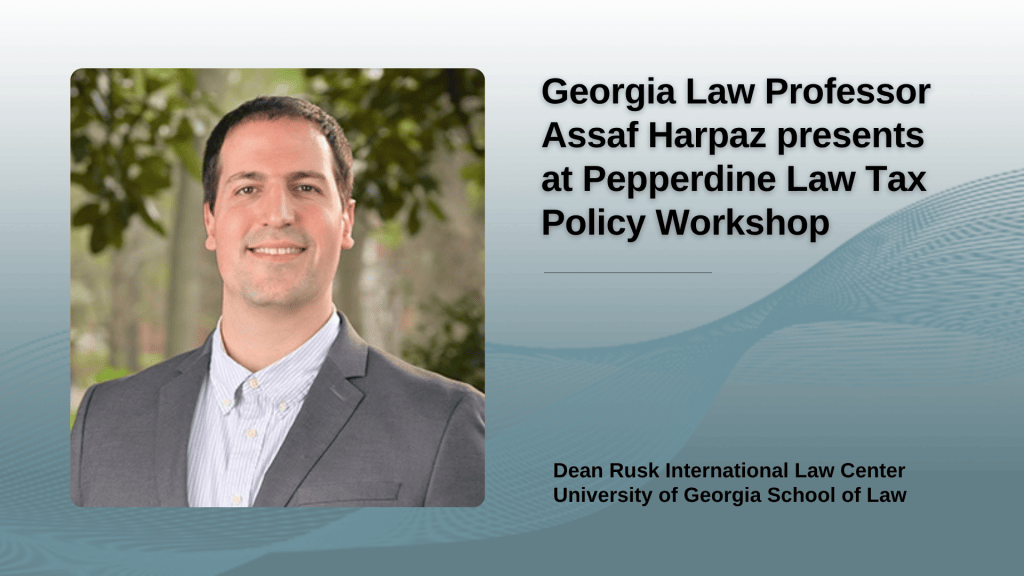
University of Georgia School of Law Professor Assaf Harpaz presented his article “The New Tax Sovereignty” at the Pepperdine Law Tax Policy Workshop series in September.
Below is the article abstract:
Tax sovereignty traditionally refers to a government’s authority to design and enforce its tax laws without external interference. Most legal scholars have examined the concept in the context of coordinated efforts to address harmful tax competition and tax evasion, focusing on the sovereignty concessions those efforts may require. However, recent assertions of tax sovereignty are arising in an increasingly fragmented international tax order marked by unilateralism and forum-shifting. That tension is demonstrated by the Trump administration’s withdrawal from international tax agreements, the proliferation of digital services taxes in Europe, and an emerging United Nations tax convention that incorporates a tax sovereignty principle. Nevertheless, tax sovereignty remains notoriously amorphous, and scholars have viewed it with skepticism because it is prone to manipulation and misuse.
This Article develops a relational theory of tax sovereignty. It argues that tax sovereignty should be understood as a principle of bounded autonomy, shaped and constrained by overlapping legal commitments and relationships of power. This theory operates across multiple axes. It applies to relations among states and between states and intergovernmental organizations, intra-state relations between national and subnational governments (e.g., U.S. states), and relations between governments and powerful institutional actors, like large corporations capable of shaping tax policy. The framework advanced in this Article ultimately rejects absolute claims of tax sovereignty, even by the world’s most powerful states. Effectively taxing offshore income demands cross-border cooperation and a willingness to accept reciprocal limits on tax sovereignty.
Harpaz joined the University of Georgia School of Law as an assistant professor in summer 2024 and teaches classes in federal income tax and business taxation. Harpaz’s scholarly focus lies in international taxation, with an emphasis on the intersection of taxation and digitalization. He explores the tax challenges of the digital economy and the ways to adapt 20th-century tax laws to modern business practices.

