
“The Future of Space Governance” conference will convene experts on October 28

17-098-Kepler-90_MultiExoplanetSystem-20171214On Monday, October 28, 2019, the Dean Rusk International Law Center and the Georgia Journal of International and Comparative Law at the University of Georgia School of Law will host a daylong conference to explore “The Future of Space Governance.” The conference will feature a keynote speech by Professor Emerita Joanne Irene Gabrynowicz, University of Mississippi School of Law, as well as panel discussions by academics and practitioners.

Participants will consider the following concept note:

International legal frameworks governing outer space developed under the conditions of a bi-polar, Cold War world, where the two great powers were the only spacefaring nations, and were engaged in a feverish race to space. The international agreements reflect the concerns of the time, primarily to prevent militarization and colonization of outer space. It seemed essential to keep the cold war out of space, and to keep it from going hot. Then, the U.S. made it to the moon, winning the race and effectively freezing space governance in Cold War terms.

Exactly half a century later, the world has changed, and so has space. A bi-polar world has gone multipolar, and an optimistic period of multilateralism has given way to a decline in robust international cooperation. Meanwhile, developments in outer space have exploded in complexity, ambition, and commercial promise. The number of entrants and potential entrants has proliferated: seventy-two nations now claim they have space agencies, and at least fourteen have orbital launch capabilities. One of the key new entrants is China, which is busy exploring the dark side of the moon and plans a permanent Chinese lunar colony as early as 2030. India, too, is broadening its ambitions, launching a moon lander trip this year, and planning for manned spaceflight and a space station launch soon thereafter. The SpaceX program is making rocket launches available for bargain basement prices, bringing space activities within the reach of a gaggle of startups keen to grab their piece of the commercial pie. Other commercial actors imagine space tourism, colonies, and missions to Mars. At the same time, the United States, still the dominant player in space, has announced plans to launch a “Space Force,” aimed at defense of U.S. military interests from space.

Fifty years after the first moonwalk, the prospect for a new set of multilateral agreements governing outer space is remote, yet the legal questions raised by new space activity are mounting. With little prospect of new multilateral treaties, outer space governance will need to make do with existing law, generate customary rules to govern new applications, and develop forms of sublegal understanding and cooperation.

This conference takes a stakeholder approach to emerging questions of outer space governance. It seeks to understand the perspective and concerns of classic space powers, new entrants, non-space faring nations, and international organizations like the Committee on the Peaceful Uses of Outer Space, as well as civilian space agencies, national militaries, and commercial actors. It asks for views on the sufficiency of existing law and governance structures and probes the legal needs of new and existing stakeholders. It will explore the agendas of the growing collection of actors, and attempt to find new prospects for governance.

Here’s the schedule:

RutledgeFull_cropped


8:45-9:00  Welcome

Peter B. “Bo” Rutledge, University of Georgia School of Law


9:00-10:30  New Entrants: Nations

What are the emerging governance challenges as new nations emerge as space-farers?

Slide1

Steven Mirmina, NASA

Saadia Pekkanen, University of Washington, Henry M. Jackson School of International Studies

Cassandra Steer, Women in International Security Canada

Charles Stotler, University of Mississippi School of Law

cohen2017crop


Moderator ǀ Harlan G. Cohen, University of Georgia School of Law


10:45-12:15  New Norms? Commercial Actors

What norms govern, or should govern, potential commercial uses such as extraction, tourism, and settlement?Panel 2

Julia Selman Ayetey, McGill University

Frans von der Dunk, Nebraska College of Law

Brian Israel, ConsenSys

Mark J. Sundahl, Cleveland-Marshall College of Law

UW Headshot


Moderator ǀ Melissa J. Durkee, University of Georgia School of Law

 

Gabrynowicz_hi_res_small1:15-2:00  Keynote

Professor Emerita Joanne Irene Gabrynowicz, University of Mississippi School of Law


2:15-3:45  New Uses: Security in Space

What are the appropriate responses to the new U.S. “Space Force” and other threats of space militarization?

Panel 3.jpg

Mariel Borowitz, Georgia Tech, Sam Nunn School of International Affairs

David Kuan-Wei Chen, Center for Research in Air and Space Law, McGill University

James Gutzman, United States Air Force

Andrea Harrington, Air Command and Staff College, Air University

img_2013crop


Moderator ǀ Diane Marie Amann, University of Georgia School of Law

GJICL EIC3:45-4:00  Closing Remarks

Lauren Elizabeth Lisauskas, Editor-in-Chief, Georgia Journal of International and Comparative Law


Registration, CLE credit, and other details here. Additional cosponsors include the International Law Society, Georgia Law’s chapter of the the International Law Students Association.
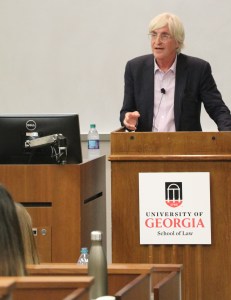
David Tolbert’s speech at Georgia Law, hosted by Dean Rusk International Law Center, and more in new issue of Georgia Journal of International and Comparative Law

A speech that noted human rights lawyer David Tolbert delivered here at the University of Georgia School of Law (right) is available in the just-released edition of the Georgia Journal of International & Comparative Law.

The law school’s Dean Rusk International Law Center was honored to host Tolbert last autumn. Currently Ford Fellow/Visiting Scholar at the Duke University Sanford School of Public Policy and immediate past president of the International Center for Transitional Justice, Tolbert has held many leadership positions at international institutions. His survey of the state of human rights, a highlight of our Center’s academic year, has been published as Quo Vadis: Where Does the Human Rights Movement Go from Here?

It is one of many stimulating publications in the newest issue of Volume 47, No. 2 of this nearly half-century-old student-edited journal. Other articles are (hyperlink connects to PDF download):

Two-Dimensional Hard-Soft Law Theory and the Advancement of Women’s and LGBTQ+ Rights Through Free Trade Agreements, by Raj Bhala, the Leo S. Brenneisen Distinguished Professor at the University of Kansas School of Law, and Cody N. Wood, an associate at Dentons LLP in Kansas City

Refugee Crisis in Germany and the Right to a Subsistence Minimum: Differences That Ought Not Be, by Dr. Ulrike Davy, Professor of Constitutional and Administrative Law, International and German Social Law, and Comparative Law at Bielefeld University, Germany, and Visiting Researcher, Faculty of Law, University of Johannesburg, South Africa

Democracy, Rule-of-Law, and Legal Ethics Education: Directing Lawyers to Support Democratization in Myanmar, by Dr. Jonathan Liljeblad, Senior Lecturer at the Australian National University College of Law, Canberra

The issue also includes the following notes, all by members of the just-graduated Georgia Law Class of 2019:

Off with Their Heads! How China’s Controversial Human Head-Transplant Procedure Exceeds the Parameters of International Ethical Standards in Human Experimentation, by Deena Agamy

Trading Places: With the United States in Retreat, Who Writes the International Rules for Trade?, by Austin C. Cohen

What Not to Wear: Religious Dress and Workplace Policies in Europe, by Sarah Lanier Flanders

Poland: Winds of Change in the Act on Windfarms, by Jacob T. McClendon

The entire issue is available here.

European Union, outer space, intercountry adoption, tequila and more in new issue of Georgia Journal of International and Comparative Law

Very pleased to announce that the Volume 47, No. 1, of the Georgia Journal of International & Comparative Law is now available in print and online.
This issue of the nearly half-century-old student-edited journal, published by the University of Georgia School of Law, includes the following articles (hyperlink connects to PDF download):

The Other Space Race: Some Law and Economics of Celestial Resource Appropriation, by Dr. Alexander W. Salter, Assistant Professor of Economics at the Rawls College of Business, and Comparative Economics Research Fellow at the Free Market Institute, both at Texas Tech University

Building Integration Through the Bill of Rights? The European Union at the Mirror, by Dr. Graziella Romeo, Assistant Professor of Constitutional Law, Department of Legal Studies, Bocconi University, Milan, Italy

The Challenges of Water Governance (and Privatization) in China; Normative Traps, Gaps, and Prospects, by Xu Qian, PhD candidate, Chinese University of Hong Kong, Faculty of Law

China’s Rule of Law from a Private International Law Perspective, by Dr. King Fung Tsang, Associate Professor, Chinese University of Hong Kong, Faculty of Law

Also included are the following student notes, all by members of the just-graduated Georgia Law Class of 2019:

Residential Requirements in the Intercountry Adoption Process: Protectionist Measure or Insurmountable Barrier?, by Morgan Renee Thomas

Regulating International Surrogacy Arrangements Within the United States: Is There a Conceivable Solution?, by Laura Rose Golden

Tacos, Tequila, and Tainted Alcohol? An Examination of the Tainted Alcohol Problem in Mexico and What It means for the American Tourist, by Tammy Le

Gulf Airline Subsidization: Should the European Union and the United States Collaborate to Combat this Alleged Threat?, by Savannah Harrison Moon

Mind Your Businesses: Why Georgia Companies Should Worry About European Privacy Law, by Emily Elizabeth Seaton

The full issue is available here.

Georgia Law Professor Cohen publishes at Just Security on “The National Security Delegation Conundrum”

“How much authority — how much room to make policy choices—can Congress delegate to the president and executive branch?”

So begins “The National Security Delegation Conundrum,” an analysis of the foreign relations jurisprudence of the U.S. Supreme Court, published at Just Security by Harlan Grant Cohen, Gabriel M. Wilner/UGA Foundation Professor in International Law and Faculty Co-Director of the Dean Rusk International Law Center here at the University of Georgia Law.

The focus of Cohen’s commentary is Gundy v. United States, a June 20 decision by a divided Court (4 supporting an opinion by Justice Elena Kagan and 3 an opinion by Justice Neil Gorsuch; Justice Samuel Alito concurred in the judgment). It declined to revive the nondelegation doctrine — but did so, Professor Cohen points out, in a way that raised further questions on how that doctrine applies to cases involving national security.

Instances in which these questions might be relevant have occurred frequently in the last couple years, Cohen wrote, on issues as varied as migration of peoples and trade in auto parts. After analyzing the issues at hand, Cohen concluded that Gundy did little to resolve them:

“What is clear though is that until a test or principle is found, the national security delegation conundrum will remain.”

The full Just Security analysis is here.

Georgia Law Professor Christopher Bruner speaks at London conference on technology and corporate governance


Christopher Bruner, the Stembler Family Distinguished Professor in Business Law here at the University of Georgia School of Law, presented his scholarship at a conference on “The Future of the Firm” held last Friday in London.

Professor Bruner’s presentation was entitled “Distributed Ledgers, Artificial Intelligence, and the Purpose of the Corporation.”

Among the other speakers were scholars from the University of Oxford, University of Cambridge, University College London, and Loyola Law School-Los Angeles.

The event was hosted by the University College London, Faculty of Laws. Co-sponsors included the University of Cambridge Centre for Corporate and Commercial Law, as well as the Brussels-based European Corporate Governance Institute, of which Professor Bruner is an Academic Member.

Global Governance Summer School students attend RECONNECT conference on democracy and the rule of law in the European Union

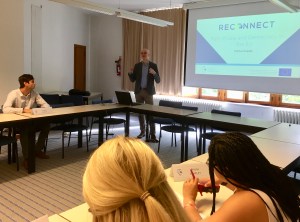
LEUVEN & BRUSSELS – The morning opened with an introduction to the European Union, presented by Michal Ovadek, a research fellow at the Leuven Centre for Global Governance Studies. An expert in the European Union legislative process, he provided an overview of the European Union architecture, and outlined the primary challenges to democracy in Europe. The session was designed to prepare students to participate fully in the rest of the day’s activities: a conference devoted to a research project aimed at reinvigorating core values of the European Union.

From left, Gamble Baffert, Charles Wells, Leila Knox, Emily Doumar, Maria Lagares Romay, Blanca Ruiz Llevot, Steven Miller, Alicia Millspaugh, and Briana Blakely.

The RECONNECT: Reconciling Europe with its Citizens through Democracy and the Rule of Law project, established by the Leuven Centre for Global Governance Studies, is supported by funds from the EU’s Horizon 2020 Research & Innovation programme. As part of the larger project, the Leven Centre convened the International Conference on Democracy and the Rule of Law in the EU. It gathered experts to discuss contemporary challenges to European Union integration, including judicial independence and rule of law, free press, and democratic institutions in countries like Poland and Hungary.

The conference took place in the Brussels’ beautiful Academy Palace, and opened with a welcome by Professor Jan Wouters (left), Co-Director of the Global Governance Summer School.

The conference featured keynote remarks by Daniel Keleman, Professor of Political Science and Law and Jean Monnet Chair in European Union Politics at Rutgers University, and Koen Lenaerts, President of the Court of Justice of the European Union (right). Two policy roundtables also featured perspectives from academics and advocates from around Europe on democracy and rule of law in the European Union, respectively.

From left, Kathleen Garnett, Holly Stephens, Steven Miller, Alicia Millspaugh, Emily Snow.

Georgia Law trio pens Daily Report commentary on ECJ arbitration ruling

Peter B. “Bo” Rutledge, Dean and Herman E. Talmadge Chair of Law here at the University of Georgia School of Law, has co-authored, with 3L Katherine M. Larsen and Amanda W. Newton (JD’19), a commentary on a recent decision related to international arbitration.

Entitled “European Decision Could Have Killed Investment Treaties, Affecting Arbitration and Investments,” the commentary appeared at The Daily Report on June 28.

It discusses the content and the implications of Achmea v. Slovakia, a May 2018 decision in which the European Court of Justice ruled a clause in a bilateral investment treaty to be incompatible with European law. Both that decisions and subsequent interpretation of it in European and US courts, the authors state, leaves “more questions than answers at this point.” (Also see prior post.)

Georgia Law Professor Amann speaks at Oxford University conference on transnational human rights

“Victors’ Justice and the New Turn to Transnational Process” is the title of a paper that Professor Diane Marie Amann presented earlier this month in England, as part of an Oxford University conference, which took place over the course of 2 days at the Law Faculty’s Bonavero Institute of Human Rights, Mansfield College, and at St. Antony’s College.

Through the lens of the “victors’ justice” critique that some late 20th century scholars used to describe post-World War II trials at Nuremberg and Tokyo, the paper examines contemporary interest in transnational means of prosecuting international crimes.

An expert in international criminal law and human rights, Amann is the Emily & Ernest Woodruff Chair in International Law and Faculty Co-Director of the Dean Rusk International Law Center here at the University of Georgia School of Law. For a portion of 2018, she was a Research Visitor/Visiting Fellow at Bonavero/Mansfield College.

Command responsibility in 2018 judgment, topic of Georgia Law Professor Amann’s ICC Forum essay

Honored to have contributed on the doctrine of command responsibility to the newest edition of ICC Forum, an online publisher of essays on human rights and international criminal law. My essay was one of several responding to this question, posed by the editors:

“What does the Bemba Appeal Judgment say about superior responsibility under Article 28 of the Rome Statute?”

My own response, entitled “In Bemba, Command Responsibility Doctrine Ordered to Stand Down,” amplified an argument I’d made in an EJIL: Talk! contribution last year (prior post).

Specifically, it traced the development of the international-humanitarian- law/law-of-armed-conflict-doctrine that places on military commanders a burden greater than that shouldered by other combatants. It then turned to the International Criminal Court Appeals Chamber’s 2018 judgment in Bemba. The majority’s interpretation of the ICC Statute’s command-responsibility provision, my essay argued, risks tolerating “derelictions of duty” so as “to condone indiscipline,” and thus “to increase the risks of the very harms that the doctrine of command responsibility is intended to dispel.” As a result, perhaps “no one can be held to account.”

Other invited experts who contributed essays were: Miles Jackson, Associate Professor of Law, Jesus College, University of Oxford; Michael A. Newton, Professor of the Practice of Law and Political Science at Vanderbilt University Law School; Nadia Carine Fornel Poutou, Executive President Association of Women Lawyers of Central African Republic; and Leila Nadya Sadat, James Carr Professor of International Criminal Law at Washington University School of Law.

ICC Forum is supported by the Promise Institute for Human Rights at UCLA School of Law; UCLA Law Professor Richard H. Steinberg serves as Editor-in-Chief.

(Cross-posted from Diane Marie Amann)

Georgia Law faculty present and comment on international law papers at annual ASIL Southeast workshop

University of Georgia School of Law faculty were well represented at the  annual American Society of International Law Southeast scholarly workshop, held this year at Washington & Lee University School of Law in Lexington, Virginia.

Kathleen A. Doty, Director of the law school’s Dean Rusk International Law Center (above, 2d from left), presented on the Women, Peace and Security (WPS) initiative established by the UN Security Council. Commenting on her paper, entitled “Rethinking the WPS Agenda in Light of International Relations Studies of Women in Conflict,” was Washington & Lee Law Professor Mark Drumbl.

Serving as commentators during the daylong workshop were 2 additional Georgia Law faculty: Professor Melissa J. Durkee, J. Alton Hosch Associate Professor of Law (above right), was the discussant for “The Corporate Keepers of International Law” by William & Mary Law Professor Jay Butler; and Christopher Bruner (above, 2d from right), Stembler Family Distinguished Professor in Business Law, commented on “The Pendulum of International Financial Regulation” by George Mason Law Professor Paolo Saguato.