Georgia Law Professor Desirée LeClercq publishes chapter in Oxford University Press book

Assistant Professor Desirée LeClercq published “Enforcing International Sustainability Standards on International and National Platforms” in The Sustainability Revolution in International Trade Agreements (G. Vidigal and K. Claussen, eds.) (Oxford University Press, 2024).

Below is a description of the book:

Once seen as aspirational and relatively innocuous, ‘sustainability’ or ‘sustainable development’ provisions are now changing the face of international trade agreements. The Sustainability Revolution in International Trade Agreements gathers fundamental, first-hand analyses of these novel commitments across dozens of agreements, considering their legal, political, and economic aspects.

Drawing on perspectives from different parts of the world and engaging experts in the law and practice of sustainability provisions, this volume offers a comprehensive assessment of the latest developments and innovations in international trade agreements. It also evaluates the development challenges that sustainability requirements pose for countries with limited resources and capacity, for whom lower labour and environmental regulatory costs have been a competitive asset.

The present volume explores the intersectional aspects of sustainability – such as gender equality, biodiversity, animal welfare, and Indigenous rights – in addition to the more traditional dimensions of sustainability, namely economic development, environmental conservation, and improvement of labour standards.

There is little doubt that a sustainability revolution in global production patterns is needed. Considering the details of its operation – how it can come into being, who will bear the increased production costs, and how decisions on difficult trade-offs will be made – reveals the immense challenges involved in developing a new international law for sustainable trade. Read together, the chapters in this volume outline the contours this emerging legal framework, examine its practical operation, and offer important reflections upon the real extent and the foreseeable consequences of this sustainability revolution in international trade agreements.

Desirée LeClercq joined the University of Georgia School of Law in 2024 as an assistant professor. She teaches International Trade and Workers Rights, International Labor Law, International Law and U.S. Labor Law. She also serves as a faculty co-director of the Dean Rusk International Law Center and as the faculty adviser for the Georgia Journal of International and Comparative Law.
Georgia Law Professor Bruner presents at London School of Economics and Political Science (LSE)

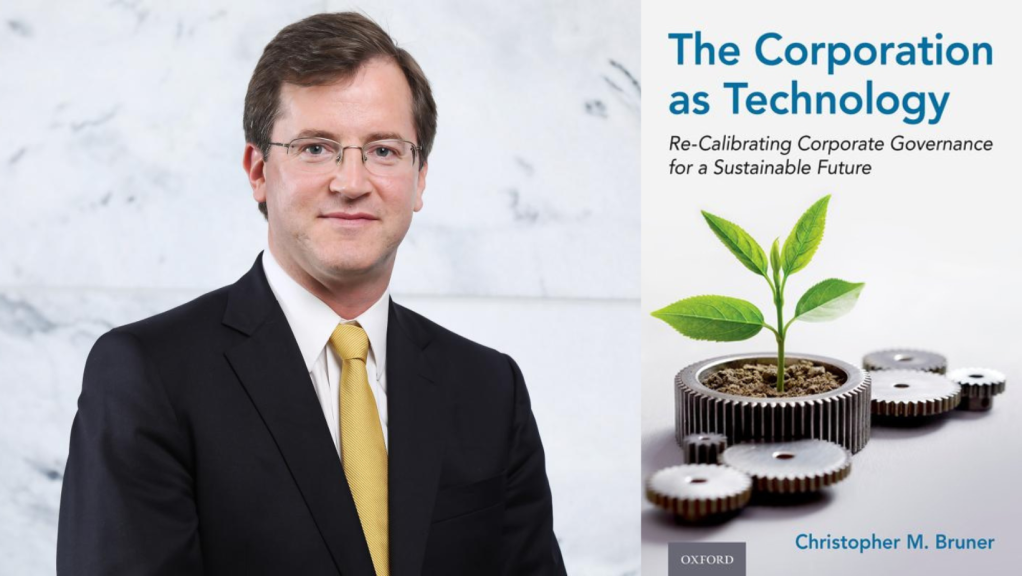
Christopher M. Bruner, Stembler Family Distinguished Professor in Business Law and Faculty Co-Director of the Dean Rusk International Law Center, presented his book, The Corporation as Technology: Re-Calibrating Corporate Governance for a Sustainable Future (Oxford University Press 2022) at the London School of Economics and Political Science (LSE) in June.

Below is a description of the book:

Recent decades have witnessed environmental, social, and economic upheaval, with major corporations contributing to a host of interconnected crises. The Corporation as Technology examines the dynamics of the corporate form and corporate law that incentivize harmful excesses and presents an alternative vision to render corporate activities more sustainable.

The corporate form is commonly described as a set of fixed characteristics that strongly prioritize shareholders’ interests. This book subverts this widely held belief, suggesting that such rigid depictions reinforce harmful corporate pathologies, including excessive risk-taking and lack of regard for environmental and social impacts. Instead, corporations are presented as a dynamic legal technology that policymakers can re-calibrate over time in response to changing landscapes.

This book explores the theoretical and practical ramifications of this alternative vision, focusing on how the corporate form can help secure an environmentally, socially, and economically sustainable future.

Georgia Law Professor Bruner publishes book review in Cambridge International Law Journal

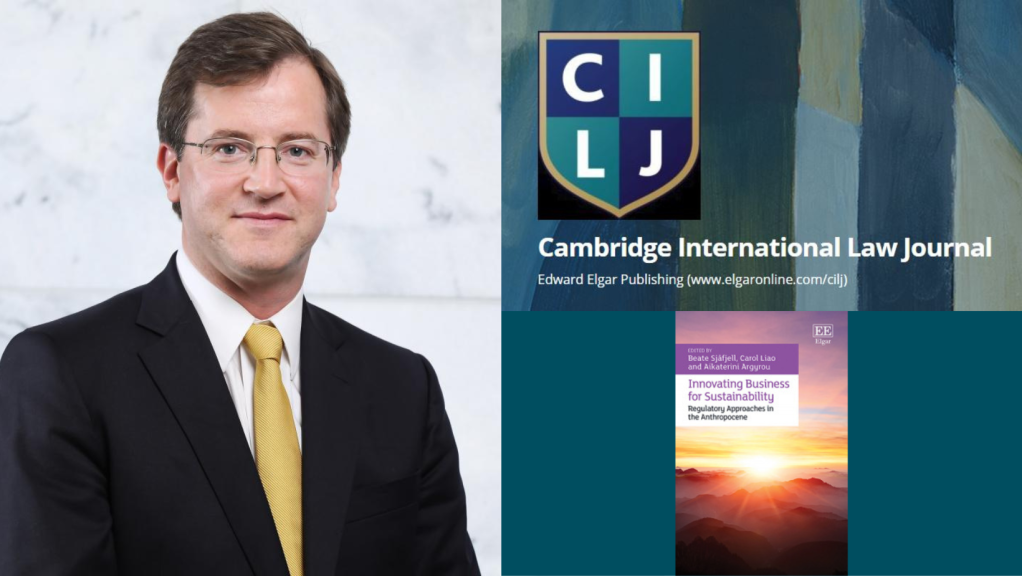
Christopher M. Bruner, Stembler Family Distinguished Professor in Business Law and Faculty Co-Director of the Dean Rusk International Law Center, published a review of a book titled Innovating Business for Sustainability: Regulatory Approaches in the Anthropocene (edited by B. Sjåfjell, C. Liao and A. Argyrou), in the Cambridge International Law Journal in December.

Below is a description of the book:

Challenging current attitudes to governance and regulation in business, this timely book ascertains how regulatory approaches can innovate to ensure sustainable business that contributes to social justice for current and future generations within ecological limits.

Combining a research-based approach with a gendered perspective of how sustainability goals are shaped and how businesses should engage with them, this pioneering book creates a comprehensive and contemporary understanding of what sustainability means for business. Identifying the limitations of current approaches to gender and equality alongside the weaknesses of current regulatory and theoretical approaches in business, chapters seek to enhance the practical understanding and embeddedness of sustainability into business within legal and regulatory landscapes. Insights from an international collection of expert scholars in fields ranging from sustainability science to law offer meaningful alternatives to the sustainable business status quo on both conceptual and concrete levels.

Providing a regulatory analysis of business positioned in a systems-based sustainability research framework, this book will prove an invaluable resource for students and scholars of sustainability science, business and management, and law and regulation. With practical insights, it will also prove essential for policymakers working in business regulation and sustainability in business.

Prior posts on Bruner’s scholarship can be found here.

UGA Law Professor Bruner presents on global value chains at Tilburg Law School in the Netherlands

Christopher M. Bruner, Stembler Family Distinguished Professor in Business Law and Faculty Co-Director of the Dean Rusk International Law Center, presented his working paper, “Prospects for a US Value Chain Due Diligence Law,” at a conference hosted by Tilburg Law School in the Netherlands titled “Connecting Responsible Organizations: Legal Strategies for Sustainability in Global Value Chains.”

Bruner participated in the panel titled “Sustainable corporate governance and tax transparency.” The conference, hosted by Tilburg’s Department of Private, Business & Labour Law, aimed to provide a platform for legal experts to discuss environmental and social sustainability challenges in global value chains.

Prior posts on Bruner’s scholarship can be found here.

UGA Law Professor Bruner presents at conferences in Canada, Sweden

Christopher M. Bruner, Stembler Family Distinguished Professor in Business Law and Faculty Co-Director of the Dean Rusk International Law Center, recently presented working papers in Canada and Sweden.

He presented “Corporate Governance and Sustainability Incentives” at a conference titled “Addressing the Sustainability Impacts of Corporations” in October. The conference was hosted by the Nathanson Centre on Transnational Human Rights, Crime and Security at the Osgoode Hall Law School (York University) in Toronto.

Bruner also presented “Corporate Personhood, Corporate Rights, and the Contingency of Corporate Law” at “Decoding the Rights of Companies in the Technocene,” a conference hosted in December by the Lund University Faculty of Law in Lund, Sweden.

Bruner’s scholarship focuses on corporate law, corporate governance, comparative law and sustainability. He is a research member of the European Corporate Governance Institute (ECGI) and has presented his work in numerous countries around the world.

Georgia Law Professor Christopher Bruner presents on corporate sustainability at seminar in London

Christopher M. Bruner, the Stembler Family Distinguished Professor in Business Law here at the University of Georgia School of Law, presented his book, The Corporation as Technology: Re-Calibrating Corporate Governance for a Sustainable Future (Oxford University Press 2022) earlier this month in London, United Kingdom.

The seminar was hosted by the University of Notre Dame’s London Global Gateway and co-sponsored by the University College London Centre for Commercial Law.

Georgia Law Professor Christopher Bruner presents on corporate sustainability disclosure in joint Minnesota-Dublin seminar

Christopher M. Bruner, the Stembler Family Distinguished Professor in Business Law here at the University of Georgia School of Law, recently took part in a seminar session on corporate sustainability disclosures, presented online for students at the University of Minnesota Law School and University College Dublin Sutherland School of Law.

“Sustainability Disclosure Around the World” was the title of the presentation by Bruner, a scholar of corporate law, corporate governance, comparative law, and sustainability, whose most recent book is The Corporation as Technology: Re-Calibrating Corporate Governance for a Sustainable Future (OUP 2022) (prior posts).

Joining Bruner in presenting the seminar were Professor Brett McDonnell, Dorsey & Whitney Chair in Law at Minnesota Law, and Xiaoyu Gu, who is a Managing Director at AB CarVal, a global alternative investment management firm. Professor Claire Hill, who is James L. Krusemark Chair in Law at Minnesota Law, and Professor Joe McGrath, of University College Dublin Law, convened the event.

Georgia Law Professor Christopher Bruner appointed Research Member of European Corporate Governance Institute

Christopher M. Bruner, the Stembler Family Distinguished Professor in Business Law here at the University of Georgia School of Law, has been appointed a Research Member of the prestigious European Corporate Governance Institute, known as ECGI.

As described on its website, the Brussels-based “ECGI is an international scientific non-profit association providing a forum for debate and dialogue between academics, legislators and practitioners, focusing on major corporate governance issues.” Its “global network of practitioner, academic and institutional members” is “appointed on the basis of their significant contribution to the field of corporate governance study.” EGCI’s press release on today’s new appointments is available here.

In addition to fostering research collaboration among its members, ECGI disseminates scholarship, hosts international events, and spearheads initiatives, including its ongoing project on “Responsible Capitalism.”

Bruner (prior posts) is a scholar of corporate law, corporate governance, comparative law, and sustainability. His books include The Corporation as Technology: Re-Calibrating Corporate Governance for a Sustainable Future (OUP 2022), The Cambridge Handbook of Corporate Law, Corporate Governance and Sustainability (co-edited with Beate Sjåfjell) (CUP 2019), Re-Imagining Offshore Finance: Market-Dominant Small Jurisdictions in a Globalizing Financial World (OUP 2016), and Corporate Governance in the Common-Law World: The Political Foundations of Shareholder Power (CUP 2013).

Georgia Law Professor Christopher Bruner presents on corporate risk and sustainability at the University of Oslo

Christopher M. Bruner, the Stembler Family Distinguished Professor in Business Law here at the University of Georgia School of Law, presented on “Corporate Risk, Shareholder Liability, and the Role of Intermediaries” as part of a “Corporate Law, Corporate Governance and Sustainability” panel at a conference last month at the University of Oslo Faculty of Law in Norway.

Bruner also moderated another session and participated in an invitation-only research-collaboration workshop.

Entitled “The Risks of Unsustainability Conference,” the University of Oslo gathering brought together “academics from various fields to discuss how a research-based concept of risks of sustainability can be placed at the centre of law and policy, in business and finance, to contribute to ensuring a safe and just space for all living beings on this planet,” with the goal of “generat[ing] holistic inclusion of the risks of unsustainability at a systemic level, and unlock[ing] the potential of new modalities of sustainability law.”

In addition to Norway and the United States, the conference welcomed scholars based in Denmark, Italy, the Netherlands, Poland, Sweden, and the United Kingdom.

Georgia Law Professor Bruner serves as commentator at University of Oslo launch of book on business and sustainability

Christopher M. Bruner, the Stembler Family Distinguished Professor in Business Law here at the University of Georgia School of Law, served as a commentator Thursday at a book launch hosted by the Faculty of Law at the University of Oslo, Norway.

The book, Innovating Business for Sustainability: Regulatory Approaches in the Anthropocene (Elgar 2022) is an essay collection edited by Professors Beate Sjåfjell, University of Oslo, Carol Liao, University of British Columbia in Canada, and Aikaterini Argyrou, Nyenrode Business University in the Netherlands. All three co-editors took part in the online launch event. Professor Cecilia Bailliet of the University of Oslo served as commentator along with Georgia Law Professor Bruner.

In a published item regarding the book – which is the second publication under the auspices of Daughters of Themis: International Network of Female Business Scholars – Bruner has written:

“There is growing recognition that the interconnected global crises we face require urgent reforms to the conduct of business, yet the nature and extent of such reforms remain hotly debated. This essential volume compellingly argues that we must embed the concept of sustainability at the very heart of corporate law, and the authors’ expert analyses challenge us to rethink prevailing regulatory approaches in light of the gendered nature of existing structures and the complexity of social-ecological systems.”