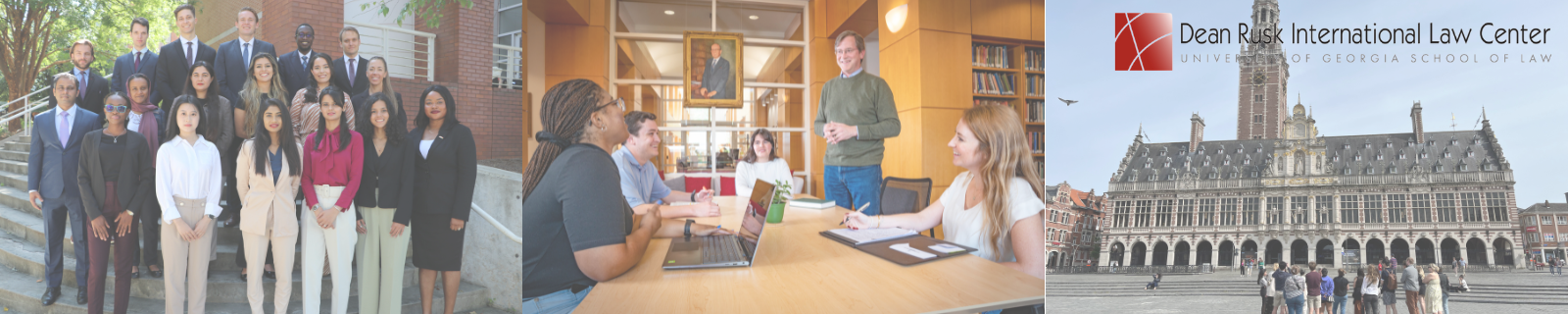
Georgia Law LL.M. Students Take Professional Development Trip

Last month, the University of Georgia School of Law Master of Laws (LL.M.) class of 2025 traveled to Atlanta for a professional development trip organized by the Dean Rusk International Law Center’s director of international professional education, Dr. Laura Tate Kagel. Students were accompanied by Dr. Kagel, International Professional Education Manager Mandy Dixon, and Center Associate Director Taher Benany.

The group of foreign lawyers was hosted by the law offices of Arnall Golden Gregory, LLP for lunch and a lively discussion with legal practitioners. Abe Schear, a partner in the Real Estate and Leasing practices at AGG, offered the students sound career advice and discussed how his involvement with the International Bar Association helped him grow the firm’s international practice. Theresa Kananen related her career journey and described her current role as partner and co-chair of the Payment Systems & Fintech industry team, offering compelling illustrations of the types of cases that arise in her practice area. Glenn Hendrix, a partner in AGG’s Healthcare Group and the founding president of the Atlanta International Arbitration Society (“AtlAS”), recounted the challenges and advantages of dispute resolution in a global society. Teri Simmons (J.D. ’89), a partner and chair of the firm’s Global Mobility practice and an adjunct professor of law at UGA, and her team members Dorothea Hockel and Naina Bishnoi (LL.M. ’24), explained how they help foreign businesses avoid legal pitfalls when bringing their operations to the United States.

Professional development trips are among many opportunities offered to Georgia Law LL.M. students to foster career connections and gain insight into potential career paths. 

To learn more about the LL.M. program, click here.

Dean Rusk International Law Center welcomes new Associate Director, Taher S. Benany

Taher S. Benany joined the University of Georgia School of Law’s Dean Rusk International Law Center as associate director in January 2025.

In this role, he oversees global international training programs, including the Global Externships Overseas (GEO) initiative. He also collaborates with Center faculty and staff to plan and implement international law research initiatives, events and conferences, including the annual Georgia Journal of International and Comparative Law conference.

Benany came to Georgia Law from the Shalakany Law Office in Cairo, Egypt, where he was a partner focusing on public international law, global disputes and government affairs for four years. In an earlier stint with the firm from 2014 to 2019, he was a senior associate focusing on public law, international litigation, compliance and government affairs. He also served as a public international law lecturer at the British University in Egypt and served as a public international law expert for the European Union Agency for Criminal Justice Cooperation.

As a legal fellow for the United Nations Human Rights Council for an African state and an international organization, he drafted resolutions and interventions while preparing universal periodic reviews and legal opinions on international human rights instruments.

He earned his Bachelor of Laws from Cairo University in 2017, then continued his legal studies as a Fulbright Scholar at the University of Michigan in Ann Arbor. He also holds a Bachelor of Science in Oral and Dental Medicine and Surgery from Misr International University in 2010, graduating as the valedictorian of his class and serving as a maxillofacial surgeon at the Munira Public Hospital for one year.

Benany speaks Arabic, English and French.   

Luwam Dirar of Western New England University speaks at Georgia Law’s International Law Colloquium

The University of Georgia School of Law’s spring 2025 International Law Colloquium welcomed Professor Luwam Dirar of Western New England University School of Law as its second speaker last week.

Dirar presented her working paper titled, “Emancipation, Decolonization, and Gender in the Context of African Integration.” Dirar’s research and scholarly focus centers on international human rights law and the intersection of international economics and international relations. Dirar has also served as a consultant to several African governments and international organizations regarding migration and law.

Associate Director of the Dean Rusk International Law Center, Taher Benany, served as Dirar’s faculty discussant. Professor Desirée LeClercq is overseeing the colloquium, which is designed to introduce students to features of international economic law through engagement with scholars in the international legal field.

Below is an abstract of Dirar’s working paper:

The 1960s institutionalization and formalization of Africa’s continental integration was a manifestation of the ontological fragility of the concept of emancipation in the African context. As a concept, continental emancipation excluded concerns of women and formalized the divorce between decolonization and racial domination on the one hand and social emancipatory movements on the other. This divorce was contrary to the expectation of women who sought the end of colonial subjugation as a turning point for women’s emancipation from not only colonial and racial domination but also from social oppression. This article argues that the continental emancipation project betrayed the hopes of women who sought decolonization or the end of white racial domination as central to the end of gendered and gendering social subjugation. This article will have four parts. The first part will be a general introduction and will explore women’s emancipation in the context of regional integration studies. The second part will explore the internal contradictions of the concept of emancipation. The third part will explore the marketization of regional integration in Africa and the debates surrounding gender in trade agreements. The fourth part will be the conclusion and way forward.

To view the full list of International Law Colloquium speakers, visit our website. A summary of the previous week’s talk with Professor Harlan Cohen can be found here.

This program is made possible through the Kirbo Trust Endowed Faculty Enhancement Fund and the Talmadge Law Faculty Fund.