University of Georgia School of Law Professor Desirée LeClercq was featured in Inside U.S. Trade regarding rapid-response mechanism petitions under the U.S.-Mexico-Canada Agreement. The article titled “RRM ‘black boxing’ spurs solidarity among tri-national labor reps” was written by Margaret Spiegelman and published 10/14/25.
LeClercq joined the University of Georgia School of Law in 2024 as an assistant professor. She teaches Contracts, International Trade and Workers Rights, International Labor Law, International Law and U.S. Labor Law, and Public International Law. She also serves as a faculty co-director of the Dean Rusk International Law Center and as the faculty adviser for the Georgia Journal of International and Comparative Law.
University of Georgia School of Law Professor Desirée LeClercq recently delivered a presentation for the Foreign, Commonwealth & Development Office’s Trade & Economic Diplomacy Faculty entitled “Growing Employment Through Trade: The Role of Fair Labour Standards.”
LeClercq discussed the evolution of international labor standards, noting how rules once designed to protect workers and improve living conditions are now used by countries such as the United States to enforce rights abroad and reshape global supply chains. Drawing on her experience as director of labour affairs at the Office of the U.S. Trade Representative and as a legal officer at the International Labour Organization, she illustrated this trend through examples from the United States-Mexico-Canada Agreement (USMCA).
LeClercq joined the University of Georgia School of Law in 2024 as an assistant professor. She teaches Contracts, International Trade and Workers Rights, International Labor Law, International Law and U.S. Labor Law, and Public International Law. She also serves as a faculty co-director of the Dean Rusk International Law Center and as the faculty adviser for the Georgia Journal of International and Comparative Law.
In March, the University of Georgia School of Law partnered with the Washington International Trade Association (“WITA”) to present a webinar about careers in international trade and law. This webinar was part of WITA Academy’s ongoing Pathways to Opportunity Series: Careers in International Trade & Law, through which law students and undergraduates are able to learn about career opportunities in international trade and law from law firms and trade professionals. This webinar featured alumni/ae from Georgia Law and the university.
The webinar included:
Introductions from Diego Añez, Executive Director, WITA Academy; Managing Director, Washington International Trade Association and Kenneth I. Levinson, Chief Executive Officer, Washington International Trade Association
A panel discussion featuring:
Nancy Fischer, Global Head of Regulatory Practices, International Trade Partner, Pillsbury Winthrop Shaw Pittman LLP (B.B.A. The University of Georgia; J.D. Syracuse University College of Law)
Eric Heath, Senior Attorney Advisor, U.S. International Trade Commission (B.A. Lipscomb University; J.D. University of Georgia School of Law, LL.M. University of Edinburgh Law School)
Tina Termei, Director & Associate General Counsel, Amazon | Global Trade, Transportation, Logistics, & Supply Chain (B.A. Emory University; J.D. The University of Georgia School of Law)
Panel moderation from: Desirée LeClercq, Assistant Professor, University of Georgia School of Law and Faculty Co-Director, Dean Rusk International Law Center
During the panel discussion, students were able to gain insights from trade law experts, engage with policymakers and legal practitioners, and explore career opportunities in international trade law from government, companies, and law firms. Students gained a unique perspective on the wide-ranging career paths available in the trade law and policy community, creating connections with key players across both the public and private sectors. All attendees received a free one-year membership to WITA.
A recording of the panel is available to WITA members. To join, email: events@wita.org
This study examines whether the RRM empowers workers’ voices in the Mexican auto sector. To this end, between January and March 2024, we interviewed 130 workers across seven supplier facilities (auto plants facilities and logistics facilities) and five assembly plants, for a total of 12 facilities. Three of the facilities were not unionized; nine facilities were unionized. Three of the twelve plants had used the RRM (“RRM facilities”), addressing various violations of labor rights, voting processes to approve or reject collective contracts, voting processes to elect independent unions, and dismissals and intimidation of workers in union activism. All three RRM cases were remediated through plans requiring the facility to hold a new legitimization vote and union election and offer worker-level trainings. Our preliminary results problematize some assumptions that drove RRM implementation. The Biden administration and members of the United States Congress have promoted the RRM as a way to strengthen the Mexican government’s efforts to implement Mexican labor law reform, empower workers in productive export sectors, and give them a voice over their labor conditions. Our results suggest that, four years after the implementation of the USMCA and the reforms of Mexico’s labor legislation, a little more than half of the workers are aware of the labor law reform, and opinions are divided on whether it is strengthening labor rights. Some workers thought the reforms were going well, while many thought the reform process was going poorly or did not know how it was going. The majority of workers we interviewed revealed that they did not understand the new democratic procedures to legitimize their collective bargaining agreements, nor that they could access the RRM platform to express their complaints. Nevertheless, the workers we interviewed at RRM facilities tended to be more knowledgeable of the labor law reforms and its attendant rights and processes than those at facilities that have not undergone RRM investigation and remediation, and they tended to view their bargaining representative and conditions of work more favorably. Our study suggests that when workers are given the opportunity to participate in democratic elections under international supervision, after receiving training on the shop floor about their rights and election procedures, they gain knowledge and ownership over their working conditions.
LeClercq joined the University of Georgia School of Law in 2024 as an assistant professor. She teaches International Trade and Workers Rights, International Labor Law, International Law and U.S. Labor Law, as well as the International Law Colloquium. She also serves as a faculty co-director of the Dean Rusk International Law Center and as the faculty adviser for the Georgia Journal of International and Comparative Law.
LeClercq’s article reviews two books that examine trade and labor rights, the development of the United States-Mexico-Canada Agreement (USMCA) and the Rapid Response Mechanism.
Below is an excerpt from the article:
Over the past decade, trade lawyers and legal researchers have had to take a crash course in international labor law and the so-called ‘sustainable development’ framework. Trade bans across the Atlantic punish governments and corporations for engaging in forced labor. The European Union (EU) recently revised its trade agenda to ensure that commitments to trade agreements with sustainable development provisions are enforceable through sanctions. The United States adopted a ‘worker-centered’ trade policy foregrounding international labor law, the International Labor Organization (ILO), and conceptions of workplace democracy, choice, and voice. The trade and labor linkage, long the source of dispute, is apparently with us to stay, with its attendant implications for trade, political relationships, and international economic law. Namely, who establishes the rules? Governments? International organizations? Civil society? And who decides whether and how those rules are violated?
LeClercq joined the University of Georgia School of Law in 2024 as an assistant professor. She teaches International Trade and Workers Rights, International Labor Law, International Law and U.S. Labor Law. She also serves as a faculty co-director of the Dean Rusk International Law Center and as the faculty adviser for the Georgia Journal of International and Comparative Law.
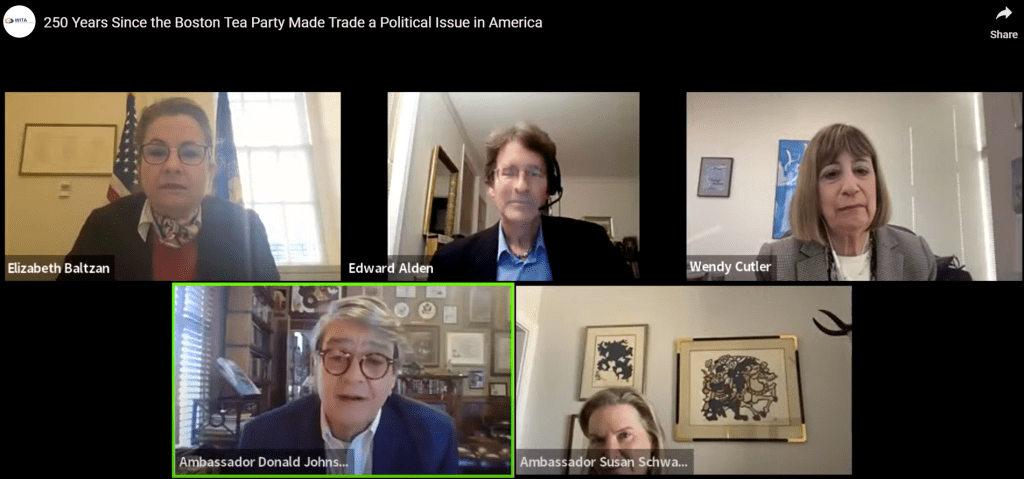
The Washington International Trade Association (WITA) hosted two panels last month to discuss changing attitudes toward trade in the 250 years since the Boston Tea Party. Taking part in the panel was University of Georgia School of Law alumnus and Director Emeritus of the law school’s Dean Rusk International Law Center, Ambassador C. Donald Johnson.
The two panels addressed the evolution of trade policy, trade’s present and future, and the role of the United States as a leader in global trade. The first panel (recording here), moderated by Edward Alden, Ross Dist Visiting Professor at Western Washington University and Bernard L. Schwartz senior fellow at the Council on Foreign Relations (CFR), featured the following speakers:
Elizabeth Baltzan, Senior Advisor, Office of the United States Trade Representative
Wendy Cutler, Vice President, Asia Society Policy Institute (ASPI), and Managing Director of the Washington, D.C. office; former Acting Deputy United States Trade Representative
Ambassador Donald Johnson, Director Emeritus, Dean Rusk Center for International Law and Policy, University of Georgia; former Chief Textile Negotiator, Office of the United States Trade Representative
Johnson’s comments contextualized the attitude towards trade during the era of the Boston Tea Party. He discusses the historical conflict between trade and labor, with roots in the Jefferson and Hamilton political philosophies, and moves through the industrialization of the 19th century.
Johnson’s book The Wealth of a Nation: a History of Trade Politics in America (Oxford University Press 2018) presents a history of trade politics from the 1790s through the Trump administration. He received the 2019 Certificate of Merit for High Technical Craftsmanship and Utility to Lawyers and Scholars (Honorable Mention) at the 113th American Society of International Law Annual Meeting, detailed in our previous post here.
Johnson served from 1998 to 2000 as Ambassador in the Office of the United States Trade Representative, and then specialized in international trade law as a partner at the Washington law firm Patton Boggs. Additionally, while serving from 1993 to 1995 as a U.S. Representative on behalf of Georgia’s 10th District, Johnson focused on national security and international economic policy, including legislation implementing North Atlantic Free Trade Agreement and the World Trade Organization. Johnson served as an Articles Editor for that journal while a student at the University of Georgia School of Law, from which he earned his J.D. in 1973. Thereafter, he studied at the London School of Economics and Political Science, earning an LL.M. degree in International Economic Law and International Relations.
Harlan Grant Cohen, who is Gabriel M. Wilner/UGA Foundation Professor in International Law and Faculty Co-Director of the Dean Rusk International Law Center here at the University of Georgia School of Law, took part earlier this month in a workshop at Temple University Beasley School of Law in Philadelphia.
Within the overall theme of “The Concept of Security in International Law,” the workshop brought together scholars from a range of fields in order to address shifting understandings of security in international law and foreign affairs, as well as how law can respond to these developments.
Professor Cohen also helped organize and edit the symposium, in which numerous scholars offer commentary on a 2021 American Journal of International Lawarticle by Shaffer, who is Chancellor’s Professor of Law and Political Science at the University of California-Irvine, and President-Elect of the American Society of International Law.
Georgia Law Professor Diane Marie Amann (above left), who is scheduled to deliver the keynote address, entitled No Exit at Nuremberg: The Postwar Order as Stage for 21st-Century Global Insecurity, during the session beginning at 9 a.m. GMT/4 a.m. Eastern on Thursday, March 31. Amann is Regents’ Professor of International Law, Emily & Ernest Woodruff Chair in International Law, and Faculty Co-Director of the Dean Rusk International Law Center at Georgia Law; served from 2012 to 2021 as International Criminal Court Prosecutor Fatou Bensouda’s Special Adviser on Children in & affected by Armed Conflict; and is a member of the Coordinating Committee of ESIL’s Interest Group on International Criminal Justice. She is writing a book, under contract with Oxford University Press, on lawyers and other women professionals at the first post-World War II international criminal trial, held from 1945 to 1946 in Nuremberg, Germany.
Lauren Brown (above right), who earned her Georgia Law J.D. degree magna cum laude and was elected to the Order of the Coif in 2019, will present Keys to the Kingdom: Export Controls and What They Really Mean at 1:30 p.m. GMT/8:30 a.m. Eastern on Wednesday, March 30, as part of a panel entitled “International Economic Law and New Frontiers of Global Security.” Brown, who is an Associate in the International Trade Practice at the Squire Patton Boggs law firm in Washington, D.C., also holds a master’s degree from the University of Edinburgh, Scotland, as well as a bachelor’s degree from the University of North Carolina at Chapel Hill.
Registration to attend this event, either in-person or online, is free and available here.
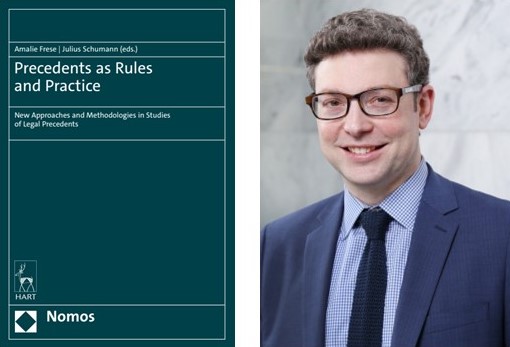
Harlan Cohen, who is Gabriel M. Wilner/UGA Foundation Professor in International Law and Faculty Co-Director of the Dean Rusk International Law Center here at the University of Georgia School of Law, has contributed a chapter entitled “Culture Clash: The Sociology of WTO Precedent” to a just-published essay collection.
Here’s the SSRN abstract for Professor Cohen’s chapter:
Thanks to the United States, the WTO Appellate Body can no longer hear appeals. Having blocked all appointments to the body, the United States has left its bench empty, with no members to fulfill its role. Among the United States’ justifications: The Appellate Body’s adoption of an apparent doctrine of precedent.
This chapter takes a deeper look at the fight over precedent at the WTO, both as a case study in the emergence and operation of precedent within international law and as a microcosm of the cultural conflicts playing out within the WTO. The chapter develops an account of precedent as a product of three overlapping, inter-dependent, and mutually constructed logics: (1) the jurisprudential, (2) the rational, and (3) the sociological. It then uses these three logics to retell the story of precedent at the WTO – the emerging patterns of argumentative practice, the Appellate Body’s adoption of a doctrinal test, and the escalating U.S. opposition to the “cogent reasons” standard that body applied. Seeing the fight over precedent as a function of all three logics reveals the real cultural fights for control of the WTO community of practice. Seeing that community of practice coalesce around and split over unwritten practices of precedent reveals how international law develops as much as a function of culture, training, and practice as of rules and power.





 exchange of notes