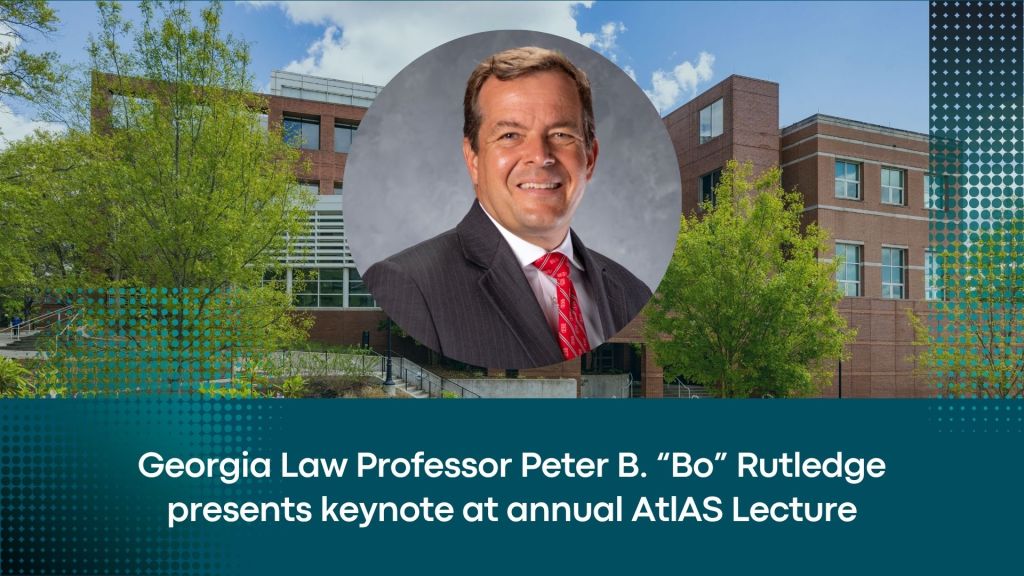
Georgia Law Professor Adam Orford presents at Climate Symposium in Germany

University of Georgia School of Law Professor Adam D. Orford presented in March at the Symposium on Just Transitions in the United States, UK, and the EU hosted by Indiana University School of Law at the European Gateway in Berlin, Germany. The symposium connected academics and social scientists for a conversation on “climate adaptation and the just transition in the United States, the United Kingdom, and European Union member nations.”

Below is a description of the symposium:

The purpose of this meeting is to connect invited scholars and practitioners writing on the topics of climate change and the just transition, broadly defined, with the goal of discussing recent developments in their respective jurisdictions and best practices for their research, as well as developing potential networks for collaboration. The day is built around brainstorming sessions and group activities to help foster conversation and possible collaborations.

Orford is an Assistant Professor of Law at the University of Georgia School of Law. His interdisciplinary research investigates legal and policy approaches to environmental protection, human health and wellbeing, and deep decarbonization of the United States economy. He also participates in collaborative research initiatives across UGA, including as the lead of the Georgia element of the National Zoning Atlas and as a participant in ongoing investigations into the legal, political, environmental and social dimensions of new energy manufacturing and emerging carbon removal technologies.

Georgia Law finishes near the top at Jessup international competition

Earlier this month, the University of Georgia School of Law finished in the top 32 teams out of 805 total teams representing 104 jurisdictions in the 2025 Philip C. Jessup International Law Moot Court Competition. This year’s team included students Dustin Batchelor (J.D. ’26), Grace Johnson (J.D. ’26), Marion Kronauge (J.D. ’26), Morgan Pfohl (J.D. ’26), and Ellis Schmitt (J.D. ’26). Jessup is the world’s largest moot court competition, bringing together students from across the globe to engage with pressing international legal challenges.

Georgia Law’s team advanced to the international rounds after winning the East Coast regional earlier this semester. Johnson and Schmitt also tied for ninth place in the individual oralist rankings.

Third-year students Joseph Colley, Katherine Lewis, and Brennan Rose served as student coaches, and Caleb Grant (J.D. ’23) served as alumni coach.

Bon voyage to students taking part in Georgia Law summer 2025 global initiatives

In summer 2025, the highest number of students in the past 10 years will travel abroad to participate in two global practice preparation offerings administered by the University of Georgia School of Law’s Dean Rusk International Law Center:

Global Governance Summer School

This year’s Global Governance Summer School will focus on comparative constitutional law. It is set to begin later this month, when students will travel to two cities in Belgium for a week of site visits and lectures led by Georgia Law’s Matthew I. Hall, Associate Professor of Law, as well as professors from partner university KU Leuven. The first week of this for-credit course also will include professional development briefings at the North Atlantic Treaty Organization (NATO), the European Parliament, the European Commission, the European Economic and Social Committee, private law firms, and NGOs.

Then, programming shifts to The Hague, Netherlands, where Hall will lead briefings at the International Criminal Court, the International Court of Justice, the Permanent Court of Arbitration, and the International Residual Mechanism for Criminal Tribunals. Center director Sarah Quinn and Global Practice Preparation Assistant Catrina Martin will provide logistical assistance throughout the program on the ground and in Athens, respectively.

A total of twenty students will participate in this year’s summer school, including:

Global Externships Overseas

Our Center’s Global Externship Overseas initiative, overseen by Center Associate Director Taher Benany, offers Georgia Law students the opportunity to gain practical work experience in a variety of legal settings around the world. This summer, nine students have opted to combine the GEO opportunity with their participation in GGSS: Nicholas Ames, Olivia Buckner, Isaac Clement, Megan Greeley, Stephanie Holterman, Laiba Noor, Jalyn Ross, Lionel Rubio, and Camille Weindorf.

A total of twenty-four Georgia Law students will pursue GEOs in practice areas such as privacy and technology law, environmental law, international arbitration, EU competition, cultural heritage and historic preservation, intellectual property, corporate law, and human rights law.

This year’s GEO class includes eighteen private-sector placements:

  • Annie Bordeaux (J.D. ’27) – MVKini; Mumbai, India
  • Meghan Brockman (J.D. ’27) – GreenCo SA; Buenos Aires, Argentina
  • Olivia Buckner (J.D. ’27) – Van Bael & Bellis; Brussels, Belgium
  • Nida Choudary (J.D. ’27) – Roudane & Partners Law Firm; Casablanca, Morocco
  • Carsen Christy (J.D. ’26) – Gleiss Lutz; Stuttgart, Germany
  • Isaac Clement (J.D. ’27) – PSA Legal; New Delhi, India
  • Margaret Farinella (J.D. ’27) – Bruchou & Funes; Buenos Aires, Argentina
  • Megan Greeley (J.D. ’26) – Bodenheimer; Cologne, Germany
  • Stephanie Holterman (J.D. ’27) – Honlet Legum Arbitration; Paris, France
  • Laiba Noor (J.D. ’27) – Gatti Pavesi Bianchi Ludovici; Milan, Italy
  • Franklin Phan (J.D. ’27) – KPMG; Ho Chi Minh City, Vietnam
  • Kara Reed (J.D. ’26) – Kuribayashi Sogo Law Office; Tokyo, Japan
  • Bailey Renfroe (J.D. ’26) – Alston & Bird; Brussels, Belgium
  • Jalyn Ross (J.D. ’27) – Bodenheimer; Cologne, Germany
  • Lionel Rubio (J.D. ’27) – Araoz y Rueda; Madrid, Spain
  • Casey Smith (J.D. ’26) – Berggren; Helsinki, Finland
  • Hope Thomas (J.D. ’27) – LNT & Partners; Ho Chi Minh City, Vietnam
  • Camille Weindorf (J.D. ’27) – Deloitte; Baku, Azerbaijan

These six students will work for public sector placements:

  • Nicholas Ames (J.D. ’27) – The International Institute for Justice and the Rule of Law; Valetta, Malta
  • Kellianne Elliott (J.D. ’26) – The Department of Conservation; Wellington, New Zealand
  • Amelia England (J.D. ’26) – eLiberare; Brasov, Romania
  • Olivia Haas (J.D. ’27) – The Department of Conservation; Wellington, New Zealand
  • Abigail Hagood (J.D. ’27) – The Antiquities Coalition; Washington, D.C.
  • Emma Hopkins (J.D. ’27) – No Peace Without Justice; Brussels, Belgium

More information on both of these Georgia Law initiatives here.

Georgia Law students attend 2025 ASIL Annual Meeting through professional development scholarships

This year, six University of Georgia School of Law students attended the 119th Annual Meeting of the American Society of International Law in Washington, D.C. This year’s ASIL Annual Meeting convened with the theme “Traditions and Transitions in International Law.”

Attendees included: Annie Bordeaux (J.D. ’27), Jack Buckelew (J.D. ’25), Eleanor Cox (J.D. ’26), Carolina Mares (J.D. ’25), Jalyn Ross (J.D. ’27), and Emma Whitmore (J.D. ’26). They received a Louis B. Sohn Professional Development Fellowship to support their attendance of this conference. Awarded by the law school’s Dean Rusk International Law Center, Sohn Fellowships enable students to attend professional development opportunities related to international law.

Each student attended numerous panel discussions addressing a range of topics in international law. Some students were able to meet with D.C.-based Georiga Law alumni/ae as well, including Caroline Bailey (J.D. ’24) and Sandon Fernandes (J.D. ’24).

Reflecting on her biggest takeaways from attending the conference, Bordeaux stated:

The speakers…offered a powerful reminder that, even amid global instability and the uneven application of the rule of law, international law still holds the potential to serve as a means of accountability. The insights shared by brilliant professors, leaders, and researchers substantiated the idea that the role of international law remains instrumental in addressing injustice and shaping governance.

Mares reflected on her favorite session from the conference:

During the session on Grotius’ Legacy: The 400th Anniversary of The Law of War and Peace, former Georgia Law Professor Harlan Cohen and fellow panelists offered a compelling and nuanced exploration of Hugo Grotius’ seminal 1625 treatise. The Law of War and Peace laid the groundwork for modern international law, illuminating the interrelationship between human rights and legal norms, the moral dimensions of law, and the idea of law as distinct from both power and religion. Gaining historical context for today’s legal frameworks was a powerful reminder of the foundational values and enduring principles that continue to guide and inspire practitioners in the field.

Buckelew illustrated the connection between attending this conference and his academic and professional goals:

Attending the ASIL Annual Meeting gave me clarity and encouragement at a pivotal moment in my legal education. Personally, it reminded me that I came to law school with the hope of engaging with serious global issues and to be part of a community that values legal principles as tools for progress. Professionally, it helped me envision a path where I can grow into expertise, not just through formal education, but through ongoing engagement with legal communities like ASIL and others.

To read prior posts about Georgia Law students using Sohn Fellowships to attend professional development opportunities, please click here and here.

Georgia Law Professor Christopher Bruner publishes article in Transnational Legal Theory

University of Georgia School of Law Professor Christopher M. Bruner published “Corporate Personhood, Corporate Rights, and the Contingency of Corporate Law” in the peer-reviewed journal Transnational Legal Theory (2025). The article was initially presented as a working paper at a conference titled “Decoding the Rights of Companies in the Technocene” at Lund University in Sweden.

Below is an abstract of the article:

Corporate personhood and corporate rights are co-constitutive in nature, meaning that they are mutually constructed – there is no singular, one-way causal path between a conception of corporate personhood and a conception of corporate rights. Consequently, modes of reasoning that purport to deduce the substance and extent of corporate rights from the mere fact of corporate personhood are logically circular. Although the relationship between corporate personhood and corporate rights is real and significant, this relationship cannot, in and of itself, comprehensively specify the content of corporate rights; their substance can only be specified by reference to external normative criteria. The upshot is that corporate law inevitably remains a socially and politically contingent field. Those advancing particular conceptions of corporate personhood and corporate rights should acknowledge the contingency of corporate law and present their preferred visions by reference to external normative criteria that they are prepared to acknowledge, describe, and defend.

Bruner is the Stembler Family Distinguished Professor in Business Law at the University of Georgia School of Law and serves as a faculty co-director of the Dean Rusk International Law Center. His scholarship focuses on corporate law, corporate governance, comparative law and sustainability.

Georgia Law Professor Amann presents “Child-Taking” at Yale University

Professor Diane Marie Amann recently presented her research on “Child-Taking” as a guest lecturer in a course on the Russo-Ukrainian War taught at Yale University this semester. Students from Yale’s law school, management school, and school of global affairs comprise the class, which is taught by Yale Law Professor Eugene R. Fidell and Margaret M. Donovan.

Amann is Regents’ Professor of International Law, Emily & Ernest Chair in International Law, and Faculty Co-Director of the Dean Rusk International Law Center here at the University of Georgia School of Law. She writes and teaches in areas including child and human rights, constitutional law, transnational and international criminal law, and global legal history.

Amann’s online guest lecture drew from her article, “Child-Taking,” soon to be published in the Michigan Journal of International Law. (Preprint draft available at SSRN.) As Amann theorizes it, child-taking occurs when a state or similarly powerful entity abducts children from their community and then endeavors to remake the children in its own image. This conduct, involving children taken from Ukraine, lies at the heart of the International Criminal Court warrants pending against President Vladimir Putin and another top Russian official. The article also examines other examples of the phenomenon, including the Nazis’ kidnappings of non-German children during World War II and the forced placement of Indigenous children into boarding schools in North America, Australia, and elsewhere.

Amann also has presented this scholarship at meetings of the American Society of International Law and at University College London Faculty of Laws and King’s College London Department of War Studies.

Consul General’s talk on Mexico’s federal lawsuit against arms makers opens 2022-2023 events calendar at Georgia Law’s Dean Rusk International Law Center

Our schedule of 2022-2023 events here at the University of Georgia School of Law Dean Rusk International Law Center opened yesterday with a compelling presentation by the Consul General of Mexico in Atlanta.

In a talk entitled “Institutional Structure of the U.S.-Mexico Relations and Key Bilateral Issues: Mexico’s Legal Case Against U.S. Gun Manufacturers,” Ambassador Javier Díaz de León began by outlining ways that Mexico and the United States – often along with their neighbor to the north, Canada – discuss and seek solutions to common problems.

One concern, of course, is security; in Mexico’s case, the southward flow of firearms and money that enable drug cartels to operate. After providing statistics on the high proportion of weapons confiscated in Mexico that have been manufactured or distributed in the United States, Ambassador Díaz turned to what he rightly called the “landmark” step that his government took on August 4, 2021, when it filed Estados Unidos Mexicanos v. Smith & Wesson Brands et al. in the U.S. District Court for the District of Massachusetts. That civil tort suit alleges that Smith & Wesson and 10 other firearms manufacturers or distributors unlawfully permitted U.S. weapons to enter Mexico, where firearms are, for the most part, prohibited. According to Ambassador Díaz, a federal judge heard argument on defendants’ motion to dismiss last spring, but has not yet ruled on that motion, and discovery is under way.

Following his presentation, Georgia Law Regents’ Professor Diane Marie Amann, one of our Center’s Faculty Co-Directors, moderated questions from the audience, composed mostly of students.

This marked the ambassador’s second visit to our University of Georgia School of Law Dean Rusk International Law Center; in 2018, also as part of our Consular Series, he spoke on “Mexico’s Relation with Georgia: Connecting Paths.”

Cosponsoring yesterday’s event with our Center were the Latin American & Caribbean Studies Institute at the University of Georgia, as well as two Georgia Law student groups, the Hispanic Law Students Association and the International Law Society.

Follow this webpage or our Twitter feed to learn about upcoming events.

Georgia Law Professor Christopher Bruner publishes in Yale Law Journal on corporate governance, sustainability

Christopher M. Bruner, the Stembler Family Distinguished Professor in Business Law here at the University of Georgia School of Law, has published “Corporate Governance Reform and the Sustainability Imperative” at 131 Yale Law Journal 1217 (2022).

Bruner argues that achieving sustainability will require reformulating corporate governance debates and revisiting features of the corporate form that incentivize companies to engage in excessive risk-taking and to externalize environmental and social costs onto society and the world. His Feature critiques the predominantly disclosure-based proposals garnering the most attention in the United States, contrasting them with more fundamental developments in other countries including France, Germany, Norway, South Africa, and the United Kingdom.

Here’s the abstract:

“Recent years have witnessed a significant upsurge of interest in alternatives to shareholder-centric corporate governance, driven by a growing sustainability imperative—widespread recognition that business as usual, despite the short-term returns generated, could undermine social and economic stability and even threaten our long-term survival if we fail to grapple with associated costs. We remain poorly positioned to assess corporate governance reform options, however, because prevailing theoretical lenses effectively cabin the terms of the debate in ways that obscure many of the most consequential possibilities. According to prevailing frameworks, our options essentially amount to board-versus-shareholder power, and shareholder-versus-stakeholder purpose. This narrow perspective obscures more fundamental corporate dynamics and potential reforms that might alter the incentives giving rise to corporate excesses in the first place.
“This Feature argues that promoting sustainable corporate governance will require reforming fundamental features of the corporation that incentivize excessive risk-taking and externalization of costs, and presents an alternative approach more conducive to meaningful reform. The Feature first reviews prevailing conceptions of the corporation and corporate law to analyze how they collectively frame corporate governance debates. It then presents a more capacious and flexible framework for understanding the corporate form and evaluating how corporate governance might be reformed, analyzing the features of the corporate form that strongly incentivize risk-taking and externalization of costs, discussing the concept of sustainability and its implications for corporate governance, and assessing how the corporate form and corporate law might be re-envisioned to produce better results.
“The remainder of the Feature uses this framework to evaluate the proposals garnering the most attention today, and to direct attention toward the broader landscape of reforms that become visible through this wider conceptual lens. Recent reform initiatives typically rely heavily on disclosure, which may be an essential predicate to meaningful reform, yet too often is treated as a substitute for it. The Feature then assesses more ambitious reform initiatives that re-envision the board of directors, and rethink underlying incentive structures—including by imposing liability on shareholders themselves, in limited and targeted ways, to curb socially harmful risk-taking while preserving socially valuable efficiencies of the corporate form. The Feature concludes that until we scrutinize the fundamental attributes of the corporate form and the decision-making incentives they produce by reference to long-term sustainability, effective responses to the interconnected environmental, social, and economic crises we face today will continue to elude us.”

The full article is available here.