Georgia Law Professor Diane Marie Amann presents on Nuremberg trial at the Lauterpacht Centre for International Law, University of Cambridge

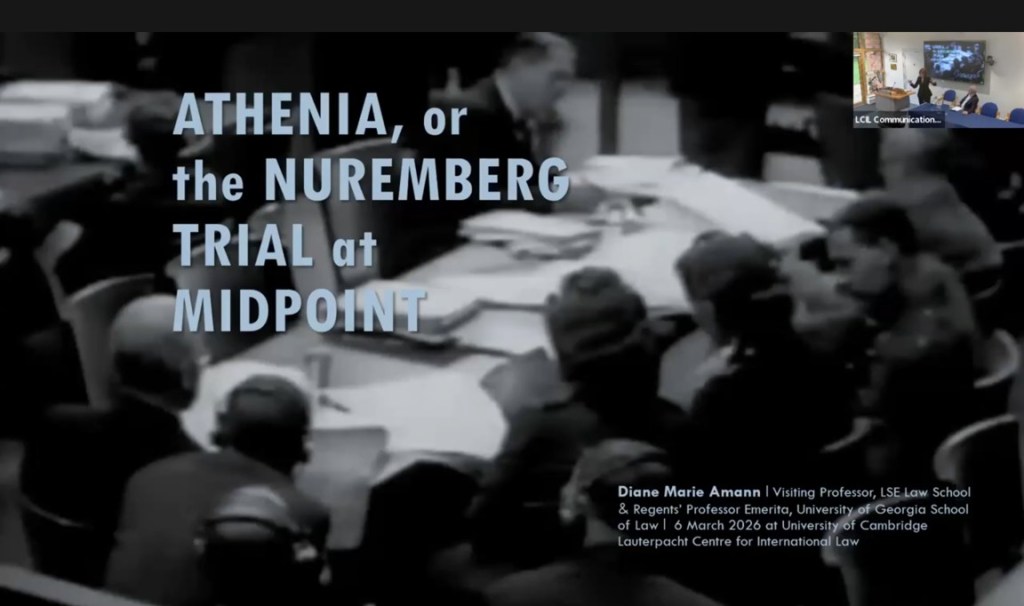
University of Georgia School of Law Professor Emerita Diane Marie Amann recently presented “Athenia, or the Nuremberg Trial at Midpoint” at the Lauterpacht Centre for International Law, University of Cambridge, United Kingdom.

Amann focused on events 80 years ago this spring, when the landmark Trial of Major War Criminals before the International Military Tribunal was at its halfway point. The British prosecution team’s evidence against German naval officers, as well as certain witnesses called by the French and Soviet prosecution teams, were featured.

Lauterpacht Centre Fellow John Barker chaired the lunchtime lecture, which may be viewed on YouTube or listened to via Spotify, Apple, and Captivate podcasts.

Amann, who is Regents’ Professor Emerita and Emily & Ernest Woodruff Chair in International Law Emerita at Georgia Law, served for many years as a Faculty Co-Director of our Dean Rusk International Law Center. She is writing a book on lawyers and other women professionals at the first Nuremberg trial.

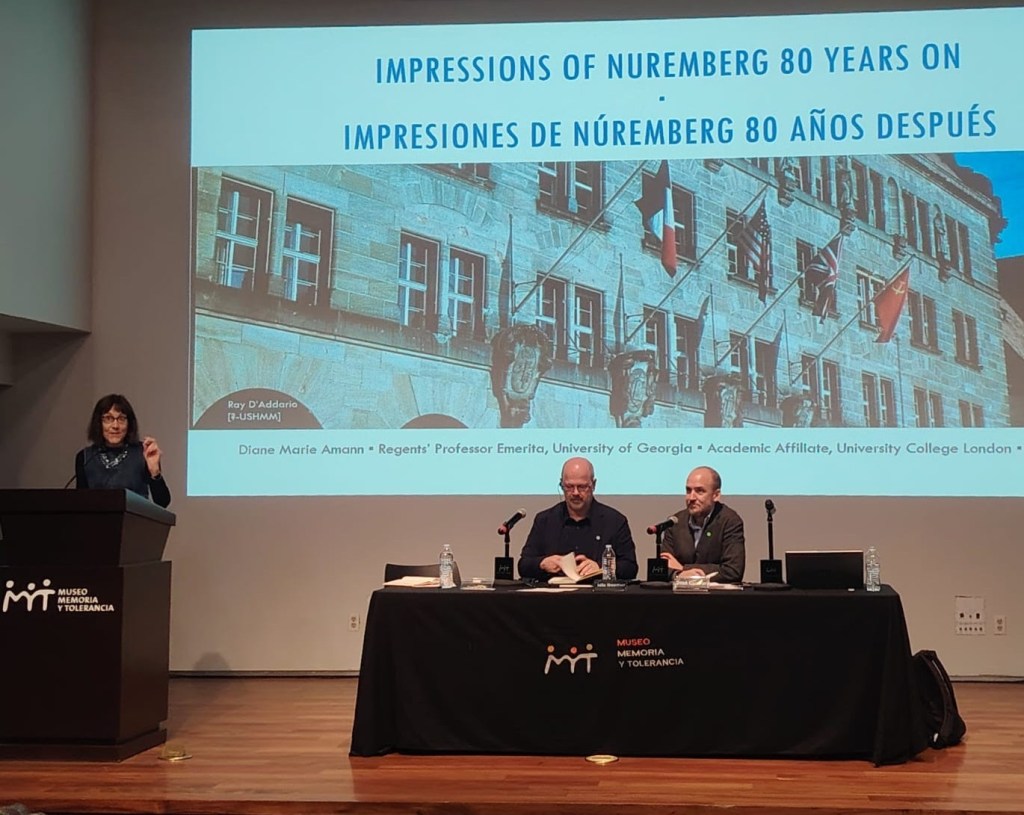
Georgia Law Professor Diane Marie Amann presents on Nuremberg trial at Mexico City museum conference

University of Georgia School of Law Professor Emerita Diane Marie Amann recently presented “Impressions of Nuremberg 80 Years On – Impresiones de Núremberg 80 años después” as part of “De Núremberg a Buenos Aires: Legados de la justicia penal internacional y el futuro de la rendición de cuentas transnacional,” an international conference at Museo Memoria y Tolerancia in Mexico City, Mexico.

Amann examined legacies of the year-long war crimes trial which took place soon after World War II in Nuremberg, Germany, before an International Military Tribunal established by Britain, France, the Soviet Union, and the United States. After discussing some lesser known aspects, such as the roles of persons not affiliated with one of those four Allied states, Amann considered contemporary legacies of the landmark trial.

The University of Texas at Dallas joined the Museo Memoria y Tolerancia in cosponsoring the two-day conference.

Amann, who is Regents’ Professor Emerita and Emily & Ernest Woodruff Chair in International Law Emerita at Georgia Law, served for many years as a Faculty Co-Director of our Dean Rusk International Law Center. At present she is an Academic Affiliate at University College London Faculty of Laws.

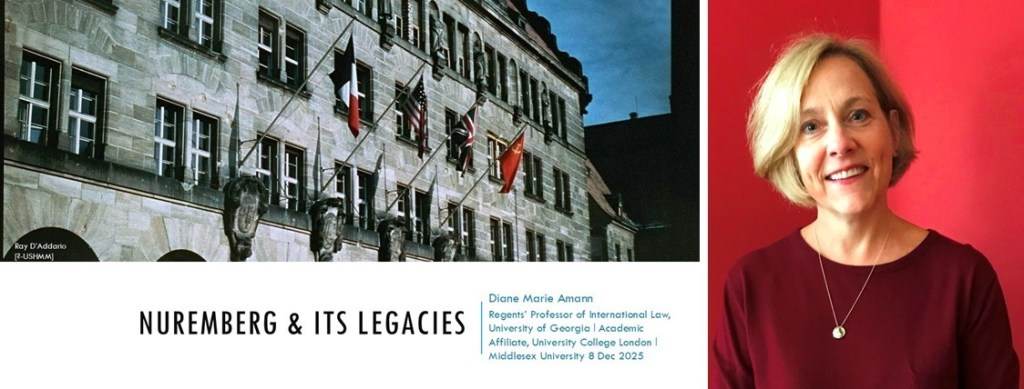
Georgia Law Professor Diane Marie Amann presents on Nuremberg trial at London’s Middlesex University

University of Georgia School of Law Professor Diane Marie Amann recently presented “Nuremberg and Its Legacies” as part of a doctoral students’ seminar at Middlesex University School of Law in London.

Amann provided an overview of the year-long post-World War II war crimes trial held in Nuremberg, Germany, before an International Military Tribunal established by Britain, France, the Soviet Union, and the United States. After discussing how the 1945-1946 trial unfolded, she considered the continued impact of the trial with regard to issues like the death penalty, the abolition of government leaders’ immunity from prosecution, and the international law duty to refuse to obey illegal orders.

Leading the two-day seminar were Middlesex Law professors William A. Schabas and Giulia Pecorella.

Amann is Regents’ Professor of International Law, Emily & Ernest Woodruff Chair in International Law, and a Faculty Co-Director of our Dean Rusk International Law Center here at Georgia Law. During her current research-intensive semester, she is an Affiliate Academic at University College London Faculty of Laws. She has published several essays on the Nuremberg era and is writing a book on lawyers and other women professionals at that first trial.

Georgia Law Professor Amann joins panel on paths to accountability in conference cosponsored by law schools at Notre Dame and Ukrainian Catholic universities

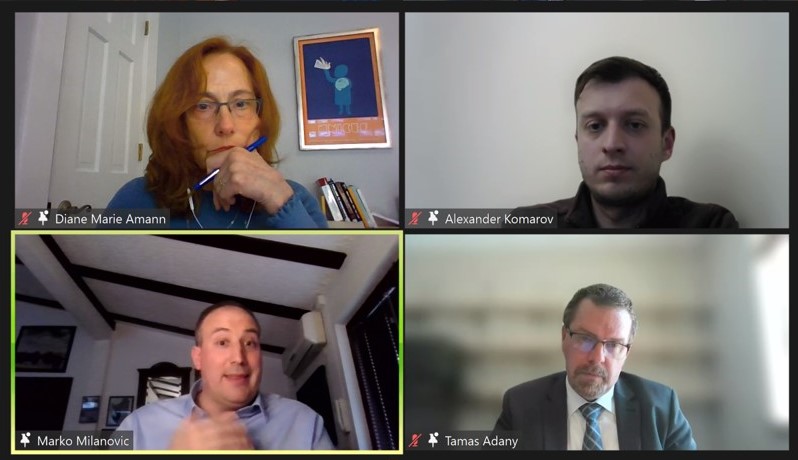
Diane Marie Amann, who is Regents’ Professor of International Law, Emily & Ernest Woodruff Chair in International Law, and Faculty Co-Director of the Dean Rusk International Law Center here at the University of Georgia School of Law, spoke yesterday at “Legal Challenges Posed by the Large-Scale Russian Invasion of Ukraine,” a conference cosponsored by the University of Notre Dame Law School and the Ukrainian Catholic University Law School.

The latter university is located in Lviv, Ukraine – also the birthplace of the late Louis B. Sohn, who was the inaugural holder of Georgia Law’s Woodruff Chair in International Law.

Professor Amann took part in a panel entitled “Prosecution,” along with Marko Milanovic, Professor of Public International Law at the University of Nottingham School of Law in the United Kingdom and Oleksandr Komarov of the Ukrainian Catholic University Law School. Moderating was Tamás Ádány, Fulbright Visiting Professor at Notre Dame Law this semester, and also Head of the Department of International Law at Pázmány Péter Catholic University in Budapest, Hungary.

Discussed in their panel were legal frameworks and forums that hold potential for providing measures of accountability for violations of international law reported since Russia’s February 24, 2022, invasion of Ukraine. These include the illegal resort to armed force – that is, the crime of aggression – as well as atrocity crimes committed once the armed conflict had begun. (Related prior posts here, here, here, and here.)

Participants in the online conference’s two other panels examined additional aspects of the Ukraine-Russia conflict; namely, challenges to the collective security structure, and the use of economic sanctions by states and international organizations.

Georgia Law Professor Amann post proposes considering new war crimes commission to investigate in Ukraine

Referring to Russia’s invasion last month of Ukraine, as well as the brutal attacks that followed, Georgia Law Professor Diane Marie Amann published “Time for a New War Crimes Commission?” Friday at Articles of War, the blog of the Lieber Institute for Law & Warfare, U.S. Military Academy West Point.

Amann, who is Regents’ Professor of International Law, Emily & Ernest Woodruff Chair in International Law, and Faculty Co-Director of the Dean Rusk International Law Center here at the University of Georgia School of Law, began by outlining the limitation that international law rules place on existing tribunals, such as the International Criminal Court, International Court of Justice, and European Court of Human Rights, as well as a proposed special tribunal on the crime of aggression. Having thus identified gaps in accountability, she wrote:

“Now and going forward, accountability could be enhanced by setting up a clearinghouse for gathering, cataloging, and preserving evidence, with an aim to eventual prosecutions in multiple national, regional, and international systems. The idea is not new; indeed, a useful model may be found in a Second World War-era institution known as the United Nations War Crimes Commission (UNWCC).”

Her post proceeded to sketch the history of this 1943-1948 commission, as well as its strengths and weaknesses. She concluded by calling for a body that would be empowered to carry out the UNWCC’s “core function”:

“specifically, the conduct of investigations aimed at preserving evidence and facilitating criminal prosecutions of suspects at all levels, for all potential offenses, and before any number of national, regional, and international systems willing and able to afford the persons they accuse a full and fair trial.”

The full Articles of War post is here.

Georgia Law Professor Amann takes part in launch of NGO report documenting crimes against children in Syria

Professor Diane Marie Amann, the Emily & Ernest Woodruff Chair in International Law and Faculty Co-Director of the Dean Rusk International Law Center here at the University of Georgia School of Law, took part last Friday in the launch of a report on crimes against and affecting children in Syria.

“Children of Syria – The Lost Hope,” was hosted by the Syrian Network for Human Rights, a nongovernmental organization that monitors, documents, and maintains a database of human rights violations in Syria, the site of a nearly ten-year-old conflict. The organization issued its Ninth Annual Report on Violations against Children in Syria (above left) on World’s Children Day, the day in November that marks the anniversary the adoptions by the UN General Assembly of the 1959 Declaration of the Rights of the Child and the 1989 Convention on the Rights of the Child.

Participants in last week’s event discussed the Ninth Report, which stated that the Syrian conflict had claimed nearly 30,000 children between March 2011 and January 2021 – nearly 200 of them as a result of torture. Additional harms, many of which may constitute war crimes or crimes against humanity, documented include arrest and detention of children, forcible disappearance, attacks on schools and deprivation of education, and recruitment and use by armed forces.

Professor Amann, an expert in international criminal law and child rights, joined a panel discussing these findings, their impact on children and society at large, and avenues for redress and accountability. Amann said that the Ninth Report described conduct

“that constitutes both systematic violations of human rights in many different sectors as well as international crimes as articulated in the statutes of multiple tribunals and recognized as customary international law.”

She further outlined treaties and forums through which such conduct might be addressed.

Also speaking at the event, which is archived and available for viewing here, were: Fadel Abdul Ghany, Chairman of the Syrian Network for Human Rights; Martin Leeser, a member of the Syria team at the German Embassy in Beirut, Lebanon; Dr. Troels Gauslå Engell, Senior Stabilisation Advisor on Syria to the Danish Ministry of Foreign Affairs; Paula Sastrowijoto, Deputy Syria Envoy at the Netherlands Ministry of Foreign Affairs; Lina Biscaia, Senior Legal Officer, Sexual and Gender-Based Crimes and Crimes against Children Unit of the UN Investigative Team for Accountability of Da’esh/ISIL; Javier Perez Salmeron of the Justice Rapid Response Child Rights Expert Roster; and Valentina Falco, Team Leader-Child Protection, UN Department of Peace Operations.

Georgia Law Professor Amann presents on sovereignties, Nuremberg woman in online Global History seminar

In this post Professor Diane Marie Amann, the Emily & Ernest Woodruff Chair in International Law and Faculty Co-Director of our Dean Rusk International Law Center here at the University of Georgia School of Law, discusses her most recent presentation, at an innovative online seminar.

What an honor to present my work in progress, “Intersectional Sovereignties: Dr. Aline Chalufour, Woman at Nuremberg – and at Paris, Ottawa, and Dalat” last week in “Global History and International Law”, a months-long seminar under way online.

Organizer of this superb scholarly offering is Dr. Anne-Sophie Schoepfel of the Institut d’études politiques de Paris, better known as SciencesPo. Her affiliation struck me as serendipitous, given that the subject of my paper was a graduate of SciencesPo. Born in 1899, Chalufour was also the 6th woman ever to earn a Ph.D. in international law from the University of Paris. In 1945-1946, she was the only woman lawyer on the French team that joined U.S., British, and Soviet allies in prosecuting vanquished Nazi leaders at Nuremberg.

Chalufour is one of the women on whom I’m focusing in my book-length study of women’s roles at that first Nuremberg trial, before the International Military Tribunal. But the richness of her experiences inspired this separate article.

Among the other highlights in Chalufour’s 90-year life: practice before the Paris Bar; activism in national and international feminist groups; teaching at colonial schools in what’s now Vietnam; serving de Gaulle’s Fighting French as a propagandist in Canada; gathering evidence about war crimes from liberated ex-detainees; taking part as the only French prosecutor in Britain’s first trial on Ravensbrück, a Nazi concentration camp for women; and, starting a few years after Nuremberg, service as a national judge.

My paper considers these episodes in light of of 3 theorizations: 1st, the shared sovereignty of the post-World War periods; 2d, sovereignty dynamics in colonial and imperial sites; and 3d, sovereignties of the person, imagined and corporeal. The paper then examines interrelations among these 3.

Serving as my discussant at last Wednesday’s session was Dr. George Giannakopoulos of King’s College London and NYU London. Numerous other participants offered valuable comments.

This was the 5th session in the seminar, which is slated to run through June 24 and has attracted law and history scholars from Asia and Latin America as well as Europe and North America. Next up, at 3 pm EDT this Wednesday, May 20, are 2 papers within the umbrella theme “Imperial Origins of the World Order”; details here.

What’s more, in due course Dr. Schoepfel and her SciencesPo colleagues are posting edited podcasts of each session. Already available at the seminar’s website and its YouTube channel:

  • “Epistemic Communities in Exile: Coining ‘Crimes against Humanity’ at London, 1940-45” by Dr. Kerstin von Lingen of the University of Vienna, Austria and author of a new journal article on this subject, as well as ‘Crimes against Humanity’. Eine Ideengeschichte der Zivilisierung von Kriegsgewalt 1864-1945 (Paderborn 2018), a monograph soon to be available in English. Discussants were Dr. Barak Kushner of the University of Cambridge, England, and Dr. Sabina Ferhadbegović of Imre Kertész Kolleg Jena, Germany.
  • “Genocide in Historical Perspective. The Language of Trangression” by Dr. Dirk Moses, of the University of Sydney, Australia, and author of The Problems of Genocide. Permanent Security and the Language of Transgression (forthcoming Cambridge University Press). Discussant was Dr. Charles Maier of Harvard University.
  • “The Nuremberg Moment. International Trial, American Lawyers and the Racial Question” by Dr. Guillaume Mouralis of Centre Marc Bloch in Berlin, and author of Le Moment Nuremberg. Le procès international, les lawyers et la question raciale (Presses de Sciences Po 2019). Discussant was Dr. Elizabeth Borgwardt of Washington University in St. Louis.

The full list of seminar participants is here; full schedule and registration information, here.

(cross-posted from Diane Marie Amann blog)
Georgia Law Professor Diane Marie Amann on her article, in International Review of the Red Cross, on ICC OTP Policy on Children, accountability for conflict-related crimes against children

In this post Professor Diane Marie Amann, the Emily & Ernest Woodruff Chair in International Law and Faculty Co-Director of our Dean Rusk International Law Center here at the University of Georgia School of Law, discusses her most recent article related to the effects on children of armed conflict and similar extreme violence.

Very pleased to announce the publication of my new article, “The Policy on Children of the ICC Office of the Prosecutor: Toward greater accountability for crimes against and affecting children.”

As indicated in the just-before-publication version that I’ve posted at SSRN, the International Review of the Red Cross placed this article online last month, on February 21. Currently, that published version is available to Cambridge Core subscribers at a First View page; once it appears in print, in a special issue on “Children and War,” it will be freely accessible at the Review‘s website.

Here’s the abstract:

The Policy on Children published by the International Criminal Court Office of the Prosecutor in 2016 represents a significant step toward accountability for harms to children in armed conflict and similar extreme violence. This article describes the process that led to the Policy and outlines the Policy’s contents. It then surveys relevant ICC practice and related developments, concluding that despite some salutary efforts, much remains to be done to recognize, prevent and punish the spectrum of conflicted-related crimes against or affecting children.

This article represents my latest effort to assist in raising awareness and developing strategies respecting children and conflict (prior posts). It’s an effort in which I’ve been deeply involved since my 2012 appointment as the International Criminal Court Prosecutor’s Special Adviser on Children in and affected by Armed Conflict.

Central to this effort was the multiyear process of researching and drafting, along with an Office of the Prosecutor working group and in consultation with others, of the document published in 5 languages and launched in November 2016 as the Policy on Children. Other aspects have included:

Happy to provide further details. And as always, comments welcome.

(Cross-posted from Diane Marie Amann blog)
2019 Global Governance Summer School concludes with briefings at the International Court of Justice and the International Criminal Court

THE HAGUE – On this final day of the 2019 Global Governance Summer School, students visited two preeminent international tribunals — the International Court of Justice and the International Criminal Court — for high level briefings. They were also treated to a visit from Dr. Kaitlin Ball (JD ’14), a Georgia Law alumna who recently finished a PhD at Cambridge and is living in Europe.

The group started the day at the International Court of Justice (ICJ) for an audience with Hendrik Denys, law clerk to the Honorable Joan Donoghue, the American judge on the International Court of Justice. Mr. Denys, an alumnus of our partner school, KU Leuven, spoke with students about the history of the Peace Palace, the structure and procedure of the Court, and several representative decisions of the ICJ’s jurisprudence. He also provided advice for preparing a career in international law.

In the afternoon, the group visited the International Criminal Court (ICC), located on the dunes near The Hague’s North Sea coast. Student first had a meeting with Prosecutor Fatou Bensouda, for whom our summer school’s co-director, Georgia Law Professor Diane Marie Amann, serves as Special Adviser on Children in & affected by Armed Conflict. Bensouda described her own path to practicing international criminal law. While acknowledging the barriers to achieving justice, she expressed the urgency of continuing the effort, on behalf of global society as well as the victims of international crimes.

The second audience at the ICC was with the Honorable Kimberly Prost of Canada, who serves as a Judge in the Trial Division. Judge Prost discussed the history of the Court and the many of the challenges facing it. She also emphasized the important concept of complementarity in regards to the ICC’s relationship to national courts.

Students also had the opportunity to view the confirmation of charges against Al Hassan, who is suspected of war crimes and crimes against humanity allegedly committed in 2012 and 2013 in Timbuktu, Mali. During the portion of the hearing that time permitted the group to observe, students heard from one of the Legal Representatives of the Victims, who emphasized the impact of the alleged crimes.

All in all, it was a great day, a successful trip, and we look forward to returning next year!

On Holocaust Remembrance Day, thanks to archives preserving histories of post-WWII war crimes trials: Amann


LOS ANGELES – On this International Holocaust Remembrance Day, I am honored to be spending this month at the USC Shoah Foundation, reviewing testimonies of persons who did their part to set right one of history’s terrible wrongs.

Seventy-three years ago today, Soviet troops liberated Auschwitz-Birkenau, the infamous Nazi concentration camp located about 45 miles west of Kraków, Poland. Liberations of other camps by other Allied forces soon followed; among them, the U.S. liberation of Buchenwald on April 11, 1945, and the British liberation of Bergen-Belsen 4 days later.

Sixty years later, a 2005 U.N. General Assembly resolution set this date aside for commemoration of World War II atrocities; to quote the resolution, of

“… the Holocaust, which resulted in the murder of one third of the Jewish people, along with countless members of other minorities …”

The resolution further:

  • honored “the courage and dedication shown by the soldiers who liberated the concentration camps”;
  • rejected “any denial of the Holocaust as an historical event”;
  • envisaged the Holocaust as “a warning to all people of the dangers of hatred, bigotry, racism and prejudice”;
  • denounced “all manifestations of religious intolerance, incitement, harassment or violence against persons or communities based on ethnic origin or religious belief, wherever they occur”; and
  • encouraged initiatives designed to “inculcate future generations with the lessons of the Holocaust in order to help to prevent future acts of genocide.”

Among the many such initiatives are memorial centers and foundations throughout the world – 2 of which have helped me in my own research into the roles that women played during postwar international criminal trials at Nuremberg.

In December, the Holocaust Memorial and Tolerance Center of Nassau County, located in Glen Cove, New York, opened its archives to me. Special thanks to Helen  Turner, archivist and Director of Youth Education, for her assistance.

This month, as the inaugural Breslauer, Rutman and Anderson Research Fellow, I am in residence at the University of Southern California, examining documents in USC Shoah Foundation’s Visual History Archive. It has been a fruitful and moving scholarly experience, and I look forward to sharing my research at a public lecture on campus at 4 p.m. this Tuesday, Jan. 30 (as I was honored to do last week at UCLA Law’s Promise Institute for Human Rights; video here). Special thanks to all at the foundation’s Center for Advanced Research – Wolf Gruner, Martha Stroud, Badema Pitic, Isabella Evalynn Lloyd-Damnjanovic, and Marika Stanford-Moore – and to the donors who endowed the research fellowship. (Fellowship info here.)

As reflected in the 2005 General Assembly resolution, the work of such institutions helps to entrench – and to prevent backsliding from – states’ promises to ensure and respect human rights and dignity norms, set out in instruments like the 1945 Charter of the United Nations, the 1948 Convention on the Prevention and Punishment of Genocide, the 1948 Universal Declaration of Human Rights, and the 1966 International Covenant on Civil and Political Rights. To this list I would add the many documents establishing international criminal fora to prosecute persons charge with violating such norms – from  the Nuremberg-era tribunals through to today’s International Criminal Court.

(Cross-posted from Diane Marie Amann; image credit)