Georgia Law hosts roundtable discussion for 2024 Mandela Fellows

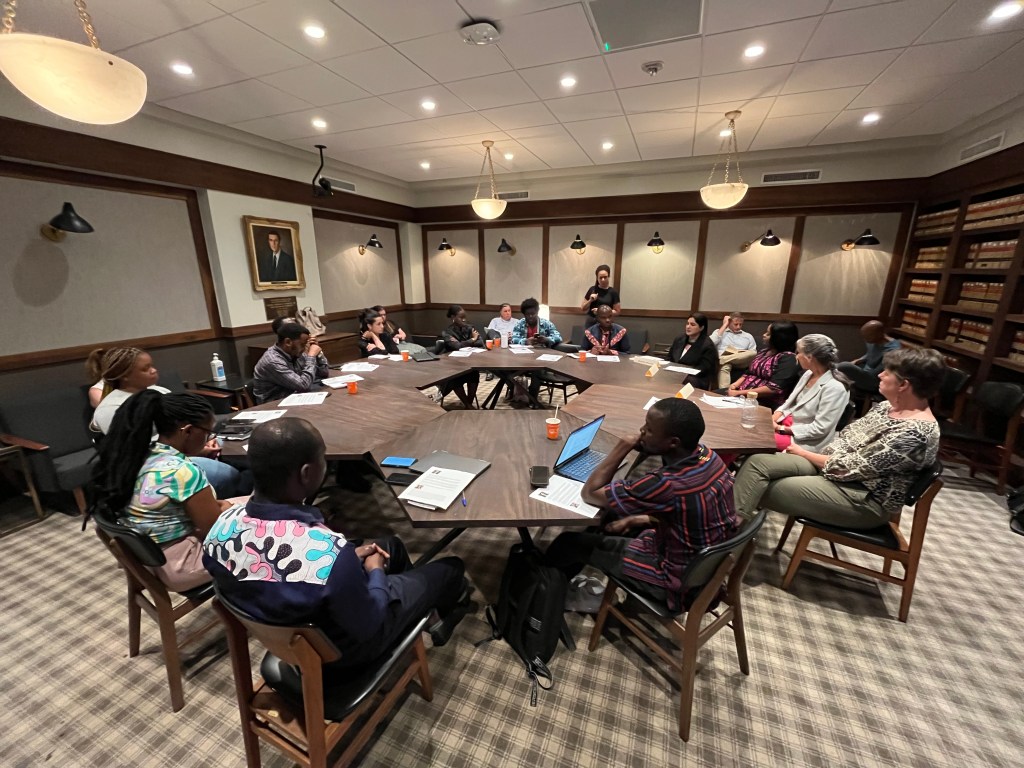
This month, a group of participants from the Mandela Washington Fellowship for Young African Leaders visited the University of Georgia School of Law for a roundtable discussion as part of their 6-week program at the university. The Fellows met with Christine M. Scartz, Clinical Associate Professor & Jane W. Wilson Family Justice Clinic Director; Joan Prittie (J.D. ’93), Executive Director of Project Safe; and two LL.M. alumnae, including Lydia Lartey (LL.M., ’24), a Court Appointed Special Advocate and former Mandela Fellow.

The 10 Fellows in attendance have work experience in anti-human trafficking, advocacy for women and girls, human rights, and refugee and victim assistance, among other topics. A total of 10 countries were represented in this group: The Republic of Congo, Ethiopia, Mali, South Africa, Zambia, Zimbabwe, Kenya, Burkina Faso, Uganda, and the Ivory Coast.

Scartz, Prittie, and Lartey began the roundtable by discussing their respective backgrounds and work, and then answered the Fellows’ questions. This is the second year that the law school has hosted a group of Fellows.

The Mandela Washington Fellowship for Young African Leaders is the flagship program of the U.S. government’s Young African Leaders Initiative (YALI) and sponsored by the U.S. Department of State. Since 2014, nearly 4,200 young leaders from every country in Sub-Saharan Africa have participated in the Fellowship. Mandela Washington Fellows, between the ages of 25 and 35, are accomplished innovators and leaders in their communities and countries. 

In 2019, UGA became a Fellowship Institute Partner and hosted its first cohort of Fellows on the UGA campus. The Mandela Washington Fellowship is delivered through a collaborative effort between the Office of Global Engagement, the J.W. Fanning Institute for Leadership Development, and the African Studies Institute at Franklin College.
LL.M. student N’Guessan Kouame contributes to World Bank report

University of Georgia School of Law LL.M. student, N’guessan “Clément” Kouame, contributed to the most recent World Bank Report for Women, Business, and the Law (WBL) released on March 2. He served as a panelist contributor for Côte d’Ivoire, West Africa, reviewing the legal framework and landscape of the country regarding the improvement of women’s rights and women’s empowerment.

Women, Business and the Law (WBL) is a World Bank Group project collecting data on the laws and regulations that affect women’s economic opportunity. Since 2009, WBL has been enhancing the study of gender equality and informing discussions on improving women’s economic opportunities and empowerment. This is the second year in a row that Kouame will contribute to the WBL’s annual report. He provides sources, laws, and regulations to corroborate his answers and make recommendations and comments.

From the report’s overview:

Women, Business and the Law 2024 is the tenth in a series of annual studies measuring the enabling environment for women’s economic opportunity in 190 economies.

This edition of the report updates the Women, Business and the Law 1.0 index of eight indicators, structured around women’s interactions with the law as they begin, progress through, and end their careers: Mobility, Workplace, Pay, Marriage, Parenthood, Entrepreneurship, Assets, and Pension.

Women, Business and the Law 2.0 sets a new frontier for measuring the environment for women’s economic inclusion across three pillars: legal frameworks, measuring laws; supportive frameworks, measuring policy mechanisms to implement laws; expert opinions, shedding light on experts’ perception of women’s outcomes.

Women, Business and the Law 2.0 also introduces two new indicators: Safety, measuring frameworks addressing violence against women, and Childcare, measuring frameworks for the availability, affordability and quality of childcare.

Data in Women, Business and the Law 2024 are current as of October 1, 2023. By examining laws and policy mechanisms affecting the economic decisions women make as they go through different stages of their working lives, as well as the opinions of experts on the legal environment for women’s economic inclusion, Women, Business and the Law makes a contribution to policy discussions about the state of women’s economic opportunities.