Georgia Law 2L Erin Nalley shares her Global Externship experience in New Zealand

Today, we welcome a guest post by Erin Nalley, a member of the University of Georgia School of Law class of 2025. Through the Global Externships Overseas (GEO) initiative, Erin was able to extern with the Department of Conservation in Wellington, New Zealand in summer 2023.
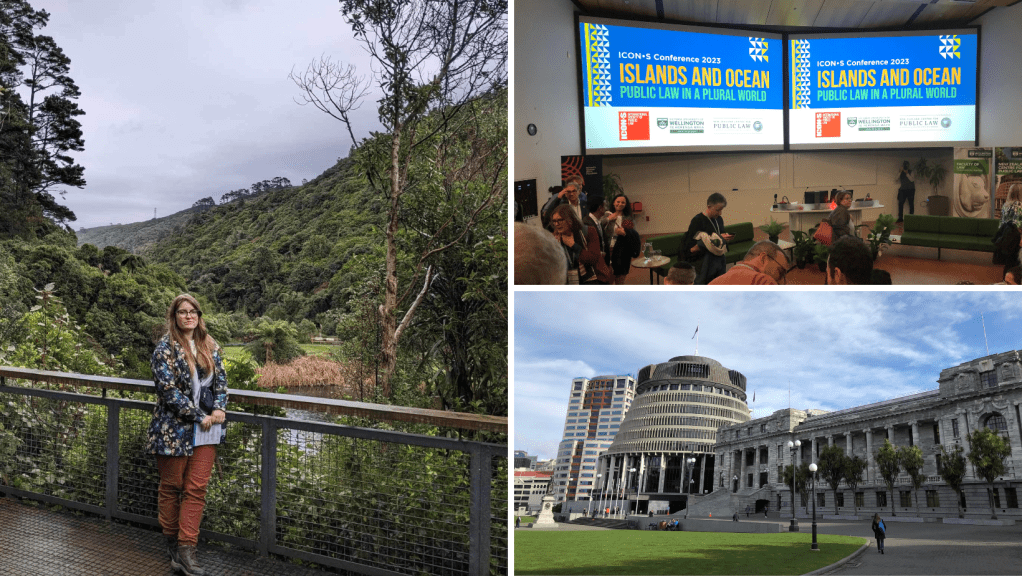
When I first landed in New Zealand last summer, I was both exhausted and excited for what the next few months would bring me. I had just finished the University of Georgia School of Law’s Global Governance Summer School, and I was worn out from the travel from Amsterdam to Atlanta to Auckland to my final destination of Wellington, New Zealand. Wellington is where I would spend the rest of my summer as a legal extern with the Department of Conservation through the Global Externships Overseas initiative.

My work in New Zealand involved picking apart the World Heritage Convention text. Specifically, I evaluated what language made the text binding and what policy documents and case law were made binding by the text itself. I also worked with case studies involving New Zealand land that was in conservation under the World Heritage Convention. I worked alongside lawyers within my department, lawyers who worked in foreign affairs, and even those who worked directly with the New Zealand Parliament. I designed my research to act as a guide for the international team at the Department of Conservation to assist in keeping New Zealand in compliance with the World Heritage Convention. As part of my externship, I was able to visit the New Zealand Parliament and observe members debating new legislation. I was also given the opportunity to attend the ICON-S Public International Law conference held in Wellington.

Along with my work experience, I had the opportunity to engage in the culture of my host community. I was in New Zealand during Matariki, the Māori New Year. Here, I saw a haka, a ceremonial performance within the Māori culture that is often performed at important events. I visited the Te Papa Tongarewa Museum and learned about the history and culture of the people of New Zealand. I tried yellow kiwi fruit, manuka honey, Wellington chocolate, and New Zealand pies. I also visited Zealandia, where part of the forest is fenced in to keep predators out and to provide the native birds within the sanctuary a place to thrive and recover their populations. Finally, one of my favorite parts of the trip was a drive to Hobbiton, where they filmed The Shire scenes in Lord of the Rings films. It was surreal being able to step inside a hobbit hole and have a drink at the Green Dragon Inn.

My Global Externships Overseas experience was everything I had hoped for and even more than I expected. I walked away from my 1L summer with significant international legal experience, new cultural understandings and appreciation, and even a tattoo of a New Zealand silver fern, an important indigenous plant that serves as a symbol of the country’s national identity.

***

Applications are now open for summer 2024 Global Externships Overseas (GEO). This initiative places University of Georgia School of Law students in four-to-twelve week international placements each summer, where they gain substantive, hands-on experience in diverse areas of legal practice. Over the last fifteen years, more than 200 Georgia Law students have completed a GEO in law firms, government agencies, corporate legal departments, intergovernmental organizations, and nongovernmental organizations around the world. Current 1Ls and 2Ls are encouraged to apply for summer GEOs. All applicants should reference this instructional video for step-by-step information regarding how to create and successfully complete an application for GEOs in UGA’s Study Away Portal by the March 10th deadline. For more information, email: ruskintlaw@uga.edu
Georgia Law LL.M. Students Take Professional Development Trip

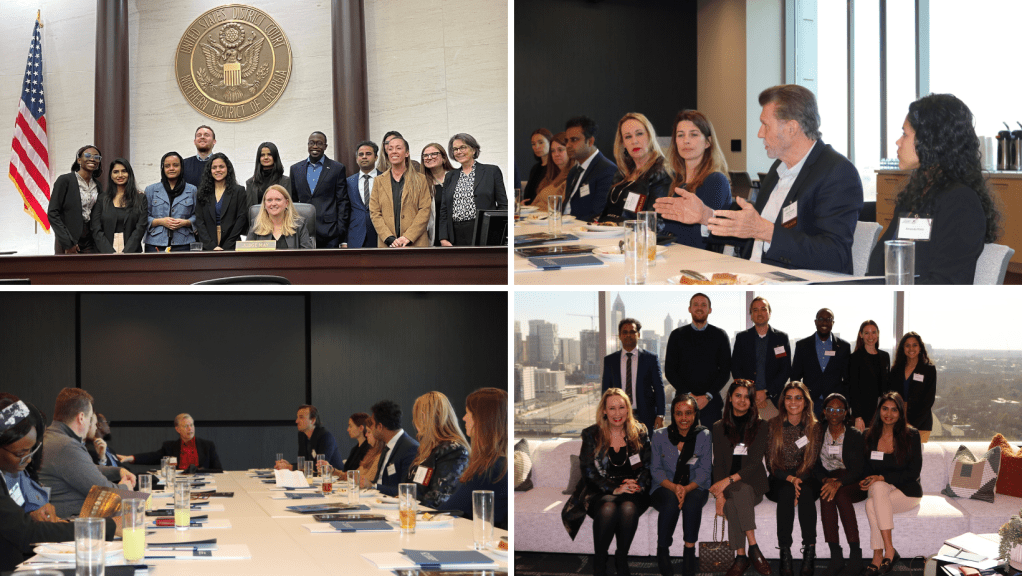
Earlier this month, the University of Georgia School of Law Master of Laws (LL.M.) class of 2025 traveled to Atlanta for a professional development trip organized by the Dean Rusk International Law Center’s director of international professional education, Dr. Laura Tate Kagel, and Mandy Dixon, international professional education manager.

The students began their day by visiting the U.S. District Court for the Northern District of Georgia, where they observed a sentencing hearing. They were hosted by the Honorable Leigh Martin May (J.D., ’98), who answered questions about the hearing, the federal judiciary, and her career path. 

The group of foreign lawyers then visited the law offices of Arnall Golden Gregory, LLP, where over lunch they heard about a variety of practice areas. Teri Simmons (J.D., ’89), a partner and chair of the firm’s International Immigration & Global Mobility practice and an adjunct professor of law at UGA, and her team members Matt Ohm (LL.M., ’14) and Dorothea Hockel, discussed the role of lawyers in helping foreign businesses bring their operations to the U.S. Glenn Hendrix a partner in AGG’s Healthcare Group, familiarized the visiting foreign lawyers with international arbitration practice and related the origins of Atlanta’s arbitration center, AtlAS. Jeffery Y. Lewis (J.D., ’82), discussed his work as a partner in AGG’s Litigation Practice and contrasted it with international arbitration. And Michael Burke, a partner in the Corporate and Finance Practice, shared his thoughts about issues facing lawyers in the international corporate arena.

Professional development trips are among many opportunities offered to Georgia Law LL.M. students to foster career connections and gain insight into potential career paths. 

To read about one of our past professional development trips for LL.M. students, click here (2019). 

To learn more about the LL.M. program, click here.

Community HeLP Clinic receives pledge from Thorpe family

The University of Georgia School of Law has announced the creation of the Community Health Law Partnership Clinic Fund. The Thorpe family, which includes 2014 alumnus Benjamin W. “Ben” Thorpe and his mother Dr. Barbara Williams, has pledged $350,000 to enable the clinic to build on its tradition of interdisciplinary advocacy at the intersection of immigration status and health.

Under the direction of Associate Dean for Clinical Programs and Experiential Learning and J. Alton Hosch Associate Professor of Law Jason A. Cade, more than 100 individuals received legal services from the clinic last year. This included clients who were granted asylum, secured immigration relief, and those challenging the abuses they endured while in U.S. immigration detention.

The clinic’s first post-graduate fellow, Thomas Evans, will join the Community HeLP team in July, 2024. Evans is a 2022 magna cum laude graduate of the law school who participated in both the Community HeLP clinic and the Jane Wilson Family Justice Clinic and received the Ellen Jordan Award for Outstanding Public Interest Student. He is currently a staff attorney in the pro se office at the 11th Circuit Court of Appeals.

To learn more about the Community HeLP Clinic and their advocacy work in immigration, click here.

Ellen Clarke (J.D., ’14), security counsel at Google, speaks at Georgia Law

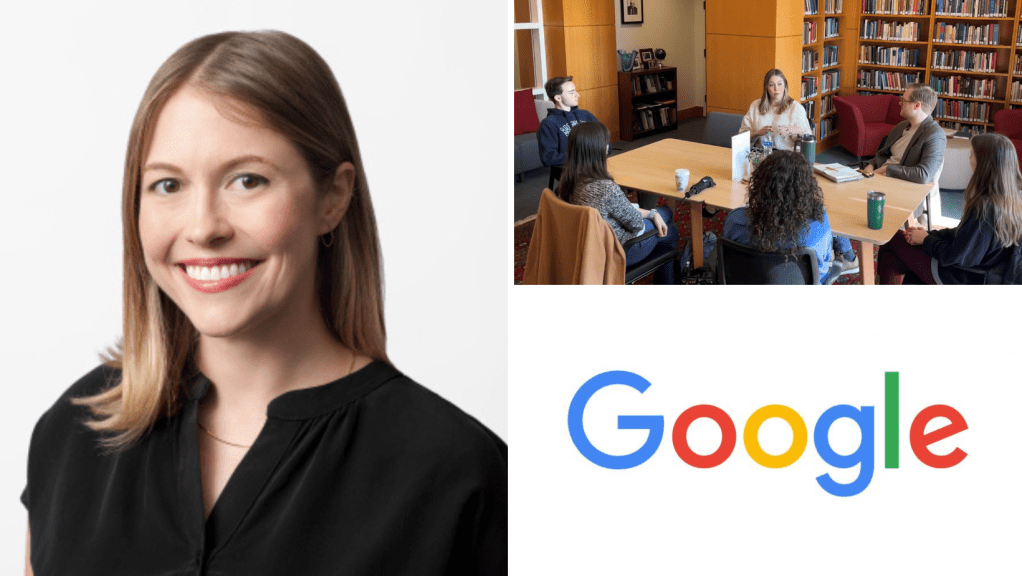
University of Georgia School of Law alumna Ellen Clarke (J.D., ’14), security counsel at Google, recently spoke to students about her career in data protection law at the Dean Rusk International Law Center’s Louis B. Sohn Library.

Students from Georgia Law’s International Law Society and Privacy, Security, and Technology Law Society attended the talk. Clarke began by discussing her professional background and explaining how her experience prosecuting white collar crime at the U.S. Department of Justice provided her with the skills and experiences to successfully transition into her current role at Google. As security counsel, Clarke advises on global data security and law enforcement issues. Students asked Clarke about her opinions on Artificial Intelligence, her decision to become a licensed solicitor in England and Wales, and about the realities of her day-to-day work at Google.

Before joining Google, Clarke prosecuted competition crimes as a trial attorney in the Washington Criminal I Section of the Antitrust Division of the U.S. Department of Justice. She joined the DOJ through the Attorney General’s Honors Program. Clarke previously served as a law clerk to Judge Richard W. Story of the U.S. District Court for the Northern District of Georgia. She received an Advanced Diploma in Data Protection Law from the Honorable Society of King’s Inns, a J.D. degree magna cum laude from the University of Georgia School of Law, and a B.S. in Foreign Service from Georgetown University. She is licensed as an attorney in Georgia and Washington, D.C., as registered in-house counsel in California, and as a solicitor in England and Wales. Clarke is currently an Adjunct Professor of Law at Georgia Law, where she teaches a mini-course entitled Cybercrime.

Georgia Law 3L Andrew Arrington reflects on significance of his Global Externship in Estonia

Today, we welcome a guest post by Andrew Arrington, a member of the Georgia Law class of 2024. Through the Global Externships Overseas (GEO) initiative, Andrew was able to extern with Sorainen, an international business law firm based in Tallinn, Estonia.

I vividly remember my first day at Sorainen, tidying my hair anxiously in the reflection of the gold elevator. It was not only the first day of my 1L summer job, but it was my first time working abroad, and I did not know what to expect. I was relieved that my apartment was only a five-minute walk from my office, but I still got there so early that I ordered breakfast and coffee in a quiet, ultramodern café next door.

As the elevator counted down to the lobby floor, I mumbled the phrase, “Tere. Mina olen Andrew,” to myself over and over, unsure if my pronunciation was even intelligible. With a ding, I was warmly greeted by the woman at the front desk. I watched my soon-to-be coworkers passing by my conference room, putting up their coats and bags in the cloakroom next door, while I waited for my boss to arrive. My anxiety finally melted when Katriina, who interviewed me months earlier, saw me sitting in the office and burst in to give me a hug. It was then I knew I was in for a special summer.

The Global Externship Overseas initiative was a moonshot for me. What I originally imagined as a substitute for not studying abroad in undergrad turned out to be the best career decision I made during law school because of the depth of legal work and client interaction I had over the span of two short months. Through the tireless work of staff at the Dean Rusk International Law Center, including Sarah Quinn and Catrina Martin, my description of a hypothetical dream placement working on data privacy in Europe, possibly in Estonia, became a reality. This request was the result of being a first-generation law student who had just graduated from Georgia Tech; at this point, I was really only familiar with the field of data privacy law after taking a class with Professor Swire and Dr. Anton at my undergraduate institution. I had my sights set on Estonia because I was familiar with the country’s leadership in technology innovation and entrepreneurship in Europe. 

I was proudly the first American intern in a couple of decades at Sorainen. During my summer there, I gained contracting skills, including with software as a service (SaaS) contracts, data protection agreements, and other standard GDPR privacy agreements. I was also able to research national security implications, genetic material requirements, and the brand new EU sanctions on Russia. I wrote memos on the effects of the then-nascent Digital Services Act and Digital Markets Act. When my time in the office came to a close, I was asked if I would like to work for a client full-time as the designated trainee to a general counsel for Pactum while I worked remotely from my home in the US. This was another great experience of implementing GDPR requirements through vetting vendors and researching the impact of US state privacy laws on a dual US-EU business.

By the end of my summer at Sorainen, I had colleagues who not only translated meetings in English for me, but also translated our nights out at the local museum. These are colleagues I am still in touch with and exchange Christmas cards with two years later.

Because of my decision to pursue a GEO, I fell in love with a place I would have never visited otherwise. I became a local at the bakery around the corner ordering rhubarb pastries in Estonian. I knew I reached local status when a new clerk working asked me a question about change in Estonian. I ate pine needle ice cream on walks by myself after work along cobblestone streets, and I was driven out of the city to Viru Bog by my fellow summer interns to visit one of the most beautiful natural parks I have ever been to. I had coworkers go out of their way to give me visits of their hometown during the weekends, and I also had an unforgettable office outing playing cards on the rooftop under the midnight sun. 

I cannot recommend enough to my fellow students the professional value of not only being able to work in a legal environment abroad but also the memories that Georgia Law and the Center made possible through the GEO program. This opportunity increased my contract drafting and editing abilities tremendously, provided opportunities to interact directly with clients, and exposed me to data privacy and compliance work. Now every time I interview, it is the topic that people most want to talk about, and I not only have a wealth of legal experiences to draw upon but also a reminder of the summer of a lifetime.

***

Applications are now open for summer 2024 Global Externships Overseas (GEO). This initiative places University of Georgia School of Law students in four-to-twelve week international placements each summer, where they gain substantive, hands-on experience in diverse areas of legal practice. Over the last fifteen years, more than 200 Georgia Law students have completed a GEO in law firms, government agencies, corporate legal departments, intergovernmental organizations, and nongovernmental organizations around the world.

Current 1Ls and 2Ls are encouraged to apply for summer GEOs. All applicants should reference this instructional video for step-by-step information regarding how to create and successfully complete an application for GEOs in UGA’s Study Away Portal by the March 1 deadline. For more information, email: ruskintlaw@uga.edu
Georgia Law Professor Diane Marie Amann presents on Nuremberg woman defendant at conference in memory of FIU Law Professor Megan A. Fairlie

University of Georgia School of Law Professor Diane Marie Amann spoke last week at a conference which paid tribute to Professor Megan A. Fairlie (1971-2022), an international criminal law scholar who had presented her own work at our law school’s Dean Rusk International Law Center.

Most recently, Dr. Fairlie had taken part in a 2019 symposium entitled “International Criminal Court and the Community of Nations,” and she published her presentation, “Defense Issues at the International Criminal Court,” in the Georgia Journal of International and Comparative Law symposium issue.

In recognition of Fairlie’s scholarship on persons accused by international criminal tribunals, Amann chose to present “Inge Viermetz, Woman Acquitted at Nuremberg,” at Friday’s conference.

Entitled “Perspectives on the International Criminal Court and International Criminal Law and Procedure: A Symposium in Memory of Megan Fairlie,” the conference took place at Miami’s Florida International University College of Law. Dr. Fairlie had taught there from 2007 – the same year she earned her Ph.D. in International Human Rights Law from the Irish Centre for Human Rights, National University of Ireland-Galway – until her death in December 2022.

Amann, who is Regents’ Professor of International Law, Emily & Ernest Woodruff Chair in International Law, and Faculty Co-Director of the Dean Rusk International Law Center here at Georgia Law, has published frequently on women professionals during the post-World War II trials at Nuremberg and elsewhere.

Georgia Law Professor Bruner publishes book review in Cambridge International Law Journal

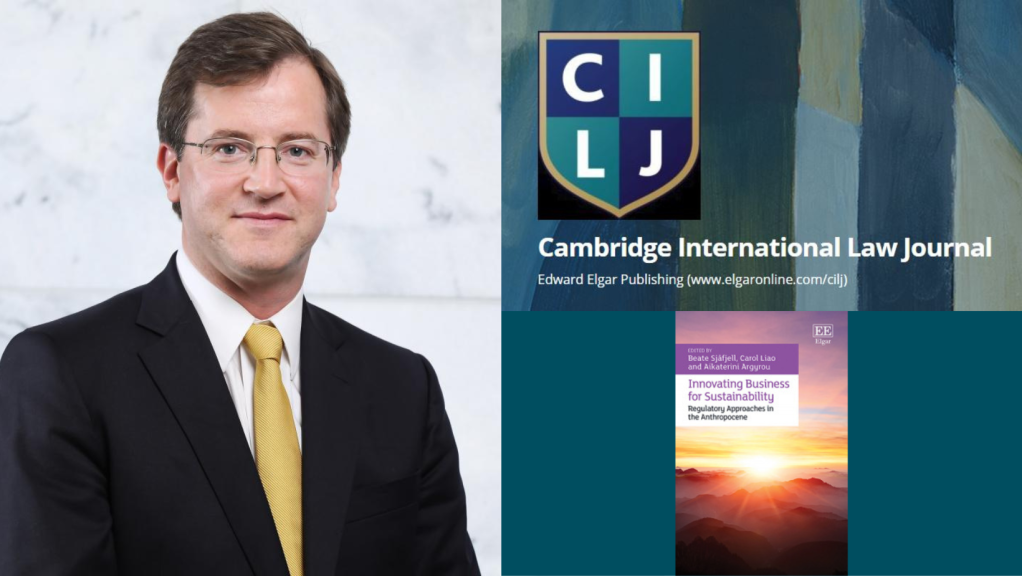
Christopher M. Bruner, Stembler Family Distinguished Professor in Business Law and Faculty Co-Director of the Dean Rusk International Law Center, published a review of a book titled Innovating Business for Sustainability: Regulatory Approaches in the Anthropocene (edited by B. Sjåfjell, C. Liao and A. Argyrou), in the Cambridge International Law Journal in December.

Below is a description of the book:

Challenging current attitudes to governance and regulation in business, this timely book ascertains how regulatory approaches can innovate to ensure sustainable business that contributes to social justice for current and future generations within ecological limits.

Combining a research-based approach with a gendered perspective of how sustainability goals are shaped and how businesses should engage with them, this pioneering book creates a comprehensive and contemporary understanding of what sustainability means for business. Identifying the limitations of current approaches to gender and equality alongside the weaknesses of current regulatory and theoretical approaches in business, chapters seek to enhance the practical understanding and embeddedness of sustainability into business within legal and regulatory landscapes. Insights from an international collection of expert scholars in fields ranging from sustainability science to law offer meaningful alternatives to the sustainable business status quo on both conceptual and concrete levels.

Providing a regulatory analysis of business positioned in a systems-based sustainability research framework, this book will prove an invaluable resource for students and scholars of sustainability science, business and management, and law and regulation. With practical insights, it will also prove essential for policymakers working in business regulation and sustainability in business.

Prior posts on Bruner’s scholarship can be found here.

Georgetown Law Professor Cliff Sloan discusses “The Court at War” at Georgia Law

Georgetown Law Professor Cliff Sloan recently discussed his new book, The Court at War: FDR, His Justices, and the World They Made, in an event sponsored by the Dean Rusk International Law center here at the University of Georgia School of Law.

Sloan was joined in conversation by two of the law school’s professors: Nathan S. Chapman, Pope F. Brock Professor of Law; and Diane Marie Amann, who is Regents’ Professor of International Law, Emily & Ernest Woodruff Chair in International Law, and the Center’s Faculty Co-Director.

Below is a description of the book:

By the summer of 1941, in the ninth year of his presidency, Franklin Roosevelt had molded his Court. He had appointed seven of the nine justices—the most by any president except George Washington—and handpicked the chief justice.

But the wartime Roosevelt Court had two faces. One was bold and progressive, the other supine and abject, cowed by the charisma of the revered president.

The Court at War explores this pivotal period. It provides a cast of unforgettable characters in the justices—from the mercurial, Vienna-born intellectual Felix Frankfurter to the Alabama populist Hugo Black; from the western prodigy William O. Douglas, FDR’s initial pick to be his running mate in 1944, to Roosevelt’s former attorney general and Nuremberg prosecutor Robert Jackson.

The justices’ shameless capitulation and unwillingness to cross their beloved president highlight the dangers of an unseemly closeness between Supreme Court justices and their political patrons. But the FDR Court’s finest moments also provided a robust defense of individual rights, rights the current Court has put in jeopardy. Sloan’s intimate portrait is a vivid, instructive tale for modern times.

Sloan joined Georgetown – where he teaches constitutional law, criminal justice, and death penalty litigation – following a distinguished legal career, in all three branches of the federal government, at leading law firms, and in-house at the Washington Post.  He is also the author of The Great Decision: Jefferson, Adams, Marshall, and the Battle for the Supreme Court, a 2009 history of the Court’s foundational decision in Marbury v. Madison.

Georgia Law Professor Amann featured in The Wall Street Journal on Gaza ruling by International Court of Justice

University of Georgia School of Law Professor Diane Marie Amann was featured in The Wall Street Journal regarding the recent order of the International Court of Justice in the Genocide Convention case which South Africa has filed against Israel. 

The article titled “World Court Rejects Demands for Gaza Cease-Fire” was written by Jess Bravin and was published on January 26.

After reporting the opinion of Utah Law Professor Amos Guiora , that both parties won something, and that, in the words of the article, “Israel avoided a legal ruling that would force it either to stop military operations or defy the world court,” Bravin then wrote:

Still, the conduct of the Gaza campaign received no pass, said Diane Marie Amann, an international-law professor at the University of Georgia. ‘Israel will need to adjust if it wishes to comply with the court’s order,’ she said.

Amann is Regents’ Professor, Emily & Ernest Woodruff Chair in International Law, and Faculty Co-Director of the Dean Rusk International Law Center here at the University of Georgia School of Law. She teaches and publishes regularly on matters relating to international law.