University of Georgia School of Law Professor Laura Phillips-Sawyer participated in the Business History Conference in Atlanta, Georgia earlier this year. She was one of several speakers in the Harvard Business School Workshop entitled “Globalization, Multinationals, and Institutions.” Additionally, she chaired the panel “Trust and Antitrust: Standard Oil and the Creation of the Global Economy.”
Phillips-Sawyer is an expert in U.S. antitrust law and policy. Broadly, she is interested in questions of economic regulation, which intersect with legal history, economic thought, business strategy and structure, and political organization. She currently holds the Jane W. Wilson Associate Professorship in Business Law at the University of Georgia School of Law.
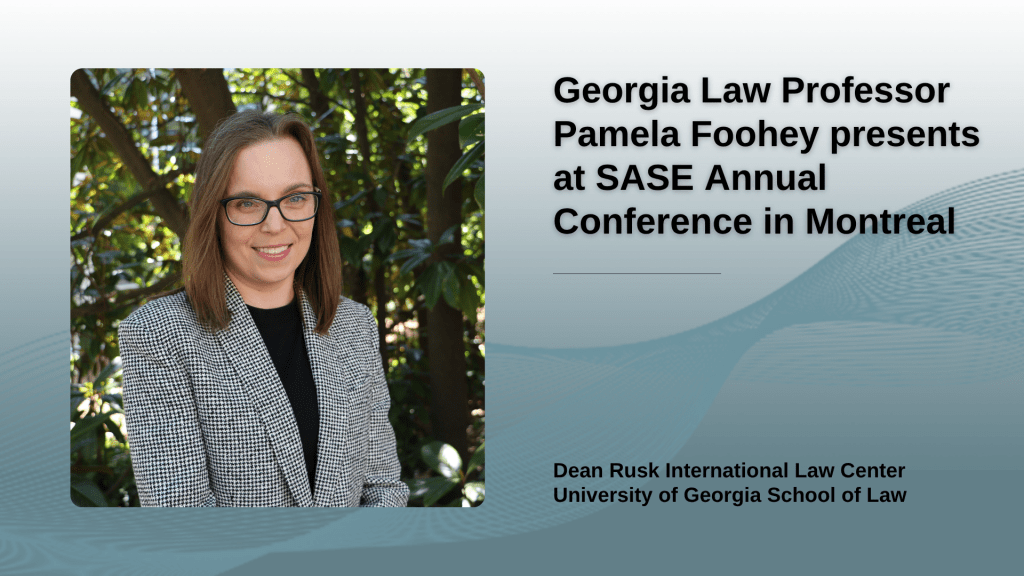
Foohey joined Georgia Law faculty as a full professor in 2024. She currently holds the Allen Post Professorship and teaches Bankruptcy, Secured Transactions and a Bankruptcy Practice Seminar. Specializing in bankruptcy, commercial law, consumer finance and business law, Foohey’s scholarship primarily involves empirical studies of bankruptcy and related parts of the legal system. She presently is a co-investigator on the Consumer Bankruptcy Project, a long-term research project studying persons who file bankruptcy. Data from this project serve as the basis of her co-authored book Debt’s Grip: Risk and Consumer Bankruptcy, University of California Press (Aug. 5, 2025). Her work in business bankruptcy focuses on nonprofit entities, with a particular emphasis on how religious organizations use bankruptcy. Data from this project are included in her in-progress book Forgive Us Our Debts: How Black Churches Use Bankruptcy to Survive, forthcoming with the University of Chicago Press.
Convened by the Remaking Trade Project (RTP) and co-hosted by the Centre for Trade and Economic Integration (CTEI), this workshop brought together a diverse range of researchers, economists, legal experts and policy advocates to explore the creation of a dedicated research stream as part of the RTP. Their stated goal is “…to continue strengthening the intellectual foundations of the trade-sustainability agenda, while also responding to a rapidly changing trade landscape in ways that are agile, inclusive, and impactful.”
Over twenty-five colleagues joined the day of interactive roundtables, from over 20 global institutions and/or countries, drawing from participants of the RTP’s work to date.
LeClercq received financial support to attend this workshop from the Dean Rusk International Law Center as a Rusk Scholar-in-Residence, an initiative promoting international opportunities for Georgia Law faculty that advance the mission of the Center.
LeClercq joined the University of Georgia School of Law in 2024 as an assistant professor. She teaches International Trade and Workers Rights, International Labor Law, International Law and U.S. Labor Law. She also serves as a faculty co-director of the Dean Rusk International Law Center and as the faculty adviser for the Georgia Journal of International and Comparative Law.
Incoming University of Georgia School of Law Professor William Ortman presented on the history of plea bargaining as part of the panel “American Perspectives on Plea Bargaining” at the Michele Taruffo Girona Evidence Week in Spain last month.
The Michele Taruffo Girona Evidence Week aims to “be a meeting point for all members of the international community who are dedicated to or interested in evidential legal reasoning.”
Ortman will join the University of Georgia School of Law as a professor of law in fall of 2025. Ortman specializes in criminal law, criminal procedure and evidence. Since 2016, he has served on the faculty at Wayne State University Law School, where he was named the David Adamany Research Scholar (2024–25) and the Edward M. Wise Research Scholar (2020–23). While at Wayne State, Ortman was recognized with multiple teaching awards. He previously held positions as a visiting professor at the University of Michigan Law School (2022) and as a Climenko Fellow and Lecturer on Law at Harvard Law School (2013–16).
Ortman’s scholarship focuses on the institutional and legal design of criminal adjudication. His recent work includes “Confession and Confrontation,” published in the California Law Review (2025), and “Cliff Running” (with Dov Fox), which is forthcoming in the Washington University Law Review.
Two students will work in private law settings: Bartholomew with extern Gleiss Lutz in Stuttgart, Germany, while Cox will extern with Bodenheimer in Berlin, Germany, under the supervision of Dr. Christof Siefarth (LL.M. ’86). Reed has a public interest placement and will extern with the Office of the Privacy Commissioner of Bermuda under the supervision of Alexander White (J.D. ’09). Through their GEOs, students will gain experience in practice areas such as international arbitration and data privacy.
Cox has been selected as the recipient of a grant from the Halle Foundation to support her externship in Germany. Based in Atlanta, The Halle Foundation seeks to promote understanding, knowledge and friendship between the people of Germany and the United States. Cox is the third Georgia Law student to receive this grant to support a semester-long GEO in Germany, following Jack Buckelew (J.D. ’25) and Pace Cassell (J.D. ’26).
Since spring 2021, eight Georgia Law students have participated in semester-long GEOs, an extension of the Center’s existing GEO initiative that is offered jointly between the Center and the law school’s Clinical and Experiential Program. Professor Jessica L. Heywood, Clinical Associate Professor and Washington, D.C., Semester in Practice Director, teaches and directs students externing abroad in partnership with Taher Benany, Associate Director of the Dean Rusk International Law Center, who oversees the GEO initiative. Like Georgia Law’s summer GEOs, semester-long GEOs are legal placements placements around the world that offer all law students the opportunity to gain practical knowledge and experience in an international setting. They are typically supervised in their work by Georgia Law alumni/ae. Students return to Athens with new colleagues and mentors, legal practice skills that set them apart from their peers, and a deeper appreciation of the global legal profession.
***
The Center is currently accepting applications for spring 2026 semester-long GEOs; all 1L and 2L students are eligible to apply. Applications are due September 15. For more information and to access the application, please email Taher Benany: taher.benany@uga.edu
Rutledge holds the Talmadge Chair of Law. From 2015 through 2024, he served as dean of Georgia Law. Prior to his appointment as dean, Rutledge served as the associate dean for faculty development working closely with the law school’s faculty, especially its untenured professors, to expand and promote scholarly and research activities.
He is the author of the book Arbitration and the Constitution and co-author with Gary Born of the book International Civil Litigation in United States Courts. His works have been published by the Yale University Press, the Oxford University Press and the Cambridge University Press, and his articles have appeared in a diverse array of journals such as The University of Chicago Law Review, the Vanderbilt Law Review and the Journal of International Arbitration. He also regularly advises parties on matters of international dispute resolution (litigation and arbitration).
Thomas E. Kadri, Assistant Professor of Law at the University of Georgia School of Law, recently spent several weeks as a fellow at the European University Institute (EUI) in Florence, Italy. His experience abroad was made possible by a Sarah H. Moss Fellowship, which “provide[s] funds for travel and related expenses for tenure-track faculty of the University of Georgia (Athens) pursuing advanced scholarship, research, and study in institutions of higher learning abroad and in the United States.” Kadri also received financial support from the Dean Rusk International Law Center as a Rusk Scholar-in-Residence, which promotes international opportunities for Georgia Law faculty that advance the mission of the Center.
In his guest post below, Kadri reflects on his time abroad, which he calls “a tremendous professional and personal experience that enriched [his] scholarly research, broadened [his] comparative understanding of legal education and academic culture, and helped [him] build meaningful relationships with scholars from across Europe and beyond.”
One of the most formative aspects of my fellowship was my participation in a seminar series titled Thinking Infrastructurally, organized by Professor Thomas Streinz. This series, which brought together researchers working across disciplines, focused on how legal scholars might better engage with insights from infrastructure studies. The seminar explored fundamental conceptual questions—how infrastructures differ from platforms, systems, or networks; how infrastructures are regulated and how they might themselves serve as regulatory tools; and how legal scholars can incorporate infrastructural thinking into normative, doctrinal, and empirical work.
Each of the three sessions I attended provided new perspectives and provocations that will shape my future research. The first session emphasized methodology, asking how legal academics might attend to “relations, processes, and imaginations” across technical, organizational, and social dimensions. The second session turned to digital infrastructures, grappling with questions such as: What is gained by viewing platforms as infrastructures—or infrastructures as platforms? What kinds of regulatory possibilities emerge when code is conceptualized as an architectural or infrastructural force? These questions dovetail with my own interests in digital platforms and online speech governance. The final session featured doctoral students presenting posters based on their projects, offering a chance to reflect on visual, material, and speculative methods for representing infrastructures and their effects.
These sessions were intellectually generative and expanded my scholarly toolkit in unexpected ways. I have long studied the regulation of online platforms, but the seminar invited me to reframe these inquiries through an infrastructural lens. This framing has already begun to shape my current writing on the regulation of deepfakes and may form the basis of future scholarly collaborations.
Workshop Participation and Interdisciplinary Dialogue
In addition to the seminar series, I participated in a workshop titled Entangled Concerns, Uncertain Futures: Law and Politics in the Making of Infrastructures, which brought together scholars and artists to discuss the construction and contestation of infrastructures. This experience was inspiring for my own work on deepfake harms and regulatory responses, helping me situate these concerns within the broader question of how legal systems should respond to emerging technologies whose boundaries and risks are often unstable. The workshop featured excellent presentations, including a memorable artifact-based presentation by the Indonesian artist Elia Nurvista, whose piece Long Hanging Fruits: Myth and Matter on Palm Oil Complex invited participants to think materially and historically about infrastructures of extraction and trade.
These discussions reaffirmed the value of interdisciplinarity in legal scholarship and encouraged me to think more creatively about the empirical and theoretical frames I use in my own research. They also exposed me to new voices and methods, enhancing my appreciation of the ways law is entangled with political economy, cultural meaning, and technological development.
Contributing to the Scholarly Community: Mentorship and Outreach
While at the EUI, I was also pleased to contribute to the intellectual life of the doctoral program by organizing and hosting a workshop titled How to Publish in U.S. Law Reviews. This session was aimed at EUI’s graduate students and demystified the odd publication process that defines American legal scholarship. The workshop served not only as a chance to offer mentorship but also to reflect on the institutional and cultural differences between U.S. and European approaches to legal scholarship. It deepened my appreciation for the rich diversity of scholarly styles across jurisdictions and highlighted the structural barriers that non-U.S. scholars often face when trying to enter the American legal academy. I left the session with a renewed commitment to making space for more international voices in U.S. legal publications and a network of aspiring scholars whose work I hope to support going forward.
Advancing Research and Building Collaborations
The EUI fellowship provided the intellectual space and community support that allowed me to make significant progress on my writing. While in residence, I began working on a forthcoming article coauthored with University of Georgia School of Law Professor Sonja West titled Deepfake Torts: Emerging Tort Frameworks in U.S. Deepfake Regulation. The piece, which will appear later this year in the peer-reviewed Journal of Tort Law, explores how various tort doctrines are being adapted to address the novel harms posed by synthetic media. Although the article is grounded in U.S. law, many of the insights I developed during my time at EUI—particularly those drawn from discussions about infrastructure and transnational platform governance—shaped how I framed the legal challenges at stake.
I also held multiple one-on-one meetings with Professor Thomas Streinz, a fellow legal scholar based at EUI who shares my interest in platform regulation, data governance, and comparative digital policy. These conversations were productive and inspiring. In addition, I had the pleasure of meeting repeatedly with Adi Mansour, a Palestinian LL.M. student whose work on censorship and surveillance by state and corporate actors in Palestine and Israel offered sobering insights into how infrastructure—both digital and political—can become a tool of domination and control.
Broader Benefits and Institutional Impact
Beyond these specific accomplishments, the fellowship helped me develop a more global perspective on legal education, research, and academic culture. Engaging with European scholars—many of whom approach legal questions from sociolegal or historical perspectives less common in the United States—challenged some of my assumptions and introduced me to new bodies of literature. I gained a clearer sense of how European doctoral training operates, how interdisciplinary work is structured, and how faculty balance research with mentorship in different institutional settings. These insights will inform my own mentorship of students and contribute to ongoing conversations within my home institution about graduate training and international engagement.
The fellowship also strengthened institutional ties between my university and EUI. I encouraged several doctoral students to consider applying for visiting opportunities in the United States and hope to maintain long-term scholarly relationships with several of the colleagues I met. In this way, the benefits of the fellowship extend beyond my own development and offer pathways for future collaboration and exchange.
***
For more information about the Rusk Scholar-in-Residence initiative, please email Sarah Quinn, Director, Dean Rusk International Law Center: squinn@uga.edu



 exchange of notes