University of Georgia Professor Peters, of Grady College and School of Law, appointed to OSCE-ODIHR Panel of Experts on Freedom of Peaceful Assembly and Association

Jonathan Peters, an associate professor who is the Head of the Department of Journalism at the Grady College of Journalism and Mass Communication and has a courtesy appointment here at the University of Georgia School of Law, has been appointed to the Panel of Experts on Freedom of Peaceful Assembly and Association of the OSCE-ODIHR; that is, the Office for Democratic Institutions and Human Rights at the Organization for Security & Co-Operation in Europe.

The 16-member panel helps advise the OSCE and its members – 57 countries in Europe, Asia, and North America – in developing and maintaining legislation regarding the freedoms of peaceful assembly and association.

Countries with experts on the panel include, in addition to the United States, Germany, Poland, Spain, North Macedonia, Ukraine, Kazakhstan, and Armenia.

Among other areas, Peters (prior posts) is a scholar of international and comparative media law. As detailed here, he has published articles and served as a consultant to numerous international organizations on issues of global free expression and European press regulation.

Scholars and practitioners of space law to speak at Georgia Law as part of new international law course led by Center’s Director, Professor MJ Durkee

Leading scholars and practitioners of space law will speak here at the University of Georgia School of Law as part of a new semester-long course in international law taught by Professor Melissa J. “MJ” Durkee, the law school’s Associate Dean for International Programs, Director of the Dean Rusk International Law Center, and Allen Post Professor.

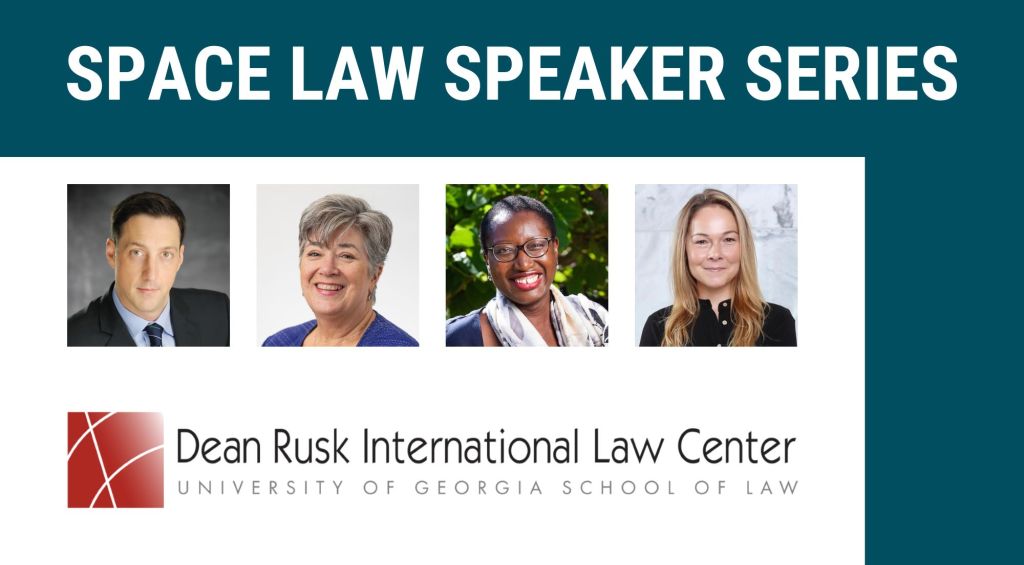
The Spring 2023 Space Law Speaker Series will feature (pictured above, left to right):

January 20, “Space Law Fundamentals”: Christopher Johnson, Space Law Advisor for the Secure World Foundation, Adjunct Professor at Georgetown University Law Center in Washington, D.C., and member of the Paris-based International Institute of Space Law

January 25, “Contemporary Space Governance”: Tanja Masson-Zwaan, Assistant Professor and Deputy Director of the International Institute of Air and Space Law at Leiden University in the Netherlands, and President Emerita of the International Institute of Space Law

February 10, “Customary Law Principles in Space Law”: Timiebi Aganaba, Assistant Professor of Space and Society in the School for the Future of Innovation in Society at Arizona State University, also affiliated with ASU’s Interplanetary Initiative, Global Futures Lab, and Sandra Day O’Connor College of Law

February 17, “Regulating Space Junk”: Kathleen Doty, Advisor for Non-Proliferation Treaties & Agreements in the Global Security, Technology, and Policy group at the Seattle-based Pacific Northwest National Laboratory, and former Director of our Dean Rusk International Law Center

Presentations will be open to all at Georgia Law. Students enrolled in the for-credit course will draw from knowledge gained during the speaker series to pitch solutions to a space law problem – the issue of debris in space, known colloquially as “space junk.” Working with them will be Professor Durkee. She too is a scholar in this area, having published “Interstitial Space Law” and “The Future of Space Governance,” the latter an essay in a Georgia Journal of International and Comparative Law symposium issue on the subject.

Supporting the speaker series as part of their work on Georgia Law’s Graduate Certificate in International Law – for which this is a required course – are the staff members of the Center’s Global Practice Preparation portfolio, Sarah Quinn and Catrina Martin.
Georgia Law Professor Kadri presents on digital evidence and security in law conference at Israel’s Bar-Ilan University

University of Georgia School of Law Professor Thomas E. Kadri presented at a three-day Research Workshop of the Israel Science Foundation, held last month at Bar-Ilan University Faculty of Law.

Kadri (prior posts) presented “A Socio-Technical Framework for Handling Digital Evidence with Security and Privacy Assurances,” as part of a panel on “Digitalization in the Courts.”

The conference, entitled “Smart Compliance Systems in the AI Era: Combining Criminal and Administrative Measures,” brought together scholars from Austria, the Netherlands, and Switzerland as well as Israel and the United States.

The University of Georgia School of Law has a longstanding partnership with the Bar-Ilan University Faculty of Law, focused on faculty exchange.

Georgia Law Professor Christopher Bruner appointed Research Member of European Corporate Governance Institute

Christopher M. Bruner, the Stembler Family Distinguished Professor in Business Law here at the University of Georgia School of Law, has been appointed a Research Member of the prestigious European Corporate Governance Institute, known as ECGI.

As described on its website, the Brussels-based “ECGI is an international scientific non-profit association providing a forum for debate and dialogue between academics, legislators and practitioners, focusing on major corporate governance issues.” Its “global network of practitioner, academic and institutional members” is “appointed on the basis of their significant contribution to the field of corporate governance study.” EGCI’s press release on today’s new appointments is available here.

In addition to fostering research collaboration among its members, ECGI disseminates scholarship, hosts international events, and spearheads initiatives, including its ongoing project on “Responsible Capitalism.”

Bruner (prior posts) is a scholar of corporate law, corporate governance, comparative law, and sustainability. His books include The Corporation as Technology: Re-Calibrating Corporate Governance for a Sustainable Future (OUP 2022), The Cambridge Handbook of Corporate Law, Corporate Governance and Sustainability (co-edited with Beate Sjåfjell) (CUP 2019), Re-Imagining Offshore Finance: Market-Dominant Small Jurisdictions in a Globalizing Financial World (OUP 2016), and Corporate Governance in the Common-Law World: The Political Foundations of Shareholder Power (CUP 2013).

Nuremberg podcast with Georgia Law Professor Amann top download of 2022

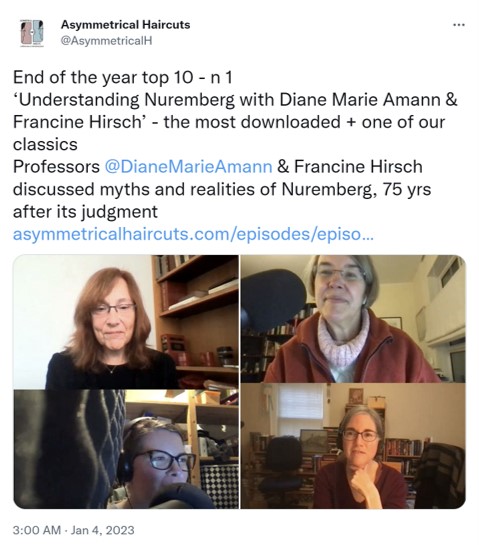
Understanding Nuremberg,” with Professor Diane Marie Amann, a Faculty Co-Director of our Dean Rusk International Law Center here at the University of Georgia School of Law, and University of Wisconsin Professor Francine Hirsch, was the most-downloaded 2022 episode of Asymmetrical Haircuts: Your International Justice Podcast.

As quoted in a prior post, the hosts, Hague-based journalists Janet Anderson and Stephanie van den Berg, described the podcast (available here) as a discussion of “what we think we know (and what we don’t) about Nuremberg trials.”

Amann, Regents’ Professor of International Law and Emily & Ernest Woodruff Chair in International Law here at Georgia Law, is writing Nuremberg Women, a book about the roles that lawyers and other women professionals played at the post-World War II trial before the International Military Tribunal. Hirsch, the Vilas Distinguished Achievement Professor of History at the University of Wisconsin-Madison, is author of the award-winning Soviet Judgment at Nuremberg: A New History of the International Military Tribunal After World War II (202o).

Georgia Law coursework begins for new class of students seeking Graduate Certificate in International Law

3L Nishka Malik (far left) and 2L Andrew Arrington (second from far right) introduce Georgia Law’s Alexander Campbell King Law Library to new Graduate Certificate in Law students; from left, Hayley Worsfold, Michael Parks, Benjamin Maurice Roy, and Angela Mossgrove

This New Year marks the arrival of the second class of Graduate Certificate in International Law students here at the University of Georgia School of Law.

Through the initiative of the law school’s Dean Rusk International Law Center, postgraduate students from other disciplines within the university will earn this academic certificate following their successful completion, in classes alongside J.D., LL.M., and M.L.S. students, of fifteen credit hours chosen from among the law school’s rich comparative, transnational, and international law curriculum; courses include Public International Law, International Human Rights, International Trade Law, Immigration Law, International Law Colloquium, and Global Governance.

Joining the first cohort, this second class of five students includes:

Three doctoral students, all from the Franklin College of Arts and Sciences: Thomas Kingsley, a Ph.D. candidate in Linguistics who is researching the effects of significant language contact, primarily in the Balkans and Central Asia; Angela Mossgrove, a Ph.D. candidate in Linguistics focusing on Syntax; and Benjamin Maurice Roy, a Ph.D. candidate in History, whose research focuses on the cognitive history of tobacco in the nineteenth century.

Two master’s students, both from the School of Public and International Affairs: Michael Parks, a candidate for the M.A. in International Affairs, and Hayley Worsfold, a candidate for the Master of International Policy degree.

Details on application of and matriculation toward the Graduate Certificate in International Law are available here and by contacting the initiative’s administrator, Sarah Quinn, Associate Director for Global Practice Preparation at the Dean Rusk International Law Center, squinn[at]uga.edu.

Georgia Law Professor MJ Durkee presents on inclusion and exclusion in international organization rulemaking at OECD-Leuven Centre roundtable

Professor Melissa J. “MJ” Durkee, Associate Dean for International Programs, Director of the Dean Rusk International Law Center, and Allen Post Professor here at the University of Georgia School of Law, presented yesterday in an online roundtable forum co-sponsored by the Organisation for Economic Co-operation and Development and the Leuven Centre for Global Governance Studies at KU Leuven, a premier university in Belgium.

Durkee spoke on “Inclusion and Exclusion of For-Profit Stakeholders in IO Rulemaking: Considerations and Pathways” in the roundtable, the overall theme of which was “Improving Inclusiveness of International Organization Rule-Making.” Other presenters included academics and practitioners based not only in the United States and Belgium, but also Czechoslovakia, France, Germany, Italy, the Netherlands, Norway, Poland, Spain, and the United Kingdom.

The forum took place in preparation for an edited volume to be published by the Secretariat of the OECD, a Paris-based international organization to which nearly forty countries, including the United States, belong.

The Leuven Centre and Georgia Law’s Dean Rusk International Law Center are partners in an annual Global Governance Summer School in Belgium and the Netherlands.

Georgia Law Professor Christopher Bruner presents on corporate risk and sustainability at the University of Oslo

Christopher M. Bruner, the Stembler Family Distinguished Professor in Business Law here at the University of Georgia School of Law, presented on “Corporate Risk, Shareholder Liability, and the Role of Intermediaries” as part of a “Corporate Law, Corporate Governance and Sustainability” panel at a conference last month at the University of Oslo Faculty of Law in Norway.

Bruner also moderated another session and participated in an invitation-only research-collaboration workshop.

Entitled “The Risks of Unsustainability Conference,” the University of Oslo gathering brought together “academics from various fields to discuss how a research-based concept of risks of sustainability can be placed at the centre of law and policy, in business and finance, to contribute to ensuring a safe and just space for all living beings on this planet,” with the goal of “generat[ing] holistic inclusion of the risks of unsustainability at a systemic level, and unlock[ing] the potential of new modalities of sustainability law.”

In addition to Norway and the United States, the conference welcomed scholars based in Denmark, Italy, the Netherlands, Poland, Sweden, and the United Kingdom.

Scholarly achievements, vibrant initiatives highlighted in newsletter of Dean Rusk International Law Center, University of Georgia School of Law

For a recap of the year’s research and global practice accomplishments, have a look at the newly published newsletter of the Dean Rusk International Law Center at the University of Georgia School of Law. Features include:

Scholarly achievements of our Center Director, Melissa J. Durkee, and our many other globally minded faculty, including Diane Marie Amann and Harlan G. Cohen, our Center’s Faculty Co-Directors, as well as Zohra Ahmed, Christopher Bruner, Jason Cade, Nathan Chapman, Walter Hellerstein, Thomas Kadri, Jonathan Peters, Peter B. “Bo” Rutledge, Tim Samples, and Laura Phillips-Sawyer.

► The exceptional performance of the Georgia Law students who competed in the 2022 Philip C. Jessup International Law Moot Court Competition, placing second in the United States, competing through octofinals internationally, and tying for best overall oralist through the International Advanced Rounds.

► Our International Law Colloquium in Spring 2022, a course featuring works-in-progress conversations with international law scholars based in Latin America and Europe as well as the United States.

► Recent events, including our day-long conference on “The Law of Global Economic Statecraft” cosponsored with the Georgia Journal of International & Comparative Law and other University of Georgia entities, our Consular Series of talks with diplomats, presentations by distinguished lawyers on issues including the Ukraine-Russia war, and participation in panels at meetings of the American Branch of the International Law Association, the American Society of International Law, and other global entities.

► Initiatives aimed at preparing our J.D. and LL.M. students for global legal practice, including our NATO Externship, our Global Externships, and the Global Governance Summer School we host in partnership with the Leuven Centre for Global Governance at Belgium’s University of Leuven (plus additional partnerships with O.P. Jindal University in India and Bar Ilan University in Israel).

The full newsletter is here.

Georgia Law Professor Laura Phillips-Sawyer’s book, “American Fair Trade,” featured on German radio broadcast

Featured recently in a broadcast on a German public radio station was Georgia Law Professor  Laura Phillips-Sawyer, author of American Fair Trade: Proprietary Capitalism, Corporatism, and the ‘New Competition,’ 1890-1940 (Cambridge University Press 2019).

The Deutschland Rundfunk Kultur broadcast by Caspar Dohmen – entitled “Aufstieg und Zerschlagung des Rockefeller-Konzerns,” or “Rise and breakup of the Rockefeller corporation” – profiled John D. Rockefeller (1839-1937), an American magnate of the so-called Gilded Age, and, in Dohmen’s words, “the first billionaire.”

Rockefeller, along with Henry M. Flagler and others, founded Standard Oil Co., a corporation that figured in precedent-setting U.S. Supreme Court antitrust litigation. This history figures in to Phillips-Sawyer’s book, and she is quoted at length in the broadcast. Some examples:

“The Gilded Age was a time of massive technological change. … There were new big players, but also horizontal mergers where different manufacturers got together and said: Let’s solve the problem of price competition by coordinating and either fixing prices or dividing markets. Partly they were looking for stability in this time of rapid technological change. …”

“If you look at Standard Oil and what Rockefeller and Flagler and his house attorney S.C. Dodd did: A lot of it was creative destruction and smart business strategy! … The oil company also built up a fleet of tankers, first for rail and later for road. … [T]hey made all sorts of innovations that were beneficial to consumers. But then there were moments when they crossed a line and tried to crush their competitors. This is when we need police, surveillance and regulation. You have to enforce the law to keep a market functioning.”

“It took a long time for the case law to change to allow the federal government to intervene in interstate commerce. … A great deal of uncertainty remained about the answer to this question until the New Deal period in the 1930s.”