Doty named Director of Georgia Law’s Dean Rusk International Law Center; Amann and Cohen Faculty Co-Directors

Kathleen A. Doty is the new Director of the Dean Rusk International Law Center at the University of Georgia School of Law. Assisting her are two Faculty Co-Directors, Diane Marie Amann and Harlan G. Cohen. The appointments took effect on August 1.

Since May 2017, Doty (left) has served as the Center’s Interim Director. She joined the law school in 2015, serving first as the Center’s Associate Director of Global Practice Preparation and then as Director of Global Practice Preparation. Her portfolio included: planning and the implementation of lectures, conferences and other events; research projects; advising students interested in global legal practice; administering Global Externships Overseas and At-Home; and coordinating and serving as a faculty member in the Global Governance Summer School, a 10-day offering in Europe conducted in partnership with the Leuven Centre for Global Governance Studies at the University of Leuven, Belgium.

As Director, Doty will oversee both global practice preparation and international professional education, including the Master of Laws, or LL.M., degree for foreign-trained lawyers. Her duties as a member of the law faculty will include teaching the Legal System of the United States course to LL.M. candidates.

Dean Peter B. “Bo” Rutledge said:

“We are very pleased that Kate Doty has agreed to take on this leadership role at the law school. I am confident that the center will benefit from her energy and extensive experience in the practice of international law.”

This autumn, the Center will celebrate its 40th birthday. Its namesake is Dean Rusk, who served as a law professor at the University of Georgia after serving as Secretary of State to Presidents John F. Kennedy and Lyndon B. Johnson. The Center serves as the law school’s international law and policy nucleus for education, scholarship, and other collaborations among faculty and students, the law school community, and diverse local and global partners. U.S. News & World Report ranks the law school’s international law curriculum 18th among U.S. law schools.

Doty will be the fifth person to lead the Dean Rusk International Law Center, following in the footsteps of Fredrick W. Huszagh, Thomas J. Schoenbaum, Gabriel M. Wilner, C. Donald Johnson Jr., and, most recently, Diane Marie Amann (left).

Professor Amann, who holds the Emily & Ernest Woodruff Chair in International Law, has just completed a term as Georgia Law’s Associate Dean for International Programs & Strategic Initiatives. An expert in public international law, she is a Counsellor of the American Society of International Law and serves as Special Adviser to the International Criminal Court Prosecutor on Children in & affected by Armed Conflict.

Amann will serve as Faculty Co-Director with Professor Cohen (right), holder of the Gabriel M. Wilner/UGA Foundation Professorship in International Law and an international economic law expert who is the Managing Editor of AJIL Unbound, the online platform of the American Journal of International Law.

In Dean Rutledge’s words:

“Diane provided excellent leadership for the Center over the past two-plus years, creating a strong foundation on which Kate and her team, assisted by Harlan and Diane, will build. I am confident the law school’s influence in the area of international law and policy will continue to grow.”

Before joining the Dean Rusk International Law Center, Doty practiced treaty law in Washington, D.C., as Assistant Counsel for Arms Control & International Law at the Office of the General Counsel, Strategic Systems Programs, U.S. Department of the Navy. Before that, she was Attorney-Editor at the D.C.-based American Society of International Law, where her duties included managing the American Journal of International Law and editing publications like ASIL Insights, International Law in Brief, International Legal Materials and the Benchbook on International Law. Her published writings cover issues such as the European Court of Human Rights, refugee law, transitional justice and the U.S. military commissions at Guantánamo.

She serves in leadership roles for the American Society of International Law (with which Georgia Law is an Academic Partner), as Chair of ASIL’s Non-Proliferation, Arms Control, and Disarmament Interest Group and Vice Chair of its Lieber Society on the Law of Armed Conflict. In 2016, Doty was selected as a Young Leaders Fellow by the World Affairs Council of Atlanta and joined other fellows in a professional development tour of China.

While earning her J.D. degree at the University of California, Davis School of Law, she competed in the international rounds of the Philip C. Jessup International Law Moot Court Competition. After serving as a judicial clerk on the Hawaiʻi Intermediate Court of Appeals, she was the inaugural Fellow of the California International Law Center at Cal-Davis Law. She received her undergraduate degree from Smith College, with a major in Latin American Studies and a minor in Film Studies, and studied abroad at La Universidad de la Habana in Cuba. She is fluent in Spanish and proficient in French.

Application season opens for University of Georgia School of Law LLM Class of 2019

Today’s the 1st day that foreign-trained lawyers may apply for 2018-19 study toward the Master of Laws, or LL.M., degree at the University of Georgia School of Law.

Over the last 4 decades, the law school has produced more than 450 LL.M. graduates, with ties to 75 countries and every continent in the world. They include judges and law firm partners, leaders in governments and in intergovernmental and nongovernmental organizations, CEOs and heads of corporate legal departments, and university professors and administrators.

Our LL.M. students pursue a one-year, full-time plan of courses side by side with J.D. candidates, gaining exposure to diverse viewpoints on a range of legal issues. They follow a flexible curriculum tailored to individual career goals – whether it’s preparation to sit for a U.S. bar examination, pursuit of a Concentration affording advancement in their home country’s legal profession or academic institutions, or something else.

As shown in our prior posts, LL.M. students benefit from the superb resources of a highly ranked law school in the heart of a top-20 public university: renowned faculty; research facilities like the Alexander Campbell King Law Library, as well as the Louis B. Sohn Library on International Relations and other initiatives at the Dean Rusk International Law Center; experiential learning opportunities; professional development and career preparation; and world-class lectures and conferences.

Details in our new LL.M. brochure (above), available in downloadable PDF and online booklet formats.

Further information available at our website, or by e-mailing LLM@uga.edu. Click here to apply now.

Global Governance Summer School enriches our study abroad tradition

Leuven Dean Bart Kerremans provides statistical analyses of the political economy of the 2017 U.S. and 2017 French presidential elections

LEUVEN and BRUSSELS, Belgium – The 2017 Global Governance Summer School may have ended, but memories linger of a brilliant week in these 2 Belgian cities.

Bicycles line sidewalks all over the University of Leuven, also known as KU Leuven

The 2017 GGSS marked the 1st summer school collaboration between our Dean Rusk International Law Center, University of Georgia School of Law, and our Belgium partner, the Leuven Centre for Global Governance Studies at the University of Leuven, one of Europe’s premier institutions of higher education since its founding in 1425.

At the same time, it contributed to Georgia Law’s long tradition of summer study in Belgium – a tradition that began in 1973 as the Brussels Seminar led by the late Professor Gabriel N. Wilner and supported by another Georgia Law professor, our Center’s namesake, Dean Rusk. Over the years hundreds of U.S. and European law students took part, sometimes launching careers in global practice. We’re proud to have continued the tradition with this year’s GGSS.

Leuven streetscape

As previously posted, our 2017 GGSS journey began at The Hague, political capital of the Netherlands, where students received professional development briefings at the International Criminal Court, the Iran-U.S. Claims Tribunal, and the International Court of Justice.

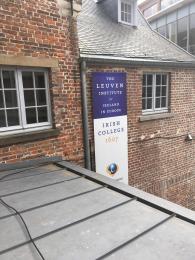
The Leuven Institute is housed in the buildings of an Irish College founded in 1607

We then moved to Leuven, a centuries-old Flanders city about 15 miles west of Brussels. The lovely Leuven Institute for Ireland in Europe was our home base for the week of June 25. Days were intense, while summery weather, late-evening sunsets, and endless lanes of historic buildings and convivial sidewalk cafes made for relaxing evenings.

The week began with students taking part in classroom seminars:

Leuven Professor Jan Wouters introduces global governance

Day 1 focused on “Global Governance and International Law: Concepts, Norms, Actors, and Processes,” and featured 4 lectures: “Global Governance: An Introduction” by Leuven Law Professor Jan Wouters, GGSS Co-Director and Leuven Centre Director; “A Classic Account of International Law” by Professor Diane Marie Amann, GGSS Co-Director; “International Organizations as Rulemakers” by Dr. Philip De Man, Leuven Centre Senior Researcher; “Why Global Governance?” by Georgia Law Professor Harlan G. Cohen.

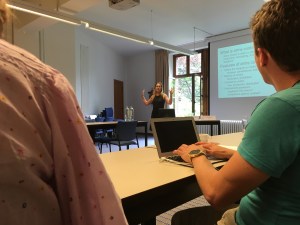
Georgia Law Professor Diane Marie Amann examines relationship between armed conflict and extraction of oil and other natural resources

Day 2 covered “Global Economic and Trade Governance,” with these lectures: “Concepts, Principles, and Issues: Global Economic and Trade Law” by Georgia Law Professor Cohen; “A Legal Perspective on Global Economic and Trade Law” by Leuven Law Professor Geert Van Calster; “International Commercial Responsibility” by Georgia Law Professor Amann; and “A Political Economic Perspective on Global Economic and Trade Governance” by Dean Bart Kerremans, head of Leuven’s Faculty of Social Sciences.

Leiden Professor Horst Fischer surveys human rights institutions

Day 3 shifted to “Global Human Rights, Rule of Law, and Security Governance.” Leiden Law Professor Horst Fischer began with a lecture on “Human Rights Governance”; then followed a lecture on “Rule of Law Governance” by as Dr. Nicolas Hachez, Leuven Centre Senior Researcher. The afternoon kicked off with a conversation on the practice of human rights law between Alison A. Smith, Legal Counsel at the Brussels NGO No Peace Without Justice, and Georgia Law Professor Amann.

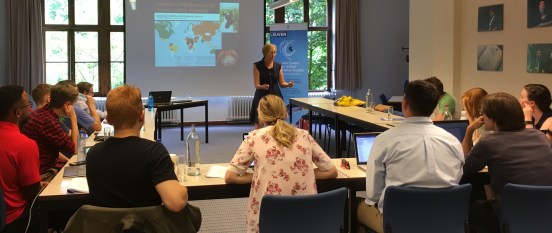
Rusk Interim Director Kathleen A. Doty summarizes arms control law to prepare students for treaty negotiation exercise

Our Center’s Interim Director, Kathleen A. Doty, then led the GGSS students’ simulated negotiation of a treaty aimed at controlling the use of drones. The day concluded with a dialogue between Leuven Law Professor Dominik Steiger and Georgia Law Professor Cohen on “Withdrawal from International Organizations and Global Governance.”

These classroom sessions prepared students for Day 4, an expert conference on “International Law and Global Governance in Turbulent Times.”

Dr. Tom Pegram, University College London, addresses conference as panelists and other participants look on

Taking part in the 1st conference panel, “Global Governance of Human Rights,” were: Georgia Law Professor Amann; Leuven Centre researcher Anna-Luise Chané; Mercedes García Pérez, Head of Division-Human Rights, European External Action Service; Dr. Tom Pegram, Senior Lecturer, University College London; and Katrien Meuwissen, Development Officer, European Network of National Human Rights Institutions.

Speaking at the conference panel on “Global Governance of Democracy and Rule of Law” were: Bologna Political Science Professor Daniela Piana; Leuven Researcher Dr. Mattieu Burnay; Professor Laurent Pech, Middlesex University London; Leuven researcher Tim Courthaut; and Dr. Petra Bard of the Central European University-Budapest.

Georgia Law Professor Harlan G. Cohen (3d from right) speaks on developments in international trade

Closing the conference was a panel on “Global Economic and Trade Governance in Protectionist Times,” featuring Professor Miles Kahler, American University; Professor John Kirton, University of Toronto; Georgia Law Professor Cohen; Tomas Baert, European Commission, Head of Unit Trade Strategy; Professor Jean-Christophe Defraigne, Université Saint-Louis Bruxelles; and Professor Pieter de Wilde, Norwegian University of Science and Technology.

GGSS concluded with a day in Brussels, capital of Belgium and home to many European and international legal institutions.

At NATO HQ in Brussels on final day of Global Governance Summer School: from left, Nils Okeson, Brian Griffin, Jennifer Cotton, Wade Herring, Nicholas Duffey, James Cox, Kathleen A. Doty, Kristopher Kobl, Lyddy O’Brien, Casey Callaghan, Ezra Thompson, Diane Marie Amann, Evans Horsley, and Eduard Snijders

Students took a morning tour of the headquarters of the North Atlantic Treaty Organization. There they learned about the work of NATO’s lawyers from member of the NATO Office of Legal Affairs, headed by Steven Hill. They lunched among NATO staffers and uniformed personnel from NATO’s 29 member states.

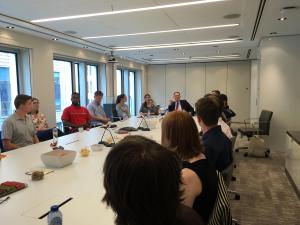
Alumnus Stephen Spinks briefs students on global legal practice

In Brussels’ “European quarter,” students stopped at the European Parliamentarium and then took part in a briefing at Sidley Austin LLP, a global law firm whose law practice all manner of global law fields, including trade, environment, life sciences, data privacy, and dispute settlement. Leading the briefing (right) was the managing partner of Sidley’s Brussels office, Stephen O. Spinks, who is a Georgia Law alumnus and member of our Dean Rusk International Law Center Council. As Spinks told student, he himself had studied in GGSS’ forerunner, the Brussels Seminar. He returned after receiving his J.D. degree, earned a master’s degree at Vrije Universiteit Brussel, and began his career as a specialist in trade and competition/antitrust, law. Sprinks’ inspiring story capped a great week for students, many of whom are spending the balance of summer at Global Externships.

Poster outside the Koninklijk Paleis van Brussel, or Royal Palace of Brussels

Hague briefings at ICC, Iran-U.S. Claims Tribunal and ICJ launch 2017 Global Governance Summer School

At the Iran-U.S. Claims Tribunal, front from left: Ana Morales Ramos, Legal Adviser; Hossein Piran, Senior Legal Adviser; Kathleen A. Doty, Interim Director, Dean Rusk International Law Center; David Caron, Tribunal Member; and Georgia Law Associate Dean Diane Marie Amann. Back row, students Nicholas Duffey, Lyddy O’Brien, Brian Griffin, Wade Herring, Jennifer Cotton, Evans Horsley, Casey Callaghan, Kristopher Kolb, Nils Okeson, James Cox, and Ezra Thompson.

HAGUE – Briefings at key international law institutions here have highlighted the initial leg of the Global Governance Summer School led by the University of Georgia School of Law Dean Rusk International Law Center.

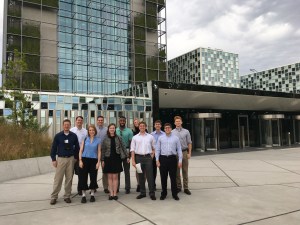
Our students’ journey began with a visit yesterday to the International Criminal Court Permanent Premises (left), a tile-and-ivy structure, located in dunelands not far from the North Sea, that opened just 18 months ago. Accompanying them were Associate Dean Diane Marie Amann and our Center’s Interim Director, Kathleen A. Doty, both of whom will lecture at the summer school next week.
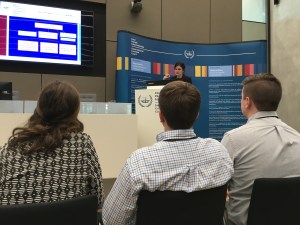
Outlining the work of the Office of the Prosecutor were the Prosecutor’s Senior Legal Adviser, Shamila Batohi, and Legal Assistant, Annie O’Reilly (right), with whom Associate Dean Amann works in her capacity as the Prosecutor’s Special Adviser on Children in and affected by Armed Conflict. Topics included case selection and specific cases, complementarity and state cooperation, and the role of the prosecution in relation to other organs of the court.

Then Leiden Law Professor Dov Jacobs, a Legal Assistant in Defense at the ICC and member of the defense team for Laurent Gbagbo, the former Ivoirian President now on trial before the court. Shifting from the theoretical to the practical and back again, he spoke about the nature and challenges of international criminal justice, particularly as it relates to the defense function before contemporary bodies like the ICC.

The journey continued today with a morning briefing at the Iran-U.S. Claims Tribunal, an international organization established by treaty 36 years ago as a means to settle disputes arising out of the 1979 takeover of the U.S. Embassy in Tehran. It comprises 3 Americans, 3 Iranians, and three members from other countries. Offering a fascinating dialogue on the history and operations of the tribunal were Dr. David Caron, a U.S. member of the tribunaland an international law professor at Kings College London, and Dr. Hossein Piran, Senior Legal Adviser at the tribunal.

(It was a treat to learn that one of Dr. Piran’s professors was the late Gabriel N. Wilner, who founded our European summer study abroad during his long tenure on the Georgia Law faculty. Holding the professorship named after Wilner is Georgia Law Professor Harlan Cohen, who will lecture in this summer school next week, along with Leuven Law Professor Jan Wouters and others.)

The afternoon brought us to the Hague’s Vredepalais (left), or Peace Palace, built in the early 1900s to house international institutions that would foster pacific, rather than warlike, settlements of disputes.

Leading discussion on one of those institutions, the International Court of Justice set up under the 1945 Charter of the United Nations, was Dr. Xavier-Baptiste Ruedin (right), Legal Adviser for Judge Joan E. Donoghue. Topics ranged from provisional measures, like those recently issued in a case involving India and Pakistan, to jurisdiction via advisory opinion (including one soon to arrive at the court, following yesterday’s U.N. General Assembly vote) or contentious case.

A question common to all 3 visits was the role of such institutions – and international law more generally – in the governance of global affairs. We’ll continue to seek answers next week, when our Global Governance Summer School moves to Belgium for classroom seminars and an experts conference with our partner institution, KU Leuven’s Leuven Centre for Global Governance Studies.

Applications welcome for Dean Rusk International Law Center Director

We at the University of Georgia School of Law Dean Rusk International Law Center, a global nucleus that will celebrate its 40th anniversary this October, seek applications for the position of Director. As stated in the vacancy notice:

“The Director’s work shall consist of (a) teaching (b) service (including, among other matters, symposia, seminars and training) and ( c) administration. A faculty director (or co-directors) may advise the director but will have no direct or indirect supervisory responsibility. This position will begin July 1, 2017 and be located in Athens, Georgia. Athens is an energetic city with a vibrant arts and cultural environment. It is located 75 miles northeast of Atlanta.

“To meet the requirements for appointment at the rank of Academic Professional, applicants must have a J.D. from an accredited university and should ideally have (1) superior academic credentials, (2) a superior teaching ability, (3) a record of participation in institutional and professional service, and (4) recognition in the field of international law.”

Details and online application here.

Associate Dean Amann named Spring 2018 Research Visitor and Visiting Fellow at University of Oxford, England

The University of Oxford, England, will host Georgia Law Associate Dean Diane Marie Amann during her research-intensive Spring 2018 semester. In the Hilary and Trinity Terms – March through June – she will be a Research Visitor at Oxford’s Bonavero Institute of Human Rights hosted by the Faculty of Law and a Visiting Fellow at its Mansfield College, where the Institute is based.

Amann joined the University of Georgia School of Law faculty in 2011, taking up the Emily & Ernest Woodruff Chair in International Law. She also has served, since 2015, as the law school’s Associate Dean for International Programs & Strategic Initiatives.

While at Oxford, Amann (right) plans to continue her research on “Women at Nuremberg,” which explores the many roles women played in post-World War II international criminal trials in Europe, as prosecutors, defense counsel, journalists, witnesses, staffers, and defendants.

As a Research Visitor, she also will have the opportunity to take part in Bonavero Institute activities, and will benefit from Oxford’s libraries, seminars and lectures, and other offerings.

The Bonavero Institute was founded in 2016 as a unit of the Oxford Faculty of Law, under the direction of Professor Kate O’Regan, a former judge on the Constitutional Court of South Africa. Construction of the institute building, located at Mansfield College, is expected to be completed in early autumn.

Amann’s research visit in England will follow a January 2018 stint as the inaugural Breslauer, Rutman and Anderson Research Fellow at the Center for Advanced Genocide Research at the University of Southern California Shoah Foundation in Los Angeles.

Thoughts on ASIL annual meeting, by Sohn Fellow Johann Ebongom

Johann Ebongom, one of several Georgia Law students who traveled to Washington last month as Louis B. Sohn Professional Development Fellows, reflects below on that experience. This Saturday Ebongom, a lawyer from Cameroon, will receive his Master of Laws (LL.M.) degree at our commencement ceremony.

From April 12-15, I, along with University of Georgia School of Law classmates, volunteered at the 111th annual meeting of the American Society of International Law in Washington, D.C. What a great networking occasion for young students interested in the legal management of international affairs and the development of a stronger and more efficient international rule of law.
I was so excited to be offered an opportunity to be a privileged observer of one the world’s biggest and most prestigious international law gatherings, particularly in a time when most nations have adopted new policies towards the protection of their interests and the security of their citizens. With the Brexit in Europe, the Syrian crisis in Middle East, the North Korean nuclear tests, the relationship between African countries and the International Criminal Court, and the recent foreign-policy-related decisions of the current President of the United States of America, no need to say that this year’s ASIL meeting was a decisive one! As an LL.M. student at Georgia Law who has a keen interest in global affairs, I could not ask for a better way to strengthen my analysis and understanding for future research.

For three days, I had the great fortune to listen and interact with experts, scholars, judges, and practitioners coming from various institutions, such as the United Nations, the World Bank, the International Criminal Court, and the U.S. Department of State, among others. Several people shared with me valuable career advice. This experience was further highlighted by an in-depth exchange with Fatou Bensouda, Prosecutor of the ICC, on the inevitable collaboration between the ICC and the soon-to-be-established African Court of Justice, which will lead to a reform of the current hierarchical organization of the international criminal justice system. Also, I enjoyed meeting Georgia Law alums – whom I’ve found always willing to assist.

The conference principally questioned the values of international law at a time when the world is subject to several events that might well compromise the value of international frameworks most nations had once believed in. The main highlighted issue seems to reside in the application or implementation of international law principles. Nations usually sign and ratify international conventions; however, these are far from being implemented, precisely in countries that are powerful enough to bypass the international order to preserve their interests.

It was an honor and privilege to represent Georgia Law as an LL.M. student. Being present for this year’s annual meeting was an inspiration for me, to one day enter the conversation in the hopes of creating a more just, more livable, and more connected world. I am very grateful to the Dean Rusk International Law Center for all its efforts and support in ensuring we have an unforgettable and fruitful time at the University of Georgia School of Law.

For other international law-minded Georgia Law students: Participating in an ASIL annual meeting is a good start to meet the international law community and benefit from invaluable advice! Do not hesitate to join next time.

(Cross-posted); prior Exchanges of Notes posts for which Johann Ebongom was a co-author here and here)


Alum Jon Smibert, U.S. Justice attaché in E. Europe, honored for public service

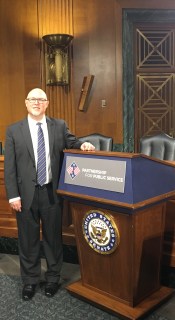
A distinguished University of Georgia School of Law alumnus, Jon R. Smibert (JD 1996), has been honored as one of the United States’ top federal employees. The honor was celebrated this month at a breakfast at the Dirksen Senate Office Building in Washington, D.C.

Smibert serves as Resident Legal Advisor for the U.S. Department of Justice at the U.S. Embassy in Tirana, Albania. As reported in the Washington Post, he is one of 26 finalists for a 2017 Samuel J. Heyman Service to America Medal, also known as a “Sammie,” awarded by the Partnership for Public Service. Smibert is a finalist in National Security and International Affairs; the medalwinners will be chosen later in the year.

In addition to this U.S. recognition, Smibert recently received a medal from  from the President of Albania. In that country, he has worked to assist in overhauling the legal system, with the particular aim of reducing public corruption. Smibert helped to redraft about a third of Albania’s constitution and more than a dozen statutes. Innovations included vetting requirement for judges and prosecutors, as well as establishment of a Constitution-level body dedicated to investigating and prosecuting corruption.

Of Smibert’s work, Donald Lu, U.S. Ambassador to Albania, said:

“A lot of Albanians consider him a hero. The Albanian prime minister has called this ‘the most important reform since the fall of communism. Jon Smibert has a real passion for what he does, not only for representing the U.S., but in making Albania better.”

Before his posting in Albania, Smibert served in Pristina, Kosovo. In addition to helping to establish independent prosecution offices and to draft Kosovo’s Criminal Procedure Code, Smibert helped to launch the Kosovo Specialist Chambers, a war crimes court that sits at The Hague in the Netherlands.

Smibert began his career as a federal prosecutor in Atlanta, Georgia, and later in Cleveland, Ohio. His publications include a 240-page book, Principles of Evidence (2014).

International Jurist features LLM study at University of Georgia School of Law

The Master of Laws (LL.M.) curriculum at the University of Georgia School of Law is featured in the latest edition of The International Jurist, described as “the magazine for foreign attorneys studying in the U.S.”

Our curriculum is highlighted on page 8 of the issue entitled “Best LL.M. Programs.” The item pays particular note to last year’s winning Georgia Law LL.M.-J.D. team in the Southeast Model African Union, as well as  the many experiential learning opportunities and skills-based courses available. It states:

“For example, an LL.M. student from Bangladesh assigned to Magistrate Court conducts legal research, writes memos and observes trials.”

More information and the Georgia Law LL.M. brochure are available here, or by e-mailing Dr. Laura Tate Kagel, Director of International Professional Education at the law school’s Dean Rusk International Law Center, at LLM@uga.edu.

On World Trade Day, alum Bill Poole earns Global Leadership Award

Very pleased to congratulate our distinguished alumnus William M. Poole (JD’73), recipient of the Global Leadership Award bestowed by the World Trade Center Atlanta.

The Center bestowed the award during its World Trade Day celebration on May 2, in order to recognize Poole’s

“exemplary service to the facilitation of international trade and investment between Georgia and the rest of the world.”

Poole, who goes by Bill, is Of Counsel at Atlanta’s Nelson Mullins Riley & Scarborough LLP. Serving as head of the office’s International Practice, Poole, whose expertise includes transnational tax law, focuses on transnational business and investment matters.

He’s taught international business transactions law as an adjunct professor here at his alma mater. While a law student, he was Editor-in-Chief of the Georgia Journal of International & Comparative Law and took part in our Jessup International Moot Court and Brussels Seminar initiatives. After earning his undergraduate degree from the U.S. Military Academy at West Point, Poole served in Vietnam and Germany.

Through its World Trade Day event, the World Trade Center Atlanta brought an array of leaders to discuss issues of trade and investment. In Georgia last year, this sector accounted for more than $157.2 billion in imports and exports.