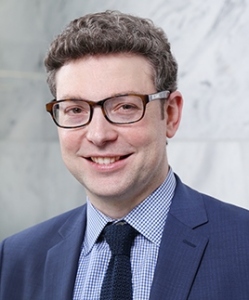
Georgia Law Professor Bruner, Cambridge corporate governance book co-editor, presents at Oslo conference

Professor Christopher M. Bruner took part last week in a Norway conference leading to a new Cambridge University Press book he is co-editing.

Bruner, who is J. Alton Hosch Professor of Law at the University of Georgia School of Law and member of our Dean Rusk International Law Center Council, together with his co-editor, University of Oslo Law Professor Beate Sjåfjell, introduced, moderated, and concluded the symposium for the Cambridge Handbook of Corporate Law, Corporate Governance and Sustainability (forthcoming 2019).

Bruner also presented a draft chapter, on Hong Kong and Singapore.

The symposium, which brought together scholars from around the world who were invited to contribute to the Handbook following a competitive call for papers, was held at the University of Oslo Faculty of Law March 12-14.

International arbitrator Wallgren-Lindholm to speak at Georgia Law

We at the University of Georgia School of Law Dean Rusk International Law Center look forward to welcoming renowned international arbitrator Carita Wallgren-Lindholm to campus this Thursday, March 8. She will speak on “Due Process and Ethics in International Arbitration: What Rules and How to Apply Them” from 11:50 a.m.-12:50 p.m. in Room A-120, Hirsch Hall.

Wallgren-Lindholm is Chair of the Commission on Arbitration and Alternative Dispute Resolution of the International Chamber of Commerce, and has served as a member of that commission since 1996. She has also been a member since 2012 of the International Chamber of Commerce International Court of Arbitration. She is a founding partner of Lindholm Wallgren, a law firm based in Helsinki, Finland.

Cosponsoring her talk is the International Law Society, Georgia Law’s chapter of the International Law Students Association.

Details here.

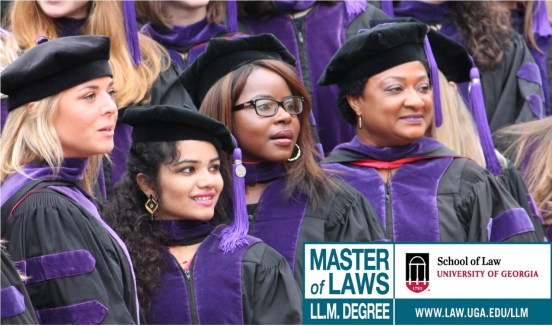
Webinar to learn about Georgia Law LL.M. degree Wednesday, March 7

LLMbrochureCLR2017Did you miss our recent information session in Atlanta about the Master of Laws (LL.M.) degree at the University of Georgia School of Law? In case you did, there’s another opportunity to find out more!

Foreign-educated attorneys are invited to join Laura Tate Kagel, Associate Director for International Professional Education, for a free webinar on the LL.M. degree on Wednesday, March 7, 2018, from 12:00-12:50 p.m. (Eastern time – U.S. and Canada).

Topics to be discussed during the presentation include:

  • benefits of obtaining an LL.M.
  • putting together a strong application
  • costs and financial aid
  • career options for LL.M. graduates
  • steps toward preparing to take a U.S. bar examination

The LL.M. is a one-year, full-time degree designed for lawyers who trained in countries outside the United States and wish to study at the University of Georgia School of Law, a 159-year-old institution that is consistently ranked among the country’s top law schools. Explore the Georgia Law LL.M. degree here.

Join the webinar from PC, Mac, Linux, iOS or Android at https://zoom.us/j/129159834, and use meeting ID 129 159 834.


Best of luck to Georgia Law’s 2018 Jessup International Law Moot team

The 2018 Georgia Law Jessup team, from left: Roger Grantham, Lyddy O’Brien, Allie Gowens, Jennifer Cotton, and Ben Torres

Members of our University of Georgia School of Law team are competing this week in New Orleans regional rounds of the Philip C. Jessup International Law Moot Court Competition. They’re part of a 59-year-old tradition, in which law students enact the presentation of arguments before the International Court of Justice, the Hague-based judicial organ of the United Nations.

In New Orleans and in cities across the globe, teams from more than 645 law schools, representing 95 countries, are arguing this year’s Jessup dispute, Case Concerning the Egart and the Ibra (People’s Democratic Republic of Anduchenca v. Federal Republic of Rukaruku).

We at Georgia Law’s Dean Rusk International Law Center have enjoyed working with this talented team of students throughout this academic year, and we wish them the best of luck in this year’s contest.

In passing: David Caron (1952-2018)

The sudden news of the passing of my dear friend and colleague, Dr. David Caron, fills me with sad thoughts and happy memories.

Years ago, when I was starting out in international law, David – then a chaired professor at Berkeley, the law school an hour’s drive from my own – was a pillar of support. He was the 1st scholar to accept my invitation to speak at the 1st conference I organized, anchoring debate on “Reconstruction after Iraq” and publishing in our Cal-Davis journal an important analysis of claims commissions as a transitional justice tool.

Warm and witty, David once sent me a handwritten note of thanks for the “lovely bouquet” of pre-tenure reprints he’d received from me.

Both of us transplants from Back East, David and I shared an enthusiasm for California and enjoyed helping to cultivate a close-knit Left Coast international law community – even as we took part in events and activities across the globe.

David’s achievements truly are too numerous to mention. Among many other things, he was an inspiring President of the American Society of International Law, from 2010 to 2012. About the time he completed that term, he took emeritus status at Berkeley, and he and his wife, Susan Spencer, embarked on new adventures – 1st as Law Dean at King’s College London.  (A distinguished international arbitration specialist (see GAR obituary here), he had practiced at London’s 20 Essex Street Chambers since 2009. David, a proud graduate of the U.S. Coast Guard Academy, also was a noted expert on the law of the sea.) In 2016, he was appointed a member of  the Iran-United States Claims Tribunal.

It was in this last capacity that I last saw David. The Global Governance Summer School sponsored by my current institution, the Dean Rusk International Law Center at the University of Georgia School of Law, brought us to The Hague not many months ago. The highlight of our legal-institution briefings was the half-day we spent as David’s guests in the lovely mansion that houses this 37-year-old claims tribunal. (It was not his 1st visit with Georgia Law students; David took part in our International Colloquium in 2008, and in the ASIL Midyear Meeting we hosted in 2012.)

With breaks for tea and biscuits – David was ever the gracious host – our students were treated to a candid discussion between David and Dr. Hossein Piran, Senior Legal Adviser. The two had served as tribunal law clerks years earlier, and the respect they showed one another provided an invaluable lesson about the promise of civil discourse and of the pacific settlement of international disputes.

That lesson is a most fitting way to commemorate David’s passing.

Pictured above, during our June 2017 visit to the Iran-U.S. Claims Tribunal, front from left: Ana Morales Ramos, Legal Adviser; Hossein Piran, Senior Legal Adviser; Kathleen A. Doty, Director of Georgia Law’s Dean Rusk International Law Center; David Caron, Tribunal Member; and Georgia Law Professor Diane Marie Amann, Faculty Co-Director of the Dean Rusk International Law Center. Back row, students Nicholas Duffey, Lyddy O’Brien, Brian Griffin, Wade Herring, Jennifer Cotton, Evans Horsley, Casey Callaghan, Kristopher Kolb, Nils Okeson, James Cox, and Ezra Thompson. This tribute is cross-posted from Diane Marie Amann.
Learn about Georgia Law LL.M. degree at Atlanta info session Tuesday, Feb. 13

Photo for Global Flash

Persons who’ve completed law studies overseas are invited to learn about earning a University of Georgia School of Law Master of Laws (LL.M.) degree at a free information session this month at Georgia Law’s Atlanta campus, located in the Buckhead area.

The session will be held at 7 p.m. on Tuesday, February 13, 2018, in Room 119 of the Terry Executive Education Center, Live Oak Square, 3475 Lenox Road, N.E. (click here for directions).

The LL.M. is a one-year, full-time degree designed for lawyers who trained in countries outside the United States and wish to study at the University of Georgia School of Law, a 159-year-old institution that is consistently ranked among the country’s top law schools.

Georgia Law LL.M. candidates study alongside J.D. candidates. Each LL.M. student pursues a flexible curriculum tailored to his or her career goals, including preparation to be eligible to sit for the Georgia or other U.S. bar examination. Details about this decades-old initiative may be found at our website and in posts at this blog of the Dean Rusk International Law Center, the law school unit that administers the LL.M. degree.

Among those speaking at the information session will be our LL.M. alumnus Javier A. Gonzalez, who will talk about the student experience at the University of Georgia School of Law. Other topics to be discussed at the information session include:

  • benefits of obtaining an LL.M.
  • putting together a strong application
  • costs and financial aid
  • career options for LL.M. graduates
  • steps toward preparing to take a U.S. bar examination

Interested persons are invited to register at no cost. Light refreshments will be served.

We look forward to seeing you and answering your questions there!

Professor Cohen’s AJIL essay on “Multilateralism’s Life-Cycle” at SSRN

Harlan Grant Cohen, the Gabriel M. Wilner/UGA Foundation Professor in International Law and Faculty Co-Director of our Dean Rusk International Law Center at the University of Georgia School of Law, has posted a chapter entitled “Multilateralism’s Life-Cycle,” which will appear in a forthcoming issue of volume 112 of the American Journal of International Law.

The manuscript, which forms part of our Dean Rusk International Law Center Research Paper Series at SSRN, may be downloaded at this SSRN link.

Here’s the abstract for this essay by Professor Cohen, an expert in global governance and member of the AJIL Board of Editors:

Does multilateralism have a life-cycle? Perhaps paradoxically, this essay suggests that current pressures on multilateralism and multilateral institutions, including threatened withdrawals by the United Kingdom from the European Union, the United States from the Paris climate change agreement, South Africa, Burundi, and Gambia from the International Criminal Court, and others, may be natural symptoms of those institutions’ relative success. Successful multilateralism and multilateral institutions, this essay argues, has four intertwined effects, which together, make continued multilateralism more difficult: (1) the wider dispersion of wealth or power among members, (2) the decreasing value for members of issue linkages, (3) changing assessment of multilateral institutions’ value in the face of increased effectiveness, and (4) members’ increased focus on relative or positional gains over absolute ones. Exploring how each of these manifests in the world today, this essay suggests that current stresses on multilateralism may best be understood as the natural growing pains of an increasingly mature set of institutions. The open question going forward is what form the next stage of development will take. Will strategies of multilateralism continue or will they be replaced by smaller clubs and more local approaches?

On Holocaust Remembrance Day, thanks to archives preserving histories of post-WWII war crimes trials: Amann


LOS ANGELES – On this International Holocaust Remembrance Day, I am honored to be spending this month at the USC Shoah Foundation, reviewing testimonies of persons who did their part to set right one of history’s terrible wrongs.

Seventy-three years ago today, Soviet troops liberated Auschwitz-Birkenau, the infamous Nazi concentration camp located about 45 miles west of Kraków, Poland. Liberations of other camps by other Allied forces soon followed; among them, the U.S. liberation of Buchenwald on April 11, 1945, and the British liberation of Bergen-Belsen 4 days later.

Sixty years later, a 2005 U.N. General Assembly resolution set this date aside for commemoration of World War II atrocities; to quote the resolution, of

“… the Holocaust, which resulted in the murder of one third of the Jewish people, along with countless members of other minorities …”

The resolution further:

  • honored “the courage and dedication shown by the soldiers who liberated the concentration camps”;
  • rejected “any denial of the Holocaust as an historical event”;
  • envisaged the Holocaust as “a warning to all people of the dangers of hatred, bigotry, racism and prejudice”;
  • denounced “all manifestations of religious intolerance, incitement, harassment or violence against persons or communities based on ethnic origin or religious belief, wherever they occur”; and
  • encouraged initiatives designed to “inculcate future generations with the lessons of the Holocaust in order to help to prevent future acts of genocide.”

Among the many such initiatives are memorial centers and foundations throughout the world – 2 of which have helped me in my own research into the roles that women played during postwar international criminal trials at Nuremberg.

In December, the Holocaust Memorial and Tolerance Center of Nassau County, located in Glen Cove, New York, opened its archives to me. Special thanks to Helen  Turner, archivist and Director of Youth Education, for her assistance.

This month, as the inaugural Breslauer, Rutman and Anderson Research Fellow, I am in residence at the University of Southern California, examining documents in USC Shoah Foundation’s Visual History Archive. It has been a fruitful and moving scholarly experience, and I look forward to sharing my research at a public lecture on campus at 4 p.m. this Tuesday, Jan. 30 (as I was honored to do last week at UCLA Law’s Promise Institute for Human Rights; video here). Special thanks to all at the foundation’s Center for Advanced Research – Wolf Gruner, Martha Stroud, Badema Pitic, Isabella Evalynn Lloyd-Damnjanovic, and Marika Stanford-Moore – and to the donors who endowed the research fellowship. (Fellowship info here.)

As reflected in the 2005 General Assembly resolution, the work of such institutions helps to entrench – and to prevent backsliding from – states’ promises to ensure and respect human rights and dignity norms, set out in instruments like the 1945 Charter of the United Nations, the 1948 Convention on the Prevention and Punishment of Genocide, the 1948 Universal Declaration of Human Rights, and the 1966 International Covenant on Civil and Political Rights. To this list I would add the many documents establishing international criminal fora to prosecute persons charge with violating such norms – from  the Nuremberg-era tribunals through to today’s International Criminal Court.

(Cross-posted from Diane Marie Amann; image credit)

Professor Bruner presents on corporate law and corporate governance at international conference in England

“Contextual Corporate Governance: Tailoring Board Independence Rules by Industry” is the title of the presentation that our Christopher Bruner, J. Alton Hosch Professor of Law at the University of Georgia School of Law, delivered Monday at the annual International Corporate Governance and Law Forum, held this year in England.

Hosted by the Centre for Business Law and Practice at the University of Leeds School of Law and cosponsored by Deakin Law School of Australia and the Alexander von Humboldt Foundation, the 2-day event brought together law and business scholars from around the world to discuss corporate board composition and process.

Bruner, a member of our Dean Rusk International Law Center Council, was among the 20 or so scholars who presented, from Australia, China, England, France, Japan, Norway, and the United States. Here’s the description of his paper:

Over recent decades, several commercially prominent jurisdictions have increasingly required that listed company boards, and certain committees, consist primarily of ‘independent’ (i.e. non-executive) directors. In the United States, for example, the Sarbanes-Oxley Act and the Dodd-Frank Act respectively require that a listed company’s audit and compensation committees be entirely independent. NYSE and NASDAQ rules go further, requiring that a majority of the whole board be independent. Such requirements reflect the prevailing view that independent directors protect minority shareholder interests through greater objectivity and practical capacity to monitor and resist domineering CEOs. That such benefits outweigh the costs – notably, limited information (relative to executive directors) – is assumed.

Recent empirical work, however, increasingly casts doubt on this assumption – at least in certain contexts. While empirical studies initially found little evidence that director independence rules impact corporate performance at all, more recent studies focusing on the cost of acquiring company-specific information suggest that the impacts of such rules are far from uniform. Indeed, mounting evidence suggests that such rules may improve performance where company-specific information can be acquired at low cost, yet harm performance where the cost of information acquisition is high. These findings – commending sensitivity to industry context – dovetail with a parallel body of post-crisis studies associating board independence (and other shareholder-centric governance structures) with potentially undesirable risk-taking incentives in certain industries – notably, finance.

These perspectives offer much-needed nuance to our thinking about corporate governance reform, strongly suggesting that one-size-fits-all rules mandating uniform board structures across the universe of listed companies may widely miss the mark in important contexts. This paper will discuss the history of such reforms, canvass relevant legal and financial literatures, and explore regulatory strategies for more targeted reforms on an industry-by-industry basis.

Professor Amann: Honored to contribute to new anthology, “Human Rights and Children”

Honored to be a contributor to Human Rights and Children, an anthology of works in the field edited by Hofstra Law Professor Barbara Stark.

The collection’s just been issued by Edward Elgar Publishing, which writes:

“This volume provides a comprehensive overview of children’s human rights, collecting the works of leading authorities as well as new scholars grappling with emerging ideas of ‘children’ and ‘rights.’ Beginning with the Convention on the Rights of the Child, the most widely ratified human rights treaty in the world, this book explores the theory, doctrine, and implementation of the legal frameworks addressing child labor, child soldiers, and child trafficking, as well as children’s socio-economic rights, including their rights to education.”

My own contribution is listed in this compendium as: “Diane Marie Amann (2013), ‘A Review of Reimagining Child Soldiers in International Law and Policy in Mark A. Drumbl, Oxford University Press’, American Journal of International Law…” On my SSRN page, I describe this book review as follows:

“This essay reviews ‘Reimagining Child Soldiers in International Law and Policy’ (2012), in which author Mark Drumbl examines legal doctrine, global activism, and social science research respecting underaged combatants.”

Additional contributors to this collection, besides Professor Stark and me: Philip Alston, Jo Becker, Maria Bouverne-De Bie, Claire Breen, Geert Cappelaere, Cynthia Price Cohen, Katherine Covell, Mac Darrow, Martha F. Davis, Michael J. Dennis, Janelle M. Diller, Sara A. Dillon, Mark A. Drumbl, Nienke Grossman, Martin Guggenheim, Stuart N. Hart, Kamran Hashemi, R. Brian Howe, David A. Levy, Janet McKnight, Tendai Charity Nhenga-Chakarisa, Paulo Sérgio Pinheiro, Roslyn Powell, Alison Dundes Renteln, Marilia Sardenberg, William A. Schabas, David M. Smolin, Murray A. Straus, Laura Thetaz-Bergman, John Tobin, Jonathan Todres, Geraldine Van Bueren, Wouter Vandenhole, Eugeen Verhellen, and Barbara Bennett Woodhouse.

(Cross-posted from Diane Marie Amann blog)