Welcoming Maisie Hopkins and Daesun Kim, Visiting Scholars at Georgia Law’s Dean Rusk International Law Center

We at the University of Georgia School of Law Dean Rusk International Law Center are pleased to welcome to two Visiting Research Scholars:

● Maisie Hopkins is a Ph.D. candidate at the Utrecht University School of Governance in the Netherlands. She works jointly at Utrecht and another Dutch university, Leiden, on a project entitled “Complex Global Regulation and Corporate Crime.” Within the overarching frame of how complexity within global governance influences corporate crime and corporate regulatory compliance, Hopkins’ research focuses on how international regime complexity theory applies to specific cases of corporate crime in both the United States and the European Union. Hopkins holds prior law degrees from the University of Amsterdam in the Netherlands and University of Nottingham, England. She worked for a year as a Global Legal Department Intern at Reckitt, a British multinational consumer goods company.

Serving as her Georgia Law faculty sponsor is Professor Melissa J. “MJ” Durkee, who is the law school’s Associate Dean for International Programs, Director of the Dean Rusk International Law Center, and Allen Post Professor.

● Daesun Kim is undertaking a comparative administrative law research relating to Vietnam, where he has practiced for several years, and the United States. Specifically, he plans to conduct a comparative analysis of changed circumstances in the two countries’ public-private-partnership projects during the Covid-19 pandemic period. Kim’s practice specialties include public-private partnerships, foreign investments, and cross-border mergers and acquisitions, with a focus on Southeast Asian countries. Holder of a J.D. degree from Handong Global University and a B.A. degree from Chonnam National University, both in Korea, Kim has practiced in Seoul, Korea, and Ho Chi Minh City, Vietnam, at several prestigious law firms, including Shin & Kim LLC and Yulchon LLC, and also was a legal counsel at a Korean construction and energy company, POSCO E&C.

Serving as Kim’s Georgia Law faculty sponsor will be Professor Kent Barnett, Associate Dean for Academic Affairs and J. Alton Professor of Law.

These visits continue our Center’s long tradition of hosting, for brief or extended stays, scholars and researchers whose work touches on issues of international, comparative, or transnational law. Details and an online application to become a visiting scholar here.
Georgia Law Prof Amann presents on children and peace agreements at California-Davis Law symposium

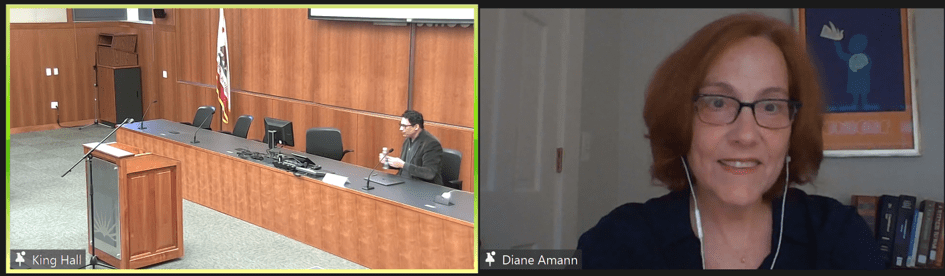
Georgia Law Professor Diane Marie Amann spoke on “Children, Armed Conflict, and Peace Agreements” Friday in a hybrid symposium at the University of California, Davis, School of Law.

Amann, who is Regents’ Professor of International Law, Emily & Ernest Woodruff Chair in International Law, and Faculty Co-Director of the Dean Rusk International Law Center here at the University of Georgia School of Law, gave an online presentation, as part of a panel on “Human Rights and Social Justice in the International Sphere,” which also featured Wadie E. Said, who is the Miles and Ann Loadholt Professor of Law at the University of South Carolina School of Law. Their talks were part of “Justice in War and Conflict: The Role of International and Humanitarian Law,” this year’s annual symposium of the University of California, Davis, Journal of International Law and Policy.

Professor’s Amann’s talk drew upon her research into children and peace settlement options. This research initially was conducted for a project at the Lauterpacht Centre for International Law, University of Cambridge, England, and subsequently was published as “International Child Law and the Settlement of Ukraine-Russia and Other Conflicts,” 99 International Law Studies 559 (2022). (prior posts available here)

The symposium took place on the one-year anniversary of the ongoing war which began with Russia’s invasion of Ukraine – a fact that Professor Amann noted even as she stressed that the findings of her research are applicable to settlement of any armed conflict or similar instance of extreme and protracted violence,

Georgia Law Professor Harlan G. Cohen presents paper on trade-security measures at Temple Law-ASIL workshop

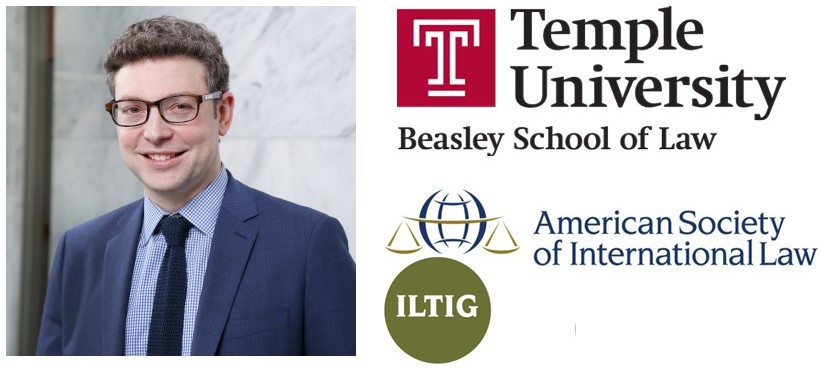
Harlan Grant Cohen, who is Gabriel M. Wilner/UGA Foundation Professor in International Law and Faculty Co-Director of the Dean Rusk International Law Center here at the University of Georgia School of Law, took part earlier this month in a workshop at Temple University Beasley School of Law in Philadelphia.

Cohen presented “Toward Best Practices for Trade-Security Measures” at the workshop, which waswhich was organized by Temple Law Professor J. Benton Heath and hosted by Temple Law’s Institute for International Law and Public Policy, in coordination with the American Society of International Law International Legal Theory Interest Group.

Within the overall theme of “The Concept of Security in International Law,” the workshop brought together scholars from a range of fields in order to address shifting understandings of security in international law and foreign affairs, as well as how law can respond to these developments.

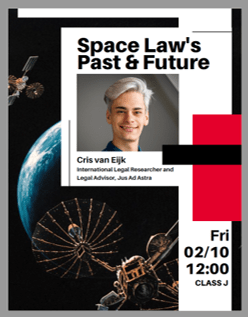
Late addition to Georgia Law’s Space Law Speaker Series: Cris van Eijk on “Space Law’s Past and Future,” tomorrow

Pleased to announce a late addition to the Space Law Speaker Series we’ve been hosting this semester here at the University of Georgia School of Law Dean Rusk International Law Center: Cris van Eijk, International Legal Researcher and Legal Advisor for Jus Ad Astra, will present at 12 noon this Friday, February 10, in Room J-347 Hirsch Hall.

Jus Ad Astra – a Latinism for “law (or rights) to the stars” – is, according to its website, “a legal project aimed at developing an authoritative international treatise clarifying the fundamental legal principles and human rights applicable to current and future human activities across outer space.”

In addition to advising for Jus Ad Astra, van Eijk is the author of thought-provoking publications on space law. He holds degrees from University of Cambridge, where he was a Senior Associate Editor for the Cambridge University Human Rights Law Journal, and Leiden University.

His presentation Friday substitutes for a scheduled speaker who was unable to take part. It will mark the third of four presentations in the Space Law Speaker Series, which, as detailed here, is part of a Spring Semester course led by our Center’s Director, Professor Melissa J. “MJ” Durkee, who is also Georgia Law’s Associate Dean for International Programs and Allen Post Professor.

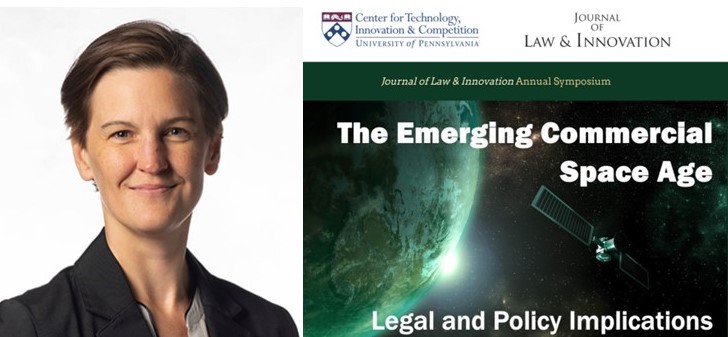
Georgia Law Professor MJ Durkee presents at University of Pennsylvania symposium on “Commercial Space Age”

Professor Melissa J. “MJ” Durkee, the law school’s Associate Dean for International Programs, Director of the Dean Rusk International Law Center, and Allen Post Professor, presented her scholarship Friday at “The Emerging Commercial Space Age: Legal and Policy Implications,” a symposium co-hosted by the University of Pennsylvania Center for Technology, Innovation & Competition and its Journal of Law & Innovation.

Her talk, “Space Law as Twenty-first Century International Law,” will be published in that journal.

Host of the symposium in Philadelphia was the Center’s Founding Director, Christopher S. Yoo, who is the John H. Chestnut Professor of Law, Communication, and Computer & Information Science at the University of Pennsylvania. Commentator for Durkee’s presentation was Professor Rebecca Crootof, University of Richmond School of Law.

Georgia Law Professor Usha Rodrigues quoted in Agence France-Presse article on challenge to “empire of Indian tycoon”

Georgia Law Professor Usha Rodrigues was quoted in an Agence France-Presse article about claims levied against against the Adani Group, led by Gautam Adani of India.

Author of the article, entitled “A US corporate scourge deflates the empire of Indian tycoon Adani,” is AFP’s Thomas Urbain. Published on January 31, the item was reprinted in several global media.

Rodrigues, a corporate law expert who is University Professor and M.E. Kilpatrick Chair of Corporate Finance & Securities Law here at the University of Georgia School of Law, is also serving as our university’s Interim Vice Provost for Academic Affairs.

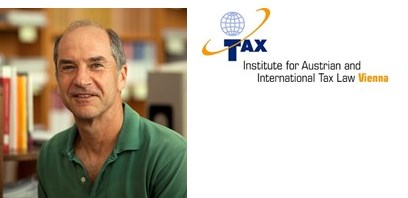
Georgia Law Professor Walter Hellerstein presents on tax obligations on digital platforms at conference in Vienna

Walter Hellerstein, Distinguished Research Professor & Shackelford Distinguished Professor in Taxation Law Emeritus here at the University of Georgia School of Law, recently presented in Vienna, Austria, as part of a panel entitled “Obligations Imposed on Digital Platforms Regarding VAT/GST,” concerning tax obligations imposed on digital platforms.

His presentation formed part of “Court of Justice of the European Union: Recent VAT Case Law,” a 3-day conference at the Institute for Austrian & International Tax Law, Vienna University of Economics & Business.

In addition to Austria and the United States, the conference included judges, academics, and practitioners from Australia, Belgium, Canada, Finland, Germany, Ireland, Italy, Luxembourg, Malta, the Netherlands, Spain, Sweden, and the United Kingdom.

Georgia Law Professor MJ Durkee presents “Pledging World Order” in Brooklyn Law School colloquium

Professor Melissa J. “MJ” Durkee, the law school’s Associate Dean for International Programs, Director of the Dean Rusk International Law Center, and Allen Post Professor, presented her scholarship online Monday as part of the Brooklyn Colloquium on International Economic Law sponsored by the Block Center for International Business Law at New York’s Brooklyn Law School. Hosts were Brooklyn Law faculty members Stephen Dean and Irene Ten Cate.

Durkee presented “Pledging World Order,” forthcoming soon in volume 48, issue 1, of the Yale Journal of International of Law.

Climate change innovation to be explored February 10 at Georgia Law’s 35th annual Red Clay Conference

“Climate Change Innovation: Stakeholders and Tools” is the title of the Red Clay Conference to be held Friday, February 10, 2023, here at the University of Georgia School of Law.

This will mark the 35th annual edition of the student-run conference, which was established to increase public awareness of environmental issues. Cosponsoring the event are the law school and its students’ Environmental Law Association, led this year by 2L Hannah Jellema and 3L Anna Scartz, president and vice president, respectively.

Here’s the program for the conference, which will take place in the Larry Walker Room on the 4th floor of Dean Rusk Hall:

➣ 9:15 a.m. Opening remarks

Opening the conference will be Melissa J. “MJ” Durkee, Associate Dean for International Programs, Director of the Dean Rusk International Law Center, and Allen Post Professor at Georgia Law.

➣ 9:10 a.m. Panel 1, Roles of Humans

Addressing the impact of climate change on agriculture, urban environments, and environmental justice communities will be: Pam Knox, Director of the UGA Weather Network and an agricultural climatologist within the university’s College of Agricultural & Environmental Sciences; Tawana Mattox, Director of Community Education & Empowerment and Neighborhood Sustainability Project Manager at the Athens Land Trust; and Professor J. Marshall Shepherd, the Georgia Athletic Association Distinguished Professor of Geography & Atmospheric Sciences at the University of Georgia. Shana Jones, Assistant Director of Strategic Operations & Planning Assistance at the University of Georgia Carl Vinson Institute of Government, will moderate.

➣ 10:55 a.m. Panel 2, Rights of Nature

Examining how the rights-of-nature doctrine can be used to combat climate change will be: Chuck O’Neal, Speak Up Wekiva, Florida; Eduardo Salazar-Ortuño, Associate Professor of Law, University of Murcia, Spain (via Zoom); and Kekek Stark, Assistant Professor of Law and Director of the Margery Hunter Brown Indian Law Clinic at the Alexander Blewitt III School of Law, University of Montana. Georgia Law Associate Professor Christian Turner will moderate.

➣ 12:55 p.m. Peter Appel Honorary Keynote

Marilyn A. Brown, Regents’ and Brook Byers Professor of Sustainable Systems in the School of Public Policy at Georgia Tech, will discuss her experience in policy work aimed at acceleration the implementation of sustainable energy sources and technology.

➣ 2:10 p.m. Panel 3, Responsibilities of Corporations

Exploring how corporate governance can reduce environmental externalities will be: Christopher M. Bruner, Stembler Family Distinguished Professor in Business Law at Georgia Law; Kelly Rondinelli, Associate – Environmental & Natural Resources at Vinson & Elkins LLP in Washington, D.C.; and Michael Vandenbergh, David Daniels Allen Distinguished Chair in Law and Director of the Climate Change Research Network at Vanderbilt Law School. Melissa J. “MJ” Durkee, Associate Dean for International Programs, Director of the Dean Rusk International Law Center, and Allen Post Professor at Georgia Law, will moderate.

➣ 3:25 p.m. Closing Remarks

Closing the conference will be Adam D. Orford, Assistant Professor of Law and Faculty Advisor of the Environmental Law Association at Georgia Law.

Attorneys licensed in Georgia can earn 4 CLE credits by attending the conference (pending approval by the state bar’s Institute of Continuing Legal Education).

Details and conference registration here.

Georgia Law 3L Collin Douglas on his D.C. Semester externship at NATO HQ SACT: “unique law school experience”

Pleased today to welcome this post by University of Georgia School of Law student Collin Douglas, who described his recently completed Fall 2022 externship in Norfolk, Virginia, in the legal department of HQ SACT, a leading unit of the North Atlantic Treaty Organization. This externship forms part of Georgia Law’s D.C. Semester in Practice initiative, in partnership with NATO Allied Command Transformation. Collin arrived at Georgia Law with a background in international affairs, having earned master’s and bachelor’s degrees in that field from the University of Oklahoma. His law school experiences have included service as Executive Articles Editor of the Georgia Journal of International & Comparative Law, internships at USAID and the Documentation Center of Cambodia, and work as a research assistant for a climate and security institute. Collin is due to receive his J.D. degree this May.

My time at the NATO Supreme Allied Command Transformation Office of the Legal Advisor was an incredibly rewarding and valuable experience. It was a completely unique law school experience, and allowed me to do work I could not do elsewhere.

In the wake of the February 2022 Russian invasion of Ukraine, the mission of NATO has felt that much more vital. The invasion of Ukraine gave NATO a renewed focus and drive, and that fact was clear from the ever-quickening pace of work around NATO SACT. The Legal Advisor performs a wide variety of legal roles within NATO SACT to support the mission, and I was able to interact with all of those roles.

As soon as I began working, I was treated as an equal member of the team and trusted with important work. One of the responsibilities of the Office of the Legal Advisor is to provide legal aid support to the international military staff of NATO SACT. This support ranges from advising on how to handle speeding tickets to coordinating with the State Department on visa issues. Within a few weeks of starting work, I was the first person who greeted any legal assistance client who walked in the door, of which there were 10-20 every day. Talking with NATO personnel from 32+ different countries exposed me to 32+ different legal perspectives and cultures. This fact gave the legal assistance portion of the work its own international perspective, as we often had to anticipate things like the Norwegian perspective on landlord-tenant issues, the German perspective on automobile sales, Albanian frustration with the visa process, or simply whether someone fully grasped the legal aspects of something they were involved with.

The Office of the Legal Advisor also performs the more typical general counsel duties of any other large organization, but with the added (and interesting) layer of being an international organization. This work covers contracting, employment intellectual property issues, and much more. This work does not differ significantly from that of a general counsel’s office in a large corporation. Where it does differ is the immunity that NATO receives under the treaties that make up the NATO system. I was able to support this work by researching and helping to articulate NATO’s view on its own immunity. Doing work of this kind for an international organization is such a rare opportunity, and I jumped on the chance to contribute to it.

My externship at NATO was part of the UGA Law Semester in D.C. program, led by Professor Jessica Heywood, so I took part in two classes that greatly contributed to my time at NATO. As part of this program we heard each week from a different lawyer working in Washington, D.C. This provided an excellent opportunity to learn about the many career paths available to attorneys who want to work in the nation’s capital. I also had a weekly class session with other students doing similar externship experiences; this allowed me to better understand my strengths and weaknesses in the workplace and to grow as an individual.

I am extremely grateful for my time at NATO SACT. There is no other law school experience that compares to it. I want to thank my amazing colleagues Monte DeBoer, Mette Hartov, Theresa Donahue, Kathy Hansen-Nord, Vincent Grassin, Butch Bracknell, Madeleine Goddrie, and Galateia Gialitaki.