Georgia Law students to compete in regional Model African Union rounds

4-2

Front row, from left: Johann Ebongom, Chanel Chauvet, Amanda Hoefer, Rebecca Wackym; back row, from left, Nelly Ndounteng, Shummi Chowdhury

A team of 6 Georgia Law students will represent the Republic of Niger in the 20th Annual Southeast Model African Union.

Thanks to the leadership of the African Studies Institute at University of Georgia, the regional competition will be held here on campus Thursday through Saturday. The Dean Rusk International Law Center, University of Georgia School of Law, is honored to cosponsor.

The contest is intended to sharpen skills in diplomacy, leadership, governmental, legal research, and public speaking. Rounds will simulate activities of the African Union.

Through the work of its many committees, this decades-old the intergovernmental organization addresses myriad issues on the continent. The competition will use as its organizing platform an African Union document,alternate-semau-flyer_0 “Agenda 2063: The Africa We Want.”

The students Georgia Law students who will compete, and their committee assignments, are:

Rebecca Wackym, 1L, Executive Council

Amanda Hoefer, 1L, Committee on Democracy, Governance and Human Rights

Johann Ebongom, LLM, Committee on Economic Matters

Nelly Ndounteng, LLM, Committee on Social Matters

Shummi Chowdhury, 1L, Committee on Pan-Africanism and Continental Unity

Chanel Chauvet, 2L, Committee on Peace and Security

niger

All the students have experience in international law and policy. Chowdhury and Chauvet are Dean Rusk International Law Center Student Ambassadors, for example, while Ndounteng and Ebongom both practiced law, in Nigeria and Cameroon respectively, before enrolling at Georgia Law.

Bon courage!

LLMs’ behind-scenes courthouse tour

photo-6_2A group of our Georgia Law LL.M. students walked downtown to the Athens Clarke-County courthouse yesterday to visit with several of our law school alums.

Assistant District Attorney Paige Otwell (JD’88) welcomed the group, which included her mentee in the LL.M. Class of 2017, Nelly Sandra Ndounteng.

Associate Magistrate Judge Ben Makin (JD’04) explained his role in the judicial system and discussed subjects ranging from arrest warrants and jail bonds to small claims court.

Ryan Hope (JD’00), who serves as Chief Assistant Solicitor  in the county’s Office of the Solicitor General, told the students how he became interested in the court system through his work at the public defender clinic in law school. In his remarks he touched on Clarke County’s accountability courts, such as DUI court, which integrate treatment and “quick, limited punishments” with the goal of reducing recidivism.

The Honorable Ethelyn N. Simpson (JD’90), Chief Judge of the State Court, related how her early experience clerking for Superior Court judges allowed her to see “a lot of good lawyers and a lot of bad lawyers,” preparing her for an unexpected career on the bench. Her enthusiasm about “the greatest job” was infectious.

After meeting with the alumni, the LL.M. students were escorted into the courtroom to view victim testimony in an ongoing trial. For the students, who come from Cameroon, Venezuela, Nigeria, Iran, Ghana, and the Bahamas, the experience was informative and rewarding. Special thanks to ADA Otwell and Dean Rusk International Law Center Student Ambassador Deborah Nogueira-Yates, a member of the Georgia Law J.D. Class of 2018 who earned her LL.M. here last May, for organizing the visit!

(Pictured above: front row, from left, Philicia Armbrister, Gilbert Oladeinbo, Valerie Mills, Nelly Ndounteng, and Assistant District Attorney Paige Otwell; top row, Noj Oyeyipo, Johann Ebongom, Javier Gonzalez, Laura Kagel (Director of International Professional Education), and Hamed Moradi Roodposhti)

Triggers and Thresholds of Non-International Armed Conflict

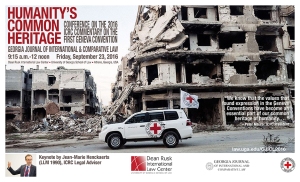
adhaque_img“Triggers and Thresholds of Non-International Armed Conflict” by Adil Ahmad Haque, originally published on Just Security Blog on September 29, 2016. We are grateful for permission to reprint this as part of our series inspired by gjicl_confposter“Humanity’s Common Heritage,” our recent conference on the 2016 ICRC Commentary on the First Geneva Convention. The author, Rutgers Law Professor Haque, was a conference participant; this post is the 1st of 3 he prepared soon after the conference. He writes:
When and where does the law of non-international armed conflict apply?  Since most contemporary armed conflicts are fought between states and organized armed groups, or between such groups, these are important questions for both international lawyers and policy makers.  The answers may affect the jurisdiction of U.S. military commissions, the detention of Taliban commanders and ISIL members, legal constraints on Saudi-led military operations in Yemen, and accountability for war crimes in Syria.

In this post, I’ll discuss the trigger and threshold of non-international armed conflict (NIAC). My point of departure is the much-discussed 2016 Commentary on the First Geneva Convention recently released by the International Committee of the Red Cross (ICRC).  The University of Georgia School of Law recently hosted a fantastic event examining a number of issues raised by the Commentary, including the duty to “ensure respect” for the Convention by other Parties, incidental harm to sick and wounded combatants, and the classification of conflicts.  This post grows out of that rich discussion.

The ICRC’s Commentary clearly states that an international armed conflict (IAC) “can arise when one State unilaterally uses armed force against another State even if the latter does not or cannot respond by military means.”  Accordingly, the law of armed conflict constrains the first use of armed force by one state against another.  Let’s call this a unilateral trigger.

In addition, “there is no requirement that the use of armed force between the Parties reach a certain level of intensity before it can be said that an [international] armed conflict exists.”  Accordingly, minor skirmishes between state armed forces, or the capture of a single soldier, “would spark an international armed conflict and lead to the applicability of humanitarian law.” Let’s call this a nominal threshold.

Unfortunately, the Commentary is not so clear with respect to non-international armed conflict.  The Commentary endorses the view that NIACs “are protracted armed confrontations occurring between governmental armed forces and … one or more armed groups, or between such groups.”  This passage, as well as some cited authority, seem to suggest a bilateral trigger, requiring “armed clashes,” “combat zones,” or, simply, “fighting.”

The Commentary also states that, for the law of NIAC to apply, “[t]he armed confrontation must reach a minimum level of intensity.”  Read alongside the Commentary’s discussion of IAC, it seems that this “minimum level of intensity” would not be met by minor skirmishes or by the capture of a single soldier or fighter.

The Commentary seems to accept a unilateral trigger and nominal threshold for IAC (quadrant 1) but a bilateral trigger and significant threshold for NIAC (quadrant 4).

screen-shot-2016-09-29-at-10-31-17-am

In my view, we should accept a unilateral trigger and nominal threshold for both IAC and NIAC.

First, if an armed group is sufficiently organized, then a first use of armed force by or against that group should trigger a NIAC.  Consider the following case:

Daesh:  Daesh fighters pour over the Syria-Iraq border, killing Iraqi civilians, capturing Iraqi territory and taking over Iraqi government institutions.  Iraqi forces flee, offering no resistance.

If we accept a bilateral trigger for NIAC, then the law of armed conflict does not apply until Iraqi forces “respond[s] by military means,” resisting Daesh’s advance.  Until that time, Daesh fighters do not violate the law of armed conflict or commit war crimes.  This result seems deeply unattractive.  Although the Daesh fighters violate Iraqi criminal law, it seems hard to accept that they do not violate the law of armed conflict.

Now consider the following scenario:

Consent:  State A attacks organized armed group G on the territory of State T, with the consent of State T.  There is no pre-existing armed conflict between State A and group G.  State A does not take feasible precautions in attack and recklessly kills many civilians.

If we accept a bilateral trigger for NIAC, then the law of NIAC does not apply until group G responds with military force, resulting in “armed clashes.”  Since State T consents, the law of IAC does not apply either.  It follows that State A does not violate the law of armed conflict or commit war crimes.  This result seems intolerable.

Importantly, human rights law may not be sufficient to protect civilians or armed forces in cross-border cases like those described above.  On most views, human rights law does not apply to the conduct of non-state armed groups that do not yet exercise territorial control and fulfill government-like functions.  Moreover, according to some militarily active states, human rights law does not constrain extraterritorial lethal targeting by state armed forces.  Yet, in my view, such conduct should be constrained by international law.

We should also accept only a nominal intensity threshold for NIAC.  Consider the following case:

Capture:  Members of organized armed group G mistakenly cross the unmarked border between State T, in which they normally operate, and State A.  They encounter a unit of State A’s soldiers, and a minor skirmish ensues.  No one is killed, but one group member is captured by the soldiers while one soldier is captured by the group and taken back across the border into State T.

In this case, it seems that both the group member and the soldier should be entitled to humane treatment under Common Article 3 of the Geneva Conventions.  Moreover, if there are civilians present when the skirmish occurs, then it seems that the conduct of the skirmish should be constrained by customary rules including distinction, precautions, and proportionality  If those rules are flagrantly violated, then those violations should amount to war crimes.

In my view, if an organized armed group has the capacity to sustain military operations then any military operation by or against that group should be constrained by the law of armed conflict.  The organization and capacity of the group is sufficient to distinguish military operations by or against the group from “internal disturbances and tensions, such as riots, isolated and sporadic acts of violence and other acts of a similar nature.”

Some might worry that applying the law of armed conflict to first uses of low intensity force will displace or reduce the protections of human rights law.  Fortunately, that is not the case.  Even during armed conflict, states may choose not to derogate from their ordinary human rights obligations.  Alternatively, derogation may be strictly required only with respect to certain measures, or only in certain parts of a state’s territory, or only in certain situations, even if the law of armed conflict provides additional constraints on all acts with a sufficient nexus to the conflict.

Most importantly, killings that are not prohibited by the law of NIAC may be prohibited by human rights law.  In particular, “[w]here military necessity does not require parties to an armed conflict to use lethal force …, but allows the target for example to be captured rather than killed, the respect for the right to life can be best ensured by pursuing this option.”  In situations of armed conflict, the law of NIAC may aid the interpretation of human rights law but does not exhaust the content of human rights law.

Finally, the law of armed conflict cannot authorize what human rights law forbids.  As the ICRC observes elsewhere, “[t]he law relating to the conduct of hostilities is primarily a law of prohibition: it does not authorize, but prohibits certain things.”  Human rights law and the law of NIAC do not conflict with each other but instead complement one another, as both impose constraints on violence rather than licenses to commit violence.  As Additional Protocol II makes clear, human rights law “offer[s] a basic protection to the human person” while the law of NIAC aims “to ensure a better protection for the victims of [] armed conflicts.”
Now available online, chapter on international criminal law & children

I’ve just posted at SSRN the chapter I published at the beginning of the year in The Cambridge Companion to International Criminal Law, edited by Professor William A. Schabas.

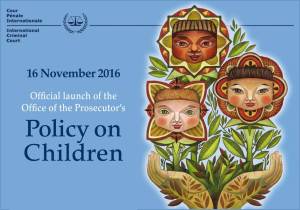
The chapter, entitled “Children,” policyaims to look back at developments in the area since World War II, and then to cast a forward glance at the comprehensive approach now under way at the International Criminal Court – where, incidentally, the ICC Office of the Prosecutor Policy on Children will be launched on November 16, 2016. I was privileged to help with drafting in my capacity as Special Adviser to the Prosecutor on this issue. (prior posts) The date coincides with the start of the annual meeting of the ICC Assembly of States Parties.

Here’s the abstract for my article:

cambridgeThis chapter, which appears in The Cambridge Companion to International Criminal Law (William A. Schabas ed. 2016), discusses how international criminal law instruments and institutions address crimes against and affecting children. It contrasts the absence of express attention in the post-World War II era with the multiple provisions pertaining to children in the 1998 Statute of the International Criminal Court. The chapter examines key judgments in that court and in the Special Court for Sierra Leone, as well as the ICC’s current, comprehensive approach to the effects that crimes within its jurisdiction have on children. The chapter concludes with a discussion of challenges to the prevention and punishment of such international crimes.

SSRN e-journals where this abstract may be found (thanks to always-welcome assistance from TJ Striepe of Georgia Law’s Alexander Campbell King Law Library) include the University of Georgia School of Law Legal Studies Research Paper Series and the Dean Rusk International Law Center Research Paper Series.

Center’s Laura Kagel to meet with prospective LLMs in Austria, Croatia

llmLaw students in Austria, Croatia, and nearby regions will soon have the opportunity for talk with a Dean Rusk International Law Center staffer about pursuing a degree at here at the University of Georgia School of Law.

Early next month yours truly, Laura Tate Kagel, the Center’s Director of International Professional Education, will take part in LL.M. fairs in Vienna, Austria, and Zagreb, Croatia. Sponsor of the fairs is EducationUSA, an arm of the U.S. Department of State.

I’ll be on hand personally to discuss the career benefits and special advantages of earning the Master of Law, or LL.M., degree at Georgia Law. (See prior posts about our current LL.M. students, as well as our hundreds of LL.M. alums, here.)

You can contact me directly at lkagel@uga.edu, and you can register for the fairs via the links below:

Wedne1sday, November 9, Vienna: 16:00 – 18:00, Amerika Haus, Friedrich-Schmidt-Platz 2, 1010 Vienna. Registration: http://www.fulbright.at/llm/.

Thursday, November 10, Zagreb: 18:00-20:00 at the Sheraton Hotel, Ul. kneza Borne 2, 10000 Zagreb. Registration: https://goo.gl/forms/sA9eCLQH1WKtzaVV2.

Hope to see you there!

Critique of ICRC’s 2016 Commentary to Geneva Convention I: Arming medical personnel, loss of protected status

mullIt’s our pleasure to publish this post as part of our series inspired by “Humanity’s Common Heritage,” our recent conference on the 2016 ICRC Commentary on the First Geneva Convention. The author is Nicholas W. Mull, a Columbia Law LL.M. candidate who served till mid-2016 at the Pentagon, as an International & Operational Law Attorney, Head Operational Law Department, U.S. Marine Corps, Office of the Judge Advocate General of the Navy. Mull, a conference participant, writes:

The protected status of medical personnel and their units, transports, and establishments, when addressed by commentators, is typically focused on affirmative duties of combatants not to target medically protected persons and objects. However, equally important is the affirmative duty of medically protected persons to refrain gjicl_confposterfrom “acts harmful to the enemy” and the extent of the right of self-defense. These are the concerns of medical providers in the field at the tactical level that are typically ignored.

These concerns are directly addressed in the ICRC’s recent updated commentary for the first Geneva Convention (GC I). While there are several opinions in the commentary that are, arguably, in error, for brevity, this post will only touch on one tactical concern. The commentary asserts that medical personnel may only carry “light individual weapons” without losing protected status, which is in error for several reasons:

  1. It purports a limit on the type of weapons to be used in self-defense; and
  2. It opines that protected status can be lost by virtue of an act that only presents a remote hypothetical harm to the enemy that can only come to fruition if the medical personnel purposefully engage in offensive hostilities.

As a preliminary issue, it is vital to interpret Article 21 of GC I, which provides for the sole reason by which protected medical personnel and establishments may lose protected status: commission, “outside their humanitarian duties, [of] acts harmful to the enemy.” The operative condition of “harmful to the enemy” requires a purposeful act that in of itself has caused harm to the enemy’s ability to conduct legitimate military operations. This is not to say that it is a high threshold to meet, but merely that it must actually cause a real definable present harm to the enemy and that it is intended to cause such harm, e.g. utilizing a field hospital to shelter “able-bodied combatants.” This standard should also be understood as more expansive than the direct participation in hostilities (DPH) standard used for determining the loss of protected status of civilians, specifically as it includes both direct and indirect actions. The generally expansive nature of this standard necessitated Article 22 of GC I, which covers actions that may not be considered as “acts harmful to the enemy” such as, inter alia, arming medical personnel.

Turning to the issue of arming medical personnel, the updated commentary concludes that medical personnel are only authorized to carry “light individual weapons” and that to possess crew-served weapons (CSW) results in the “loss of specific protection of the military medical unit.” The qualification of “light” and “individual” is a noticeable addition in the 2016 commentary that is absent from the 1952 Pictet Commentary. This addition presents unnecessary danger to medical personnel in contemporary conflicts of which reciprocity can no longer be presumed.

From a textual analysis, Article 22 makes no condition regarding the quality or quantity of the arms that medical personnel may posses; it only presents a limitation on the employment of the weapons for self-defense. Looking to the 1952 Pictet Commentary, it focuses exclusively on the purpose and permissible use of the arms.

Despite the clear meaning of the text of Article 22, which is free from ambiguity, the 2016 commentary draws an inappropriate analogy to Article 13 of Additional Protocol I (AP I), which states that the equipping of civilian medical personnel with “light individual weapons” would not be considered an act harmful to the enemy. Article 13 of AP I was not an attempt to clarify any ambiguity of Article 22, but was instead pertaining to a completely different class of personnel. Further, it is a highly illogical inferential leap to assume that States would want civilians being armed to the same degree as military medical personnel that are subject to the high standards of discipline of a uniformed service.

States must be able to arm their medical personnel to the degree as they see fit to counter the likely threats to medical personnel in a theatre of operations. Certainly, such arms may only be used in self-defense, but to limit medical personnel to side arms and small assault rifles while the enemy or “marauders” attack them with CSW and other anti-material weapons is unjust. commentary-e1458062747572To paraphrase Pictet in his Commentary, it is not proper to require medical personnel to be the sacrificial lamb to unlawful actions of the enemy or criminals.

It is not hard for a combat experienced individual to envision situations in which medical personnel may have a need to defend themselves with CSW and anti-material weapons. For example, field hospitals may be present in a combat zone in which enemy tactics could include suicide vehicle borne improvised explosive devices (SVBIEDs). To personally defend themselves as well as their patients this scenario may require the use of a .50 caliber machine gun—a weapon primarily designed for anti-material purposes—to subdue the imminent threat to life.

Lastly, as previously noted, to lose the protected status medical personnel must purposefully commit an act that in of itself creates a present harm to the enemy. Arming medical personnel with CSW or other heavier weapons as necessary to counter likely threats to save their lives and the lives of their patients does not result in a present harm to the enemy. In fact, the only way it could be a present harm to the enemy is to presume that the medical personnel intend to violate the law by engaging in offensive hostilities. In reality, this only presents a remote hypothetical harm that does not meet the standard of being harmful to the enemy.

armletIt may not be the best policy choice to heavily arm medical personnel for the risk of confusion that can be created as to their protected status, especially if the situation is one in which medical personnel are not displaying Red Cross armlets, as is often the case with U.S. military medical personnel. But, this is ultimately a policy choice that should not be confused with status of law.

Sojourn stirs questions about policies in China, Cuba and the United States

Our Center’s Director of Global Practice Preparation, Kathleen A. Doty, is a World Affairs Council Young Leaders Fellow just completing her tour of China. Traveling with her have been eleven others, many from globally minded businesses. This is the last dispatch in Kate’s series of posts on her travels.

4BEIJING – The people of China are warm. They love babies. I quickly found the best way to make a friend was to coo at the child in her arms. They love long meals and good toasts, and have spent centuries mastering the art of hospitality. Being a guest in China is wonderful.

Beijing is a vastly different city than Shanghai. It is old, gritty, artistic. I heard many people say that Beijing was like Washington, D.C., and Shanghai was like New York. I think that it is a shallow comparison, and having lived in both U.S. cities, I disagree.image1

New York is much more than high rises; Beijing is a city alive and rich in a similar way. Of course, this impression has much to do with the organization of our trip; in Shanghai we were taken primarily to government developments, while in Beijing we were taking primarily to private companies and cultural sites. We visited the sleek showroom of Huawei, the Chinese version of Apple, and iQIYI, the Chinese version of Netflix, which exudes a hip imagestart-up vibe. I sipped exotic tea as I strolled through galleries in the profoundly cool 798 Art District, wandered back alleys in Old World neighborhoods, and saw a palace that has been grand since before my own country was founded. When the lights went out in a restaurant at dinner, the servers calmly brought candles to the table and we kept on with the toasts. Beijing was much more what I image2expected to find in China: a mix of the modern and the historical, of wealth and underdevelopment.

Cultural heritage was a theme I pondered throughout the trip. China is old in a way that I, a woman from Colorado, a place young even in the history of the United States, find mind-blowing. Beijing is a huge city. The several ring roads surrounding it put the Beltway or the Perimeter to shame. The city has been developed and redeveloped countless times, replacing so much of what once was. Walking the Great Wall (which is covered in scratched graffiti, in Chinese characters so foreign to my eye) and seeing the Forbidden City provided just a taste of an incredibly rich history that, little by little, is lost with improvements to modern life. I commented to a friend, an American expat living in China, that I found this sad. He responded that the history in 3China is too long to preserve the physical – you just can’t save every 5,000-year-old building – the cultural heritage of China lives in the language. Having mastered only four words in ten days – “Hello,” “Thank you,” “Cheers,” and “too expensive” – I have to admit that this is lost on me. But it emphasized the importance of intangible cultural heritage work as a means of preserving at least some of an ancient way of life.

Sitting alone in a public park one day, I marveled at how a parent or grandparent needed only to speak a word to a child and he or she behaved. Meeting times were given at strangely precise intervals (for example, 1:25) and taken very seriously. I heard more apologies for tardiness than I thought reasonable given a city of such size and with such congestion. Our guides shared their views that much of Eastern culture derives from Confucius’ thought, and emphasizes hierarchy and respect. This consideration to others was surprising given our pre-trip prepping that people push and don’t stand in line or respect your space, but it just reinforced the cultural difference in the meaning of “consideration.” In so many of my reflections about Communism and the economy, I couldn’t help but wonder how much of the attitudes I picked up on were born of pre-existing Eastern philosophy and culture, or from the current economic and political systems in the country.

I also couldn’t help but wonder about the tension between the incredible feats of the state and human rights. Much has been written about this topic and I am no expert, so I won’t belabor the point. But I found myself reflecting, much as I did during my studies in Cuba, on the tension between the social benefits of a Communist system – universal healthcare, education, and in the case of China, the elevation of an extraordinary number of people out of poverty in a short time frame – with the profound lack of freedoms.

2During our visit to the Great Wall, we were standing in an epically long line to take a shuttle bus from the base of the Wall to the parking lot where our bus was waiting. Our guide, a young man in the employ of the University who spoke nearly perfect English, sighed as we inched forward. He said:

“Thank God for the family planning policy.”

I was surprised because the one-child policy so deeply offends our Western concept of individual choice that I simply expected someone of roughly my age to concur; yet in such a populous country, a limit on the number of people is sometimes welcome. I relayed my surprise at his comment to another young Chinese woman I met, and she said,

“Oh yes. The problem with the family planning is that we now have a China that is out of balance, with too many old people and not enough young ones.”

I was so amazed; again, it was a comment totally focused on the macro. Is that Chinese culture? Is that the effect of a Communist system of government? Is it both?

These are the questions that will for me remain unanswered. After studying in Cuba, my takeaway was that they don’t have it right, but neither do we in the United States. The “right” is somewhere in the middle. My impression of China is that it is inching closer to the right balance than Cuba. I have far more context about Cuba to make that statement; this trip showed me, more than anything else, how much I don’t know about China. But standing in Tiananmen Square in the rain, I couldn’t help but think that an inch is terrifically small.

In politics, East is East and West is West even as economies grow closer

Our Center’s Director of Global Practice Preparation, Kathleen A. Doty, is a World Affairs Council Young Leaders Fellow just completing her tour of China. Traveling with her have been eleven others, many from globally minded businesses. This is another dispatch in Kate’s series of posts on her travels.

imageSHANGHAI – A Chinese official at the Pilot Free Trade Zone in Shanghai told us:

“The United States is a very different economy than China; it is much more globalized. We are still learning.”

Visiting Shanghai, one would never guess that China is still learning. The city is shockingly modern, with architecture straight out of a sci-fi movie, sparklingly clean public spaces, and every sort of of consumer product available. The brands are recognizable to Americans – from Walmart to most high-end designers. Yet the rhetoric from the officials with which we’ve met has been all about development: how to further open up China’s economy.

The efforts in this regard are impossible to miss. Almost everywhere in the city there are new buildings going up and renovations in progress.

The Chinese are obsessed with space: the first thing they tell you about any project is the number of square kilometers it will occupy and the population of people living or working there. This is understandable given the stress such a high population places on the limited physical space and infrastructure of the city.

image3Perhaps more striking: they are obsessed with showcasing this development. The government has erected entire museums and project-specific showrooms dedicated to urban planning with information tailored to foreign visitors. They are surreal – we saw several unbelievably intricate miniature models of the building projects, complete with lights in the windows of the mini-buildings, and incredibly high resolution 3D video tours set to dramatic symphonic music. At one such display a colleague leaned over and said:

“Wow, it’s propaganda.”

And propaganda it is. Unlike Cuba, which is still brimming with billboards of Fidel and slogans like “¡Patria o Muerte! ¡Venceremos! (Homeland or Death! We Shall Overcome!),” the Chinese version is more subtle. It’s not centered on a leader or on separation from the rest of the world, but on the collective progress: development, innovation, opening up.

I expected Shanghai to be filled with the iconic Soviet concrete-style buildings, but the new Communism is glass and steel. It is rows of narrow, tall apartment buildings shooting out of the ground in perfectly aligned formation. But it still feels cold, a little sterile, and with pollution hanging in the air, eerie.

image1It was also quite clear that the Chinese keep a tight grip on the narrative available to foreign visitors. My trip, sponsored by the Confucius Institute, a division of the government education agency, made sure to show us the best of what China had to offer. We looked up at a major skyscraper in the distance and asked our tour guide if we were going to go there. He looked at us in complete seriousness and said:

“But why would we go there? You saw it in the model.”

I realized then that the propaganda wasn’t just for the foreign visitors, he believed it too. Government control of the narrative affects everyone.

We were told that the farmers who used to be on the land now occupied by the new industrial parks were simply removed from their land. Eminent domain is in full force in China. Here’s a statement of fact about the issue, rather than skepticism, from our same tour guide:

“You can’t bargain with the government.”

Nor can you reason with it. On my way out of the airport, after the security checkpoint where they took large liquids, I bought two waters. These were confiscated in an unexpected secondary screening on the jetway. When I asked the guard why he took them, he explained it was because of TSA rules. When I protested that they had already screened for liquids and that I purchased these past security, he just shook his head and tossed my water in a bin. Perhaps China doesn’t regulate items for purchase after security and therefore doesn’t meet TSA standards, but I find that unlikely. Despite the progress in China, it felt much more like the absurdity of life characteristic of such a strong state government.

image2China is impressive. It is actualizing public works and infrastructure projects at a rate that is unimaginable in the United States. It is developing its cities and offering its people access to a diverse marketplace of consumer goods.
Wandering a mall, I couldn’t help but wonder if this was Cuba’s future. It’s not a bad compromise between the socialist and capitalist models. (Oh, the irony; I wonder if Marx could ever have envisioned a transition back to capitalism.)

I’m not entirely certain whether the official we spoke with at the Free Trade Zone would say that the main difference between the United States and China was the economic model of each country, but I know that I left thinking that no matter how open the Chinese economy becomes, we will always be far apart, even in business, because of our different underlying political systems.

Distinguished jurist Pillay discusses state sovereignty, human rights

duo“The biggest violators of human rights are states themselves, by commission or omission.”

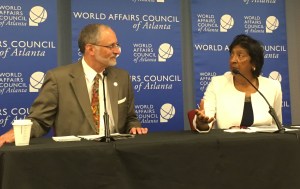
This quote by Navi Pillay aptly summarized her talk on “National Sovereignty vs. International Human Rights.” Pillay, whose renowned legal career has included posts as U.N. High Commissioner for Human Rights and as a judge on the International Criminal Court and the International Criminal Tribunal for Rwanda, spoke this morning at the University of Georgia School of Law Atlanta campus.

Elaborating on the quote above, Pillay decried national legislation aimed at restricting the activities – and with it the effectiveness – of local nongovernmental organizations. Such anti-NGO laws already have passed in Russia and are pending in Pillay’s home state of South Africa, among other countries. That said, she welcomed new means of speaking law to power; in particular, social media that permit human rights advocates to reach millions. Also welcomed were accountability mechanisms that the United Nations has developed in recent decades, such as Universal Periodic Review by the Human Rights Council, reporting processes of treaty bodies, and reports by special rapporteurs.

amann_pillayI was honored to give welcoming remarks at the breakfast. Georgia Law’s Dean Rusk International Law Center, which I lead, cosponsored this Georgia WILL event with the World Affairs Council of Atlanta and Georgia State University’s Global Studies Institute. (We owe special thanks to Judge Dorothy Toth Beasley for her hospitality this week.)

Conversing with Pillay was World Affairs Council President Charles Shapiro. They began by speaking of Pillay’s childhood in Durban, where she grew up the daughter of a bus driver. She spoke of how testifying as a 6-year-old in the trial of a man who’d stolen money from her helped spark her desire to become a lawyer – and how donations from her community helped make that dream a reality.

Shapiro then asked about capital punishment, noting a scheduled execution. Pillay acknowledged the absence of any universal treaty outlawing the death penalty, but found evidence of U.N. opposition both in the decision not to permit the penalty in U.N. ad hoc international criminal tribunals and in the growing support for the oft-repeated U.N. General Assembly resolution calling for a moratorium on capital punishment.

“It started with just 14 states against the death penalty, and is now more than 160,” said Pillay, who currently serves on the International Commission against the Death Penalty.

img_0335On this and other issues, she said, advocates endeavor to encourage states first to obligate themselves to respect and ensure human rights, and then to implement the undertakings they have made in this regard:

“The United Nations was formed by states. It is a club of governments. Look how steadily they have adopted treaties and agreed to be bound by them. That doesn’t mean we are transgressing sovereignty.”

Center Council member Anita Ninan helps promote Georgia-India links

ninan

Presenting Ninan with a Distinguish Speaker Award are, at left, Nanik Rupani, chair of the convention, and, at right, Dr. Lalit Kanodia, national president of the Indo-American Chamber of Commerce

Among those working to strengthen ties between Georgia and India is Anita E. J. Ninan, a Georgia Law alumna and member of our Dean Rusk International Law Center Council.

Ninan (LL.M. 1991) is Of Counsel, International Business Practice, at Arnall Golden Gregory LLP in Atlanta, as well as an  Advocate before the Bar Council of Delhi, India. She serves on the Board of the Georgia Indo-American Chamber of Commerce, or GIACC.

She joined a delegation of GIACC members who traveled in August to Mumbai to take part in the annual two-day conference of the Indo-American Chamber of Commerce, this year carrying the theme “Unleashing Indo-giaccU./S. economic synergy.” Ninan gave a presentation on foreign direct investment in Georgia. As quoted in a Global Atlanta article, Ninan explained:

“Indians mostly aren’t as aware of Atlanta and Georgia as they are of other places like New York, Chicago or Los Angeles so this was a good opportunity to let them know about our state’s advantages.”

Next on GIACC’s agenda: a “Bollywood Meets Georgia” film festival, set for April 2017 at Kennesaw State University.