Georgia Law Foreign and International Law Librarian Anne Burnett presents virtual program for international lawyers through the Jacksonville Urban League Center 

University of Georgia School of Law’s Foreign and International Law Librarian Anne Burnett presented “Legal Research Reimagined: AI, Exams, and the Global Legal Mindset” for the Jacksonville Urban League Center for Advocacy and Social Justice on July 14, 2025. She discussed the rapidly-evolving impact of artificial intelligence on legal research and legal education as well as providing an introduction to the variety of paths and opportunities for international lawyers.

Burnett has been the foreign and international law librarian at the University of Georgia School of Law Alexander Campbell King Law Library since 1996. Burnett serves as the primary provider of reference services for the international, foreign and comparative law collections and is a member of the library’s research team. Burnett also teaches courses in international legal research, advanced legal research and the LL.M. Legal System of the United States course.

Burnett’s previous law library experience includes the Legislative Reference Library in Austin, TX, and the Young Law Library at the University of Arkansas School of Law. Her other professional legal experience includes working as deputy legislative counsel at the Legislative Counsel Bureau for the Nevada Legislature in Carson City, NV. She also worked as a judicial law clerk for the Honorable Deborah A. Agosti, Second Judicial District Court, State of Nevada. Burnett is a member of the state bars of California and Nevada. She is active in the American Association of Law Libraries, the International Federation of

Georgia Law Professor Assaf Harpaz presents at the 2025 Law and Society Association Annual Meeting

University of Georgia School of Law Professor Assaf Harpaz  presented his paper, Artificial Intelligence and Taxpayer Entity, at the 2025 Law and Society Association Annual Meeting in May. This presentation was part of the Global Taxation and Policy panel. Harpaz also chaired the conference’s panel on Local Governments and Tax Benefits.

Below is an abstract of the paper:

Artificial intelligence (AI) is changing the world and presents numerous challenges to legal and regulatory frameworks. The evolving, complex yet still ambiguous concept demands rethinking longstanding doctrines at risk of obsoleteness. These tensions are highlighted in federal income taxation, which generally compartmentalizes taxpayers into individuals and business entities. Technological developments such as generative AI upend these conceptions given their capacity to create value and operate autonomously, interacting with the economy in ways that combine human and non-human attributes.

Under current U.S. law, even the most advanced AI models are not directly subject to the income tax regime, as they are neither individuals nor separate business entities. AI is poised to dramatically reshape the tax base by altering both the sources of income (from humans to robots) and the type of income (from labor to capital) that is subject to tax.

This article examines the intersections and frictions between AI models and federal income tax policy. It focuses on questions of taxpayer entity and ownership that arise from the widespread use of AI. The article argues that the unique and non-binary characteristics of AI challenge the principles of personhood, income, and asset character, at the foundation of the income tax system. The extent of disruption will depend on the degree to which AI displaces human labor and achieves sentience.

Harpaz joined the University of Georgia School of Law as an assistant professor in summer 2024 and teaches classes in federal income tax and business taxation. Harpaz’s scholarly focus lies in international taxation, with an emphasis on the intersection of taxation and digitalization. He explores the tax challenges of the digital economy and the ways to adapt 20th-century tax laws to modern business practices.

Georgia Law Professor Thomas Kadri selected as Visiting Fellow of the Law Department of the European University Institute in Florence, Italy

University of Georgia School of Law Professor Thomas E. Kadri was selected as a Visiting Fellow at the Law Department of the European University Institute in Florence, Italy. Kadri’s fellowship will be supported by a Sarah Moss Fellowship and the Rusk Faculty Scholar-in-Residence Program provided by the Dean Rusk International Law Center.

During his time in Florence, Kadri will expand his ongoing research pertaining to the legal and technical regulation of AI-generated “deepfakes” and focus on the European regulatory approaches to this topic. In 2024, Kadri authored his third book, Dilemmas in Digital Abuse, which discusses related topics including harmful technological advancements and the corresponding regulatory responses.

Kadri is an Assistant Professor of Law at Georgia Law Law, and his research focuses on torts and criminal law, with an emphasis on how technology, law, and social norms enable and affect privacy, speech, and abuse. His scholarship appears in journals including the Harvard Law Review Forum, UCLA Law Review, Texas Law Review, Utah Law Review, Maryland Law Review, and Journal of Free Speech Law and he has published shorter pieces in The New York Times and Slate. His course offerings include Torts, Cybercrime, and Regulating Digital Abuse.

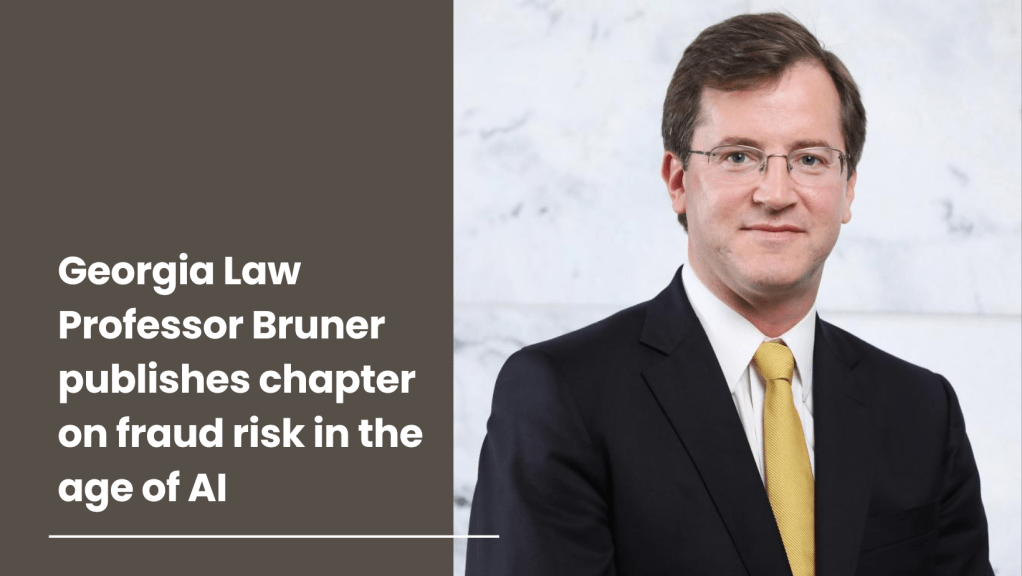
Georgia Law Professor Bruner publishes chapter on fraud risk in the age of AI

University of Georgia School of Law professor Christopher M. Bruner published a chapter titled “Managing Fraud Risk in the Age of AI” in a book titled Fraud and Risk in Commercial Law (Hart 2024), edited by professor Paul S. Davies of University College London and professor Hans Tjio of the National University of Singapore (NUS).

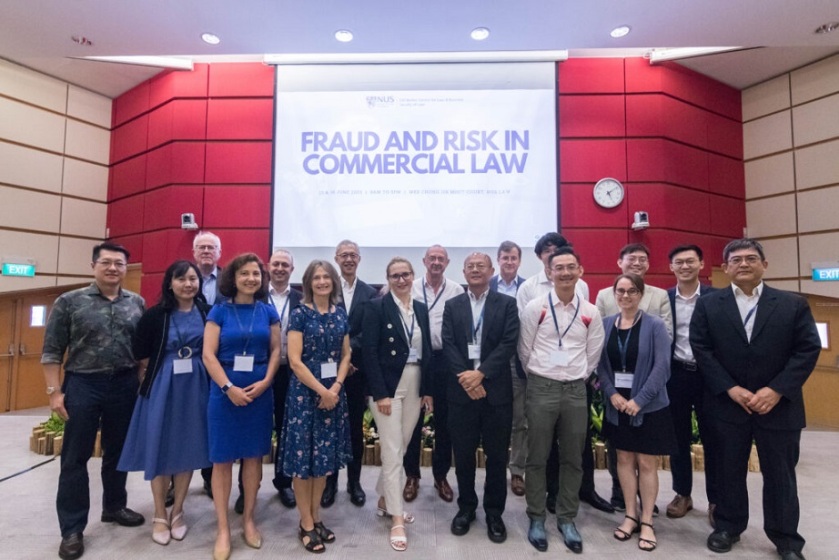
The volume includes papers presented at a conference at NUS, described in a previous post.

Below is a description of the book:

This book focuses on contemporary problems related to fraud and risk in commercial law.

It has been said by some that we are in a ‘golden age of fraud’. In part this has been caused by globalisation, technological changes and the financialisation of business. This has resulted in the creation of automated linkages with integrated supply chains and the creation of systemic risks, which have been exacerbated by new forms of intangible assets like tokens and their ease of movement. While regulation has ebbed and flowed given the desire of governments to generate economic growth, as well as the distrust of their coercive powers, the courts have sought to strike a balance between considerations such as commercial certainty and fairness.

The book provides an analysis of key contemporary issues on the theme of fraud and risk in commercial law, including: technology and fraud, secondary liability and ‘failure to prevent’ economic crime, abuse of business entities, insolvency and creditor protection, injunctions and other orders, cross-border issues, the relationship between regulation and private law, and solutions for policy makers.

Christopher M. Bruner is the Stembler Family Distinguished Professor in Business Law at the University of Georgia School of Law and serves as a faculty co-director of the Dean Rusk International Law Center.

Ninth Annual AtlAS Lecture speaker, Emory Professor Stacie Strong, considers use of artificial intelligence in international arbitration proceedings

A member of the Dean Rusk International Law Center’s staff, Global Practice Preparation Assistant Catrina Martin, attended this year’s ninth annual Atlanta International Arbitration Society (AtlAS) lecture, “Rage Against the Machine: Governing the Use of AI in International Arbitration.” AtlAS is one of the Center’s institutional partners, and Georgia Law alumnus Dr. Christof Siefarth (LL.M., ’88) is the newly-elected president. Below are some of Martin’s reflections of the event.

Earlier this month, the Atlanta International Arbitration Society co-hosted its 9th annual lecture with the Charlotte International Arbitration Society, held at Wyche Law Firm in downtown Greenville, South Carolina. Stacie Strong, Acting Professor of Law at Emory University Law, presented “Rage Against the Machine: Governing the Use of AI in International Arbitration,” to a hybrid crowd of practitioners, students, and academics.

Her lecture discussed the potential copyright concerns in using AI, such as who owns the created data, as well as privacy concerns given that AI generators have the ability to move past firewalls and other security measures. Discussion included a critique of how the increasing use of AI in arbitration, and across the broader legal field, is training students and young lawyers for the profession, and developing the building block skills of research, writing, and cite checking.

Strong advised that in arbitration, both parties agree during preliminary discussions on the use of AI, and that arbitrators proactively raise the issue with their clients.

Martin reflected on the value of this topic for law students in particular:

“[Strong’s] perspective is helpful for students who are interested in best practices in arbitration, and especially those ‘digital natives,’ for whom AI usage feels like a natural extension of technology already ingrained in their legal education, such as LexisNexis case searches. For students who are interested in international arbitration, generative AI use may offer cost and time savings on the front end, but the pitfalls, especially when arbitrating across common- and civil-law countries, outweigh this potential.”

Strong has taught at law schools around the world and has acted as a dual-qualified (England-US) practitioner with major international law firms in the UK and the US. She has also written over 130 books, articles, and other works and has acted as an expert consultant to a variety of governmental, non-governmental and intergovernmental organizations. A full biography can be found on Emory University’s website.

American Branch of the International Law Association shares reflections of Georgia Law LL.M. student Bohdan Krivuts

University of Georgia School of Law Master of Laws (LL.M.) student Bohdan Krivuts was recently featured in the American Branch of the International Law Association‘s blog. Krivuts, who served as one of ABILA’s Student Ambassadors for their 2023 International Law Weekend (ILW), writes about the panel discussion, “Global AI Regulation (Mis)Alignment Challenge.”

Moderated by Thomas Streinz and featuring panelists Adele BarzelayNathalie Smuha, and Yirong Sun, the panel addressed Artificial Intelligence, specifically the challenges and importance of regulatory schemes that address the risks associated with AI. 

As stated by Krivuts:

“…the uncontrolled usage of AI technologies poses numerous risks to users, governments, and society at large. However, when subjected to appropriate regulations, the use of AI may be beneficial. In today’s world, we can observe how AI technologies have already permeated various aspects of our lives, much like the invention of the internet reshaped the course of human progress decades ago. Therefore, to ensure the effective, and more importantly, safe utilization of AI technologies, international organizations and foreign nations should collaborate in the development of comprehensive AI regulations.”

Krivuts attended ABILA’s ILW along with 7 other Georgia Law students through the support of Louis B. Sohn Professional Development stipends, detailed in a prior post (here). Krivuts’ full blog post can be accessed here

UGA Law Professor Bruner presents “Managing Fraud Risk in the Age of AI” at the National University of Singapore (NUS)

Professor Christopher Bruner, the Stembler Family Distinguished Professor in Business Law and a newly appointed Faculty Co-Director of the Dean Rusk International Law Center, presented “Managing Fraud Risk in the Age of AI” at the National University of Singapore (NUS) in June.

Bruner’s talk was part of a conference titled Fraud and Risk in Commercial Law, organized by Professors Paul Davies (University College London) and Hans Tjio (NUS) and hosted by the EW Barker Centre for Law & Business at the NUS Faculty of Law.

Below is Bruner’s presentation abstract:

Artificial Intelligence (AI) applications are widely expected to revolutionize every dimension of business. This paper explores current and potential impacts of AI on corporate management of fraud risk in both operational and compliance contexts. Much attention has been paid to the operational efficiencies that AI applications could enable in numerous industry settings, and such systems have already become central to a range of services in certain industries – notably finance. Heavy reliance on algorithmic processes can be expected to give rise, however, to a range of risks, including fraud risks. New forms of internal fraud risk, emanating from intra-corporate actors, as well as external fraud risk, emanating from extra-corporate actors, are already placing greater demands on the compliance function and requiring greater corporate investment in responsive AI capacity to keep pace with the evolving risk management environment. At the same time, these developments have already begun to prompt reevaluation of conventional legal theories of fraud that took shape, in commercial and financial contexts alike, by reference to human actors, as opposed to algorithmic processes.

The paper begins with an overview of growing operational reliance upon increasingly sophisticated AI applications across various industry settings, reflecting the increasingly data-intensive nature of modern business. It then explores forms of internal and external fraud risk that may arise from efforts to exploit weaknesses in operational AI, which efforts may themselves involve sophisticated deployment of malicious extra-corporate AI applications – ‘offensive AI’, as the cyber security industry describes it. This can in turn be expected to require responsive corporate efforts in the form of ‘defensive AI’, and the paper describes burgeoning efforts along these lines, as well as the increasing pressure to devote substantial resources and managerial attention to these dynamics that may arise from both corporate law and commercial realities. Finally, the paper analyzes shortcomings of conventional legal theories of fraud in this context. Here the paper assesses the difficulty of applying concepts such as deception, scienter, reliance, and loss causation to algorithmic processes lacking conventional capacity for intentionality and defying conventional explanation as to how inputs and outputs logically relate – a reflection of the AI ‘black box’ problem. The paper concludes with proposals to reform corporate oversight duties to incentivize managerial attention to these issues, and to reform conventional legal theories of fraud to disincentivize malicious AI applications.