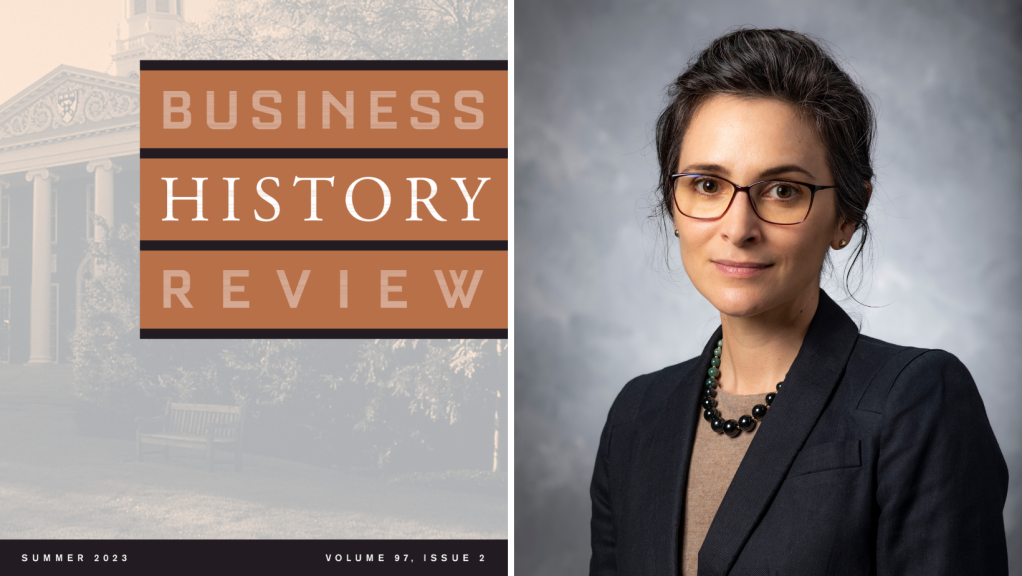
University of Georgia School of Law Professor Laura Phillips-Sawyer participated in the Business History Conference in Atlanta, Georgia earlier this year. She was one of several speakers in the Harvard Business School Workshop entitled “Globalization, Multinationals, and Institutions.” Additionally, she chaired the panel “Trust and Antitrust: Standard Oil and the Creation of the Global Economy.”
Phillips-Sawyer is an expert in U.S. antitrust law and policy. Broadly, she is interested in questions of economic regulation, which intersect with legal history, economic thought, business strategy and structure, and political organization. She currently holds the Jane W. Wilson Associate Professorship in Business Law at the University of Georgia School of Law.
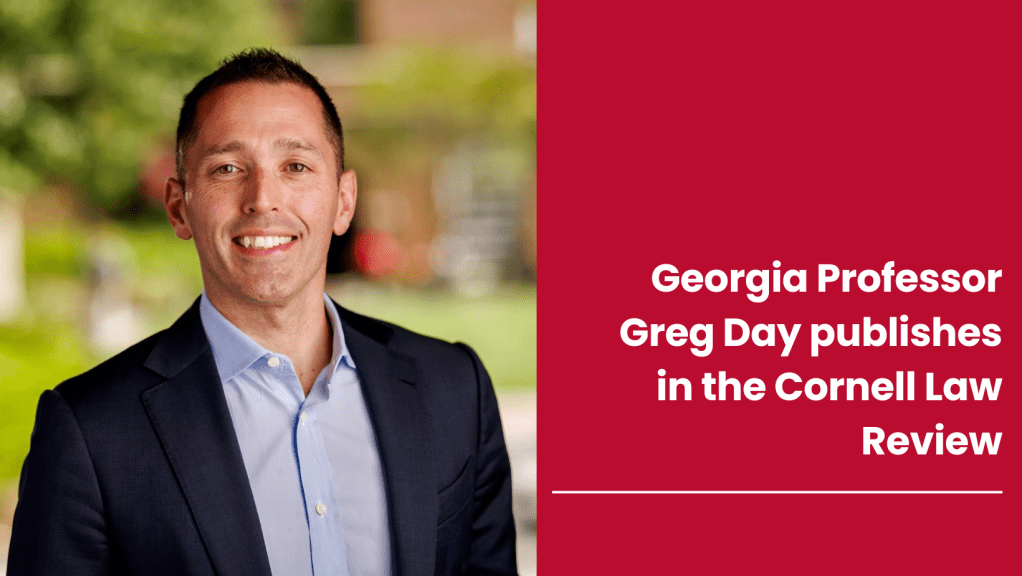
Greg Day, Associate Professor of Legal Studies at the Terry College of Business and professor (by courtesy) at the University of Georgia School of Law, published “Antitrust for Immigrants” in the Cornell Law Review.
Below is an abstract from the draft paper:
Immigrants and undocumented people have often encountered discrimination because they compete against “native” businesses and workers, resulting in protests, boycotts, and even violence intended to exclude immigrants from markets. Key to this story is government’s ability to discriminate as well: it is indeed common for state and federal actors to enact protectionist laws and regulations meant to prevent immigrants from braiding hair, manicuring nails, operating food trucks, or otherwise competing. But antitrust courts have seldom mentioned a person’s immigration status, much less offered a remedy.
This Article shows that antitrust’s “consumer welfare” standard has curiously ignored the plight of immigrants. Part of the reason is that antitrust law is characterized as a “colorblind” regime benefitting consumers collectively, meaning that it isn’t supposed to prioritize insular groups such as immigrants. Courts and scholars have also described matters of inequality and discrimination as “social harms” existing beyond antitrust’s scope. In fact, antitrust lawsuits have successfully sought to drive immigrants out of markets, alleging that competitors gained an “unfair” advantage from employing undocumented workers. Under this view of antitrust law, the exclusion of immigrants is an appropriate way of promoting competition.
This Article argues that anti-immigrant discrimination creates the exact types of harms that antitrust was meant to remedy. Since excluding immigrants can misallocate resources on citizenship or racial lines as opposed to their most productive usages, certain acts of discrimination should entail “conduct without a legitimate business purpose,” even when based solely on racial animus. A hidden type of market power is revealed in that foreign-born people are less able to employ self-help remedies to correct market failures. In addition to analyzing antitrust’s purpose and economic foundation, this Article delves into antitrust’s history to show that an original function of competition law was to protect foreigners. By demonstrating how incumbents can inflict greater levels of harm on immigrants while wielding less market power, this Article reimagines the consumer welfare standard and its colorblind approach as well as reveals how marginalized communities defy antitrust’s assumptions of self-help remedies.
Greg Day is an Associate Professor of Legal Studies at the Terry College of Business and holds a courtesy appointment in the School of Law. He is also an Affiliated Fellow at Yale Law School’s Information Society Project as well as the University of North Carolina’s Center for Information, Technology, and Public Life. His research has primarily focused on the intersection of competition, technology, innovation, and privacy as well as the disparate impact of anticompetitive conduct.
Laura Phillips-Sawyer, Jane W. Wilson Associate Professor in Business Law, recently had her review essay titled “Revisiting Interwar Global Economic Governance: Technocrats, Sovereignty, and the Perennial Problem of Legitimacy in Global Governance” published online by Cambridge University Press. Phillips-Sawyer is an expert in U.S. antitrust law and policy, and her scholarship is related to questions of economic regulation, which intersect with legal history, economic thought, business strategy and structure, and political organization.
“These two extraordinary books, written by historians of international political economy, reject that failure narrative, at least in part. While it is of course true that the League of Nations failed to stem the Great Depression or quell the forces leading to World War II, the League fundamentally changed international law. Most notably, the League represented a turn away from empire and toward international institutions, which have governed global capitalism through “technocratic internationalism” ever since (Mulder, p. 21; Martin, p. 30). Historians have too often overlooked interwar international institution-building and the steady growth of administrative rule-making because of that failure narrative. Nonetheless, recent scholarship has highlighted the novel approaches that interwar international institutions took to managing international public health, migration, drug prohibition, contraband, and colonial supervision (Martin, pp. 8, 269n21). Building on a thriving subfield of “interwar internationalism,” Mulder and Martin both argue that the First World War marked a decisive turning point in global capitalism as new international institutions eroded the power and authority of empires and created a new category of “international economic regulation” (Mulder, p. 10; Martin, p. 8). Mulder focuses on the development of economic sanctions, which were first deployed in peacetime by the League of Nations in the wake of World War I, and explains how they became commonplace despite highly undesirable and unanticipated effects. Martin shows how international institutions intervened in global capital and commodity markets in ways that shaped and limited domestic policies, especially for states with uncertain or partial sovereignty. Both books show how the devices of economic regulation developed first under the auspices of empire were repurposed for the use of international institutions and then deployed first at the periphery and then on the European continent. The bottom line is that these were novel forms of organization and intervention, which rewrote international law and laid the groundwork for post-World War II “second wave” iterations of global governance (Martin, p. 3). The League may have failed, but not for lack of power and it—alongside other international groups—left an indelible mark on global governance.”
Prior posts on Phillips-Sawyer’s scholarship can be found here.

 exchange of notes