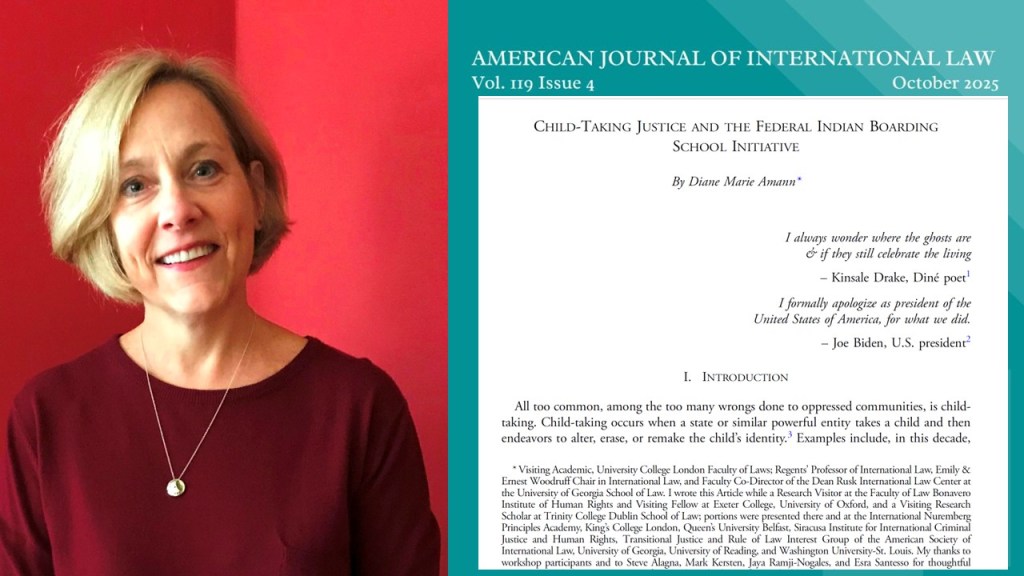
Georgia Law Professor Diane Marie Amann publishes “Child-Taking Justice and the Federal Indian Boarding School Initiative” in the American Journal of International Law

“Child-Taking Justice and the Federal Indian Boarding School Initiative,” an article by University of Georgia School of Law Professor Diane Marie Amann, has just been published in the American Journal of International Law.

Amann is Regents’ Professor of International Law, Emily & Ernest Woodruff Chair in International Law, and a Faculty Co-Director of our Dean Rusk International Law Center here at Georgia Law. During her current research-intensive semester, she is a Visiting Academic at University College London Faculty of Laws.

This new publication continues scholarly research that Amann first explored in her article “Child-Taking,” 45 Michigan Journal of International Law 305 (2024), and that she has presented at many universities and other learned societies in the United States, Ireland, and the United Kingdom.

Here’s an abstract for the new work:

The focus of this article is the 2022–2024 Federal Indian Boarding School Initiative undertaken the U.S. Executive Branch. The article chronicles this three-year process, which included sessions with survivors and their descendants, and which resulted in a two-volume report, in an apology by President Joe Biden, and in designation of a national memorial at one of the most notorious school sites. This article examines the initiative as an example of “child-taking justice”; that is, as a process of what is called “transitional justice”, done in an effort to redress the takings of children from their community, followed by efforts to alter, erase, or remake the children’s identities. The initiative shed glaring light on the past history and present effects of a centuries-old practice by which the United States took Indigenous children from their families and forced them to attend residential schools where they were compelled to submit to Westernized and Christianized notions of “civilization.”

Unfolding within the internal constitutional framework of the United States, the U.S. initiative benefited from meaningful engagement with affected communities. This article nonetheless argues for a framing that also addresses external frameworks; to be specific, one that engages fully with applicable international law and lessons learned elsewhere. The argument runs counter to the United States’ longstanding practice of holding international human rights law at arm’s length, while pressing other countries to conform to that law’s strictures. Efforts of a U.S. human-rights-at-home movement have not reversed that trend. Thus the U.S. initiative made only a hesitant overture to international issues and to three countries, Canada, Australia, and New Zealand, with which it claimed kinship. The 2025 inauguration of a President hostile to rights-based justice pointed to limitations of this approach.

Three Georgia Law students to pursue global externships in fall 2025

In the upcoming fall semester, three University of Georgia School of Law students will gain international hands-on learning experience through the Global Externships Overseas (GEO) initiative: Alexis Bartholomew (J.D. ’26), Eleanor Cox (J.D. ’26), and Kara Reed (J.D. ’26).

Two students will work in private law settings: Bartholomew with extern Gleiss Lutz in Stuttgart, Germany, while Cox will extern with Bodenheimer in Berlin, Germany, under the supervision of Dr. Christof Siefarth (LL.M. ’86). Reed has a public interest placement and will extern with the Office of the Privacy Commissioner of Bermuda under the supervision of Alexander White (J.D. ’09). Through their GEOs, students will gain experience in practice areas such as international arbitration and data privacy.

Cox has been selected as the recipient of a grant from the Halle Foundation to support her externship in Germany. Based in Atlanta, The Halle Foundation seeks to promote understanding, knowledge and friendship between the people of Germany and the United States. Cox is the third Georgia Law student to receive this grant to support a semester-long GEO in Germany, following Jack Buckelew (J.D. ’25) and Pace Cassell (J.D. ’26).

Since spring 2021, eight Georgia Law students have participated in semester-long GEOs, an extension of the Center’s existing GEO initiative that is offered jointly between the Center and the law school’s Clinical and Experiential Program. Professor Jessica L. Heywood, Clinical Associate Professor and Washington, D.C., Semester in Practice Director, teaches and directs students externing abroad in partnership with Taher Benany, Associate Director of the Dean Rusk International Law Center, who oversees the GEO initiative. Like Georgia Law’s summer GEOs, semester-long GEOs are legal placements placements around the world that offer all law students the opportunity to gain practical knowledge and experience in an international setting. They are typically supervised in their work by Georgia Law alumni/ae. Students return to Athens with new colleagues and mentors, legal practice skills that set them apart from their peers, and a deeper appreciation of the global legal profession.

***

The Center is currently accepting applications for spring 2026 semester-long GEOs; all 1L and 2L students are eligible to apply. Applications are due September 15. For more information and to access the application, please email Taher Benany: taher.benany@uga.edu

Georgia Law Professor Sonja R. West presents at Oxford’s Bonavero Institute of Human Rights

University of Georgia School of Law Professor Sonja R. West participated in two events hosted by the Bonavero Institute of Human Rights at the University of Oxford in June. First, she was part of a Comparative Media Law Workshop; then, she presented as part of a panel titled “The Future of Press Freedom” at the Democracy, Law, and Independent Journalism conference.

The Bonavero Institute is dedicated to fostering world-class research and scholarship in human rights law, to promoting public engagement in and understanding of human rights issues, and to building valuable conversations and collaborations between human rights scholars and human rights practitioners.

West holds the Otis Brumby Distinguished Professorship in First Amendment Law, a post shared by the law school and Grady College of Journalism and Mass Communication. She specializes in constitutional law, media law and the U.S. Supreme Court.

Georgia Law Foreign and International Law Librarian Anne Burnett wins award

University of Georgia School of Law’s Foreign and International Law Librarian Anne Burnett received the 2025 Daniel L. Wade Outstanding Service Award from the American Association of Law Libraries Foreign, Comparative and International Law Special Interest Section. Established in 2006, the Award honors an FCIL-SIS (“the Section”) member who has made outstanding contributions to the Section in the areas of section activity and professional service.

Burnett has been the foreign and international law librarian at the University of Georgia School of Law Alexander Campbell King Law Library since 1996. Burnett serves as the primary provider of reference services for the international, foreign and comparative law collections and is a member of the library’s research team. Burnett also teaches courses in international legal research, advanced legal research and the LL.M. Legal System of the United States course.

Burnett’s previous law library experience includes the Legislative Reference Library in Austin, TX, and the Young Law Library at the University of Arkansas School of Law. Her other professional legal experience includes working as deputy legislative counsel at the Legislative Counsel Bureau for the Nevada Legislature in Carson City, NV. She also worked as a judicial law clerk for the Honorable Deborah A. Agosti, Second Judicial District Court, State of Nevada. Burnett is a member of the state bars of California and Nevada. She is active in the American Association of Law Libraries, the International Federation of Library Associations and the American Society of International Law.

Georgia Law Professor Christopher Bruner presents on panel discussing sustainability and emerging markets

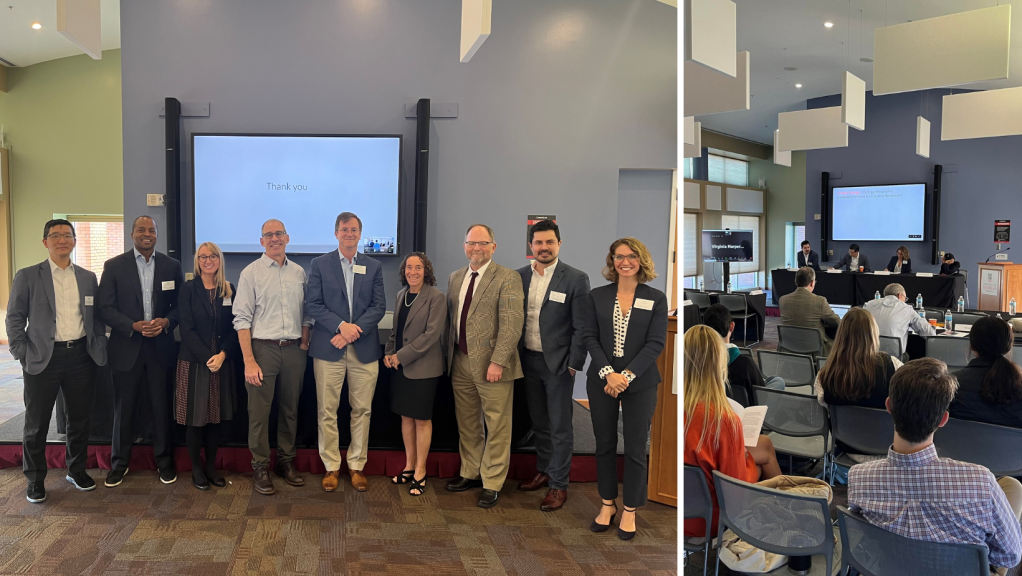
University of Georgia School of Law Professor Christopher M. Bruner presented on a panel titled “Sustainability and Emerging Markets” at the “Corporate Governance in the Global South” roundtable hosted by George Washington University Law School in Washington, D.C. The panel was moderated by Rosa Celorio, Associate Dean for International and Comparative Legal Studies and Burnett Family Distinguished Professorial Lecturer in International and Comparative Law and Policy at George Washington University Law School.

Christopher M. Bruner is the Stembler Family Distinguished Professor in Business Law at the University of Georgia School of Law and serves as a faculty co-director of the Dean Rusk International Law Center.

UGA Law Professor Bruner presents on global value chains at Tilburg Law School in the Netherlands

Christopher M. Bruner, Stembler Family Distinguished Professor in Business Law and Faculty Co-Director of the Dean Rusk International Law Center, presented his working paper, “Prospects for a US Value Chain Due Diligence Law,” at a conference hosted by Tilburg Law School in the Netherlands titled “Connecting Responsible Organizations: Legal Strategies for Sustainability in Global Value Chains.”

Bruner participated in the panel titled “Sustainable corporate governance and tax transparency.” The conference, hosted by Tilburg’s Department of Private, Business & Labour Law, aimed to provide a platform for legal experts to discuss environmental and social sustainability challenges in global value chains.

Prior posts on Bruner’s scholarship can be found here.

Video available for “ESG and Corporate Sustainability: Global Perspectives on Regulatory Reform,” conference held October 16 at UGA Law

The annual conference of the University of Georgia School of Law’s Georgia Journal of International and Comparative Law, entitled “ESG and Corporate Sustainability: Global Perspectives on Regulatory Reform,” can now be viewed online.

As posted previously, speakers representing a diverse range of doctrinal, institutional, and jurisdictional perspectives gathered on October 16 to discuss the array of contemporary ESG and corporate sustainability initiatives, mapping this rapidly evolving global landscape and engaging with the host of complex international and comparative legal challenges they raise.

Keynoting the conference was University of Pennsylvania Carey School of Law Professor Jill E. Fisch, Saul A. Fox Distinguished Professor of Business Law; Co-Director, Institute for Law & Economics.

The video links are as follows:

Introduction and Panel 1: ESG and Sustainable Finance, with Usha Rodrigues, University Professor and M.E. Kilpatrick Chair of Corporate Finance and Securities Law, University of Georgia School of Law; George S. Georgiev, Associate Professor of Law, Emory University School of Law; Virginia Harper Ho, Professor of Law, City University of Hong Kong; Stephen Park, Associate Professor of Business Law and Satell Fellow in Corporate Social Responsibility, University of Connecticut School of Business; and Anne Tucker, Professor of Law, Georgia State University College of Law.

Panel 2: Corporate Law, Corporate Governance and Sustainability, with Christopher M. Bruner, Stembler Family Distinguished Professor in Business Law and Faculty Co-Director of the Dean Rusk International Law Center, University of Georgia School of Law; Matthew T. Bodie, Robins Kaplan Professor of Law, University of Minnesota Law School; Andrew Johnston, Professor of Company Law and Corporate Governance, University of Warwick School of Law; Lindsay Sain Jones, Assistant Professor, University of Georgia Terry College of Business; and Omari Scott Simmons, Professor of Law, George Washington University Law School.

Panel 3: Multinational Corporations and Global Value Chains, with Harlan G. Cohen, Gabriel M. Wilner/UGA Foundation Professor in International Law and Faculty Co-Director of the Dean Rusk International Law Center, University of Georgia School of Law (and the GJICL’s Faculty Advisor); Sarah Dadush, Professor of Law, Rutgers Law School; David Hess, Professor of Business Law and Business Ethics, University of Michigan Stephen M. Ross School of Business; Kish Parella, Class of 1960 Professor of Ethics and Law, Washington and Lee University School of Law; and Jaakko Salminen, Associate Senior Lecturer, Department of Law, Lund University.

Keynote Address by Jill E. Fisch, Saul A. Fox Distinguished Professor of Business Law and Co-Director of the Institute for Law and Economics, University of Pennsylvania Carey Law School

This event was cosponsored by the Dean Rusk International Law Center.

Eduardo Conghos (LL.M., ’98), speaks about Argentinian environmental law at UGA Law

Director of GreenCo SA and National University of the South professor Eduardo Conghos (LL.M., ’98) spoke to students at the University of Georgia School of Law last week about environmental law in Argentina and the effects of “constitutional greening” in Latin America. The conversation was moderated by Adam D. Orford, Assistant Professor of Law.

Conghos provided students with historic context for environmental legal developments in Latin America, tracing the global period of “constitutional greening” that stretched from the 1970s through the 90s. Over these two decades, 14 of the 20 countries in Latin America encoded environmental considerations and protections into law. Some common characteristics included protection of natural resources, wildlife, and protected natural areas; a right to the environment; and a right to public participation in environmental processes. Despite these strong constitutional protections for the environment, Conghos noted that the lack of statutory laws created tension between judicial rulings in favor of environmental protection and consistent implementation and oversight of environmental regulations. He used the 2007 Argentinian Supreme Court decision, Mendoza, Beatriz Silvia et al. v. National Government et al. about damages (damages derived from the environmental pollution of the Matanza Riachuelo River) and the rulings that followed it to illustrate this conflict. Students asked Conghos about the reality of the private sector being able to adapt to new environmental regulations and whether arbitration would be the appropriate way to address some of these issues.

Conghos is an environmental lawyer, consultant, and professor based in Buenos Aires, Argentina. He is currently the Director of GreenCo S.A., an environmental consulting business that provides services to both public and private institutions. Conghos is also professor at the National University of the South in Buenos Aires, where he has worked in several faculty positions since 1999. His specialties include environmental legislation and environmental training, skills that he has honed over several decades of experience in both the public and private sectors in Argentina. Dr. Conghos received his LL.M. from the University of Georgia School of Law in 1998, as well as postgraduate degrees from the University of Salamanca, the National University of the South, the University of San Andres, and Buenos Aires University.

Kannan Rajarathinam (LL.M., ’88) speaks about the future of the United Nations at UGA Law

University of Georgia School of Law alumnus Dr. Kannan Rajarathinam (LL.M., ’88) spoke to students last week about the future of the United Nations in a multipolar world in a lecture entitled, “The UN at a Crossroads.”

Rajarathinam used his decades of experience working at the UN to frame his central question of what lies ahead for the international organization. Founded in 1945, the UN’s main focus over the past 80 years has remained the same: to provide all nations with the opportunity to work together to find shared solutions to shared challenges. From supporting refugees to providing food and vaccines globally, the UN has many ongoing campaigns that realize this vision.

One area where he felt the UN had been particularly successful is in building awareness of and consensus around the global challenge of climate change. He noted that the UN has led over twenty conferences on climate change, and, as a direct result of their commitment to this topic, climate security is a top concern for many western nations. Although there is still much work to be done, Rajarathinam stated that shared solutions, like a fund being developed to aid the Global South in managing the disproportionately-felt effects of climate change and technology-sharing to establish renewable energy systems worldwide, are more likely to find consensus due to the inclusive design of the UN.

There are many challenges to the UN’s role in the new multipolar landscape, including the emergence of regionally-focused forums like BRICS and the G20, international development initiatives like China’s Belt and Road Initiative, and ongoing conflicts like Russia’s invasion of Ukraine and the Israel-Hamas war. Rajarathinam believes that the ability of the UN to offer all 193 Member States from India to Nauru an equal vote is its main strength in withstanding this contemporary power shift. He concluded his talk by observing that, now that we are entering into a multipolar global landscape, no one country has the ability to control history anymore – and that, as a result, the world will be more colorful.

After his afternoon lecture, Rajarathinam met with current LL.M. students to discuss his career in the UN. Students shared their backgrounds and professional aspirations and were able to get advice from Rajarathinam and his wife, Usha.

Rajarathinam recently retired after nearly three decades of UN peace keeping and political work in the former Yugoslavia, Cyprus, Afghanistan, Iraq, Sudan and Somalia. Prior to the UN, he briefly practiced and taught law in India. A commentator of international and political affairs in India, he is the author of two political biographies of Indian leaders and his next work, on the political history of his state of Tamil Nadu in India is due next summer.

UGA Law 3L Meredith Williams reflects on participation in the Bavarian International Trademark Association (“BITMA”) convention in Munich, Germany

Today we welcome a guest post by Meredith Williams, a member of the University of Georgia School of Law Class of 2024. Meredith is one of several UGA Law students to participate in a semester-long international externship, a pilot extension of our existing Global Externships Overseas initiative. This pilot is a joint initiative between the Dean Rusk International Law Center and the law school’s Clinical and Experiential Program. Meredith’s post describes her experience attending an international convention as part of her externship.

I am spending the fall semester of my 3L year working as a legal extern with Weickmann, an intellectual property law firm located in Munich, Germany. I work under Dr. Udo W. Herberth (LL.M., ’96), who heads the firm’s brands and designs group.

A highlight of my global externship thus far has been attending the second annual Bavarian International Trademark Association (“BITMA”) convention, which Dr. Herberth founded. The conference took place over two days, during which I met trademark and patent attorneys from fourteen different countries. On the first day, attorneys from each country presented on the topics of 1) use and 2) jurisdiction.

My externship and this conference in particular have crystalized for me how intellectual property is an increasingly international area of law. Many clients and companies wish to register, maintain, and prevent infringement of their trademarks in more than one country; yet, there are nuanced and important distinctions between different jurisdictions’ requirements and timelines. In a field of law where adding value to a brand is crucial, it is important to be aware of these differences and stay on top of deadlines.

I enjoyed learning from the diverse group of individuals at the BITMA conference. For example, a topic I found compelling was the question of translation of trademark languages. In Canada, the Quebec charter regarding French language has been amended. Attorneys at the conference suggested this will have an impact on trademarks because the French portion of the mark must be twice the size, yet the entire trademark need not be translated. For example, in Quebec, an Apple store could display a large “Le Magasin” before “Apple,” and not have to translate “Apple” into “Pomme.” Further, in Japan, there are four different scripts, which create even more nuance to registering a word mark. These evaluations go into much more detail than we had time to cover during the conference, but it has piqued my interest as something I had never thought about living in the English-dominant US.

Another aspect of the BITMA conference that I enjoyed was the balance between personal and professional. The group of 25 of us shared many meals, watched the traditional Bavarian parade for the opening weekend of Oktoberfest, and eventually made our way to the festivities. While the substantive knowledge I acquired from this group is important, I also learned a lot from interacting with everyone on a personal level. Dr. Herberth fostered a warm and supportive atmosphere throughout the convention. This type of collegial experience served as a reminder that there is value in getting to know colleagues as people outside of work. The BITMA group treated me as an equal and were interested in my path and life. It reminded me that I want to lend a helping hand to law students and those in the early stages of their careers as I progress through mine.

I look forward to the second half of my semester working at Weickmann. I thank UGA Law for leaving such a lasting, positive impression on Dr. Herberth; it is for this reason that he was incentivized to provide educational experiences for UGA Law students like myself, and it is also why I know that I, too, want to provide this type of experience to a UGA Law student one day.