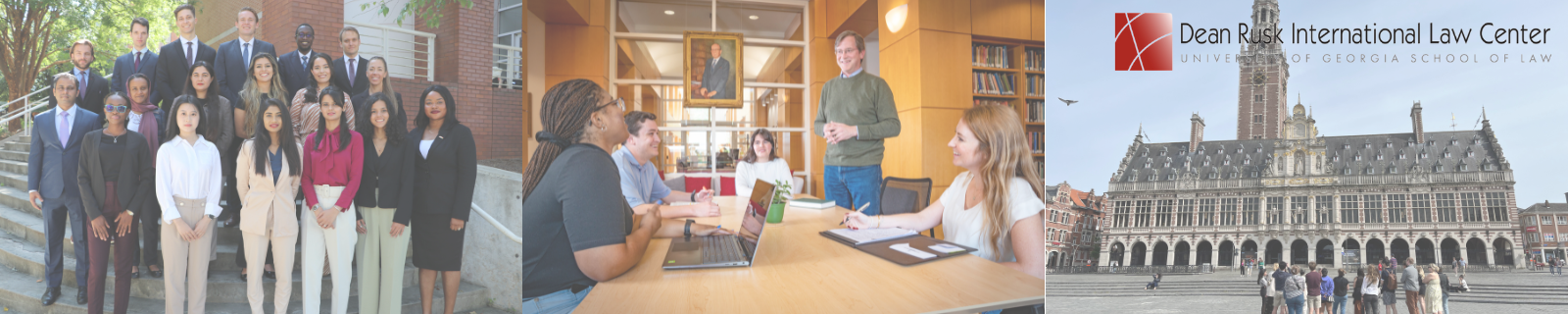
Belgium week of our Global Governance Summer School concludes on a (World Cup) celebratory note

LEUVEN – Final sessions of our 2018 Global Governance Summer School‘s Belgium leg came to an end yesterday, even as the country’s national team vaulted into the final four of the World Cup.

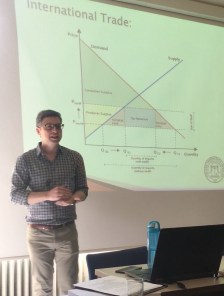
Day 5 of the summer school, devoted to Global Security Governance,  began with a lecture by Dr. Nicolas Hachez. He is a Fellow at the Leuven Centre for Global Governance Studies, University of Leuven, with which we at the Dean Rusk International Law Center, University of Georgia School of Law, partner to present the Global Governance Summer School. Hachez’ lecture began with an historical account dating to Aristotle, and ended with a survey of contemporary challenges to rule of law and democracy. (Just below, he listens to a response from Georgia Law student Brooke Carrington.) The presentation provided a valuable recap of many issues raised at the high-level RECONNECT conference our students attended earlier in the week.

Next, yours truly, Georgia Law Professor Diane Marie Amann, Emily & Ernest Woodruff Chair in International Law, one of our Center’s Faculty Co-Directors, and a founding Co-Director of the Global Governance Summer School. I introduced the concept of Global Security Governance, which incorporates within its analysis of human, national, and collective security insights from traditional international law subfields like human rights, the laws of war, and development law.

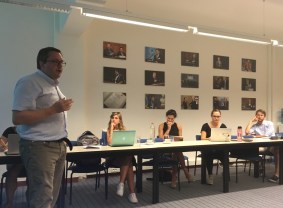
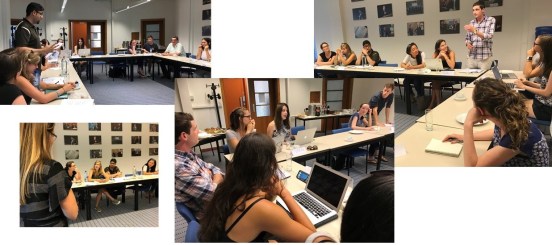
Our Center’s Director, Kathleen A. Doty, offered an overview of legal regimes related to disarmament and weapons control, including the Nuclear Non-Proliferation Treaty and the Chemical Weapons Convention. Then, as pictured at top, she led our summer school students – variously educated at Georgia Law, Leuven, and several other European institutions – in a spirited, simulated, multilateral negotiation for a new treaty to curb an imagined new development in weapons technology.

The week’s classroom component concluded with a lecture on “Global Governance, International Law and Informal Lawmaking in Times of Antiglobalism and Populism” by Leuven Professor Jan Wouters (right), Jean Monnet Chair ad personam EU and Global Governance, Full Professor of International Law and International Organizations, Director of the Leuven Centre for Global Governance Studies, and founding Co-Director of our summer school. Touching on concepts and issues introduced throughout the week, Wouters exposed shortcomings of classic international law. He further urged greater acceptance of the significance of informal lawmaking actors, norms, and processes, which form the core of global governance studies.

Leuven and Georgia Law students, faculty, staff, and friends then enjoyed a conference dinner, plus a live, and lively, screening of the Belgium Red Devils’ 2-1 World Cup victory over Brazil – then headed to Oude Markt to celebrate with other denizens of this lovely city.

Global Governance Summer School students at high-level conference on project aiming to RECONNECT Europe

Yesterday’s sessions of our Georgia Law-Leuven Centre Global Governance Summer School were devoted to a new, 4-year research project aimed at reinvigorating core values of the European Union.

Called RECONNECT: Reconciling Europe with its Citizens through Democracy and the Rule of Law and supported by funds from the EU’s Horizon 2020 Research & Innovation programme, the project has just been established by KU Leuven’s Leuven Centre for Global Governance Studies and 17 partner institutions.

Our summer school’s morning began at a classroom in Leuven, where Michal Ovádek (left), a Leuven Centre PhD candidate and research fellow,  provided an introduction to the structure of, and contemporary challenges, to European Union integration. Among them are the efforts of recently elected governments to undermine judicial independence, free press, and other democratic institutions in Poland and Hungary, as well as the aftermath of the 2016 Brexit referendum, in which a slight majority in the United Kingdom voted to leave the EU.

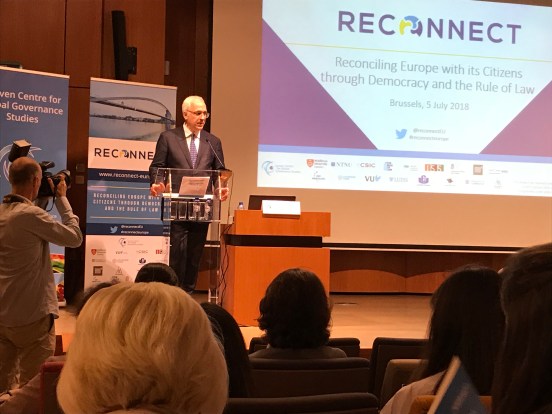
We then traveled to Brussels’ neoclassical Academy Palace, home to the Royal Flemish Academy of Belgium for Science and the Arts and the site of an afternoon conference launching the RECONNECT project.

Leuven Law Professor Jan Wouters, whose many titles include Director of the Leuven Centre for Global Governance Studies and Co-Director of our summer school, opened the conference (top photo). Stating that “the EU and its members are confronted with an existential crisis,” Wouters explained how “RECONNECT will intervene in the public discourse, to build a new narrative for Europe.” The EU can “regain authority and legitimacy through democracy and the rule of law,” he said, “provided citizens’ views taken into account.”

Delivering keynotes were H.E. Didier Reynders, Belgium’s Deputy Prime Minister and Minister of Foreign Affairs & European Affairs – who urged, as a way to reconnect, emphasizing that the EU is not just an economic project, but also based on values and principles – and Dr. Adam Bodnar, Ombudsman of the Republic of Poland.

Two policy roundtables followed:

► “Strengthening Democracy in the European Union,” chaired by Julie Smith and featuring Alberto Alemanno, Richard Youngs, Zselyke Csaky, Vivien Schmidt, Carlos Closa Montero, and Amichai Magen.

► “Addressing Rule of Law Challenges in the EU,” chaired by Laurent Pech and including Tamas Lukacsi, Philip Bittner, Peter Claes, Lotte Leicht, Petra Bárd, and Dimitry Kochenov.

Many speakers revisited developments in countries like Hungary, Poland, and post-Brexit UK, touching on issues ranging from freedom of speech to social media, economic anxiety and political processes. Europe’s responses to global migration both within and outside its borders, was another topic frequently mentioned.

In a particularly moving presentation, Lotte Leicht (3d from right), EU Director for Human Rights Watch, told of seeing, at a middle school where she recently spoke, signs saying “Be Kind” and “Treat One Another as You Want to Be Treated.” Commenting that youths “get it,” she proceeded to outline problems and to welcome innovative solutions.  Yet Leicht cautioned against adopting perceived solutions that would have negative effects:
“It is a redline when we start undermining the rule of law and our obligations under international law.”

Our stay in Leuven concludes tomorrow, after sessions on related to human rights and security governance – and, fittingly, after tomorrow night’s World Cup contest between Belgium and Brazil.

Human rights, criminal justice, NATO, business practice, reception with Georgia Law alums: Global Governance Summer School day 3, Brussels

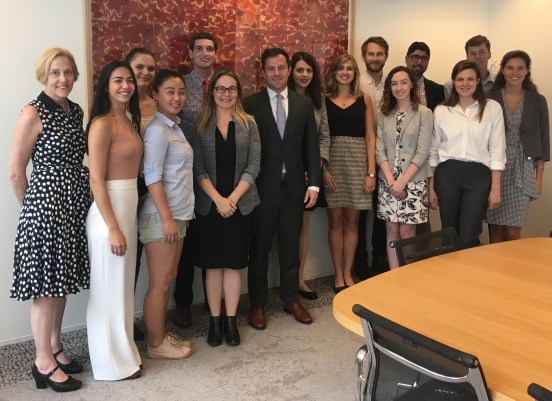
Professor Amann, Ana Sofie Silveira, Lucia Hakala, Eunjun Kim, Bryant Oliver, Professor Doty, NATO Legal Adviser Steven Hill, Hanna Karimipour, Maddie Neel, Julian Skoruppa, Brooke Carrington, Saif Ahmed, Caroline Harvey, Mills Culver, and Frances Plunkett

BRUSSELS – A variety of briefings in this Belgium capital, and home of many European Union institutions, highlighted day 3 of the Global Governance School that our University of Georgia School of Law Dean Rusk International Law Center offers with the Leuven Centre for Global Governance Studies at KU Leuven, one of Europe’s premier research institutions.

Our cohort of students from Georgia Law and multiple European universities first traveled to the Brussels office of No Peace Without Justice (left), a nongovernmental organization founded a quarter-century ago to promote “the protection and promotion of human rights, democracy, the rule of law and international justice.” There Alison A. Smith (left), Legal Counsel and Director of the organization’s International Criminal Justice Program, took part in a dialogue on “International Human Rights Lawyering” with Georgia Law Professor Diane Marie Amann, Emily & Ernest Woodruff Chair in International Law and one of our Center’s Faculty Co-Directors. Then the organization’s Secretary-General, Niccolò A. Figà-Talamanca, described the Rome diplomatic conference that led to adoption in 1998 of the Rome Statute of the International Criminal Court.

Next, Steven Hill, Legal Adviser and Director of the Office of Legal Affairs at the North Atlantic Treaty Organization, outlined the work of his office, where an 8-lawyer team serves as counsel to NATO Secretary-General Jens Stoltenburg and further liaises with NATO lawyers throughout the world. He then discussed key issues likely to be discussed at next week’s NATO Summit. (Preparations for that meeting of member states’ heads of state and government precluded a visit to the new NATO headquarters; we are grateful to the Brussels law firm Van Bael & Bellis for providing the lovely conference room, pictured above, where our students met with Hill.)

Finally, we made our way to the Brussels office of Sidley Austin LLP. There Stephen Spinks (Georgia Law JD’76), a member of our Dean Rusk International Law Center Council, led a presentation on key areas of global business practice at his office. Spinks is the immediate past managing partner of that office, and a well-known lawyer expert in matters related to EU competition (in effect, antitrust) law and trade law. Assisting in the presentation by Spinks (standing, at left) were 4 additional Sidley lawyers. From left: Dr. Michele Boggiani, who spoke on anti-corruption and life sciences law, Paul Greaves, on data privacy law, Anne Robert, on competition law, and Dr. Bregt Natens, on trade law.
The day concluded with a lively reception that Sidley kindly hosted. Participants included our students, firm attorneys, Center Director Kathleen A. Doty and myself, Sidley attorneys including Wim Nauwelaerts (LLM’94), an alumnus and head of the firm’s data privacy group, plus other Georgia Law graduates. These included: Johan De Bruycker (LLM’90), General Counsel, Ageas, Brussels; Porter Elliott (JD’96), the Van Bael & Bellis partner who helped secure a room for the morning NATO presentation; Daniel J. Felz (JD’09), an associate at Alston & Bird LLP; Professor Erik Franckxx (LLM’83), Professor of Law Director of the Department of International and European Law at Vrije Universiteit Brussel; and Dr. Christof Siefarth (LLM’86), a partner at GÖRG law firm in Cologne, Germany, and member of our Center’s Council.

Our group returns to Brussels tomorrow, to the Royal Flemish Academy of Belgium for Science and the Arts, to take part in Reconnect: Reconciling Europe with its Citizens through Democracy and the Rule of Law, a conference kicking off a 4-year-research project among 18 partners, including our partner institution, the Leuven Centre for Global Governance Studies, KU Leuven.

Contemporary challenges to global trade and sustainable development the focus of 2018 Georgia Law-Leuven Centre Global Governance Summer School day 2

IMG_2511

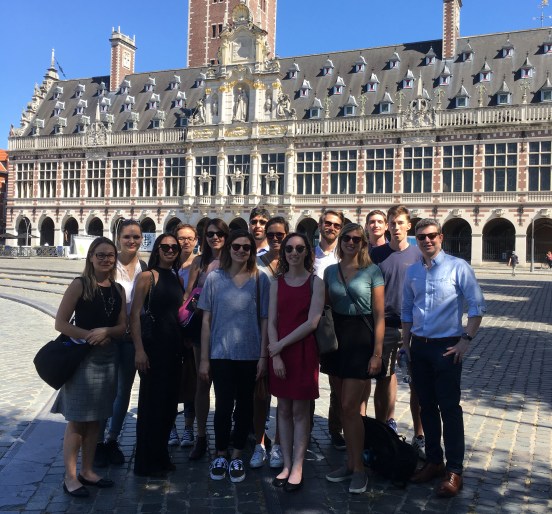
Global Governance Summer School students and faculty at the Central Library at Leuven. From Left: Professor Doty, Lucia Halala, Ana Sofia Silveira, Sarah Brugger, Hanna Karimipour, Caroline Harvey, Saif-Ullah Ahmed, Frances Plunkett, Brooke Carrington, Julian Skoruppa, Maddie Neel, Bryant Oliver, Mills Culver, Professor Cohen.

LEUVEN – Fresh from a walking tour of this centuries-old university city (top), not to mention last night’s celebrations in the Oude Markt plaza of Belgium’s breathtaking World Cup win, students in our 2018 Georgia Law-Leuven Centre Global Governance Summer School returned to the classroom today to explore contemporary challenges in the areas of global trade and sustainable development.

They took part in four lectures on the subject:IMG_2537 (1)

1st, Dr. Jan Van Hove (left), Professor of European and International Economics at KU Leuven, presented “A Political Economic Perspective on Global Economic and Trade Governance,” focusing on the changing landscape of global trade, including disruptions to traditional trade regimes.

IMG_25492d, Georgia Law Professor Harlan G. Cohen (right), Gabriel M. Wilner/UGA Foundation Professor in International Law and one of our Center’s Faculty Co-Directors, lectured on “Global Economic and Trade Law.” His lecture highlighted the issue of governance choice in the areas of trade, finance, and international business transactions.

IMG_2558 (1)3d, Leuven Law Professor Geert Van Calster (left) spoke on “Trade Policy and Sustainable Development.” Concepts like regulatory harmonization and risk management design informed his lecture.

IMG_25654th, Dr. Axel Marx (right) concluded the day with a lecture on “Challenges of the Post-Westphalian Order.” Among the challenges to traditional public international law he discussed were non-state actors and the effectiveness of international rules and standards.

Tomorrow, students will travel to Belgium’s nearby capital, Brussels, for a day of professional development briefings at a variety of law offices.

On Belgium World Cup day, 2018 Georgia Law-Leuven Centre Global Governance Summer School begins

LEUVEN – Our 2018 Global Governance School has just begun in this centuries-old university city, where sidewalks cafes are awash in outdoor plasma screens and bedecked with Belgian flags, all in anticipation of the Red Devils’ knockout World Cup match this evening against Japan.

This is the 2d year that our University of Georgia School of Law Dean Rusk International Law Center has presented this summer school in partnership with the Leuven Centre for Global Governance Studies at KU Leuven, one of Europe’s premier research institutions. It continues a 4-decades-old Georgia Law tradition of summer international education in Belgium.

Today, students from Georgia Law and a range of European universities came together for three lectures designed to introduce them to the concept and practice of global governance:

1st, yours truly, Georgia Law Professor Diane Marie Amann (left), Emily & Ernest Woodruff Chair in International Law and one of our Center’s Faculty Co-Directors, presented a classical account of international law. Using the example of the ongoing controversy over the Chagos Islands, I then raised questions of the challenges posed by the state-centric system at the core of that account.

2d, Dr. Leonie Reins (below), an Assistant Professor in Law at Tilburg University in the Netherlands, focused on issues related to climate change as a way to explore challenges of international environment law governance.

3d, Georgia Law Professor Harlan G. Cohen (top), Gabriel M. Wilner/UGA Foundation Professor in International Law and one of our Center’s Faculty Co-Directors, answered the question “Why Global Governance?” Concepts like the tragedy of the commons and game theory informed his presentation.

The week’s coursework resumes tomorrow, when a quartet of American and European experts will deliver lectures on trade and sustainable development.

Summer 2018 GEOs & Summer School: Georgia Law Students take off around the globe

Globe (002)_kdIn the weeks ahead, 13 rising 2L and 3L students at the University of Georgia School of Law will depart for Global Externship Overseas (GEO) and Global Externship At Home (GEA) placements all around the world. Administered by the Dean Rusk International Law Center, the GEO and GEA initiatives place Georgia Law students in externships lasting between four and twelve weeks, and offer students the opportunity to gain practical work experience in a variety of legal settings worldwide.

This summer, GEO students will undertake placements in law firms, in-house legal departments, nongovernmental organizations, and intergovernmental organizations across Europe, Asia, and the Pacific. Practice areas include: dispute resolution, corporate law, international trade law, intellectual property law, international human rights law, refugee law, cultural heritage law, and international environmental law.

This year’s GEO class includes the following students, who will complete placements in private law settings:

  • Brooke Carrington (2L) – Buse Heberer Fromm, Frankfurt, Germany
  • Brad Gerke (3L) – Ferrero S.A., Luxembourg
  • Ashley Henson (2L) – PwC, Turin, Italy
  • Maddie Neel ­(2L) – GÖRG, Cologne, Germany
  • Nicole Song (2L) – Araoz y Rueda, Madrid, Spain

Additionally, the following students will work in public interest law placements:

  • Zoe Ferguson (2L) – War Child, Amsterdam, Netherlands
  • Drew Hedin (2L) – Secretariat of the Pacific Regional Environment Programme, Apia, Samoa
  • Hanna Karimipour (2L) – No Peace Without Justice, Brussels, Belgium
  • Matt Isihara (3L) – Boat People SOS, Bangkok, Thailand
  • Devon Pawloski (2L) – Documentation Centre of Cambodia, Phnom Penh, Cambodia
  • Frances Plunkett (2L) – Open Society Justice Initiative, The Hague, Netherlands

Last, but certainly not least, two students will undertake GEA placements in Washington, D.C.:

  • Casey Callahan (3L) — International Trade Administration, U.S. Department of Commerce
  • Caroline Harvey (2L) – The Antiquities Coalition

Finally, during the first ten days of July, eight Georgia Law students will gather in Leuven, Belgium for the Global Governance Summer School, which the Center again co-presents with the Leuven Centre for Global Governance Studies. Students will spend several days in classroom sessions at Leuven, and then spend two days in Brussels: one to attend a high-level policymaking event, and the other on professional development visits at a law firm, a nongovernmental organization, and an intergovernmental organization.  The group will then proceed to The Hague, Netherlands, for several days of briefings at international courts and tribunals and other cultural excursions.

Join us in wishing these students an unforgettable summer, and stay tuned for travel updates in the coming months!

At the centenary of chemical warfare, a visit to Flanders’ WWI battlefields

YPRES, Belgium – Beautiful vistas and bright sunlight cannot blind the visitor to the pain of this place.

This place is Flanders Fields, the name given to the part of west Belgium, close to the French border, that saw intense battles and horrendous casualties during World War I. This town – Ypres in French and Ieper in Flemish, but called “Wipers” by British WWI soldiers – played a central role. So too nearby Passchendaele/Passendale. Both towns were leveled, and like many in the region, were rebuilt in the old manner after the war ended.

During the war, upwards of half a million persons died in this area alone.

Our visit to Flanders Fields occurred on the 4th of July. Memories linger, and were sparked again by today’s commemoration of the 100th anniversary of the 1st large-scale use, in Ypres, of chemical weapons; mustard gas, to be precise. It was the 3d compound to be attempted, after chlorine and phosgene proved less reliable as lethal weapons, according to our tour guide, Raoul Saracen, a retired history teacher. Initial efforts to fight back against chemicals also were crude: before the development and widespread distribution of gas masks, Canadian troops resorted to breathing through kerchiefs soaked in ammonia-rich urine.

The cruelty of chemical warfare did not stop its use. Recording other places where chemicals have been used was a signpost in Langemark, the cemetery where German soldiers (including several with whom I share a surname) are buried. Tokyo, Japan, Halabja, Iraq, and Ghouta, Syria, receive mention, though more recent gassing sites in that last country have yet to be added.

The thousands of headstones in the many Flanders Fields cemeteries of course give pause. So too the cramped trenches, still on display at Sanctuary Wood Museum.

Yet it was a different site that stole my breath – the “dressing station,” a kind of field hospital, at Essex Farm Cemetery. The station’s cement-bunker cells were small, dark, and saddening, a truly concrete reminder of the scourge of war.

(Cross-posted)


Georgia Law students sweeping the planet as Summer 2017 Global Externs

This summer, twenty law students will earn practice experience through our Global Externship initiative. Most will be GEOs, or Global Externs Overseas, while a couple are GEAs, or Global Externs At-Home. Some will complement this experience with participation in our Global Governance Summer School in Belgium and the Netherlands.

Administered by our Dean Rusk International Law Center, University of Georgia School of Law, the decades-old Global Externship enables Georgia Law students to gain practice experience via placements at law firms, in-house legal departments, government agencies, and nongovernmental organizations around the world. Thanks to generous donations, virtually all Global Externs receive financial support from law school funds; a few receive funds from their placement. (Posts about last year’s Global Externs here and here.)

This year’s class of rising 2Ls and 3Ls will work in Africa, North America, Asia, Europe, and the Middle East. The class includes twelve students in business-law placements, in practice areas including intellectual property, finance, environment, and trade:

Taryn Arbeiter, U.S. Court of International Trade, New York, New York
► Casey Callahan – Buse Heberer Fromm, Frankfurt, Germany
► James Cox – PSA Legal, New Delhi, India
► Nicholas Duffey – GÖRG, Cologne, Germany
► Brian Griffin – PwC, Milan, Italy
► Karen Hays – Fererro, Luxembourg
► Matt Isihara – MV Kini, New Delhi, India
► George Ligon – PwC, Milan, Italy
► Nils Okeson – Maples Teesdale, London, England
► Matt Poletti – Araoz & Rueda, Madrid, Spain
► Nicholas Steinheimer – PSA Legal, New Delhi, India
► Ezra Thompson – Al Tamimi & Co., Dubai, United Arab Emirates

The remaining eight students will be in public interest law placements, working on issues such as international criminal law, international child law, and international human rights:

► Jeremy Akin – Research Assistant for Professor William A. Schabas, Middlesex University, London, England
► Lauren Brown – War Child, Amsterdam, The Netherlands
► Jennifer Cotton – Global Coalition to Protect Education from Attack / Human Rights Watch, New York, New York
► Wade Herring – Open Society Justice Initiative, The Hague, The Netherlands
► Zack Lindsey – Women in Law and Development in Africa, Accra, Ghana
► Lyddy O’Brien – No Peace Without Justice, Brussels, Belgium
► Azurae Orie – Global Coalition to Protect Education from Attack / Human Rights Watch, remote research from Athens, Georgia
►Rebecca Wackym – Legal Unit of the Hebron Rehabilitation Committee, Israel

Join us in congratulating them on their success and wishing them a great summer!

Applications now welcome for 2017 Global Governance Summer School, presented by Georgia Law & Leuven Centre for Global Governance Studies

We at the Dean Rusk International Law Center at the University of Georgia School of Law, are proud to partner with the Leuven Centre for Global Governance Studies at the University of Leuven, to present our 2017 Global Governance Summer School. The Summer School’s core events will take place June 26-30 in Belgium.

Georgia Law students will join at Leuven a target audience of: advanced students in international law, international relations, international political economy, and international and European studies; and practitioners and policy experts who wish to update their knowledge on developments in global governance and international law. We partner institutions welcome applications from such individuals; register here.

International_Court_of_Justice.jpg

Peace Palace at The Hague in the Netherlands, home of the International Court of Justice

Our Georgia Law students will begin their European journey with a 3-day professional development trip to The Hague, site of many international legal institutions. Plans include attendance at the trial  of Prosecutor v. Ongwen at the International Criminal Court, touring the Peace Palace and a briefing at the International Court of Justice, and an audience with a judge and legal advisers at the Iran-U.S. Claims Tribunal.

Our students then will travel to the centuries-old University of Leuven, one of Europe’s premier research institutions, to take part, alongside other participants, in the Belgium-based Global Governance Summer School. The program is as follows:

universiteitsbibliotheek.jpg

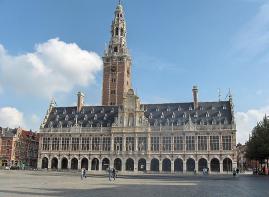
University Library, University of Leuven, Belgium

► June 26-28, participants will attend classroom seminars on issues of international law and global governance, including global economic and trade governance and global human rights, rule of law, and security governance. Instructors include the Summer School’s co-directors, Georgia Law Associate Dean Diane Marie Amann and Leuven Professor Jan Wouters, along with others from both universities: from Georgia Law, Professor Harlan Cohen and Kathleen A. Doty, our Center’s Director for Global Practice Preparation; from Leuven, Dean Bart Kerremans, Professors Horst Fischer, Dominik SteigerGeert Van Calster, Drs. Matthieu Burnay and Nicolas Hachez, and Senior Researcher Philip De Man.

► Next, on June 29, Summer School participants will participate in International Law and Global Governance in a Turbulent World, an expert conference featuring three panels composed of scholars and practitioners from around the world:

  • Global Governance of Human Rights. How to enforce universal values in contested world?
  • Global Governance of Democracy and Rule of Law in international perspective.
  • Global Economic and Trade Governance in Protectionist Times. Will we see the emergence of trade wars in the coming years?
20150127_sg_report-2014-photo-7.jpg

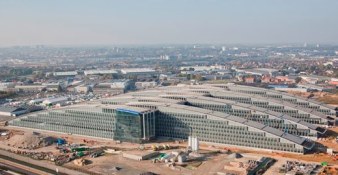
Headquarters of the North Atlantic Treaty Organization, Brussels, Belgium

► The Summer School will conclude on June 30 with a professional development trip in Brussels, where students will visit the headquarters of the North Atlantic Treaty Organization and the office of the global law firm Sidley Austin LLP.

Further information here; registration for the Belgium-based components of the Summer School here.

Belgian Consul General de Baets featured at Global Atlanta luncheon

willem

Pictured at front, from right: Belgian Consul General William de Baets and Phil Bolton and Trevor Williams, respectively, publisher and managing editor of Global Atlanta.

For decades, we at the University of Georgia School of Law have welcomed collaboration with Belgium and its people and institutions. Even before 1978, when Belgium’s national airline became the 1st foreign carrier to fly nonstop to Atlanta, a Belgian attorney became the 1st foreign-trained lawyer to earn Georgia Law’s Master of Laws (LL.M.) degree. And thanks to the hard work and generosity of Georgia Law professors like Gabriel Wilner and our Center’s namesake, former U.S. Secretary of State Dean Rusk, we’ve partnered with leading Belgian universities to offer summer seminars on issues related to international  law and policy, often with a focus on European Union and transatlantic cooperation. That tradition will continue via this summer’s global governance school at the home of our partner, the Leuven Centre for Global Governance at the University of Leuven, one of Europe’s premier research institutions.

Thus it was a special pleasure to attend last Friday’s “Consular Conversations: Luncheon Interview With Belgium’s Consul General,” held at the Atlanta office of Miller & Martin, where Tom Harrold, Georgia Law alumnus and member of our Dean Rusk International Law Center Council, leads the International/World downloadLaw practice group. The event was part of a series of conversations sponsored by another Center partner, Global Atlanta.
Guest of honor was William de Baets, who’s served since last April as Belgium’s top diplomat in the Southeastern United States. In a wide-ranging conversation with Phil Bolton and Trevor Williams, Global Atlanta’s publisher and managing editor, de Baets explained he’d joined Belgium’s foreign service following 9 years as a Navy officer. Postings before his arrival at Atlanta included deputy head of mission in Côte d’Ivoire, Ethiopia, and Venezuela, and political counselor at Belgium’s embassy in Washington, D.C.

De Baets said that his office provides consular services and also engages in public and economy diplomacy; Friday’s conversation fulfilled the latter role. He spoke to a full house – a testament to the fact that Belgium ranks among the top 10 foreign investors in Georgia, which is home to more than 70 Belgian companies and more than 5,000 Belgian nationals.

Asked about Belgium’s renown as the home of Tintin and the Smurfs, not to mention 20th C. surrealists like René Magritte, de Baets recalled an artistic tradition that reaches back to the 16th C. Flemish master, Peter Paul Rubens. Additionally, Belgium did not gain independence until 1830; before that “the territory kept changing hands and was ruled by other people,” he noted. “We couldn’t speak up too much. We were saying yes and thinking no, or saying yes and doing what we wanted to do. It was a source of our humor – we couldn’t take ourselves too seriously.”

Again answering a question, de Baets spoke of his father’s participation in the resistance during Germany’s occupation of Belgium during World War II.

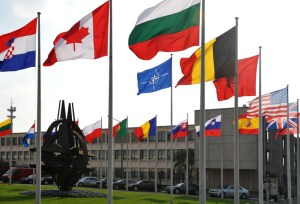
Flags of the 28 NATO member countries

Conversation then turned to Belgium’s role in contemporary matters. Regarding Brussels-based NATO (right), the defense alliance established 68 years ago by the North Atlanta Treaty, de Baets noted apparent disagreement within the new U.S. administration. Indeed, earlier in the week the South Carolina Governor tapped to become U.S. Ambassador to the United Nations, Nikki Haley, had called NATO “important.”

Although the United States can defend itself without NATO, Europe cannot, and so de Baets advocated strengthening the European Union’s security pillar to offset any weakening of NATO. Such alliances are essential for countries like Belgium and its neighbor, Luxembourg. Yet de Baets acknowledged difficulty in achieving the goal, given disagreement among EU member states – including Britain, even before its people voted in favor of Brexit.

Dubbing compromise a “Belgian export,” de Baets indicated that his country could a key role in aiding Europe’s efforts to resolve crises in financial and security sectors, as well as migration. The goal, he said, is to “strengthen our security without giving up our values.”