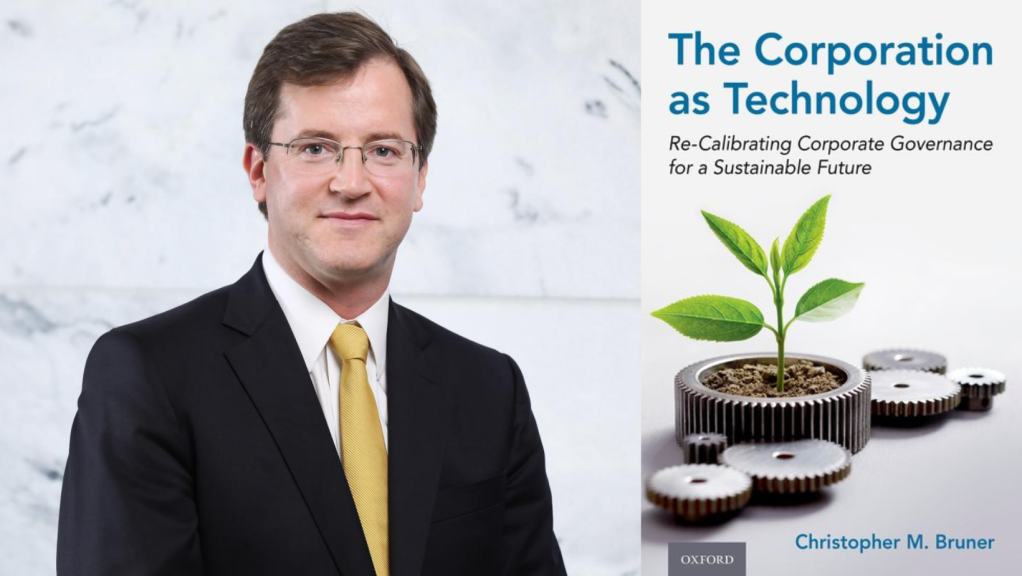
Recent decades have witnessed environmental, social, and economic upheaval, with major corporations contributing to a host of interconnected crises. The Corporation as Technology examines the dynamics of the corporate form and corporate law that incentivize harmful excesses and presents an alternative vision to render corporate activities more sustainable.
The corporate form is commonly described as a set of fixed characteristics that strongly prioritize shareholders’ interests. This book subverts this widely held belief, suggesting that such rigid depictions reinforce harmful corporate pathologies, including excessive risk-taking and lack of regard for environmental and social impacts. Instead, corporations are presented as a dynamic legal technology that policymakers can re-calibrate over time in response to changing landscapes.
This book explores the theoretical and practical ramifications of this alternative vision, focusing on how the corporate form can help secure an environmentally, socially, and economically sustainable future.
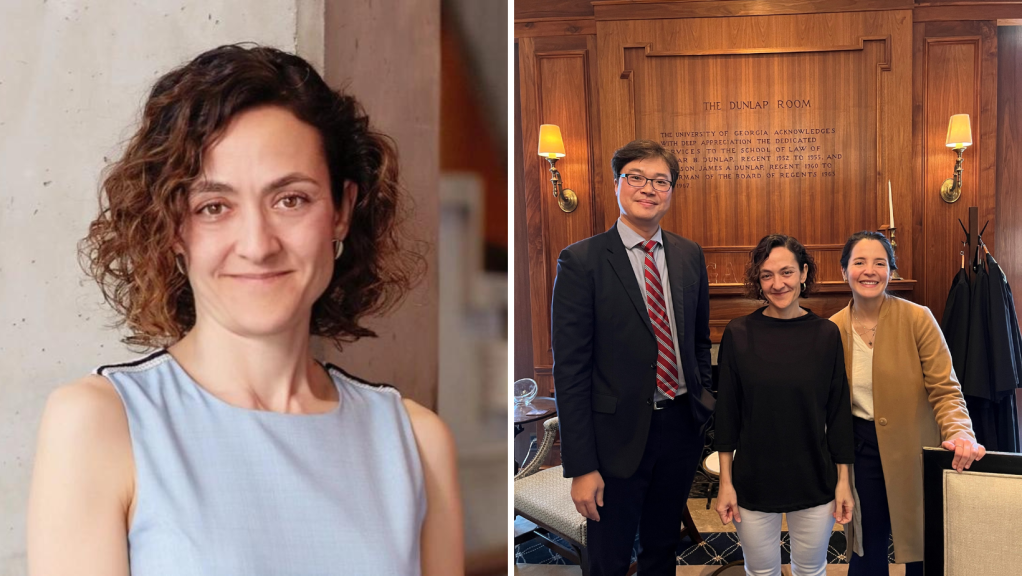
The Dean Rusk International Law Center Visiting Researcher for 2023-2024, Mine Turhan, Assistant Professor of Administrative Law in the Faculty of Law at the Izmir University of Economics in Türkiye, recently concluded her research year at the University of Georgia School of Law under the supervision of Georgia Athletic Association Professor in Law David E. Shipley. Below are some of Turhan’s reflections on her research findings regarding administrative procedure and procedural fairnessat Georgia Law.
I was a visiting researcher at the University of Georgia School of Law and the Dean Rusk International Law Center for my post-doc research during 2023-2024 academic year.
My research was related to administrative procedure and procedural fairness. The concept of administrative procedure serves a dual purpose within a legal framework. Primarily, it defines and establishes the limits of the authority of administrative agencies by outlining the structured steps and processes they must follow. Simultaneously, administrative procedure prevents arbitrary actions of agencies by ensuring accurate decisions by the proper application of the law to the facts. This dual function promotes transparency, fairness, and accountability in the functions of administrative agencies.
My research focused on the right to be heard in administrative procedure, and administrative hearings during the process of individual measures which would adversely affect the person concerned. I looked specifically at American and European procedural rights in adjudicative proceedings, in particular the right to be heard before administrative agencies. I tried to answer how procedural rights were protected by different administrative procedures in the U.S. and European countries against arbitrary actions of administrative agencies. I also tried to understand the administrative hearing procedures and components of hearings in common law and civil law systems.
Administrative procedure acts have a significant role in protecting the procedural rights. Therefore, I focused on the administrative procedure acts of different countries to find an answer. The U.S. Administrative Procedure Act, dated 1946, was helpful for my research. I have analyzed the court precedents regarding the right to be heard and I also have observed administrative hearings in U.S. to better understand administrative hearing procedures in U.S.
Throughout my time at the Dean Rusk International Law Center, I have been impressed by the dedication of the faculty, scholars, and staff to fostering a dynamic learning environment. The guidance and mentorship I received from Professor David Shipley has been instrumental in shaping my research. His expertise and encouragement have inspired me to push the boundaries of my intellectual curiosity and pursue excellence in my studies. The resources available at the School of Law, including the extensive library collections and research databases, have greatly enriched my research endeavors.
As I reflect on my time at the Dean Rusk International Law Center, I am filled with appreciation for the enriching experiences and lasting connections forged during my research. The skills and insights gained through my research studies will undoubtedly serve me well in my future endeavors, both academically and professionally.
I extend my heartfelt thanks to everyone at the Dean Rusk International Law Center and the University of Georgia School of Law for their support and encouragement. I am proud to have been a part of such an vibrant academic community and look forward to carrying forward the relationships formed as I embark on the next chapter of my journey.
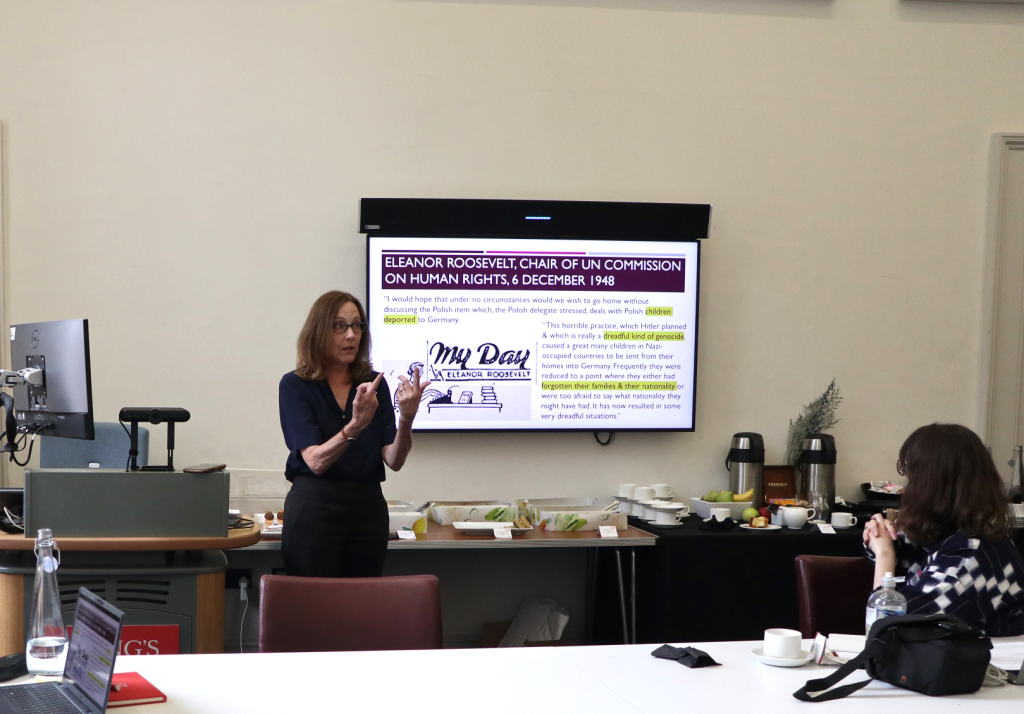
Professor Diane Marie Amann recently presented her research on “Child-Taking” during a Forced Separation Workshop at King’s College London, which cosponsored the event along with Queen’s University Belfast School of Law and the UK Gender, Justice and Security Hub.
Organizers of the workshop – Professor Fionnuala Ni Aolain, Dr. Rebekka Friedman, and Dr. Diana Florez – brought together a global array of participants who engaged in a multidisciplinary exploration of instances and consequences of separating families. Studied were contemporary and historical contexts across the globe. They included: armed conflict and similar violence; security, carceral, and migration detention; coerced schooling; enslavement; and illegal adoptions.
Amann’s talk drew from her article, “Child-Taking,” soon to be published in the Michigan Journal of International Law. (Preprint draft available at SSRN.) As Amann theorizes it, child-taking occurs when a state or similarly powerful entity abducts children from their community and then endeavors to remake the children in its own image. This conduct, involving children taken from Ukraine, lies at the heart of the International Criminal Court warrants pending against President Vladimir Putin and another top Russian official. The article also examines other examples of the phenomenon, including the Nazis’ kidnappings of non-German children during World War II and the forced placement of Indigenous children into boarding schools in North America, Australia, and elsewhere.
Amann is Regents’ Professor of International Law, Emily & Ernest Chair in International Law, and Faculty Co-Director of the Dean Rusk International Law Center here at the University of Georgia School of Law. She writes and teaches in areas including child and human rights, constitutional law, transnational and international criminal law, and global legal history.
A member of the Dean Rusk International Law Center’s staff, Global Practice Preparation Assistant Catrina Martin, attended this year’s ninth annual Atlanta International Arbitration Society (AtlAS) lecture, “Rage Against the Machine: Governing the Use of AI in International Arbitration.” AtlAS is one of the Center’s institutional partners, and Georgia Law alumnus Dr. Christof Siefarth (LL.M., ’88) is the newly-elected president. Below are some of Martin’s reflections of the event.
Her lecture discussed the potential copyright concerns in using AI, such as who owns the created data, as well as privacy concerns given that AI generators have the ability to move past firewalls and other security measures. Discussion included a critique of how the increasing use of AI in arbitration, and across the broader legal field, is training students and young lawyers for the profession, and developing the building block skills of research, writing, and cite checking.
Strong advised that in arbitration, both parties agree during preliminary discussions on the use of AI, and that arbitrators proactively raise the issue with their clients.
Martin reflected on the value of this topic for law students in particular:
“[Strong’s] perspective is helpful for students who are interested in best practices in arbitration, and especially those ‘digital natives,’ for whom AI usage feels like a natural extension of technology already ingrained in their legal education, such as LexisNexis case searches. For students who are interested in international arbitration, generative AI use may offer cost and time savings on the front end, but the pitfalls, especially when arbitrating across common- and civil-law countries, outweigh this potential.”
Strong has taught at law schools around the world and has acted as a dual-qualified (England-US) practitioner with major international law firms in the UK and the US. She has also written over 130 books, articles, and other works and has acted as an expert consultant to a variety of governmental, non-governmental and intergovernmental organizations. A full biography can be found on Emory University’s website.
In her role at the Center, Torchia assists with integral Center tasks, including: drafting blog posts, conducting research on international programs at a national level, designing social media graphics assisting with event setup and cleanup, and promoting the law school’s international programs at university-wide events, including the fall 2023 Study Abroad Fair, shown above in the top left.
One of her nominators for the award, Sarah Quinn, director of the Dean Rusk International Law Center, shared the following:
“Not only does Tiffany conduct all of her responsibilities with exquisite attention to detail and professionalism, but she also takes the initiative to make things better. This comes from a place of deeply understanding and believing in the mission of our Center, and also being a caring, conscientious, and thoughtful person.
As a place on campus that welcomes many international students and visitors, having Tiffany as the face of our Center at the desk in our lobby has been an immeasurable asset. She is helpful, kind, empathetic, and patient with stressed-out students who are thousands of miles away from their homes and are engaged in demanding coursework, and she takes the time to greet and speak with everyone who walks through our Center doors as though she is greeting close friends. No matter if we have a consul general or a prospective student walking through our Center doors, I know that Tiffany’s will greet them AND leave them with a positive impression of our Center and the work that we do.“
Each spring, UGA coordinates a selection process and chooses the Student Employee of the Year to recognize the outstanding contributions and achievements of students. For more information about the annual award, please visit the UGA Career Center’s website.
For over a decade, our international law initiatives have ranked in the top 20 or so among U.S. law schools. In this year’s rankings, our international law curriculum tied with Northwestern University (Pritzker) Law, University of California (Davis) Law, and Vanderbilt University for the No. 20 spot. (The University of Georgia School of Law, as a whole, earned a No. 20 ranking this year for the second year in a row, as is posted here.)
► Superb members of the law faculty, including: Dean Peter B. “Bo” Rutledge, an international arbitration expert; the Center’s Faculty Co-Directors, Professors Diane Marie Amann, an expert in peace-and-security fields including the laws of war, child rights, and international criminal justice, and Christopher M. Bruner, a comparative corporate governance scholar. Among those supporting their efforts are many other Georgia Law faculty and courtesy faculty members, including: Thomas Burch, who leads the Appellate Clinic that has won clients relief under the Convention Against Torture; Anne Burnett, foreign and international law research librarian; Jason Cade and Clare Norins, who recently led a clinical team in securing federal redress for immigration detainees; Nathan S. Chapman, a scholar of due process and extraterritoriality; Jessica L. Heywood, Director of the Washington, D.C. Semester in Practice; Thomas E. Kadri, whose expertise includes cybercrime and global data privacy; Elizabeth Weeks, a health law specialist; Jonathan Peters, a journalism and law professor expert in international media and free speech; Laura Phillips-Sawyer, an expert in antitrust law and policy; Kalyani Ramnath, a global legal historian who focuses on South Asia; Lori A. Ringhand, a scholar of comparative constitutional law and elections law; Tim Samples, whose scholarship includes global digital platforms agreements; Kent Barnett, Sonja West, and Elizabeth Chamblee Burch, who have presented overseas on administrative law, media law, and civil procedure, respectively; Adam D. Orford, an environmental and energy law scholar; Kristen E. Shepherd, who developed and teaches the Legal Spanish curriculum; Walter Hellerstein, a world-renowned tax specialist; and Michael L. Wells, a European Union scholar.
► Visiting Scholars and Researchers, including, Mine Turhan, an assistant professor of administrative law in the Faculty of Law at the Izmir University of Economics in Türkiye, and Daesun Kim, an attorney practicing law in Vietnam who specializes in cross-border M&A, foreign investment, and public-private partnerships.
► Graduates who excel as partners in international commercial law firms, as heads of nongovernmental organizations and international organizations, as in-house counsel at leading multinational enterprises, and as diplomats and public servants – and who give back through participation in our Dean Rusk International Law Center Council, through mentoring, speaking with students (like Kannan Rajarathinam, Eduardo Conghos, Alexander White, Ellen Clarke, and Clete Johnson), and through other support.
With thanks to all, we look forward to continuing to strengthen our initiatives in international, comparative, transnational, and foreign relations law – not least, in the preparation of Georgia Law students to practice in our globalized legal profession.
Wilson-Wade and Vaughn attended the event with undergraduate and graduate students from across campus, including from the School of Public and International Affairs and from the Washington Semester program. Students were able to hear about Driehaus’ career and ask him questions about the relationship between domestic politics and international development.
Driehaus represented Ohio’s 1st Congressional District from 2008 to 2010. While in the House of Representatives, he focused on issues related to regional development, financial reform, and government accountability. Before serving in the U.S. House, Driehaus spent eight years in the Ohio Statehouse, including time as House Minority whip. He served for three years as Resident Senior Director in Iraq for the National Democratic Institute (NDI), a non-profit NGO that works around the world to safeguard democratic institutions. Driehaus is a founding member of the Good Government Group, a full-service public policy and public relations consulting firm. Additional work experience includes time as the Executive Director of Cincinnati Compass and Country Director for the United States Peace Corps in Morocco and Swaziland.
In the article, Quinn discusses the Center’s focus on providing Georgia Law students with opportunities to globalize their legal education. She highlights the Center’s student-facing programming, including Global Governance Summer School, Global Externships Overseas, the NATO Externship, and semester-long exchanges with institutional partner O.P. Jindal Global University’s Jindal Global Law School. Explaining how the Center encourages all J.D. students to consider participating in these programs, Quinn states:
“We underscore to our students just how globalized the practice of law is— even [students] aspiring to work domestically can benefit from taking an international law course or gaining work experience abroad.”
Quinn provides information about the Center’s initiatives for foreign-educated law students and professionals, ranging from the 10-month Master of Laws (LL.M.) degree to the Visiting Researcher initiative. She notes that the Center’s events throughout the academic year, including the annual Georgia Journal of International and Comparative Law conference, offer opportunities for participation, particularly from alumni/ae and from interested professionals.
The article can be accessed in its entirety here. Global Atlanta is one of the Center’s institutional partners.
Quinn was named the permanent director of the Dean Rusk International Law Center after leading the unit for seven months on an interim basis. Quinn, who joined the School of Law in 2019, previously served as the associate director for global practice preparation. She was instrumental in developing the school’s partnership with India’s Jindal Global University, establishing the Graduate Certificate in International Law and transitioning the Global Governance Summer School into a credit-bearing program. Prior to joining the law school, Quinn worked with the UGA Office of Global Engagement and the U.S. Peace Corps in addition to serving as a director for the American School Language Institute in Morocco. She earned her B.A., B.F.A. and M.I.P. from UGA and her ED.M. from Harvard University.
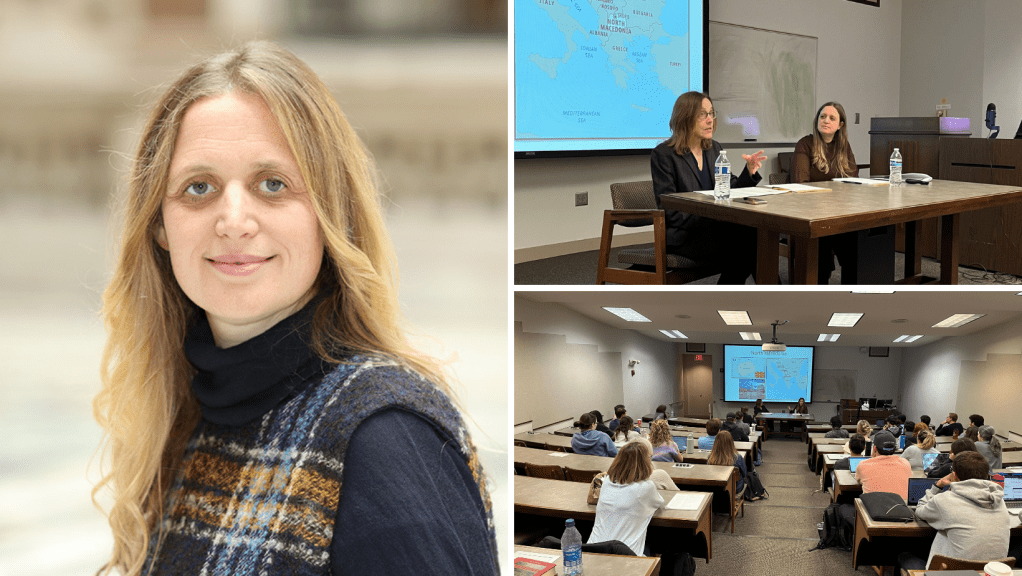
Galloway spoke with students about her diplomatic career, including her post as the United Kingdom’s Ambassador to North Macedonia. She was joined in conversation by Diane Marie Amann, Regents’ Professor of International Law, Emily & Ernest Woodruff Chair in International Law, Faculty Co-Director of the Dean Rusk International Law Center. Galloway’s talk was the most recent installment of the Dean Rusk International Law Center’s ongoing Consular Series, which presents students, staff, and faculty with global perspectives on international trade, cooperation, development, and policy.
Galloway assumed her current post as the British consul general in Atlanta in 2022, replacing former consul general Andrew Staunton. Staunton gave a presentation at Georgia Law in 2019 as part of the Center’s ongoing Consular Series. Galloway has more than 20 years of diplomatic experience; she started her career with the Foreign, Commonwealth and Development Office in 2000 and spent three years chairing the Maghreb working group at the European External Action Service. She has also held roles as the U.K. Permanent Representation to Brussels (2012-15), deputy head of the FCO’s International Organisations Department (2008-11) and head of the Darfur section of the Sudan unit in the FCO’s international development department (2007-08). Galloway spent a brief stint on a provincial reconstruction team in Helmand, Afghanistan, in 2006, that same year serving on the counter-terrorism review team in Her Majesty’s Treasury. Her only prior posting in the U.S. prior to her current role was a four-year assignment in Washington as second secretary in the political section at the British Embassy from 2002-06.
Professor Diane Marie Amann recently presented her research on “Child-Taking” as a guest lecturer in a course on the Russo-Ukrainian War taught at Yale University this semester. Students from Yale’s law school, management school, and school of global affairs comprise the class, which is taught by Yale Law Professor Eugene R. Fidell and Margaret M. Donovan.
Amann is Regents’ Professor of International Law, Emily & Ernest Chair in International Law, and Faculty Co-Director of the Dean Rusk International Law Center here at the University of Georgia School of Law. She writes and teaches in areas including child and human rights, constitutional law, transnational and international criminal law, and global legal history.
Amann’s online guest lecture drew from her article, “Child-Taking,” soon to be published in the Michigan Journal of International Law. (Preprint draft available at SSRN.) As Amann theorizes it, child-taking occurs when a state or similarly powerful entity abducts children from their community and then endeavors to remake the children in its own image. This conduct, involving children taken from Ukraine, lies at the heart of the International Criminal Court warrants pending against President Vladimir Putin and another top Russian official. The article also examines other examples of the phenomenon, including the Nazis’ kidnappings of non-German children during World War II and the forced placement of Indigenous children into boarding schools in North America, Australia, and elsewhere.
Amann also has presented this scholarship at meetings of the American Society of International Law and at University College London Faculty of Laws and King’s College London Department of War Studies.