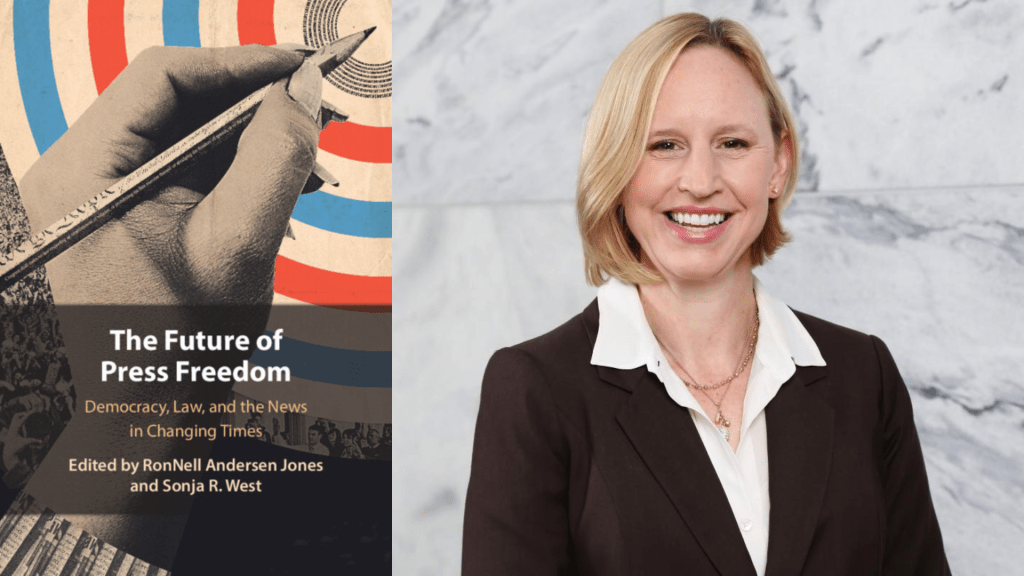
Georgia Law Professor Sonja R. West presents at Oxford’s Bonavero Institute of Human Rights

University of Georgia School of Law Professor Sonja R. West participated in two events hosted by the Bonavero Institute of Human Rights at the University of Oxford in June. First, she was part of a Comparative Media Law Workshop; then, she presented as part of a panel titled “The Future of Press Freedom” at the Democracy, Law, and Independent Journalism conference.

The Bonavero Institute is dedicated to fostering world-class research and scholarship in human rights law, to promoting public engagement in and understanding of human rights issues, and to building valuable conversations and collaborations between human rights scholars and human rights practitioners.

West holds the Otis Brumby Distinguished Professorship in First Amendment Law, a post shared by the law school and Grady College of Journalism and Mass Communication. She specializes in constitutional law, media law and the U.S. Supreme Court.

Georgia Law hosts annual Georgia Journal of International and Comparative Law conference, “Defending Democracy: A Comparative Perspective”

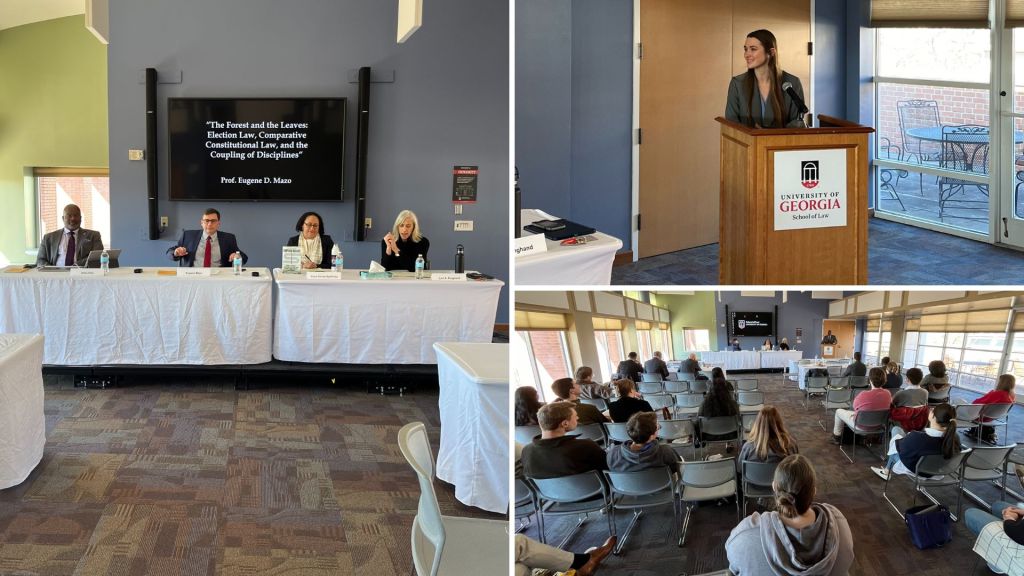
The annual conference of the University of Georgia School of Law’s Georgia Journal of International and Comparative Law, entitled “Defending Democracy: A Comparative Perspective,” took place last week.

As posted previously, this event brought together comparative law scholars from across the country to discuss a range of issues involving democracy, democratic backsliding, and comparative constitutional protections of democratic norms and institutions. Discussions included comparative lessons in “militant democracy,” the role of judges in defining or protecting democracy and democratic participation, democratic protections in the American constitutional system and how they differ from other nations, democracy and free speech, and lessons from recent elections around the world. University of Georgia School of Law Professor Lori A. Ringhand, J. Alton Hosch Professor of Law & Josiah Meigs Distinguished Teaching Professor, worked with GJICL students to conceptualize the conference theme and panels.

The panels from the conference are outlined below:

Panel 1: Democracy and Institutional Legitimacy: Panelists included Richard Albert, Hines H. Baker and Thelma Kelley Baker Chair in Law, University of Texas at Austin School of Law; Zachary Elkins, Professor, University of Texas at Austin; and moderator Taher S. Benany, Associate Director, Dean Rusk International Law Center, University of Georgia School of Law

Panel 2: Democratic Governance and Constitutional Design: Panelists included David E. Landau, Mason Ladd Professor and Associate Dean for International Programs, Florida State University College of Law; David S. Law, E. James Kelly, Jr., Class of 1965 Research Professor of Law, University of Virginia; Miguel Schor, Class of 1977 Distinguished Scholar and Professor of Law, Drake University Law School; and moderator Joseph S. Miller, Ernest P. Rogers Chair of Intellectual Property and Unfair Competition Law, University of Georgia School of Law

Panel 3: Individual Rights and Democratic Participation: Panelists included Ciara Torres-Spelliscy, Professor of Law, Stetson Law; Eugene D. Mazo, Associate Professor of Law, Duquesne University; Atiba Ellis, Laura B. Chisholm Distinguished Research Scholar and Professor of Law, Case Western Reserve School of Law; and moderator Lori A. Ringhand, J. Alton Hosch Professor of Law & Josiah Meigs Distinguished Teaching Professor, University of Georgia School of Law

Georgia Law Dean Usha R. Rodrigues, University Professor & M.E. Kilpatrick Chair of Corporate Finance and Securities Law, provided introductory remarks for the conference. Jasmine Furin, Editor in Chief, Georgia Journal of International and Comparative Law, gave a closing address. Professor Desirée LeClercq serves as the journal’s Faculty Adviser.

This event was cosponsored by the Dean Rusk International Law Center.

“Defending Democracy: A Comparative Perspective,” February 21 Georgia Journal of International and Comparative Law annual conference

This year’s annual conference of the Georgia Journal of International and Comparative Law will address “Defending Democracy: A Comparative Perspective.”

The daylong conference will take place on Friday, February 21 in the Larry Walker Room of Dean Rusk Hall at the University of Georgia School of Law.

Sponsoring along with GJICL, a student-edited journal established more than 50 years ago, is the law school’s Dean Rusk International Law Center. GJICL Editor in Chief, Jasmine Furin (J.D. ’25) and Executive Board members Logan Berg, Nina Dickerson, and Caleb Morris worked with Professor Lori A. Ringhand, J. Alton Hosch Professor of Law & Josiah Meigs Distinguished Teaching Professor; Center staff Sarah Quinn, Director; Catrina Martin, Global Practice Preparation Assistant; Taher S. Benany, Center Associate Director; and with the GJICL’s Faculty Advisor, Professor Desirée LeClercq, who is Assistant Professor of Law & Faculty Co-Director of the Dean Rusk International Law Center.

Below is the concept note of the conference:

Nations across the world are struggling to defend their institutions of democratic government. Voters are dissatisfied with how their institutions are working, social media is changing how nations define and regulate political speech, and courts are struggling to understand their rule in policing constraints on the exercise of political power and protecting individual rights. 

This event brings together comparative law scholars from across the country to discuss a range of issues involving democracy, democratic backsliding, and comparative constitutional protections of democratic norms and institutions. Discussions may include comparative lessons in “militant democracy,” the role of judges in defining or protecting democracy and democratic participation, democratic protections in the American constitutional system and how they differ from other nations, democracy and free speech, and lessons from recent elections around the world. 

The day’s events are as follows:

9:00-9:15am | Welcome Messages

Usha Rodrigues, Dean, University Professor & M.E. Kilpatrick Chair of Corporate Finance and Securities Law

9:15-10:30am | Panel 1: Democracy and Institutional Legitimacy 

  • Richard Albert, Hines H. Baker and Thelma Kelley Baker Chair in Law, University of Texas at Austin School of Law 
  • Zachary Elkins, Professor, University of Texas at Austin 
  • Panel Moderator: Taher S. Benany, Associate Director, Dean Rusk International Law Center, University of Georgia School of Law

10:30-10:45am | Break

10:45-12:00pm | Panel 2: Democratic Governance and Constitutional Design

  • David E. Landau, Mason Ladd Professor and Associate Dean for International Programs, Florida State University College of Law
  • David S. Law, E. James Kelly, Jr., Class of 1965 Research Professor of Law, University of Virginia
  • Miguel Schor, Class of 1977 Distinguished Scholar and Professor of Law, Drake University Law School
  • Panel Moderator: Joseph S. Miller, Ernest P. Rogers Chair of Intellectual Property and Unfair Competition Law, University of Georgia School of Law

12:00-1:00pm | Lunch

1:00-2:15pm | Panel 3: Individual Rights and Democratic Participation

  • Ciara Torres-Spelliscy, Professor of Law, Stetson Law
  • Eugene D. Mazo, Associate Professor of Law, Duquesne University
  • Atiba Ellis, Laura B. Chisholm Distinguished Research Scholar and Professor of Law, Case Western Reserve School of Law 
  • Panel Moderator: Lori A. Ringhand, J. Alton Hosch Professor of Law & Josiah Meigs Distinguished Teaching Professor, University of Georgia School of Law

2:15 | Closing Remarks

Jasmine Furin, Editor in Chief, Georgia Journal of International and Comparative Law

Shannon Green of USAID’s Bureau for Democracy, Human Rights, and Governance speaks at Georgia Law

Shannon N. Green, a UGA graduate who serves as the Assistant to the Administrator of the Bureau for Democracy, Human Rights, and Governance (DRG) at the U.S. Agency for International Development (USAID), spoke to students at the University of Georgia School of Law last week. The discussion, entitled “Building a Career in Human Rights Diplomacy,” was moderated by Dr. Amanda Murdie, Head of the Department of International Affairs and Georgia Athletic Association Professor of International Affairs.

In Green’s current role, she leads USAID’s efforts to invigorate democracy, enhance human rights and justice, and bolster governance that advances the public interest and delivers inclusive development. Previously, Green was the Senior Advisor to the Administrator and Executive Director of the Anti-Corruption Task Force where she led USAID’s historic elevation of anti-corruption and aligned the Agency’s policies, programming, and resources to counter corruption at a global scale.

Before returning to public service in 2021, Green was the Senior Director of Programs at the Center for Civilians in Conflict (CIVIC) and Director and Senior Fellow of the Human Rights Initiative at the Center for Strategic and International Studies (CSIS), where her research focused on addressing threats to democratic institutions and norms, enhancing justice and accountability, and improving security forces’ respect for human rights.

From 2004 – 2015, Green held a number of positions in the U.S. Government, including as the Senior Director for Global Engagement on the National Security Council. In that role, she spearheaded efforts to deepen and broaden U.S. engagement with critical populations overseas, including the President’s Stand with Civil Society Agenda and young leader initiatives around the world. Prior to that, Green served in the DRG Center, where she developed policies, strategies, and programs to advance political reform and human rights in the Middle East and North Africa.

This event was part of a visit organized by the UGA Office of Global Engagement under the leadership of the Associate Provost for Global Engagement, Martin Kagel, as part of the FYOS Global Citizenship Cluster series. The event was co-sponsored by the School of Public and International Affairs.

Georgia Law center, ABILA to cohost International Law Weekend South April 7

Delighted to announce that the Dean Rusk International Law Center at the University of Georgia School of Law will cohost International Law Weekend South with American Branch of the International Law Association.

Entitled “Democracy and Governance in the Internet Era,” the daylong online conference will take place on Wednesday, April 7. Registration here.

Following a welcome by Georgia Law Dean Peter B. “Bo” Rutledge and an introduction by ABILA President Leila Sadat, the conference will consist of these four 75-minute sessions, featuring an international array of scholars:

Civil society’s role in informing, protecting the right of peaceful assembly

In July 2020, the U.N. Human Rights Committee adopted General Comment No. 37 on Article 21 of the International Covenant on Civil and Political Rights. Article 21 guarantees the right of peaceful assembly, and the GC provides an authoritative interpretation of that right as well as guidance to ensure its practical enjoyment, online and offline. The GC addresses a wide variety of assembly issues at a particularly critical time. In an effort to raise awareness of what the GC does, how it came to be, and its significance in the United States and beyond, this panel will feature experts from civil society organizations who helped inform the GC’s drafting and who are now helping to see it implemented.

Moderator:  Jonathan Peters, University of Georgia
• Francesca Fanucci, European Center for Not-for-Profit Law
• Paulina Gutierrez, Legal Officer, Article 19
• Michael Hamilton, University of East Anglia
• Daniel Simons, Greenpeace

Political Campaigns: Perspectives from Abroad

Existing rules governing political party spending and campaign finance are increasingly seen as not up to the task of effectively and transparently regulating political communications around elections. Social media algorithms that amplify outrage, rampant disinformation campaigns, and foreign interference in domestic elections all complicate what was already the challenging task of devising effective and fair regulation in this realm. This panel brings together election law scholars from around the world to discuss how their legal regimes are tackling these new and challenging problems.

Moderator: Lori A. Ringhand, University of Georgia
• Irene Couzigou, University of Aberdeen
• Yasmin Dawood, University of Toronto
• Jacob Eisler, University of Southampton
• Galen Irwin, Leiden University
• Graeme Orr, University of Queensland, Australia
• Ciara C. Torres-Spelliscy, Stetson University

Reforming the National Security State

For many, the past four years highlighted growing concerns over the U.S. national security state. For some, the concerns focused on national security priorities, including the last administration’s focus on immigration and trade. For others, the concerns focused on increased presidential unilateralism and broad readings of executive powers over treaty withdrawal and the use of force. For still others, the concerns focused on national security tools and how they have been used, from immigration enforcement to criminal investigations to individual sanctions.
With a new administration and a new Congress, many see this is a unique opportunity to reform the national security state. This roundtable will consider how the current administration might rethink priorities and tools and how Congress might approach its role in facilitating and limiting presidential discretion.

Participants:
• Diane Marie Amann, University of Georgia
• Elena Chachko, Harvard University
• Harlan G. Cohen, University of Georgia
• Maryam Jamshidi, University of Florida

Social Media and the Language of Statehood

Scholars, journalists, and companies increasingly frame social media’s decisionmaking using the language of democratic governance and human rights. From talk of “corporate constitutionalism” to Facebook’s “Supreme Court,” the lines between private and public “governance” are murkier than ever.
This panel will assess these rhetorical moves. Are they helpful in understanding how the companies operate and how their power might be constrained? Or do they provide corporate actions with false legitimacy that undermines or overpowers calls for public regulation?

Moderator: Thomas E. Kadri, University of Georgia
• Evelyn M. Aswad, Oklahoma College of Law
• Elettra Bietti, Berkman Klein Center for Internet and Security, Harvard
• Brenda Dvoskin, Harvard University
• David Kaye, University of California, Irvine
• Genevieve Lakier, University of Chicago

2L Emina Sadic Herzberger, President of the Georgia Law International Law Society, will close the conference.
Belgium week of our Global Governance Summer School concludes on a (World Cup) celebratory note

LEUVEN – Final sessions of our 2018 Global Governance Summer School‘s Belgium leg came to an end yesterday, even as the country’s national team vaulted into the final four of the World Cup.

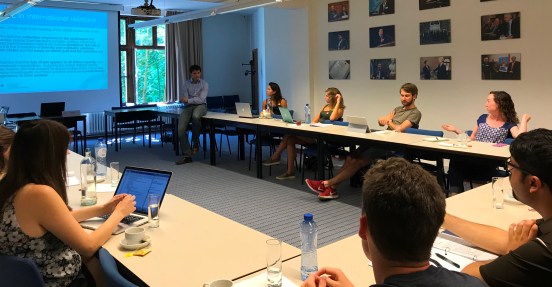
Day 5 of the summer school, devoted to Global Security Governance,  began with a lecture by Dr. Nicolas Hachez. He is a Fellow at the Leuven Centre for Global Governance Studies, University of Leuven, with which we at the Dean Rusk International Law Center, University of Georgia School of Law, partner to present the Global Governance Summer School. Hachez’ lecture began with an historical account dating to Aristotle, and ended with a survey of contemporary challenges to rule of law and democracy. (Just below, he listens to a response from Georgia Law student Brooke Carrington.) The presentation provided a valuable recap of many issues raised at the high-level RECONNECT conference our students attended earlier in the week.

Next, yours truly, Georgia Law Professor Diane Marie Amann, Emily & Ernest Woodruff Chair in International Law, one of our Center’s Faculty Co-Directors, and a founding Co-Director of the Global Governance Summer School. I introduced the concept of Global Security Governance, which incorporates within its analysis of human, national, and collective security insights from traditional international law subfields like human rights, the laws of war, and development law.

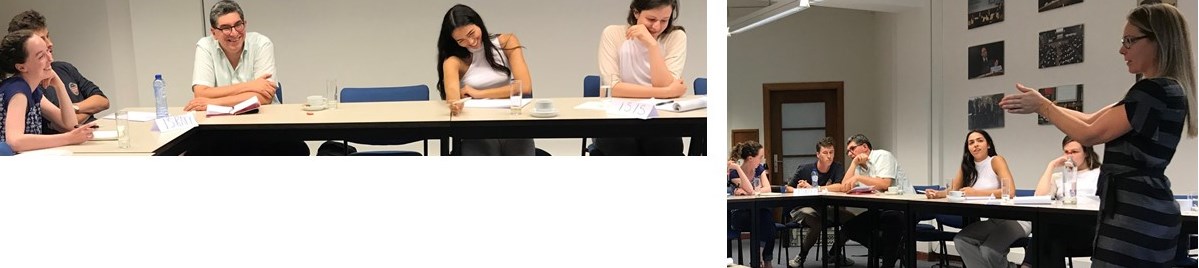
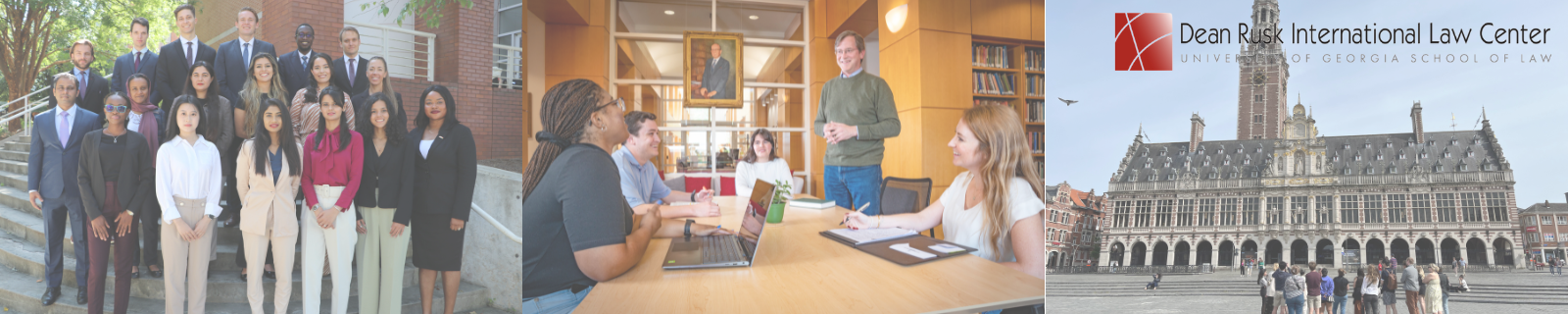
Our Center’s Director, Kathleen A. Doty, offered an overview of legal regimes related to disarmament and weapons control, including the Nuclear Non-Proliferation Treaty and the Chemical Weapons Convention. Then, as pictured at top, she led our summer school students – variously educated at Georgia Law, Leuven, and several other European institutions – in a spirited, simulated, multilateral negotiation for a new treaty to curb an imagined new development in weapons technology.

The week’s classroom component concluded with a lecture on “Global Governance, International Law and Informal Lawmaking in Times of Antiglobalism and Populism” by Leuven Professor Jan Wouters (right), Jean Monnet Chair ad personam EU and Global Governance, Full Professor of International Law and International Organizations, Director of the Leuven Centre for Global Governance Studies, and founding Co-Director of our summer school. Touching on concepts and issues introduced throughout the week, Wouters exposed shortcomings of classic international law. He further urged greater acceptance of the significance of informal lawmaking actors, norms, and processes, which form the core of global governance studies.

Leuven and Georgia Law students, faculty, staff, and friends then enjoyed a conference dinner, plus a live, and lively, screening of the Belgium Red Devils’ 2-1 World Cup victory over Brazil – then headed to Oude Markt to celebrate with other denizens of this lovely city.

Global Governance Summer School students at high-level conference on project aiming to RECONNECT Europe

Yesterday’s sessions of our Georgia Law-Leuven Centre Global Governance Summer School were devoted to a new, 4-year research project aimed at reinvigorating core values of the European Union.

Called RECONNECT: Reconciling Europe with its Citizens through Democracy and the Rule of Law and supported by funds from the EU’s Horizon 2020 Research & Innovation programme, the project has just been established by KU Leuven’s Leuven Centre for Global Governance Studies and 17 partner institutions.

Our summer school’s morning began at a classroom in Leuven, where Michal Ovádek (left), a Leuven Centre PhD candidate and research fellow,  provided an introduction to the structure of, and contemporary challenges, to European Union integration. Among them are the efforts of recently elected governments to undermine judicial independence, free press, and other democratic institutions in Poland and Hungary, as well as the aftermath of the 2016 Brexit referendum, in which a slight majority in the United Kingdom voted to leave the EU.

We then traveled to Brussels’ neoclassical Academy Palace, home to the Royal Flemish Academy of Belgium for Science and the Arts and the site of an afternoon conference launching the RECONNECT project.

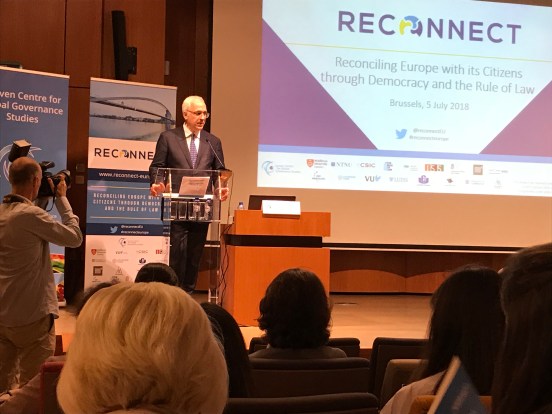
Leuven Law Professor Jan Wouters, whose many titles include Director of the Leuven Centre for Global Governance Studies and Co-Director of our summer school, opened the conference (top photo). Stating that “the EU and its members are confronted with an existential crisis,” Wouters explained how “RECONNECT will intervene in the public discourse, to build a new narrative for Europe.” The EU can “regain authority and legitimacy through democracy and the rule of law,” he said, “provided citizens’ views taken into account.”

Delivering keynotes were H.E. Didier Reynders, Belgium’s Deputy Prime Minister and Minister of Foreign Affairs & European Affairs – who urged, as a way to reconnect, emphasizing that the EU is not just an economic project, but also based on values and principles – and Dr. Adam Bodnar, Ombudsman of the Republic of Poland.

Two policy roundtables followed:

► “Strengthening Democracy in the European Union,” chaired by Julie Smith and featuring Alberto Alemanno, Richard Youngs, Zselyke Csaky, Vivien Schmidt, Carlos Closa Montero, and Amichai Magen.

► “Addressing Rule of Law Challenges in the EU,” chaired by Laurent Pech and including Tamas Lukacsi, Philip Bittner, Peter Claes, Lotte Leicht, Petra Bárd, and Dimitry Kochenov.

Many speakers revisited developments in countries like Hungary, Poland, and post-Brexit UK, touching on issues ranging from freedom of speech to social media, economic anxiety and political processes. Europe’s responses to global migration both within and outside its borders, was another topic frequently mentioned.

In a particularly moving presentation, Lotte Leicht (3d from right), EU Director for Human Rights Watch, told of seeing, at a middle school where she recently spoke, signs saying “Be Kind” and “Treat One Another as You Want to Be Treated.” Commenting that youths “get it,” she proceeded to outline problems and to welcome innovative solutions.  Yet Leicht cautioned against adopting perceived solutions that would have negative effects:

“It is a redline when we start undermining the rule of law and our obligations under international law.”

Our stay in Leuven concludes tomorrow, after sessions on related to human rights and security governance – and, fittingly, after tomorrow night’s World Cup contest between Belgium and Brazil.