Georgia Law Professor MJ Durkee publishes in ASIL Proceedings on participation of nonstate actors

Melissa J. “MJ” Durkee, the Allen Post Professor here at the University of Georgia School of Law, has published an essay in the most recent volume of proceedings from an annual meeting of the American Society of International Law.

Her article, which appears in a section called “Between Participation and Capture: Non-state Actor Participation in International Rule-Making,” is entitled “Welcoming Participation, Avoiding Capture: A Five-Part Framework,” and may be found at 114 Proceedings of the ASIL Annual Meeting 39-42 (2020). It’s also available at SSRN.

Here’s the abstract:

What role should non-state actors have in the work of international organizations? It is particularly fitting that this panel is titled “between participation and capture,” because the phrase calls up the conflicting values that animate this question. When we think of non-state actors “participating” in the work of international organizations, we think about open, transparent organizations that are receiving the benefit of diverse perspectives and expertise. We may associate this phrase with process, access, and legitimacy in governance. On the other hand, when we think about non-state actors “capturing” the agenda of international organizations, we have a conflicting set of mental images: we imagine corruption, mission-drift, and the erosion of legitimacy in global governance. Openness is both valuable and dangerous.

Georgia Law clinics share in national CLEA Award for work on behalf of immigrant women who endured abuse, retaliation while in ICE detention

Efforts on behalf of immigrant women detained in a U.S. immigration center have earned national recognition for the Community HeLP Clinic and First Amendment Clinic here at the University of Georgia School of Law.

The Georgia Law clinics will share that recognition – the 2021 Clinical Legal Education Association Award for Excellence in a Public Interest Project – with law clinics at Harvard, Columbia, Texas A&M, and Boston universities.

The CLEA Award will be presented online 12 noon-1 pm Eastern Friday, April 30, as part of the annual Conference on Clinical Education of the Association of American Law Schools.

The clinics’ project confronted abuse of immigrant women while in the custody of U.S. Immigration and Customs Enforcement (ICE) at the Irwin Detention Center, a privately run facility in south Georgia. As previously posted, the women there were subjected to nonconsensual, medically unindicated, or invasive gynecological procedures. Those who spoke out about abuses faced accelerated deportation proceedings, solitary confinement, and other acts of retaliation. The project has pursued several administrative, judicial, and advocacy avenues, including ongoing litigation of Oldaker v. Giles, a consolidated habeas petition and class action complaint filed in the U.S. District Court for the Middle District of Georgia.

The Project’s efforts have resulted in the release of nearly all 80 women in ICDC, as well as over 200 men, and stays of deportation for most of the Oldaker plaintiffs.

Leading the project on behalf of Georgia Law were Jason Cade (above right), Associate Dean for Clinical Programs & Experiential Learning, J. Alton Hosch Professor of Law, and Director of the Community HeLP Clinic, and Clare Norins (above left), Clinical Assistant Professor and Director of the First Amendment Clinic. Also taking part in this team effort were 3L students Raneem Ashrawi, Frederick King, Julia Griffis, and Anish Patel, 2L students Thomas Evans, Paige Medley, and Davis Wright, First Amendment Clinic Legal Fellow Samantha Hamilton, Community HeLP Clinic Staff Attorney Kristen Shepherd, and administrative associate Sarah Ehlers.

Other collaborators included non-profits, private firms, legislative advocates, and community organizers.

Georgia Law Professor Amann in roundtable on international criminal justice at GW Law journal conference

Diane Marie Amann, the Emily & Ernest Woodruff Chair in International Law and Dean Rusk International Law Center Faculty Co-Director here at the University of Georgia School of Law, recently took part in an online panel entitled “International Courts and Their Role in Cross-Border Criminal Prosecutions.”

The panel was one of several at the 2021 symposium of the George Washington University International Law Review, which considered international law and policy challenges created by global technological and physical shifts.

Joining Amann, who is also the Special Adviser to the International Criminal Court Prosecutor on Children in & affected by Armed Conflict, in the roundtable discussion were: Olympia Bekou, Professor of Public International Law and Head of the University of Nottingham School of Law; and Patricia Viseur Sellers, Special Advisor for Gender for the Office of the Prosecutor of the International Criminal Court, Visiting Fellow, Kellogg College, University of Oxford, and Practicing Professor, London School of Economics. Moderator was Michael J. Matheson, Adjunct Professor at GW Law.

Georgia Law Professor Harlan Cohen presents “Nations and Markets” to University of Trento, Italy

Harlan Cohen, who is Gabriel M. Wilner/UGA Foundation Professor in International Law and Faculty Co-Director of the Dean Rusk International Law Center here at the University of Georgia School of Law, recently gave an online presentation of his new article “Nations and Markets” at Italy’s University of Trento School of International Studies.

Available at SSRN, “Nations and Markets” was published in December in the peer-reviewed Journal of International Economic Law.

Its description:

“Economics and security seem increasingly intertwined. Citing national security, states subject foreign investments to new scrutiny, even unwinding mergers. The provision of 5G has become a diplomatic battleground—Huawei at its center. Meanwhile, states invoke national security to excuse trade wars. The USA invoked the General Agreement on Tariffs and Trade national security exception to impose steel and aluminum tariffs, threatening more on automotive parts. Russia invoked that provision to justify its blockade of Ukraine, as did Saudi Arabia and the United Arab Emirates to excuse theirs of Qatar. And with the spread of COVID-19, states are invoking national security to scrutinize supply lines. Multiplying daily, such stories have led some observers to dub the era one of geoeconomics.

“Nonetheless, these developments remain difficult to judge, and the relationship between economics and national security remains confused and slippery. The essay seeks clarity in the deeper logic of these labels, revealing a fundamental choice between the logics of markets and the logics of state. Whether invoked to ‘secure’ borders, privacy, health, the environment, or jobs, ‘national security’ is a claim about the proper location of policymaking. Appeals to economics, with their emphasis on global welfare and global person-to-person relationships, are such claims as well. Resolving disputes, this essay argues, requires recognizing these root choices.”

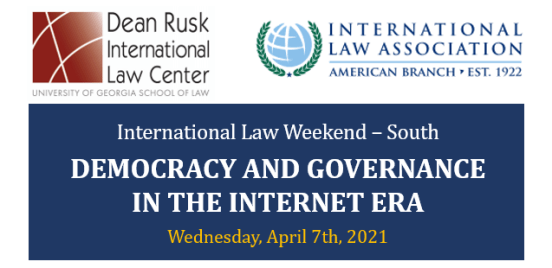
Georgia Law center, ABILA to cohost International Law Weekend South April 7

Delighted to announce that the Dean Rusk International Law Center at the University of Georgia School of Law will cohost International Law Weekend South with American Branch of the International Law Association.

Entitled “Democracy and Governance in the Internet Era,” the daylong online conference will take place on Wednesday, April 7. Registration here.

Following a welcome by Georgia Law Dean Peter B. “Bo” Rutledge and an introduction by ABILA President Leila Sadat, the conference will consist of these four 75-minute sessions, featuring an international array of scholars:

Civil society’s role in informing, protecting the right of peaceful assembly

In July 2020, the U.N. Human Rights Committee adopted General Comment No. 37 on Article 21 of the International Covenant on Civil and Political Rights. Article 21 guarantees the right of peaceful assembly, and the GC provides an authoritative interpretation of that right as well as guidance to ensure its practical enjoyment, online and offline. The GC addresses a wide variety of assembly issues at a particularly critical time. In an effort to raise awareness of what the GC does, how it came to be, and its significance in the United States and beyond, this panel will feature experts from civil society organizations who helped inform the GC’s drafting and who are now helping to see it implemented.

Moderator:  Jonathan Peters, University of Georgia
• Francesca Fanucci, European Center for Not-for-Profit Law
• Paulina Gutierrez, Legal Officer, Article 19
• Michael Hamilton, University of East Anglia
• Daniel Simons, Greenpeace

Political Campaigns: Perspectives from Abroad

Existing rules governing political party spending and campaign finance are increasingly seen as not up to the task of effectively and transparently regulating political communications around elections. Social media algorithms that amplify outrage, rampant disinformation campaigns, and foreign interference in domestic elections all complicate what was already the challenging task of devising effective and fair regulation in this realm. This panel brings together election law scholars from around the world to discuss how their legal regimes are tackling these new and challenging problems.

Moderator: Lori A. Ringhand, University of Georgia
• Irene Couzigou, University of Aberdeen
• Yasmin Dawood, University of Toronto
• Jacob Eisler, University of Southampton
• Galen Irwin, Leiden University
• Graeme Orr, University of Queensland, Australia
• Ciara C. Torres-Spelliscy, Stetson University

Reforming the National Security State

For many, the past four years highlighted growing concerns over the U.S. national security state. For some, the concerns focused on national security priorities, including the last administration’s focus on immigration and trade. For others, the concerns focused on increased presidential unilateralism and broad readings of executive powers over treaty withdrawal and the use of force. For still others, the concerns focused on national security tools and how they have been used, from immigration enforcement to criminal investigations to individual sanctions.
With a new administration and a new Congress, many see this is a unique opportunity to reform the national security state. This roundtable will consider how the current administration might rethink priorities and tools and how Congress might approach its role in facilitating and limiting presidential discretion.

Participants:
• Diane Marie Amann, University of Georgia
• Elena Chachko, Harvard University
• Harlan G. Cohen, University of Georgia
• Maryam Jamshidi, University of Florida

Social Media and the Language of Statehood

Scholars, journalists, and companies increasingly frame social media’s decisionmaking using the language of democratic governance and human rights. From talk of “corporate constitutionalism” to Facebook’s “Supreme Court,” the lines between private and public “governance” are murkier than ever.
This panel will assess these rhetorical moves. Are they helpful in understanding how the companies operate and how their power might be constrained? Or do they provide corporate actions with false legitimacy that undermines or overpowers calls for public regulation?

Moderator: Thomas E. Kadri, University of Georgia
• Evelyn M. Aswad, Oklahoma College of Law
• Elettra Bietti, Berkman Klein Center for Internet and Security, Harvard
• Brenda Dvoskin, Harvard University
• David Kaye, University of California, Irvine
• Genevieve Lakier, University of Chicago

2L Emina Sadic Herzberger, President of the Georgia Law International Law Society, will close the conference.
Georgia Law Prof Diane Marie Amann elected to Council on Foreign Relations

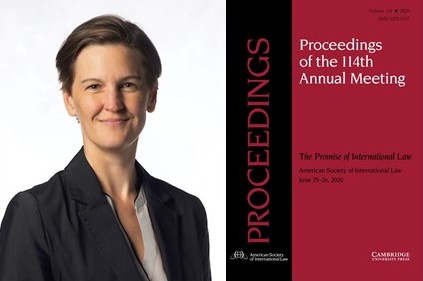
Our Dean Rusk International Law Center Faculty Co-Director, Georgia Law Professor Diane Marie Amann, has just been elected to the Council on Foreign Relations. The council is an independent, nonpartisan organization and thinktank that is composed of the most prominent foreign policy leaders, including top government officials, renowned scholars, business executives, acclaimed journalists, prominent lawyers and distinguished nonprofit professionals.

Amann holds Georgia Law’s Emily and Ernest Woodruff Chair in International Law at the University of Georgia School of Law, and also a courtesy appointment in the Department of International Affairs at the university’s School of Public & International Affairs.

Since 2012, she has served as the Special Adviser to the International Criminal Court Prosecutor on Children in and affected by Armed Conflict. Her current research concerns issues of child security and also histories of international law. Under contract with the Oxford University Press, she is writing what will be the first-ever book on the roles of women professionals at the 1945-46 trial before the International Military Tribunal at Nuremberg.

In addition to CFR, her professional affiliations include service as a Counsellor and past Vice President of the American Society of International Law, and also member of the founding coordinating committee member for the Interest Group on International Criminal Justice of the European Society of International Law.

Georgia Law Professor Amann marks Holocaust Remembrance Day with talk on women at Nuremberg trials

Women at the Nuremberg Trials was the title of a lecture delivered last week by Professor Diane Marie Amann, the Emily & Ernest Woodruff Chair in International Law and Faculty Co-Director of the Dean Rusk International Law Center here at the University of Georgia School of Law.

Occurring on International Holocaust Remembrance Day, Wednesday’s talk focused on several of the many women who took part in the Nuremberg proceedings, as lawyers and legal professionals, translators and interpreters, witnesses and journalists – in short, in nearly every post except judge.

Sponsor of the event was the Center on National Security and Human Rights Law at Chicago-Kent College of Law.

Georgia Law Professor Amann takes part in launch of NGO report documenting crimes against children in Syria

Professor Diane Marie Amann, the Emily & Ernest Woodruff Chair in International Law and Faculty Co-Director of the Dean Rusk International Law Center here at the University of Georgia School of Law, took part last Friday in the launch of a report on crimes against and affecting children in Syria.

“Children of Syria – The Lost Hope,” was hosted by the Syrian Network for Human Rights, a nongovernmental organization that monitors, documents, and maintains a database of human rights violations in Syria, the site of a nearly ten-year-old conflict. The organization issued its Ninth Annual Report on Violations against Children in Syria (above left) on World’s Children Day, the day in November that marks the anniversary the adoptions by the UN General Assembly of the 1959 Declaration of the Rights of the Child and the 1989 Convention on the Rights of the Child.

Participants in last week’s event discussed the Ninth Report, which stated that the Syrian conflict had claimed nearly 30,000 children between March 2011 and January 2021 – nearly 200 of them as a result of torture. Additional harms, many of which may constitute war crimes or crimes against humanity, documented include arrest and detention of children, forcible disappearance, attacks on schools and deprivation of education, and recruitment and use by armed forces.

Professor Amann, an expert in international criminal law and child rights, joined a panel discussing these findings, their impact on children and society at large, and avenues for redress and accountability. Amann said that the Ninth Report described conduct

“that constitutes both systematic violations of human rights in many different sectors as well as international crimes as articulated in the statutes of multiple tribunals and recognized as customary international law.”

She further outlined treaties and forums through which such conduct might be addressed.

Also speaking at the event, which is archived and available for viewing here, were: Fadel Abdul Ghany, Chairman of the Syrian Network for Human Rights; Martin Leeser, a member of the Syria team at the German Embassy in Beirut, Lebanon; Dr. Troels Gauslå Engell, Senior Stabilisation Advisor on Syria to the Danish Ministry of Foreign Affairs; Paula Sastrowijoto, Deputy Syria Envoy at the Netherlands Ministry of Foreign Affairs; Lina Biscaia, Senior Legal Officer, Sexual and Gender-Based Crimes and Crimes against Children Unit of the UN Investigative Team for Accountability of Da’esh/ISIL; Javier Perez Salmeron of the Justice Rapid Response Child Rights Expert Roster; and Valentina Falco, Team Leader-Child Protection, UN Department of Peace Operations.

Georgia Law alumna Chanel Chauvet publishes at Opinio Juris on POW remittances, in blog symposium on 2020 GCIII Commentary directed by alumnus Jean-Marie Henckaerts

Pleased to note the publication last Thursday by a recent graduate of the University of Georgia School of Law, as part of an ongoing joint symposium sponsored by Opinio Juris and by the Humanitarian Law & Policy Blog of the International Committee of the Red Cross.

Author of the contribution entitled “Prisoners of War Remittances – Financial Challenges of Sanctions and Conversion Rates” is Chanel Chauvet, who earned her J.D. degree from Georgia Law in 2018, and also, just last year, her LL.M. degree cum laude in International Humanitarian Law and Human Rights from the Geneva Academy of International Humanitarian Law and Human Rights in Switzerland.

Applying a case study of relations between Iran and the United States, Chauvet’s post details the obstacles faced by a prisoner of war, or POW, in securing remittances – funds that family members send “in an effort to contribute to the POW’s financial welfare” – on account of financial sanctions regimes and currency conversion rates. She concludes with recommendations that would remove remittances from the effects of these regimes, writing:

“The legal landscape governing POW remittances is insufficient, and as such, states should collectively address the obstacles that damage the financial health of POWs by incorporating specific protections for POWs (e.g., a legal exclusion for POW payments and remittances) from the effects of the banking sanctions that are in place in their Power of Origin.”

While a J.D. student, Chauvet served as a Dean Rusk International Law Center Student Ambassador and a research assistant to the Center’s Faculty Co-Directors, Professors Harlan Cohen and Diane Marie Amann. She completed the Grotius Centre Summer School on Humanitarian Law at Leiden Law School in the Netherlands, competed on a winning Model African Union team, served as worldwide student president of the International Law Students Association, and was the recipient of the Blacks of the American Society of International Law Annual Meeting Scholarship.

Chauvet is a member of the Bars of the State of Georgia and of the District of Columbia.

At the Geneva Academy, she was elected the Student Council LL.M. Representative and was the student commencement speaker. She served as a Legal Intern in the International Law & Policy Department at the ICRC, and also made presentations at meetings of the UN Human Rights Council in her capacity as the Permanent Representative in Geneva for the International Association of Jewish Lawyers and Jurists.

Chauvet’s LL.M. thesis, from which the Opinio Juris post draws, was supervised by a Geneva Academy professor who is himself earned his LL.M. at Georgia Law in 1990: Dr. Jean-Marie Henckaerts, Legal Adviser in the ICRC’s Legal Division and a member of our Dean Rusk International Law Center Council.

Chauvet’s post forms part of a symposium of articles analyzing aspects of Convention (III) relative to the Treatment of Prisoners of War. Geneva, 12 August 1949. Commentary of 2020. Known colloquially as GCIII, that commentary is the third published under Dr. Henckaerts’ directorship. Indeed, we at the Center were honored to host a daylong conference marking the issuance of the initial volume, the Commentary on First Geneva Convention, with papers published in the Georgia Journal of International & Comparative Law.

“Future of Global Health Governance” topic of Monday’s Georgia Law international journal conference

Global Healthcare Governance Conference Header

“The Future of Global Healthcare Governance” is the topic of the annual Georgia Journal of International & Comparative Law daylong symposium, to be held this Monday, January 25.

We at the Dean Rusk International Law Center of the University of Georgia School of Law are cosponsoring this online conference along with GJICL and the law school’s Health Law Society and International Law Society, as well as the university’s College of Veterinary Medicine, School of Public & International Affairs, and School of Social Work.

Taking into account the effects of globalization and climate change on the spread of historically localized pathogens — among them, H1N1, Zika, Ebola, and COVID-19 — the conference will re-examine legal and other frameworks designed to respond to global pandemics. The roles to be played by stated and by international entities like the World Health Organization will be explored. To quote the concept note:

“This conference will address three crucial questions of global health governance. It will consider, first, whether and how the ailing global public health infrastructure might be reinvigorated; second, how the pandemic has threatened and exposed limitations of the social safety net in the United States and other economies around the world; and, finally, the phenomenon of vaccine refusal and what national and international legal institutions might do to curb it.”

Delivering opening remarks will be Georgia Law Dean Peter B. “Bo” Rutledge and Elizabeth Weeks, the University of Georgia Associate Provost for Faculty Affairs and Charles H. Kirbo Chair in Law. A keynote address, panel presentations, and breakout sessions will follow. These include (all times Eastern):

10:30-11:30 a.m. The Role of International Organizations in Global Health Governance, moderated by Georgia Law Professor Fazal Khan. Speakers: Thomas J. Bollyky, Council on Foreign Relations; Benjamin Mason Meier, University of North Carolina-Chapel Hill; Alexandra Phelan, Georgetown University Center for Global Health Science & Security; Pedro Villarreal, Max Planck Institute for Comparative Public Law & International Law; and Alicia Yamin, Harvard Law.

12:45-1:45 p.m. The Role of Federal Governments in Pandemics, moderated by Elizabeth Weeks, the University of Georgia Associate Provost for Faculty Affairs and Charles H. Kirbo Chair in Law. Speakers: Christina S. Ho, Rutgers Law; Renée M. Landers, Suffolk Law; Gwendolyn Roberts Majette, Cleveland-Marshall Law; and Wendy Parmet, Northeastern Law.

2-3 p.m. The Global Campaign for the Collective Good, moderated by Hillel Y. Levin, Alex W. Smith Professor of Law at Georgia Law and Director of UGA Law in Atlanta. Speakers: Shawn Harmon, Dalhousie University; Glen Nowak, University of Georgia; Saad Omer, Yale School of Medicine; and Dorit Reiss, California-Hastings Law.

3:30-4 p.m. Keynote Address by Marice Ashe, ChangeLab Solutions, and Elsie E. Hayford, Lamèsè.

Papers will be published in a forthcoming GJICL issue. The full program, with registration information, is available here.