Hague briefings at ICC, Iran-U.S. Claims Tribunal and ICJ launch 2017 Global Governance Summer School

At the Iran-U.S. Claims Tribunal, front from left: Ana Morales Ramos, Legal Adviser; Hossein Piran, Senior Legal Adviser; Kathleen A. Doty, Interim Director, Dean Rusk International Law Center; David Caron, Tribunal Member; and Georgia Law Associate Dean Diane Marie Amann. Back row, students Nicholas Duffey, Lyddy O’Brien, Brian Griffin, Wade Herring, Jennifer Cotton, Evans Horsley, Casey Callaghan, Kristopher Kolb, Nils Okeson, James Cox, and Ezra Thompson.

HAGUE – Briefings at key international law institutions here have highlighted the initial leg of the Global Governance Summer School led by the University of Georgia School of Law Dean Rusk International Law Center.
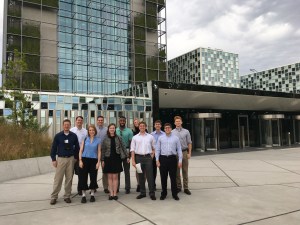
Our students’ journey began with a visit yesterday to the International Criminal Court Permanent Premises (left), a tile-and-ivy structure, located in dunelands not far from the North Sea, that opened just 18 months ago. Accompanying them were Associate Dean Diane Marie Amann and our Center’s Interim Director, Kathleen A. Doty, both of whom will lecture at the summer school next week.
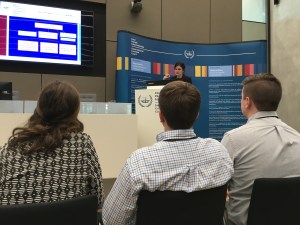
Outlining the work of the Office of the Prosecutor were the Prosecutor’s Senior Legal Adviser, Shamila Batohi, and Legal Assistant, Annie O’Reilly (right), with whom Associate Dean Amann works in her capacity as the Prosecutor’s Special Adviser on Children in and affected by Armed Conflict. Topics included case selection and specific cases, complementarity and state cooperation, and the role of the prosecution in relation to other organs of the court.

Then Leiden Law Professor Dov Jacobs, a Legal Assistant in Defense at the ICC and member of the defense team for Laurent Gbagbo, the former Ivoirian President now on trial before the court. Shifting from the theoretical to the practical and back again, he spoke about the nature and challenges of international criminal justice, particularly as it relates to the defense function before contemporary bodies like the ICC.

The journey continued today with a morning briefing at the Iran-U.S. Claims Tribunal, an international organization established by treaty 36 years ago as a means to settle disputes arising out of the 1979 takeover of the U.S. Embassy in Tehran. It comprises 3 Americans, 3 Iranians, and three members from other countries. Offering a fascinating dialogue on the history and operations of the tribunal were Dr. David Caron, a U.S. member of the tribunaland an international law professor at Kings College London, and Dr. Hossein Piran, Senior Legal Adviser at the tribunal.

(It was a treat to learn that one of Dr. Piran’s professors was the late Gabriel N. Wilner, who founded our European summer study abroad during his long tenure on the Georgia Law faculty. Holding the professorship named after Wilner is Georgia Law Professor Harlan Cohen, who will lecture in this summer school next week, along with Leuven Law Professor Jan Wouters and others.)

The afternoon brought us to the Hague’s Vredepalais (left), or Peace Palace, built in the early 1900s to house international institutions that would foster pacific, rather than warlike, settlements of disputes.

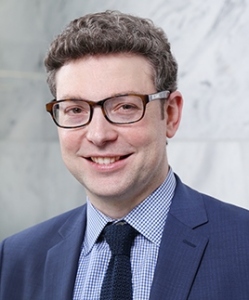
Leading discussion on one of those institutions, the International Court of Justice set up under the 1945 Charter of the United Nations, was Dr. Xavier-Baptiste Ruedin (right), Legal Adviser for Judge Joan E. Donoghue. Topics ranged from provisional measures, like those recently issued in a case involving India and Pakistan, to jurisdiction via advisory opinion (including one soon to arrive at the court, following yesterday’s U.N. General Assembly vote) or contentious case.

A question common to all 3 visits was the role of such institutions – and international law more generally – in the governance of global affairs. We’ll continue to seek answers next week, when our Global Governance Summer School moves to Belgium for classroom seminars and an experts conference with our partner institution, KU Leuven’s Leuven Centre for Global Governance Studies.


“International Law and Global Governance in a Turbulent World” to be explored at Georgia Law-Leuven Centre conference, June 29 in Belgium

“International Law and Global Governance in a Turbulent World” is the title of the daylong conference we’ll be co-presenting later this month at the University of Leuven in Belgium.

Set for Thursday, June 29, 2017, the conference will be held in Auditorium Zeger Van Hee at Leuven’s College De Valk (Law School, pictured below), Tiensestraat 41, Leuven. It is free and open to the public; register no later than June 27 here.

The conference also is a component of the Global Governance Summer School that we at the Dean Rusk International Law Center, University of Georgia School of Law, are presenting in partnership with the Leuven Centre for Global Governance Studies at the University of Leuven. Co-Directors are Georgia Law Associate Dean Diane Marie Amann and the Leuven Centre’s Director, Law Professor Jan Wouters. (prior post) Applications for the summer school are still being accepted here.

Here’s the June 29 conference concept:

“This conference aims to discuss some of the main challenges faced by contemporary international law and global governance in a time of crises. The conference starts with an exploration of the main challenges inherent to the enforcement of universal values such as human rights. Unlike in many other fields, legal standards are well-established and are the object of a broad, sometimes even universal consensus. Yet, not a single day passes without more of less grave violations of such standards in one or the other part of the world. The conference will then also focus on the difficulties to come up with a consensus on the rule of law at the global level. Starting from an analysis of the diversity in the ways the rule of law has been understood across time and geography, the conference will address some of the main challenges to the rule of law within the European Union and at the United Nations level. Finally the conference will also address the risks for the emergence of trade wars in a context of rising protectionism. Questions such as the future of multilateral and bilateral trade agreements will be discussed in light of the changes in the US foreign trade policy and the rising skepticism of citizens vis-à-vis further liberalization of international trade.”

These issues will be explored within the following framework:

  • Panel 1: Global Governance of Human Rights. How to enforce universal values in contested world?
  • Panel 2: Global Governance of Democracy and Rule of Law in international perspective.
  • Panel 3: Global Economic and Trade Governance in Protectionist Times. Will we see the emergence of trade wars in the coming years?

A transatlantic array of speakers will take part. Confirmed so far are Georgia Law Professors Diane Marie Amann and Harlan G. Cohen, and from Leuven, Anna-Luise Chané and Dr. Matthieu Burnay, along with scholars from numerous other institutions: Dr. Tom Pegram, University College London, England; Dr. Katrien Meuwissen, European Association of National Human Rights Institutions; Professor Daniela Piana, University of Bologna, Italy; Professor Petra Bard, Central European University, Budapest, Hungary; Professor Laurent Pech, Middlesex University, London, England; Professor Miles Kahler, American University School of International Service, Washington, D.C.; Professor John Kirton, University of Toronto Munk School of Global Affairs, Canada; and Mr. Tomas Baert, Head of Unit, Trade Strategy, European Commission, Brussels, Belgium.

We hope to see you there; more information here and here.

Cohen publishes article on political question doctrine in wake of Zivotofsky

Harlan Grant Cohen, the Gabriel N. Wilner/UGA Foundation Professor in International Law here at the University of Georgia School of Law, has published an article examining the U.S. political question doctrine in light of recent Supreme Court litigation in Zivotofsky, which arose out of the request by U.S. citizens that their child, born in Jerusalem, be issued a passport designating “Israel” as the child’s birthplace. Entitled “A Politics-Reinforcing Political Question Doctrine,” Professor Cohen’s article appears at 49 Arizona State Law Journal 1 (2017).

The manuscript, which forms part of our Dean Rusk International Law Center Research Paper Series at SSRN, may be downloaded at this SSRN link.

Here’s the abstract:

“The modern political question doctrine has long been criticized for shielding the political branches from proper judicial scrutiny and allowing the courts to abdicate their responsibilities. Critics of the doctrine thus cheered when the Supreme Court, in Zivotofsky I, announced a narrowing of the doctrine. Their joy though may have been short-lived. Almost immediately, Zivotofsky II demonstrated the dark side of judicial review of the separation of powers between Congress and the President: deciding separations of powers cases may permanently cut one of the political branches out of certain debates. Judicial scrutiny in a particular case could eliminate political scrutiny in many future ones.

“A return to the old political question doctrine, with its obsequious deference to political branch decisions, is not the answer. Instead, what is needed is a politics-reinforcing political question doctrine that can balance the need for robust review with the desire for robust debate. The uncertain boundaries between the political branches’ overlapping powers create space for political debate. Their overlapping powers allow different groups to access the political system and have a voice on policy. Deciding separation of powers questions once-and-for-all can shut off those access points, shutting down political debate. A politics-reinforcing political question doctrine preserves the space in the political system for those debates by turning the pre-Zivotofsky political question doctrine on its head. Whereas the pre-Zivotofsky political question suggested abstention when the branches were in agreement and scrutiny when they were opposed, a politics-reinforcing political question doctrine suggests the opposite, allowing live debates to continue while scrutinizing political settlements. In so doing, it brings pluralism and politics back into the political question analysis, encouraging democracy rather than deference.”

Un petit part de la part de la planète

This essay, reflecting on yesterday’s presidential announcement of intent to withdraw from the Paris Agreement on climate change,  is cross-posted from the website of Georgia Law Professor Diane Marie Amann)

Do Your Part,” Allied posters proclaimed during World War II. Women were urged to join the U.S. Army Auxiliary to work at defense plants, families were pressed to keep farms producing, and all were advised to keep their mouths shut. This coming-together defeated Axis enemies and gave rise to unprecedented postwar intergovernmental cooperation.

That 72-year-old global infrastructure is under threat. Last week saw fractious meetings at NATO headquarters (where I’m due to bring students later this month) and Taormina (just 75 miles north of the Siracusa summer school where I was then teaching). Today it’s the President’s invocation of the provision permitting U.S. withdrawal, in about 4 years, from the 2015 Paris Agreement on climate change, to which 195 – nearly all – the countries in the world have agreed.

The news spurs reflection on the very small part I played in the development of the Paris Agreement.

As with most international accords, this one did not happen on the spur of the moment. Rather, countries had engaged in consultations and negotiations for years before the summit. France was especially active, eager to accomplish something significant in October-November 2015, when it would host COP21, the 21st Conference of the Parties to the 1992 U.N. Framework Convention on Climate Change.

Thus in June 2015 I joined French and American colleagues at a symposium entitled “Le Changement climatique, miroir de la globalisation (Climate Change, Mirror of Globalization),” a pre-summit preparatory meeting whose cosponsors included the Collège de France and Fondation Charles Léopold Mayer pour le Progrès de l’Homme. Our interventions aided thinking about the impending summit.

My own contribution, “Le changement climatique et la sécurité humaine,” reprised a chapter published in Regards croisés sur l’internationalisation du droit : France-États-Unis (Mireille Delmas-Marty & Stephen Breyer eds., 2009). As indicated in the English version, “Climate Change and Human Security,” the essay demonstrated that litigation would not proved a fruitful method for combatting climate change. It thus advocated a human security approach, one drawn from U.S. legal traditions like the 1941 Four Freedoms speech of President Franklin Delano Roosevelt and the 1945 Statement of Essential Human Rights of the American Law Institute.

The essay concludes:

“Emphasis on state duty carries with it an assumption that legislative and executive officials will assume their obligation to avoid harm from occurring. Such officials may not assume, as seems the wont of some who operate under a litigation model, that they may act as they wish unless and until a court steps in to order some belated and imperfect sanction for the wrongs they have committed. A state that endeavors to achieve human security, moreover, is likely to fashion comprehensive, before-the-fact remedies. That is preferable even in isolated cases; in other words, we would rather have an agent of the state eschewed torture than have to compensate a victim after she has suffered state torture. This comprehensive, before-the-fact framework is even more preferable with regard to human insecurities that have communitywide, even planetary consequences – to name one, the threat to human security posed by climate change.”

Theories like these undergird the agreement reached in fall 2015. They yet may maintain a firm hold in these next 4 years.

Associate Dean Amann named Spring 2018 Research Visitor and Visiting Fellow at University of Oxford, England

The University of Oxford, England, will host Georgia Law Associate Dean Diane Marie Amann during her research-intensive Spring 2018 semester. In the Hilary and Trinity Terms – March through June – she will be a Research Visitor at Oxford’s Bonavero Institute of Human Rights hosted by the Faculty of Law and a Visiting Fellow at its Mansfield College, where the Institute is based.

Amann joined the University of Georgia School of Law faculty in 2011, taking up the Emily & Ernest Woodruff Chair in International Law. She also has served, since 2015, as the law school’s Associate Dean for International Programs & Strategic Initiatives.

While at Oxford, Amann (right) plans to continue her research on “Women at Nuremberg,” which explores the many roles women played in post-World War II international criminal trials in Europe, as prosecutors, defense counsel, journalists, witnesses, staffers, and defendants.

As a Research Visitor, she also will have the opportunity to take part in Bonavero Institute activities, and will benefit from Oxford’s libraries, seminars and lectures, and other offerings.

The Bonavero Institute was founded in 2016 as a unit of the Oxford Faculty of Law, under the direction of Professor Kate O’Regan, a former judge on the Constitutional Court of South Africa. Construction of the institute building, located at Mansfield College, is expected to be completed in early autumn.

Amann’s research visit in England will follow a January 2018 stint as the inaugural Breslauer, Rutman and Anderson Research Fellow at the Center for Advanced Genocide Research at the University of Southern California Shoah Foundation in Los Angeles.

Applications now welcome for 2017 Global Governance Summer School, presented by Georgia Law & Leuven Centre for Global Governance Studies

We at the Dean Rusk International Law Center at the University of Georgia School of Law, are proud to partner with the Leuven Centre for Global Governance Studies at the University of Leuven, to present our 2017 Global Governance Summer School. The Summer School’s core events will take place June 26-30 in Belgium.

Georgia Law students will join at Leuven a target audience of: advanced students in international law, international relations, international political economy, and international and European studies; and practitioners and policy experts who wish to update their knowledge on developments in global governance and international law. We partner institutions welcome applications from such individuals; register here.

International_Court_of_Justice.jpg

Peace Palace at The Hague in the Netherlands, home of the International Court of Justice

Our Georgia Law students will begin their European journey with a 3-day professional development trip to The Hague, site of many international legal institutions. Plans include attendance at the trial  of Prosecutor v. Ongwen at the International Criminal Court, touring the Peace Palace and a briefing at the International Court of Justice, and an audience with a judge and legal advisers at the Iran-U.S. Claims Tribunal.

Our students then will travel to the centuries-old University of Leuven, one of Europe’s premier research institutions, to take part, alongside other participants, in the Belgium-based Global Governance Summer School. The program is as follows:

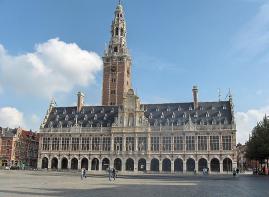
universiteitsbibliotheek.jpg

University Library, University of Leuven, Belgium

► June 26-28, participants will attend classroom seminars on issues of international law and global governance, including global economic and trade governance and global human rights, rule of law, and security governance. Instructors include the Summer School’s co-directors, Georgia Law Associate Dean Diane Marie Amann and Leuven Professor Jan Wouters, along with others from both universities: from Georgia Law, Professor Harlan Cohen and Kathleen A. Doty, our Center’s Director for Global Practice Preparation; from Leuven, Dean Bart Kerremans, Professors Horst Fischer, Dominik SteigerGeert Van Calster, Drs. Matthieu Burnay and Nicolas Hachez, and Senior Researcher Philip De Man.

► Next, on June 29, Summer School participants will participate in International Law and Global Governance in a Turbulent World, an expert conference featuring three panels composed of scholars and practitioners from around the world:

  • Global Governance of Human Rights. How to enforce universal values in contested world?
  • Global Governance of Democracy and Rule of Law in international perspective.
  • Global Economic and Trade Governance in Protectionist Times. Will we see the emergence of trade wars in the coming years?
20150127_sg_report-2014-photo-7.jpg

Headquarters of the North Atlantic Treaty Organization, Brussels, Belgium

► The Summer School will conclude on June 30 with a professional development trip in Brussels, where students will visit the headquarters of the North Atlantic Treaty Organization and the office of the global law firm Sidley Austin LLP.

Further information here; registration for the Belgium-based components of the Summer School here.

Georgia Law profs Cohen and Cade win interdisciplinary research seed grants

Two University of Georgia School of Law professors will take part in transnationally focused research projects, recent winners in a universitywide funding competition.
The 2 projects were among a dozen funded by the University of Georgia  Presidential Interdisciplinary Seed Grant Program. More than 150 faculty teams submitted proposals.

The Georgia Law award-winners are:

Harlan G. Cohen, who holds the Gabriel M. Wilner/UGA Foundation Professor in International Law, will take part in research on “Forecasting the threat of cyber attacks, nation by nation.” Also on the team for this project are faculty from the university’s Franklin College of Arts & Sciences and School of Public & International Affairs, plus a political scientist from the State University of New York-Albany.

Jason A. Cade, Assistant Professor of Law and Director of the law school’s Community Health Law Partnership Clinic. He will collaborate on “Building a network of cultural liaisons to improve the health and well-being of Athens-area Latinos.” The research project’s team also includes faculty from the university’s College of Education, College of Family & Consumer Sciences, College of Pharmacy, College of Public Health, School of Social Work, Latin American & Caribbean Studies Institute, and J.W. Fanning Institute for Leadership Development.

“Judicial Federalism in the European Union,” new article by Professor Wells

Professor Michael Lewis Wells, who holds the Marion and W. Colquitt Carter Chair in Tort and Insurance Law here at the University of Georgia School of Law, has published an article comparing judicial practice in Europe and the United States. Entitled “Judicial Federalism in the European Union,” it appears at 54 Houston Law Review Winter ​697 (2017).

The manuscript, which forms part of our Dean Rusk International Law Center Research Paper Series at SSRN, may be downloaded at this SSRN link.

Here’s the abstract:

This article compares European Union judicial federalism with the American version. Its thesis is that the European Union’s long-term goal of political integration probably cannot be achieved without strengthening its rudimentary judicial institutions. On the one hand, the EU is a federal system in which judicial power is divided between EU courts, of which there are only three, and the well-entrenched and longstanding member state court systems. On the other hand, both the preamble and Article 1 of the Treaty of Europe state that an aim of the European Union is “creating an ever closer union among the peoples of Europe.” The article argues that central government courts and member state courts are not fungible. In close cases, the latter are more likely than the former to favor the member state’s interests. The EU’s approach to judicial federalism, with its heavy reliance on member state courts, will retard the political integration envisioned by the Treaty. The article develops this thesis by comparing EU judicial federalism with the American variant, which differs from the EU system in two key respects: First, most issues of EU law are adjudicated in the member state courts. In the U.S., a network of lower federal courts adjudicates many federal law issues. Second, the U.S. Supreme Court reviews state court judgments that turn on issues of federal law. The Court of Justice of the European Union does not review member state judgments, even on issues of EU law. The article argues that these aspects of the federal system in the U.S. were indispensable to achieving and maintaining national unity. If the EU aspires to a similar level of political integration, their absence may prove to be a significant obstacle.

Professor Cade publishes in Georgia Bar Journal special immigration issue

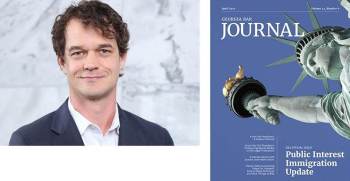
Jason A. Cade, Assistant Professor at the University of Georgia School of Law, has just published “Proportionality Lost? The Rise of Enforcement-Based Equity in the Deportation System and Its Limitations,” at 22 Georgia Bar Journal 16 (2017).

Cade teaches Immigration Law and directs the law school’s Community Health Law Partnership Clinic. His scholarship explores intersections between immigration enforcement and criminal law, the role of prosecutorial discretion in the modern immigration system, and judicial review of deportation procedures.

His latest article, featured in a GBJ special issue entitled “Public Interest Immigration Update,” may be downloaded at SSRN. Here’s the abstract:

This article briefly explains and critiques the legal framework that has made enforcement discretion the primary means of injecting proportionality and fairness into the modern deportation system. The article provides an overview of shifting approaches to this enforcement discretion under the Obama and Trump administrations, and describes some of the key Supreme Court jurisprudence interpreting this framework.

Distinguished India-based alumna, Priti Suri, earns prestigious ABA award

Delighted to congratulate of our our distinguished LL.M. alumnae, Priti Suri, recipient of one of the most prestigious American Bar Association awards. (photo credit)

The ABA Section of International Law bestowed its Mayre Rasmussen Award for the Advancement of Women in International Law upon Suri Wednesday, at a luncheon during the Section’s Spring Meeting in Washington, D.C. Regarding Suri’s award, the Section said:

“Priti’s role as a mentor and in opening doors for women and women lawyers in India make her the perfect candidate for the Mayre Rasmussen Award.”

In a LinkedIn post, Suri responded:

“I feel truly humbled, as the first Asian, to receive ABA’s Mayre Rasmussen career achievement award. To everyone who contributed – my incredible family, my friends, my co-workers, my teachers and to every single person who has been with me on this journey – a very big thank you. Miles and miles to go still….”

Suri is the founder-partner of PSA Legal Counsellors, an Indian business law firm with offices in New Delhi and Chennai. Its practice spans many industries, and includes cross-border M&A transactions, strategic investments, joint-ventures including tender and exchange offers, venture capital financings, structuring private equity deals, leveraged buyouts, and divestitures.

This week’s ABA honor comes not long after another: last October, Suri was named to the India Business Law Journal A-List of India’s top 100 lawyers.

Since earning her Master of Laws degree from in 1989, Suri has remained active in the University of Georgia School of Law community. She frequently welcomes Georgia Law students as part of our Global Externship Overseas, and she has been an officer of the LL.M. Alumni Association.

The ABA Rasmussen Award is named after “a pioneer in the field of international business law” who died in 1998, and is given

“to individuals who have achieved professional excellence in international law, encouraged women to engage in international law careers, enabled women lawyers to attain international law job positions from which they were excluded historically, or advanced opportunities for women in international law.”

Among the prior Rasmussen Award recipients is another member of our Georgia Law community, Associate Dean Diane Marie Amann.

Brava!