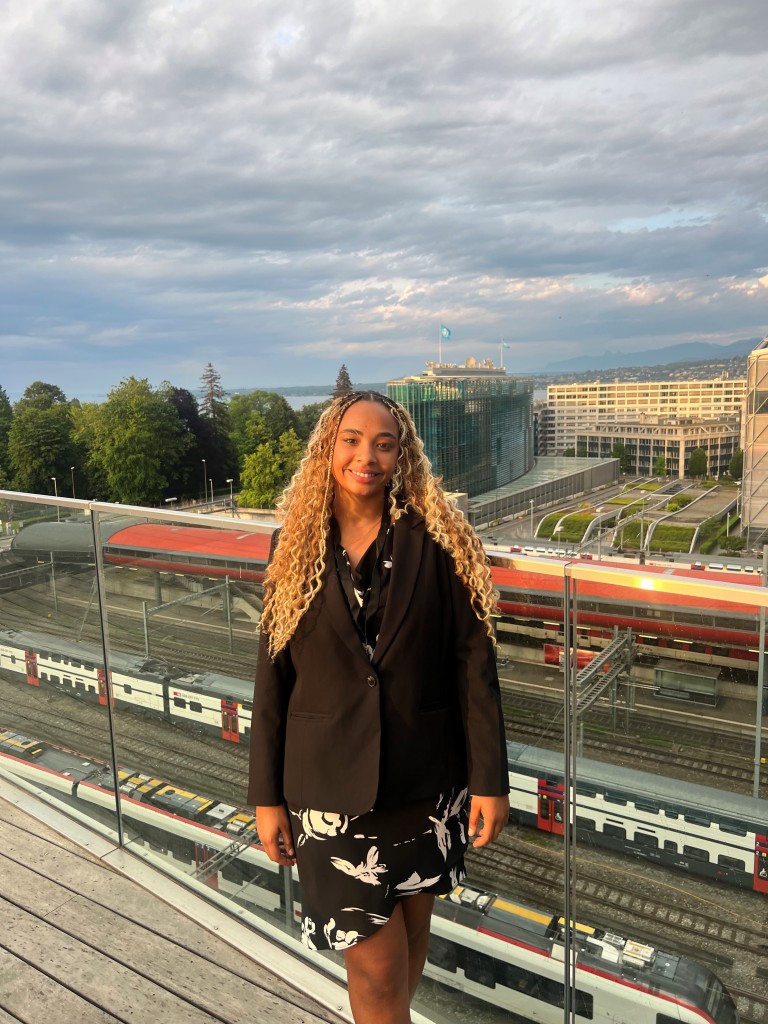
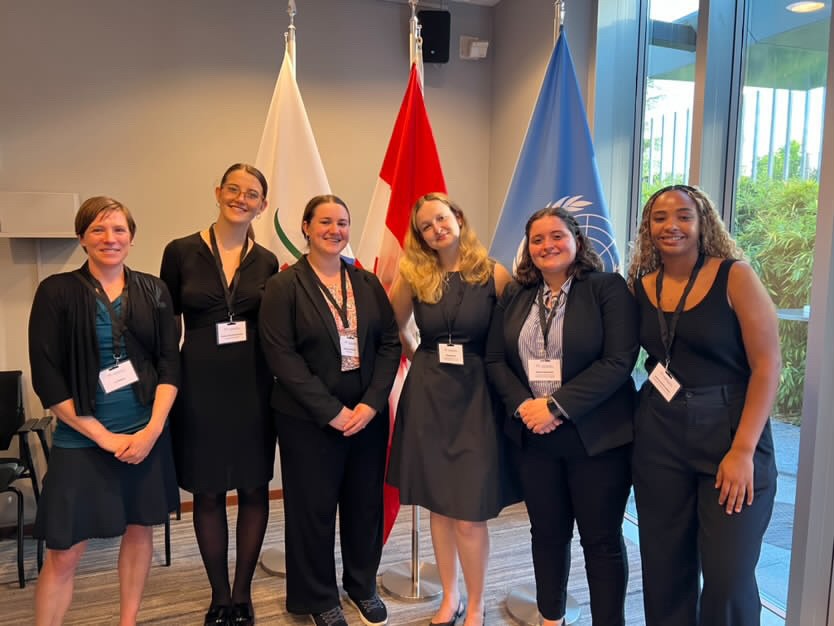
University of Georgia School of Law student, rising 2L Aubrey “Ellie” Wilson-Wade, recently attended the American Society of International Law (ASIL)’s 2024 ASIL Abroad meeting on June 5-6 at the University of Geneva in Geneva, Switzerland. The two-day conference consisted of dual parallel tracks on Human Rights, International Humanitarian Law, International Criminal Law (Track 1) and International Dispute Resolution & International Economic Law (Track 2). Georges Abi-Saab (honorary professor at The Geneva Graduate Institute) delivered a keynote speech, with Laurence Boisson de Chazournes (University of Geneva) as discussant. Below, Wilson-Wade reflects on her experience as an attendee of the conference. Georgia Law is an academic partner of ASIL.
I am so grateful to have had the opportunity to attend the 2024 ASIL Abroad Conference in Geneva, Switzerland. I was able to attend sessions in both track 1 and track 2, as I have an interest in both tracks’ topics. The most memorable sessions that I attended included “Enforcement of Arbitral Awards Rendered Against States” and “Compensation in International Law.” Additionally, I was able to see a mock arbitration related to growing tensions between investment treaties and environmental protection. These panels taught about investment and trade disputes in international law.
My favorite session was titled “Gender, Sexualized Violence, and Conflict: Incorporating the Women, Peace, and Security Agenda into Global Atrocity Prevention Efforts.” The panelists, including Priya Gopalan, Vanessa Murphy, and Dalila Seoane, were able to share their firsthand knowledge and experience working on issues related to gender-based violence.
Overall, the conference was a once-in-a-lifetime learning experience and every panel had an array of diverse perspectives and ideas. Not only was the substantive portion of the conference great, but I also met so many legal professionals and students during my time in Geneva. In just two days, I was able to connect with students attending law school throughout the United States, as well as from schools in England, Brazil, and Geneva. I was also able to network with legal professionals from all over the world.
As a first-year law student, it was a unique opportunity to learn about intricacies of international law outside of the typical classroom setting from professionals in the field. Additionally, it was a great way to make connections with international lawyers and law students. I would highly recommend any student who wishes to globalize their legal perspective and education to attend this conference.
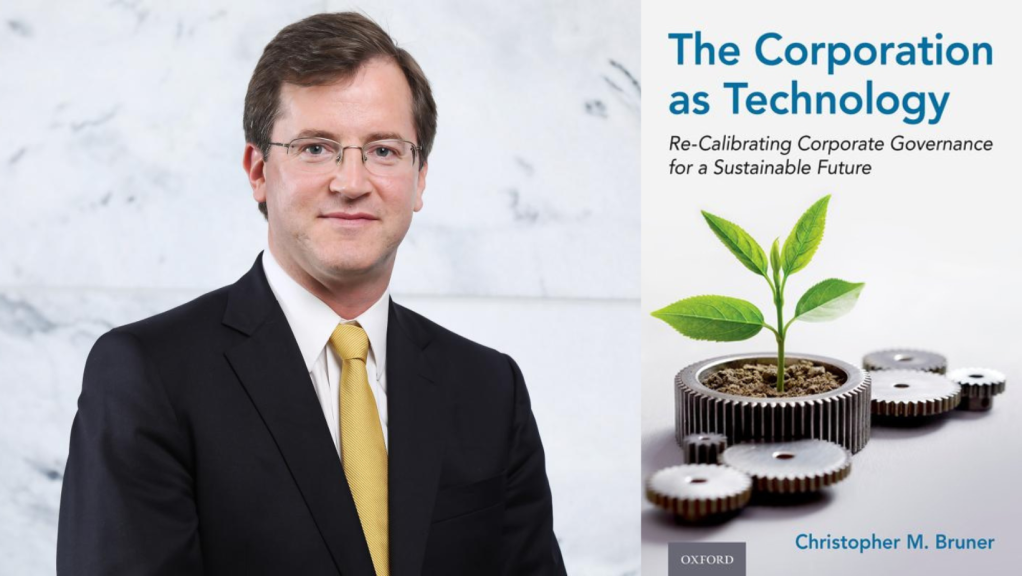
Recent decades have witnessed environmental, social, and economic upheaval, with major corporations contributing to a host of interconnected crises. The Corporation as Technology examines the dynamics of the corporate form and corporate law that incentivize harmful excesses and presents an alternative vision to render corporate activities more sustainable.
The corporate form is commonly described as a set of fixed characteristics that strongly prioritize shareholders’ interests. This book subverts this widely held belief, suggesting that such rigid depictions reinforce harmful corporate pathologies, including excessive risk-taking and lack of regard for environmental and social impacts. Instead, corporations are presented as a dynamic legal technology that policymakers can re-calibrate over time in response to changing landscapes.
This book explores the theoretical and practical ramifications of this alternative vision, focusing on how the corporate form can help secure an environmentally, socially, and economically sustainable future.
The Dean Rusk International Law Center Visiting Researcher for 2023-2024, Mine Turhan, Assistant Professor of Administrative Law in the Faculty of Law at the Izmir University of Economics in Türkiye, recently concluded her research year at the University of Georgia School of Law under the supervision of Georgia Athletic Association Professor in Law David E. Shipley. Below are some of Turhan’s reflections on her research findings regarding administrative procedure and procedural fairnessat Georgia Law.
I was a visiting researcher at the University of Georgia School of Law and the Dean Rusk International Law Center for my post-doc research during 2023-2024 academic year.
My research was related to administrative procedure and procedural fairness. The concept of administrative procedure serves a dual purpose within a legal framework. Primarily, it defines and establishes the limits of the authority of administrative agencies by outlining the structured steps and processes they must follow. Simultaneously, administrative procedure prevents arbitrary actions of agencies by ensuring accurate decisions by the proper application of the law to the facts. This dual function promotes transparency, fairness, and accountability in the functions of administrative agencies.
My research focused on the right to be heard in administrative procedure, and administrative hearings during the process of individual measures which would adversely affect the person concerned. I looked specifically at American and European procedural rights in adjudicative proceedings, in particular the right to be heard before administrative agencies. I tried to answer how procedural rights were protected by different administrative procedures in the U.S. and European countries against arbitrary actions of administrative agencies. I also tried to understand the administrative hearing procedures and components of hearings in common law and civil law systems.
Administrative procedure acts have a significant role in protecting the procedural rights. Therefore, I focused on the administrative procedure acts of different countries to find an answer. The U.S. Administrative Procedure Act, dated 1946, was helpful for my research. I have analyzed the court precedents regarding the right to be heard and I also have observed administrative hearings in U.S. to better understand administrative hearing procedures in U.S.
Throughout my time at the Dean Rusk International Law Center, I have been impressed by the dedication of the faculty, scholars, and staff to fostering a dynamic learning environment. The guidance and mentorship I received from Professor David Shipley has been instrumental in shaping my research. His expertise and encouragement have inspired me to push the boundaries of my intellectual curiosity and pursue excellence in my studies. The resources available at the School of Law, including the extensive library collections and research databases, have greatly enriched my research endeavors.
As I reflect on my time at the Dean Rusk International Law Center, I am filled with appreciation for the enriching experiences and lasting connections forged during my research. The skills and insights gained through my research studies will undoubtedly serve me well in my future endeavors, both academically and professionally.
I extend my heartfelt thanks to everyone at the Dean Rusk International Law Center and the University of Georgia School of Law for their support and encouragement. I am proud to have been a part of such an vibrant academic community and look forward to carrying forward the relationships formed as I embark on the next chapter of my journey.
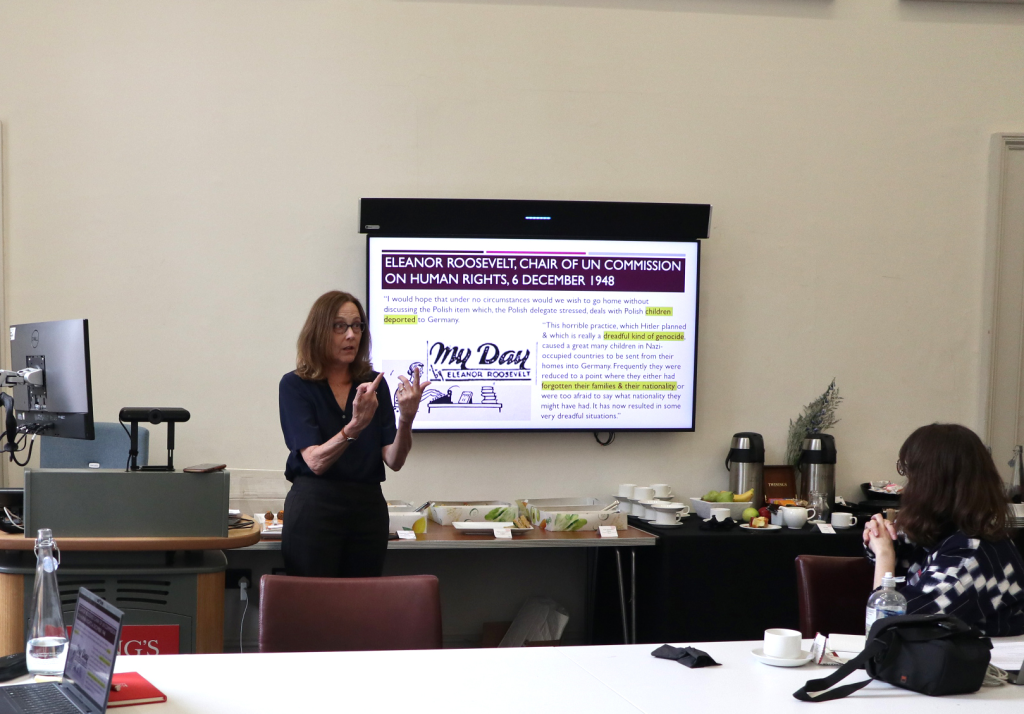
Professor Diane Marie Amann recently presented her research on “Child-Taking” during a Forced Separation Workshop at King’s College London, which cosponsored the event along with Queen’s University Belfast School of Law and the UK Gender, Justice and Security Hub.
Organizers of the workshop – Professor Fionnuala Ni Aolain, Dr. Rebekka Friedman, and Dr. Diana Florez – brought together a global array of participants who engaged in a multidisciplinary exploration of instances and consequences of separating families. Studied were contemporary and historical contexts across the globe. They included: armed conflict and similar violence; security, carceral, and migration detention; coerced schooling; enslavement; and illegal adoptions.
Amann’s talk drew from her article, “Child-Taking,” soon to be published in the Michigan Journal of International Law. (Preprint draft available at SSRN.) As Amann theorizes it, child-taking occurs when a state or similarly powerful entity abducts children from their community and then endeavors to remake the children in its own image. This conduct, involving children taken from Ukraine, lies at the heart of the International Criminal Court warrants pending against President Vladimir Putin and another top Russian official. The article also examines other examples of the phenomenon, including the Nazis’ kidnappings of non-German children during World War II and the forced placement of Indigenous children into boarding schools in North America, Australia, and elsewhere.
Amann is Regents’ Professor of International Law, Emily & Ernest Chair in International Law, and Faculty Co-Director of the Dean Rusk International Law Center here at the University of Georgia School of Law. She writes and teaches in areas including child and human rights, constitutional law, transnational and international criminal law, and global legal history.
Amann situated the crime of human trafficking within efforts to combat illicit flows of myriad goods, ranging from armaments to endangered animal species. She then considered the interplay of multilateral treaties and national statutes by comparing U.S. and British precedents on whether diplomatic immunity applies in cases alleging domestic servitude.
The talk furthered outreach efforts by the American Society of International Law, on whose Judicial Education Committee Amann serves.
Amann is Regents’ Professor of International Law, Emily & Ernest Chair in International Law, and Faculty Co-Director of the Dean Rusk International Law Center here at the University of Georgia School of Law. She writes and teaches in areas including transnational and international criminal law, child and human rights, constitutional law, and global legal history.
States increasingly use driver’s license laws to further policy objectives unrelated to road safety. This symposium contribution employs a health justice lens to focus on one manifestation of this trend—state schemes that prohibit noncitizen residents from accessing driver’s licenses and then impose criminal sanctions for driving without authorization. Status-based no-license laws not only facilitate legally questionable enforcement of local immigration priorities but also impose structural inequities with long-term health consequences for immigrants and their family members, including US citizen children. Safe, reliable transportation is a significant social determinant of health for individuals, families, and communities. Applying a health justice lens to the weaponization of no-license laws against noncitizens will both catalyze new legal challenges and create momentum for coalition building and policy reforms.
Jason A. Cade is Associate Dean for Clinical Programs and Experiential Learning, J. Alton Hosch Professor of Law & Community Health Law Partnership Clinic Director. In addition to overseeing the law school’s 11 in-house clinics and 7 externship programs, Cade teaches immigration law courses and directs the school’s Community Health Law Partnership Clinic (Community HeLP), in which law students undertake an interdisciplinary approach to immigrants’ rights through individual client representation, litigation, and project-based advocacy before administrative agencies and federal courts.
Global Externships Overseas (GEO), 4-12 week placements for rising second- and third-year law students in private-sector and public-sector law placements around the world.
Global Governance Summer School
This year’s Global Governance Summer School will focus on comparative administrative law. It is set to begin this month, when students will travel to Belgium for a week of lectures led by Georgia Law Associate Dean for Academic Affairs & J. Alton Hosch Professor of Law Kent Barnett, as well as professors from partner university KU Leuven. The first week of this for-credit course also will include professional development briefings at the North Atlantic Treaty Organization, the American Chamber of Commerce to the European Union, private law firms, and NGOs.
Then, programming shifts to The Hague, Netherlands, where Barnett will lead briefings at the International Criminal Court, the International Court of Justice, the Permanent Court of Arbitration, the International Residual Mechanism for Criminal Tribunals, and the U.S. Embassy in The Hague. Center director Sarah Quinn and Global Practice Preparation Assistant Catrina Martin will provide logistical assistance during the program.
Our Center’s Global Externship Overseas initiative places Georgia Law students in externships lasting between four and twelve weeks. It thus offers students the opportunity to gain practical work experience in a variety of legal settings worldwide. This summer, three students have opted to combine the GEO opportunity with participation in GGSS: Emily Munger, Karlie “Kara” Reed, and Benjamin Privitera.
This summer, sixteen Georgia Law students are set to pursue Global Externships Overseas, in practice areas such as privacy and technology law, intellectual property law, cultural heritage and historic preservation, environmental law, international arbitration, corporate law, and human rights law.
This year’s GEO class includes these private-sector placements:
Andrew Miller (rising 3L) – Weickmann & Weickmann; Munich, Germany
University of Georgia School of Law 2L Madison Graham recently completed an externship in Norfolk, Virginia, in the legal department of HQ SACT, a leading unit of the North Atlantic Treaty Organization. This externship forms part of Georgia Law’s D.C. Semester in Practice initiative, in partnership with NATO Allied Command Transformation. Graham arrived at Georgia Law after working as a Staff Assistant and Legislative Correspondent in the U.S. Senate. As an undergraduate at the University of Tennessee, Knoxville, Graham interned for the USDA in Washington, D.C. Her law school experiences have included service as an Editorial Board Member of the Georgia Journal of International & Comparative Law, a summer internship at Brussels-based law firm Van Bael & Bellis through the Global Externships Overseas initiative, and President of the International Law Society. Below, Graham reflects on her experiences as an extern with NATO HQ SACT this semester.
I first heard about the opportunity to intern with NATO through the University of Georgia School of Law and the Dean Rusk International Law Center nearly three years ago. At the time, I was only beginning to think about law school and where I might apply. Eventually, however, opportunities like this one are the reason I came to Georgia Law. Getting to spend the spring semester in the Office of the Legal Advisor at NATO’s Headquarters Supreme Allied Command Transformation (HQ SACT) was nothing short of a dream come true.
Fortunately, the mere fact of doing the externship is not where the dream ended. Not only was I working in the midst of an international organization, I was also physically working on a section of the biggest naval base in the world. Because of these two features, I received uniquely multifaceted exposure to both the complexities of working in an international organization, as well as the realities of working in a military environment. As a law student interested in pursuing a career in the national security realm of federal public service, this exposure could not have been more valuable.
The substance of the work was also incredibly rewarding. The Office of the Legal Advisor performs an wide variety of legal roles to support HQ SACT’s mission, and I was fortunate to experience parts of each.
First, the office provides legal assistance to the international military staff of HQ SACT. This is usually in the form of helping them obtain local driver licenses, helping their spouses obtain work permits, assisting with traffic tickets, ensuring their visas are up to date, and preparing powers of attorney for outgoing military personnel. Personally, I found this facet of my work to be an incredibly eye-opening and important reminder of how hard it is to legally transition to life in America. But even further, this work involved communicating with NATO staff from each of the 32+ NATO member countries. This was a test of my ability to communicate clearly, anticipate needs and expectations based on certain peoples’ backgrounds, and generally remind myself of how much peoples’ own cultural perceptions affect their approach to life. As an undergraduate anthropology major, I thought I was prepared for this, but could not have expected how much this work experience even further tested and honed these skills for me.
Second, the Office of the Legal Advisor supports HQ SACT through a variety of more general counsel duties. This might include anything from advising on intellectual property rights, contracting, employment law, operational law, and international law. However, the office prides itself on supporting the endeavors of other sections of HQ SACT – ensuring that their plans and processes are within legal possibility. Because of this, the work of the office is largely dependent on the needs and processes of other offices. In my case, this meant I got to help with contracting guidance for contracting officers in the procurement branch, as well as helping to draft another HQ SACT-wide directive for the permissible use of funding for staff morale and welfare activities. This was a great way to hone the knowledge and skills from previous semesters’ contracting and drafting classes, while also having to adapt to the unique requirements NATO has for such documents.
The highlight of my time, however, may have been the multiple educational and coursework opportunities I was able to participate in. These ranged from online, subject-specific courses – on topics like counterterrorism and gender perspectives in armed conflict – to a week-long Strategic Writing Course, to sitting in on meetings with representatives from the International Committee on the Red Cross. Lastly, the Office of the Legal Advisor hosted a week-long Legal Gathering, with legal advisors from several NATO commands around the world invited to talk about each other’s ongoing work and areas in need of assistance. This as a great opportunity to meet other European lawyers with their own unique backgrounds, as well as learn more about NATO’s structure and the roles of each command. Most importantly, however, my supervisors were incredibly supportive of my participation in all these learning opportunities. It is well-understood that just being in the room, taking in as much information as you can, is so valuable to a young student.
Lastly, I was lucky enough to work with incredible colleagues in HQ SACT during my externship. For example, interns from all over Europe, working in other offices at HQ SACT, welcomed me with open arms and have become close friends. I would, however, like to specifically thank my supervisors and colleagues in the Office of the Legal Advisor: Monte DeBoer, Theresa Donahue, Renata Vaisviliene, Cyrille Pison, Kathy Hansen-Nord, Mette Hartov, Agathe Tregarot, and Galateia Gialitaki. Their kindness, patience, and overall support made an already incredible experience even more special. From bi-weekly staff meetings to monthly staff lunches, to staff birthday celebrations, I felt welcomed as a full member of the team from my first day to my last.
I could not be more thankful for my time at NATO HQ SACT, and was reminded of that each time I was asked: “so how do you get to be here?” Over the course of the semester, I must have watched at least a dozen people marvel at the fact that Georgia Law has this externship opportunity available to students. Its uniqueness cannot be understated; I firmly believe it is an something every student at Georgia Law – regardless of your current interests may be – should at least take a moment to appreciate, if not consider doing themselves.
“‘Adrift in the Indian Ocean’ explores how and why empires and nation-states looked beyond land-based territorial conquests and claimed maritime spaces. It is a history of sovereignty and placemaking set in the Indian Ocean from the 18th century onwards, one where imperial officials and scientists confronted the differing views of space held by maritime and coastal communities. Legal fictions such as the ‘territorial sea’ or ‘historic waters’ emerged from these encounters, showing how oceanic space patrolled for security was eventually enclosed as property. Exploring key sites looking out to the ocean from south Indian coasts, ‘Adrift’ shows how people and places once abandoned are dredged up during present-day legal disputes over maritime boundaries in the Indian Ocean.“
Ramnath received her Ph.D. in history from Princeton University in 2018, and was a Prize Fellow in Economics, History, and Politics at the Center for History and Economics at Harvard University from 2018 – 2021. She also holds a bachelor’s degree in arts and law (B.A., LL.B. (Hons.) (JD equivalent) from the National Law School of India University (NLSIU) and a master’s degree in law (LL.M.) from the Yale Law School.
A member of the Dean Rusk International Law Center’s staff, Global Practice Preparation Assistant Catrina Martin, attended this year’s ninth annual Atlanta International Arbitration Society (AtlAS) lecture, “Rage Against the Machine: Governing the Use of AI in International Arbitration.” AtlAS is one of the Center’s institutional partners, and Georgia Law alumnus Dr. Christof Siefarth (LL.M., ’88) is the newly-elected president. Below are some of Martin’s reflections of the event.
Her lecture discussed the potential copyright concerns in using AI, such as who owns the created data, as well as privacy concerns given that AI generators have the ability to move past firewalls and other security measures. Discussion included a critique of how the increasing use of AI in arbitration, and across the broader legal field, is training students and young lawyers for the profession, and developing the building block skills of research, writing, and cite checking.
Strong advised that in arbitration, both parties agree during preliminary discussions on the use of AI, and that arbitrators proactively raise the issue with their clients.
Martin reflected on the value of this topic for law students in particular:
“[Strong’s] perspective is helpful for students who are interested in best practices in arbitration, and especially those ‘digital natives,’ for whom AI usage feels like a natural extension of technology already ingrained in their legal education, such as LexisNexis case searches. For students who are interested in international arbitration, generative AI use may offer cost and time savings on the front end, but the pitfalls, especially when arbitrating across common- and civil-law countries, outweigh this potential.”
Strong has taught at law schools around the world and has acted as a dual-qualified (England-US) practitioner with major international law firms in the UK and the US. She has also written over 130 books, articles, and other works and has acted as an expert consultant to a variety of governmental, non-governmental and intergovernmental organizations. A full biography can be found on Emory University’s website.


 exchange of notes