
“Crimmigration as Paradigmatic Migration Control in the United States: Exploring the Impact on Communities, Courts, and Attorneys” November 7 Georgia Journal of International and Comparative Law and Georgia Criminal Law Review annual conference

This year’s annual conference of the Georgia Journal of International and Comparative Law will present “Crimmigration as Paradigmatic Migration Control in the United States: Exploring the Impact on Communities, Courts, and Attorneys“. The conference will be offered jointly by the GJICL and the Georgia Criminal Law Review.

The daylong conference will take place on Friday, November 7 in the Larry Walker Room of Dean Rusk Hall at the University of Georgia School of Law. CLE credit is available for both in-person and virtual attendance. Registration information can be found on the conference webpage.

Sponsoring along with GJICL, a student-edited journal established more than 50 years ago, is the law school’s Dean Rusk International Law Center. GJICL Editor in Chief, Casey Smith (J.D. ’26) and Executive Conference Editor Kellianne Elliot (J.D. ’26) worked Georgia Criminal Law Review Editor in Chief Kerolls Gadelrab (J.D. ’26); Professor Jason A. Cade, J. Alton Hosch Professor of Law & Community Health Law Partnership Clinic Director; Center staff Sarah Quinn, Director; Catrina Martin, Global Practice Preparation Assistant; Taher S. Benany, Center Associate Director; and with the GJICL’s Faculty Advisor, Professor Desirée LeClercq, who is Assistant Professor of Law & Faculty Co-Director of the Dean Rusk International Law Center.

Below is the concept note of the conference:

Political and legal developments have precipitated a convergence of the fields of criminal law and immigration law. Now commonly referred to as crimmigration, this merger of previously distinct practice areas already has profoundly reshaped the legal and social terrain for migrants in the United States. While entry and removal decisions remain essentially administrative, enforcement practices and rhetoric increasingly embrace the punitive logic and carceral reach of the criminal legal system, but with fewer due process protections. As new legislation vastly expands detention authorization and other enforcement resources, it seems apparent that the rhetoric and mechanics of crimmigration will continue to dominate immigration policy in the United States for the foreseeable future. 

This symposium, jointly sponsored by the Dean Rusk International Law Center, the Georgia Journal of International and Comparative Law, and the Georgia Criminal Law Review, invites scholars, immigration attorneys and judges to engage with these developments. We hope panelists will collectively address a number of important questions, such as the following: How does the new crimmigration landscape impact immigrants and communities in the Southeast and beyond? What new burdens does it put on the judiciary, and what role do federal courts have today in determining and upholding constitutional and statutory protections for migrants? Does the durability and continued expansion of crimmigration pose new challenges for immigration and criminal law attorneys; and, if so, how are the immigration and criminal law bars responding to those challenges? As crimmigration tactics expand, what new legal threats face U.S. citizens, including family members, employers, and immigrant advocates? Does the crimmigration paradigm contend with or obscure the structural forces that drive migration, particularly from the global south? Are there reasons to hope or expect the emergence of alternatives to crimmigration as the governing paradigm for the regulation of immigrants in the United States? 

These conversations will occur through three panels and a lunchtime keynote speaker. 

The day’s events are as follows:

9:30am | Opening Remarks

Usha Rodrigues, Dean, University Professor & M.E. Kilpatrick Chair of Corporate Finance and Securities Law

9:35am | Panel 1: Introduction to Crimmigration & the Current State of Affairs

  • Abel Rodríguez, Assistant Professor of Law, Wake Forest Law
  • Shalini Ray, Associate Professor of Law and Director of Faculty Research, Alabama Law
  • Gracie Willis, Attorney, National Immigration Project
  • Moderator: Christian Turner, Associate Professor of Law, University of Georgia School of Law

10:35am | Break

10:45am| Panel 2: The Impact of Crimmigration Policies on Communities and Advocates 

  • Jessica Vosburgh, Senior Staff Attorney, Center for Constitutional Rights
  • Jenny R. Hernandez, Lead Senior Attorney at Immigration Defense Unit, City of Atlanta Office of the Public Defender
  • Carolina Antonini, Founding Partner, Antonini & Cohen Immigration Law
  • Moderator: Elizabeth Taxel, Clinical Associate Professor & Criminal Defense Practicum Director, University of Georgia School of Law

12:00pm | Keynote Introduction

Jason A. Cade, J. Alton Hosch Professor of Law & Community Health Law Partnership Clinic Director, University of Georgia School of Law

12:05     Keynote Address

Judge Ana C. Reyes, United States District Court, District of Columbia

1:00pm | Panel 3: Challenging the Legality of Migration Controls & Envisioning Reform

  • Daniel I. Morales, Associate Professor of Law; Dwight Olds Chair, The University of Houston Law Center
  • Rebecca A. Sharpless, Associate Dean for Experiential Learning, Professor of Law, Director, Immigration Clinic, University of Miami School of Law
  • Emily Torstveit Ngara, Director of Clinical Programs, Associate Clinical Professor and Director, Immigration Clinic, Center for Access to Justice, Immigration Law Clinic, Georgia State University College of Law
  • Moderator: Jason A. Cade J. Alton Hosch Professor of Law & Community Health Law Partnership Clinic Director, University of Georgia School of Law

2:00 | Closing Remarks

Casey Smith, Editor in Chief, Georgia Journal of International and Comparative Law

Georgia Journal of International and Comparative Law publishes Issue 1 of 53rd Volume
The University of Georgia School of Law’s Georgia Journal of International and Comparative Law (GJICL) is pleased to announce the publication of Issue 1 of its 53rd Volume

This issue features three Articles that engage with pressing global legal developments. These include:

Four student Notes were also published on a range of timely topics, including:

The GJICL is a preeminent forum for academic discussion on current international subjects. From its inception in 1970 as a student initiative supported by former U.S. Secretary of State and Georgia Law Professor Dean Rusk, GJICL features work by legal scholars and practitioners as well as student notes written by students on GJICL’s editorial board.

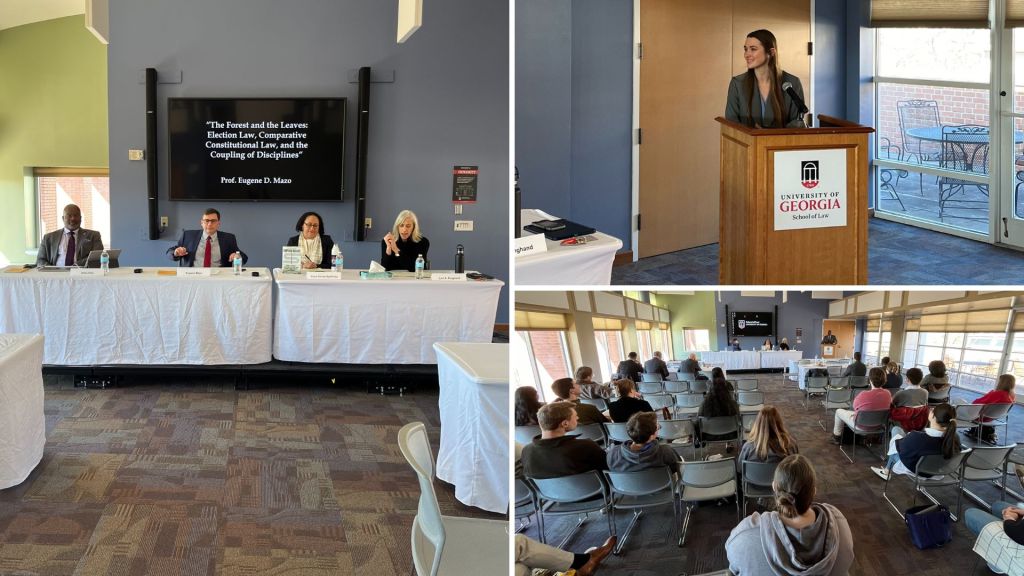
Georgia Law hosts annual Georgia Journal of International and Comparative Law conference, “Defending Democracy: A Comparative Perspective”

The annual conference of the University of Georgia School of Law’s Georgia Journal of International and Comparative Law, entitled “Defending Democracy: A Comparative Perspective,” took place last week.

As posted previously, this event brought together comparative law scholars from across the country to discuss a range of issues involving democracy, democratic backsliding, and comparative constitutional protections of democratic norms and institutions. Discussions included comparative lessons in “militant democracy,” the role of judges in defining or protecting democracy and democratic participation, democratic protections in the American constitutional system and how they differ from other nations, democracy and free speech, and lessons from recent elections around the world. University of Georgia School of Law Professor Lori A. Ringhand, J. Alton Hosch Professor of Law & Josiah Meigs Distinguished Teaching Professor, worked with GJICL students to conceptualize the conference theme and panels.

The panels from the conference are outlined below:

Panel 1: Democracy and Institutional Legitimacy: Panelists included Richard Albert, Hines H. Baker and Thelma Kelley Baker Chair in Law, University of Texas at Austin School of Law; Zachary Elkins, Professor, University of Texas at Austin; and moderator Taher S. Benany, Associate Director, Dean Rusk International Law Center, University of Georgia School of Law

Panel 2: Democratic Governance and Constitutional Design: Panelists included David E. Landau, Mason Ladd Professor and Associate Dean for International Programs, Florida State University College of Law; David S. Law, E. James Kelly, Jr., Class of 1965 Research Professor of Law, University of Virginia; Miguel Schor, Class of 1977 Distinguished Scholar and Professor of Law, Drake University Law School; and moderator Joseph S. Miller, Ernest P. Rogers Chair of Intellectual Property and Unfair Competition Law, University of Georgia School of Law

Panel 3: Individual Rights and Democratic Participation: Panelists included Ciara Torres-Spelliscy, Professor of Law, Stetson Law; Eugene D. Mazo, Associate Professor of Law, Duquesne University; Atiba Ellis, Laura B. Chisholm Distinguished Research Scholar and Professor of Law, Case Western Reserve School of Law; and moderator Lori A. Ringhand, J. Alton Hosch Professor of Law & Josiah Meigs Distinguished Teaching Professor, University of Georgia School of Law

Georgia Law Dean Usha R. Rodrigues, University Professor & M.E. Kilpatrick Chair of Corporate Finance and Securities Law, provided introductory remarks for the conference. Jasmine Furin, Editor in Chief, Georgia Journal of International and Comparative Law, gave a closing address. Professor Desirée LeClercq serves as the journal’s Faculty Adviser.

This event was cosponsored by the Dean Rusk International Law Center.

“Defending Democracy: A Comparative Perspective,” February 21 Georgia Journal of International and Comparative Law annual conference

This year’s annual conference of the Georgia Journal of International and Comparative Law will address “Defending Democracy: A Comparative Perspective.”
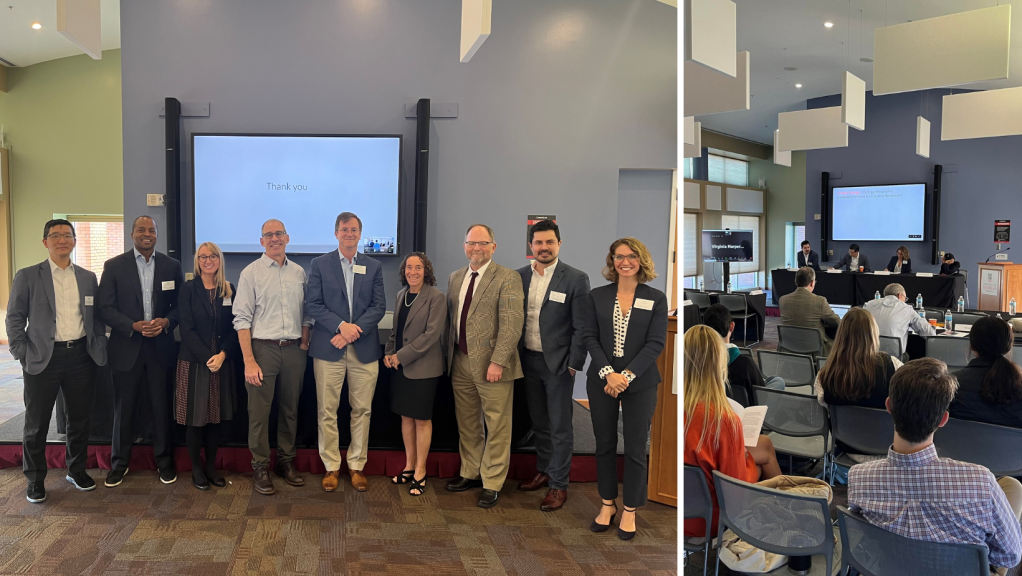
The daylong conference will take place on Friday, February 21 in the Larry Walker Room of Dean Rusk Hall at the University of Georgia School of Law.

Sponsoring along with GJICL, a student-edited journal established more than 50 years ago, is the law school’s Dean Rusk International Law Center. GJICL Editor in Chief, Jasmine Furin (J.D. ’25) and Executive Board members Logan Berg, Nina Dickerson, and Caleb Morris worked with Professor Lori A. Ringhand, J. Alton Hosch Professor of Law & Josiah Meigs Distinguished Teaching Professor; Center staff Sarah Quinn, Director; Catrina Martin, Global Practice Preparation Assistant; Taher S. Benany, Center Associate Director; and with the GJICL’s Faculty Advisor, Professor Desirée LeClercq, who is Assistant Professor of Law & Faculty Co-Director of the Dean Rusk International Law Center.

Below is the concept note of the conference:

Nations across the world are struggling to defend their institutions of democratic government. Voters are dissatisfied with how their institutions are working, social media is changing how nations define and regulate political speech, and courts are struggling to understand their rule in policing constraints on the exercise of political power and protecting individual rights. 

This event brings together comparative law scholars from across the country to discuss a range of issues involving democracy, democratic backsliding, and comparative constitutional protections of democratic norms and institutions. Discussions may include comparative lessons in “militant democracy,” the role of judges in defining or protecting democracy and democratic participation, democratic protections in the American constitutional system and how they differ from other nations, democracy and free speech, and lessons from recent elections around the world. 

The day’s events are as follows:

9:00-9:15am | Welcome Messages

Usha Rodrigues, Dean, University Professor & M.E. Kilpatrick Chair of Corporate Finance and Securities Law

9:15-10:30am | Panel 1: Democracy and Institutional Legitimacy 

  • Richard Albert, Hines H. Baker and Thelma Kelley Baker Chair in Law, University of Texas at Austin School of Law 
  • Zachary Elkins, Professor, University of Texas at Austin 
  • Panel Moderator: Taher S. Benany, Associate Director, Dean Rusk International Law Center, University of Georgia School of Law

10:30-10:45am | Break

10:45-12:00pm | Panel 2: Democratic Governance and Constitutional Design

  • David E. Landau, Mason Ladd Professor and Associate Dean for International Programs, Florida State University College of Law
  • David S. Law, E. James Kelly, Jr., Class of 1965 Research Professor of Law, University of Virginia
  • Miguel Schor, Class of 1977 Distinguished Scholar and Professor of Law, Drake University Law School
  • Panel Moderator: Joseph S. Miller, Ernest P. Rogers Chair of Intellectual Property and Unfair Competition Law, University of Georgia School of Law

12:00-1:00pm | Lunch

1:00-2:15pm | Panel 3: Individual Rights and Democratic Participation

  • Ciara Torres-Spelliscy, Professor of Law, Stetson Law
  • Eugene D. Mazo, Associate Professor of Law, Duquesne University
  • Atiba Ellis, Laura B. Chisholm Distinguished Research Scholar and Professor of Law, Case Western Reserve School of Law 
  • Panel Moderator: Lori A. Ringhand, J. Alton Hosch Professor of Law & Josiah Meigs Distinguished Teaching Professor, University of Georgia School of Law

2:15 | Closing Remarks

Jasmine Furin, Editor in Chief, Georgia Journal of International and Comparative Law
Six Master of Laws (LL.M.) students selected as Graduate Editors of the Georgia Journal of International and Comparative Law

Six Master of Laws (LL.M.) students from the University of Georgia School of Law’s class of 2025 were selected to join the Editorial Board of the Georgia Journal of International and Comparative Law as Graduate Editors. The students are: Sara Dorbahani, Michael Faleye, Neethu James, Samuel Kuo, Dzmitry Liasovich, and Ramakrishna Rut Palepu.

As Graduate Editors, each LL.M. student conducts citation checks and writes a Comment or Book Review on the legal topic of their choice. The Graduate Editors further facilitate the Journal’s commitment to “including a diversity of perspectives, experiences, and backgrounds within [its] membership,” according to the Editor in Chief, Jasmine Furin (J.D. ’25).

The Georgia Journal of International and Comparative Law is a preeminent forum for academic discussion on current international subjects. From its inception in 1971 as a student initiative supported by former U.S. Secretary of State and Georgia Law Professor Dean Rusk, the Journal features work by legal scholars and practitioners and student notes written by Journal members.

Georgia Law Professor Diane Marie Amann presents on Nuremberg woman defendant at conference in memory of FIU Law Professor Megan A. Fairlie

University of Georgia School of Law Professor Diane Marie Amann spoke last week at a conference which paid tribute to Professor Megan A. Fairlie (1971-2022), an international criminal law scholar who had presented her own work at our law school’s Dean Rusk International Law Center.

Most recently, Dr. Fairlie had taken part in a 2019 symposium entitled “International Criminal Court and the Community of Nations,” and she published her presentation, “Defense Issues at the International Criminal Court,” in the Georgia Journal of International and Comparative Law symposium issue.

In recognition of Fairlie’s scholarship on persons accused by international criminal tribunals, Amann chose to present “Inge Viermetz, Woman Acquitted at Nuremberg,” at Friday’s conference.

Entitled “Perspectives on the International Criminal Court and International Criminal Law and Procedure: A Symposium in Memory of Megan Fairlie,” the conference took place at Miami’s Florida International University College of Law. Dr. Fairlie had taught there from 2007 – the same year she earned her Ph.D. in International Human Rights Law from the Irish Centre for Human Rights, National University of Ireland-Galway – until her death in December 2022.

Amann, who is Regents’ Professor of International Law, Emily & Ernest Woodruff Chair in International Law, and Faculty Co-Director of the Dean Rusk International Law Center here at Georgia Law, has published frequently on women professionals during the post-World War II trials at Nuremberg and elsewhere.

Video available for “ESG and Corporate Sustainability: Global Perspectives on Regulatory Reform,” conference held October 16 at UGA Law

The annual conference of the University of Georgia School of Law’s Georgia Journal of International and Comparative Law, entitled “ESG and Corporate Sustainability: Global Perspectives on Regulatory Reform,” can now be viewed online.

As posted previously, speakers representing a diverse range of doctrinal, institutional, and jurisdictional perspectives gathered on October 16 to discuss the array of contemporary ESG and corporate sustainability initiatives, mapping this rapidly evolving global landscape and engaging with the host of complex international and comparative legal challenges they raise.

Keynoting the conference was University of Pennsylvania Carey School of Law Professor Jill E. Fisch, Saul A. Fox Distinguished Professor of Business Law; Co-Director, Institute for Law & Economics.

The video links are as follows:

Introduction and Panel 1: ESG and Sustainable Finance, with Usha Rodrigues, University Professor and M.E. Kilpatrick Chair of Corporate Finance and Securities Law, University of Georgia School of Law; George S. Georgiev, Associate Professor of Law, Emory University School of Law; Virginia Harper Ho, Professor of Law, City University of Hong Kong; Stephen Park, Associate Professor of Business Law and Satell Fellow in Corporate Social Responsibility, University of Connecticut School of Business; and Anne Tucker, Professor of Law, Georgia State University College of Law.

Panel 2: Corporate Law, Corporate Governance and Sustainability, with Christopher M. Bruner, Stembler Family Distinguished Professor in Business Law and Faculty Co-Director of the Dean Rusk International Law Center, University of Georgia School of Law; Matthew T. Bodie, Robins Kaplan Professor of Law, University of Minnesota Law School; Andrew Johnston, Professor of Company Law and Corporate Governance, University of Warwick School of Law; Lindsay Sain Jones, Assistant Professor, University of Georgia Terry College of Business; and Omari Scott Simmons, Professor of Law, George Washington University Law School.

Panel 3: Multinational Corporations and Global Value Chains, with Harlan G. Cohen, Gabriel M. Wilner/UGA Foundation Professor in International Law and Faculty Co-Director of the Dean Rusk International Law Center, University of Georgia School of Law (and the GJICL’s Faculty Advisor); Sarah Dadush, Professor of Law, Rutgers Law School; David Hess, Professor of Business Law and Business Ethics, University of Michigan Stephen M. Ross School of Business; Kish Parella, Class of 1960 Professor of Ethics and Law, Washington and Lee University School of Law; and Jaakko Salminen, Associate Senior Lecturer, Department of Law, Lund University.

Keynote Address by Jill E. Fisch, Saul A. Fox Distinguished Professor of Business Law and Co-Director of the Institute for Law and Economics, University of Pennsylvania Carey Law School

This event was cosponsored by the Dean Rusk International Law Center.

“ESG and Corporate Sustainability: Global Perspectives on Regulatory Reform,” October 16 Georgia Journal of International and Comparative Law annual conference

This year’s annual conference of the Georgia Journal of International and Comparative Law will address “ESG and Corporate Sustainability: Global Perspectives on Regulatory Reform.” Featured will be a keynote discussion by Jill E. Fisch, the Saul A. Fox Distinguished Professor of Business Law and Co-Director of the Institute for Law and Economics at the University of Pennsylvania Carey Law School, as well as panels including more than a dozen experts from around the world.

The daylong conference will take place on Monday, October 16, in the Larry Walker Room of Dean Rusk Hall at the University of Georgia School of Law.

Sponsoring along with GJICL, a student-edited journal established more than 50 years ago, is the law school’s Dean Rusk International Law Center. GJICL Editor in Chief, 3L Jack Schlafly, worked with Professor Christopher M. Bruner, who is the Stembler Family Distinguished Professor in Business Law and a newly appointed Faculty Co-Director of the Dean Rusk International Law Center; Center staff Sarah Quinn, Interim Director; Catrina Martin, Global Practice Preparation Assistant; and with the GJICL’s Faculty Advisor, Professor Harlan Grant Cohen, who is Gabriel M. Wilner/UGA Foundation Professor in International Law and one of the Center’s Faculty Co-Directors.

Below is the concept note of the conference:

We live in an era marked by complex and interconnected environmental, social, and economic crises, including climate change and various forms of destabilizing inequalities. Efforts to grapple with these realities are rapidly evolving and taking shape through a host of private and public institutions, both domestically and internationally, and an array of novel reform efforts aim to curb harmful corporate practices that have contributed to such crises.

Global asset managers have increasingly prioritized “environmental, social, and governance” (ESG) factors – emphasizing their relation to investment risk and investment return – and have taken up existing tools available to them through corporate law, securities regulation, and capital market structures to push for change. Meanwhile, various types of domestic regulatory reforms have been adopted, or are under consideration, in jurisdictions around the world to promote “corporate sustainability,” understood to include environmental, social, and economic dimensions. Some reform initiatives focus on disclosure, reflecting confidence that investors, consumers, and other constituencies armed with sufficient information could differentiate between sustainable and unsustainable companies, and that these private actors would effectively reward the former and punish the latter. Other reform initiatives take more direct aim at decision-making incentives of managers and investors alike, through corporate governance structures creating novel – and potentially powerful – liability regimes intended to force both domestic and multinational businesses to internalize costs that would otherwise be externalized to society and the environment. At the same time, a host of international organizations have sought to promote ESG and corporate sustainability through a range of global standard-setting and coordination efforts.

This symposium will grapple with the array of ESG and corporate sustainability initiatives taking shape today, mapping this rapidly evolving global landscape and engaging with the host of complex international and comparative legal challenges they raise. Speakers offering a diverse range of doctrinal, institutional, and jurisdictional perspectives will tackle these issues through presentations and panel discussions focusing on capital market developments, corporate governance reform initiatives, and efforts to constrain multinational businesses.

The day’s events are as follows:

9:00-9:15am | Welcome Messages

Peter B. “Bo” Rutledge, Dean and Talmadge Chair of Law, University of Georgia School of Law

Sarah Quinn, Interim Director, Dean Rusk International Law Center

9:15-10:30am | Panel 1: ESG and Sustainable Finance

  • George S. Georgiev, Associate Professor of Law, Emory University School of Law
  • Virginia Harper Ho, Professor of Law, City University of Hong Kong (Zoom)
  • Stephen Park, Associate Professor of Business Law and Satell Fellow in Corporate Social Responsibility, University of Connecticut School of Business
  • Anne Tucker, Professor of Law, Georgia State University College of Law
  • Moderator: Usha Rodrigues, University Professor and M.E. Kilpatrick Chair of Corporate Finance and Securities Law, University of Georgia School of Law

10:30-10:45am | Break

10:45-12:00pm | Panel 2: Corporate Law, Corporate Governance and Sustainability

  • Matthew T. Bodie, Robins Kaplan Professor of Law, University of Minnesota Law School
  • Andrew Johnston, Professor of Company Law and Corporate Governance, University of Warwick School of Law (UK) (Zoom)
  • Lindsay Sain Jones, Assistant Professor, University of Georgia Terry College of Business 
  • Omari Scott Simmons, Professor of Law, George Washington University Law School 
  • Moderator: Christopher M. Bruner, Stembler Family Distinguished Professor in Business Law and Faculty Co-Director of the Dean Rusk International Law Center, University of Georgia School of Law

12:00-1:00pm | Lunch

1:00-2:15pm | Panel 3: Multinational Corporations and Global Value Chains

  • Sarah Dadush, Professor of Law, Rutgers Law School (Zoom)
  • David Hess, Professor of Business Law and Business Ethics, University of Michigan Stephen M. Ross School of Business
  • Kish Parella, Class of 1960 Professor of Ethics and Law, Washington and Lee University School of Law (Zoom)
  • Jaakko Salminen, Associate Senior Lecturer, Department of Law, Lund University (Sweden) (Zoom)
  • Moderator: Harlan G. Cohen, Gabriel M. Wilner/UGA Foundation Professor in International Law and Faculty Co-Director of the Dean Rusk International Law Center, University of Georgia School of Law

2:15-2:30pm | Break

2:30-2:35pm | Keynote Introduction

Christopher M. Bruner, Stembler Family Distinguished Professor in Business Law and Faculty Co-Director of the Dean Rusk International Law Center, University of Georgia School of Law

2:35-3:15pm | Keynote Address

Jill E. Fisch, Saul A. Fox Distinguished Professor of Business Law and Co-Director of the Institute for Law and Economics, University of Pennsylvania Carey Law School

3:15 | Closing Remarks

Jack Schlafly, Editor in Chief, Georgia Journal of International and Comparative Law

Professor MJ Durkee publishes essay on legacy of 1972 Stockholm Declaration in special issue of Georgia Journal of Comparative and International Law

Professor Melissa J. “MJ” Durkee, Associate Dean for International Programs, Director of the Dean Rusk International Law Center, and Allen Post Professor at the University of Georgia School of Law, published “International Environmental Law at Its Semicentennial: The Stockholm Legacy” in 50 Georgia Journal of International and Comparative Law 748 (2022), available at the journal’s website as well as SSRN.

The publication reflects upon issues raised at, the journal’s October 2021 conference, “The 1972 Stockholm Declaration at 50: Reflecting on a Half-Century of International Environmental Law.” (Prior posts and links to panel videos here)

Here’s the SSRN abstract of Professor Durkee’s essay:

“The 1972 United Nations Conference on the Human Environment produced the Stockholm Declaration, an environmental manifesto that forcefully declared a human right to environmental health and birthed the field of modern international environmental law. The historic event powerfully “dramatized . . . the unity and fragility of the biosphere,” sparking a remarkable period of international legal innovation and cooperation on environmental protection in the decades to come.

“The Stockholm Declaration can be rightly celebrated for putting environmental issues on the international legal agenda and driving the development of environmental law at the domestic level around the world. At the same time, the Declaration’s distinctive framing of environmental problems and solutions deeply influenced these abundant subsequent laws, and here its legacy is mixed. This special issue, in celebration of the Georgia Journal of International and Comparative Law’s 50th anniversary volume, evaluates the legacy of the Stockholm Declaration and the legal movement it launched.”

Published in the same journal issue were: “‘In Countless Ways and On an Unprecedented Scale’: Reflections on the Stockholm Declaration at 50” by Rebecca Bratspies, Professor of Law and founding Director of the Center for Urban Environmental Reform at CUNY School of Law; and “Legal Rights for Rivers” by Katie O’Bryan, Lecturer and Member of the Castan Centre for Human Rights Law, Faculty of Law, at Monash University in Australia.

Stockholm Declaration conference: link to video of Shelton keynote and panel on international environmental law’s future

This image has an empty alt attribute; its file name is panel3.png

A superb third panel and keynote speech concluded “The 1972 Stockholm Declaration at 50: Reflecting on a Half-Century of International Environmental Law” conference that we at the Dean Rusk International Law Center and the Georgia Journal of International and Comparative Law at the University of Georgia School of Law hosted on October 8.

Following on our prior posts outlining the first and second parts of our daylong conference, we’re pleased in this post to recap the final segment, video of which is available here. (The full series, meanwhile, is available here.)

It begins with the third panel of the conference, entitled “International Environmental Law’s Future,” and moderated by MJ Durkee, Associate Dean for International Programs, Director of the Dean Rusk International Law Center, and Allen Post Professor at Georgia Law (pictured above, middle right). Joining her were 4 panelists (pictured clockwise from bottom center): Lakshman D. Guruswamy, Nicholas Doman Professor of International Environmental Law at Colorado Law; Jutta Brunnée, Dean, University Professor, and James Marshall Tory Dean’s Chair at the University of Toronto Faculty of Law in Canada; Cymie Payne, Associate Professor in the Department of Human Ecology and the School of Law, Rutgers University; and Rebecca M. Bratspies, Professor and Director of the Center for Urban Environmental Reform at CUNY Law.

Together, they consider the part of Principle 1 of the Stockholm Declaration that declares:

“[Humankind] bears a solemn responsibility to protect and improve the environment for present and future generations.”

In light of that statement, panelists examined the major successes and failures of the last half-century of international environmental law, and, imagining a “2022 Stockholm Declaration,” they considered how to prioritize environmental protection efforts going forward.

Then follows “Stockholm Plus 50: Glass Half Full, Half Empty, or Shattered?,” the keynote address by Dinah L. Shelton, Manatt/Ahn Professor of International Law Emeritus at George Washington University School of Law. In it, Shelton sounds an urgent call to action to ensure protection from the worst effects of climate change, especially for the most vulnerable populations.

Kimberlee Styple, GJICL Editor-in-Chief, then delivers closing remarks.