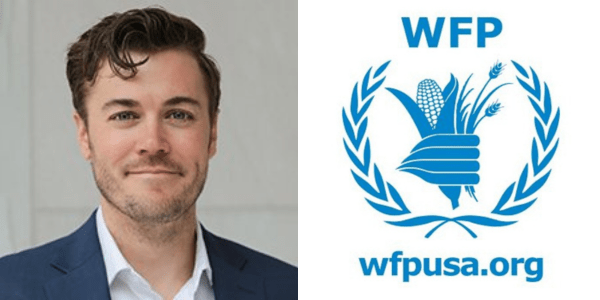
Chase Sova, senior director of Public Policy and Research at World Food Program USA, speaks at UGA Law

Senior director of Public Policy and Research at World Food Program USA (WFP USA) Chase Sova spoke to students about the intersection of international law and policy as it relates to the global challenge of food insecurity Monday here at the University of Georgia School of Law.

Sova began his talk by explaining the relationship between WFP USA, a US-based non-profit organization, and the United Nations World Food Programme, which the WFP USA works to support stateside. He then discussed the global food insecurity landscape and how it is driven primarily by climate change, conflict, and economic disruptions, or shocks. Sova established links between international trade law and food insecurity, especially in the context of recent global events like the COVID-19 pandemic and the Russian invasion of Ukraine. He introduced students to the current debates about whether policies resulting in extreme food insecurity and starvation could be violations of international human rights law. Students were able to ask Sova questions about his educational background, his advice to those seeking careers in public service, and job opportunities for students interested in the work of the WFP USA.

Before his current position with WFP USA, Sova worked with the United Nations Food and Agriculture Organization (FAO), International Center for Tropical Agriculture (CIAT) and the CGIAR Research Program on Climate Change, Agriculture and Food Security (CCAFS). He has consulted with the World Bank, Johns Hopkins, and Tufts University. Interested in the intersection of food insecurity and conflict, humanitarian assistance, climate change, and sustainable agriculture, Sova has worked on food systems in 15 developing countries across Latin America, sub-Saharan Africa and South Asia. He has led several major research initiatives including WFP USA’s Winning the Peace: Hunger and Instability flagship report. Sova has served as an expert witness at the Senate Foreign Relations Committee, his writing has been featured extensively in peer-reviewed journals, and he regularly lectures on food insecurity at Universities in Washington, D.C. He delivered a TEDx talk on “Winning the Long Game in the Fight to End Hunger” in 2018. Sova earned his Ph.D. from Oxford University.

This event was part of a visit organized by the UGA Office of Global Engagement under the leadership of the Associate Provost for Global Engagement, Martin Kagel, as part of the FYOS Global Citizenship Cluster series. It was cohosted by the Terry College of Business.

Georgia Law Professor MJ Durkee publishes article on industry groups and international governance in Journal of Human Rights and the Environment

Professor Melissa J. “MJ” Durkee, who is the Associate Dean for International Programs, Director of the Dean Rusk International Law Center, and Allen Post Professor here at the University of Georgia School of Law, has published “Industry Groups in International Governance: A Framework for Reform” in the bi-annual, peer-reviewed Journal of Human Rights and the Environment.

Here’s the abstract:

“The Sustainable Development Goals and the UN Guiding Principles on Business and Human Rights encourage engaging with businesses as partners in important global governance agendas. Indeed, many international organizations are now partnering with business groups to secure funding and private sector engagement. At the same time, reforms at the World Health Organization, Food and Agriculture Organization and others seek to restrain the dangers of mission distortion and capture by business groups. Shareholders at major multinational oil and gas companies also recognize these dangers and seek to rein in lobbying that is at odds with the goals of the Paris Climate Agreement. Despite these tensions, little scholarly attention has been paid to the regulations that govern how industry and trade groups may participate in the work of international organizations. Specifically, little attention has been devoted to how those regulations could best capture the potential benefits of business engagement while restraining the potential harms. This article offers a history of engagement between international organizations and industry and trade associations, reviews arguments for embracing or restraining their participation, and develops a framework for regulations to govern their access.”

A version of this new article also is available at SSRN.

Georgia Law Professor Amann presents in Geneva conference on children and International Criminal Court

Georgia Law Professor Diane Marie Amann presented Thursday in a 2-day global conference entitled “A New Path towards Accountability for Crimes and Violations affecting Children in Armed Conflict.” Sponsor of the event, which took place in Geneva, Switzerland, in a hybrid format, was the nongovernmental organization Save the Children.

Amann’s online presentation at last week’s conference concerned the ICC Office of the Prosecutor Policy on Children (2016) (left), which she helped research and draft. She recapped the 4-year process leading to publication of the 2016 Policy, surveyed key points in its content, and suggested areas in which the policy and its implementation could be enhanced.

Amann is Regents’ Professor of International Law, Emily & Ernest Woodruff Chair in International Law, and Faculty Co-Director of the Dean Rusk International Law Center here at the University of Georgia School of Law. By appointment of ICC Prosecutor Fatou Bensouda, Amann served from 2012 to 2021 as the first Special Adviser to the ICC Prosecutor on Children in & affected by Armed Conflict. She continues to publish and present on issues relation to international child law. (prior posts)

Indeed, such an enhancement effort began at Thursday’s event: ICC Prosecutor Karim Khan QC, who took office in mid-2021, announced the launch of a process “to build upon, and renew,” the 2016 Policy. He issued a public call for submission of suggestions, as part of a consultation process set to unfold in the new few months.

Assisting in this Policy-renewal process will be Amann’s successor as Special Adviser in this area: Véronique Aubert, who is also the Lead on Children & Armed Conflict at Save the Children. Aubert spearheaded the organization of last week’s conference in Geneva.

Georgia Law Professor Louis B. Sohn (1914-2006), noted international law expert, featured as “Groundbreaker”

A renowned member of the University of Georgia School of Law faculty, Louis B. Sohn (1914-2006), is the latest subject in the university’s “Georgia Groundbreaker” news series.

Author Robin Lally starts her article, “Louis B. Sohn: An international legal scholar,” with these apt words:

“Louis B. Sohn spent his life promoting international law and peace.”

The article proceeds to discuss his birth in the city now known as Lviv, Ukraine, and his move to the United States in 1939, just weeks before the Nazi invasion. Installed at Harvard, he helped to draft the United Nations Charter, wrote many books, including the co-authored World Peace through World Law.

As a Georgia Law professor teaching human rights law and law of the sea from 1981 to 1991, Sohn mentored a generation of students. Lally’s article quotes several such Georgia Law alums: Jean-Marie Henckaerts (prior posts), who is a Legal Adviser at the International Committee of the Red Cross in Geneva, Switzerland; Susan Timberlake, a former United Nations lawyer; former U.S. diplomat Kit Traub (prior post); and Paige Otwell (prior posts), an Assistant District Attorney in Athens-Clarke County.

The article features many photographs of Sohn, and pays tribute to his donation of 5,000 volumes from his personal collection, now formed the Louis B. Sohn Library on International Relations. Housed in the Dean Rusk International Law Center, it is a branch of Alexander Campbell King Law Library at Georgia Law

Also quoted is Regents’ Professor Diane Marie Amann, who holds the Emily & Ernest Woodruff Chair in International Law, which Sohn had inaugurated upon his arrival at Georgia Law. Amann said:

“‘Professor Sohn was a path breaker in international human rights law, the law of peace, and international environmental law, fields of keen interest to our students, important to our world …'”

Georgia Law Professors Durkee, Amann in key roles at annual International Law Weekend conference in New York

Our University of Georgia School of Law Dean Rusk International Law Center was well-represented at last week’s International Law Weekend, the annual 3-day conference of the American Branch of the International Law Association held at multiple venues in New York City. Theme of this year’s conference, which marked the centennial anniversary of the American Branch, was “The Next 100 Years of International Law.”

Our Center’s Director, Professor Melissa J. “MJ” Durkee, who is also Associate Dean for International Programs and Allen Post Professor here at Georgia Law, served as a Co-Chair of the ILW conference. She also chaired Friday’s keynote address, on “The Biden Administration’s Approach to International Justice,” delivered by Beth Van Schaack, U.S. Ambassador-at-Large for Global Criminal Justice.

On Saturday, Diane Marie Amann, who is Regents’ Professor of International Law, Emily & Ernest Woodruff Chair in International Law, and a Faculty Co-Director of our Center, took part in exploration of “The Legitimacy and Fundamental Principles of International Human Rights Law.” Moderated by Mortimer Sellers (Maryland), the panel also featured as speakers Gloria Y.A. Ayee (Harvard), Hélène Ruiz Fabri (Max Planck Institute Luxembourg), and Aaron Xavier Fellmeth (Arizona State). In her own talk on legitimacy and human rights, Amann discussed her article on international child law and peace negotiations, which grew out of a University of Cambridge Lauterpacht Centre settlement options project. (Article available here; prior posts here and here.)

Georgia Law was honored to serve as a Gold Level cosponsor of this conference.

Georgia Law Professor Diane Marie Amann interviewed on international law and developments in Ukraine-Russia war

An international law analysis by Georgia Law Professor Diane Marie Amann on recent developments in the Ukraine-Russia war is quoted in an article published Sunday by Voice of America Russian Service.

The Russian-language article, Юристы по международному праву: аннексия, проведенная Путиным, юридически ничтожна (that is, International Lawyers: The Annexation Carried out by Putin Is Legally Null and Void), was written by Evgenii Komarov. In addition to Amann, who is Regents’ Professor of International Law, Emily & Ernest Woodruff Chair in International Law, and Faculty Co-Director of the Dean Rusk International Law Center here at the University of Georgia School of Law, Komarov interviewed international law professors Lea Brilmayer and Zakhar Tropin, from, respectively, Yale Law School and the Shevchenko National University in Kyiv, Ukraine.

The article related particularly to last week’s assertion by Russian President Vladimir Putin that his country had annexed four regions of Ukraine that Russian troops had occupied in the months following their February 2022 invasion of the country.

Amann analyzed this development in light of international law norms set out in agreements to which Ukraine and Russia both belong, including the 1945 Charter of the United Nations, the 1949 Geneva Conventions, and human rights treaties. She also discussed the potential for accountability and international pressure, through, for instance, economic sanctions and geopolitical isolation, UN treaty bodies on human rights and anti-discrimination, the International Criminal Court, and proposals for a special tribunal.

Komarov wrote:

“The effectiveness of international law ‘depends on political will, and I think that the countries that make these decisions weigh the benefits and costs,’ states Diane Marie Amann. This leads to the fact that justice is moving very slowly.”

Georgia Law Professor Amann publishes “International Child Law and the Settlement of Ukraine-Russia and Other Conflicts” in International Law Studies

Georgia Law Professor Diane Marie Amann has published, in the century-old, peer-reviewed international law journal of the U.S. Naval War College, an article analyzed international child law in order to imagine ways that peace processes may engage with children and ensure that children’s issues are addressed in future peace agreements.

Entitled “International Child Law and the Settlement of Ukraine-Russia and Other Conflicts,” the article appears at 99 International Law Studies 559-601 (2022) and is available here.

Amann, who is Regents’ Professor of International Law, Emily & Ernest Woodruff Chair in International Law, and Faculty Co-Director of the Dean Rusk International Law Center here at the University of Georgia School of Law, she served from 2012 to 2021 as the Special Adviser to the International Criminal Court Prosecutor on Children in & affected by Armed Conflict.

She undertook research on this topic while a Visiting Academic at University College London this past summer. An earlier version of her research forms part of the Ukraine Peace Settlement Project of the Lauterpacht Centre for International Law at the University of Cambridge in the United Kingdom. (prior post)

Here’s the abstract for Amann’s just-published article:

The Ukraine-Russia conflict has wreaked disproportionate harms upon children. Hundreds reportedly were killed or wounded within the opening months of the conflict, thousands lost loved ones, and millions left their homes, their schools, and their communities. Yet public discussions of how to settle the conflict contain very little at all about children. This article seeks to change that dynamic. It builds on a relatively recent trend, one that situates human rights within the structure of peace negotiations, to push for particularized treatment of children’s experiences, needs, rights, and capacities in eventual negotiations. The article draws upon twenty-first century projects that examine the lives of children in armed conflict by synthesizing international child law. The projects’ syntheses have influenced the work of certain international organizations bodies but not, to date, the work of peace settlements.

To demonstrate their relevance to conflict resolution, the article first outlines two syntheses by the United Nations and by the International Criminal Court Office of the Prosecutor. After mapping child rights and conflict harms, it examines the treatment of children in Colombia’s 2016 peace agreement and a 1999 agreement related to Sierra Leone. The article concludes by proposing child-inclusive options for peace processes and eventual peace agreements.

As part of Cambridge project, Georgia Law Professor Amann publishes options for including children in eventual Ukraine-Russia peace process and agreement

Georgia Law Professor Diane Marie Amann has contributed an analysis of international child law to the Ukraine Peace Settlement Project of the Lauterpacht Centre for International Law at the University of Cambridge in the United Kingdom.

The paper itself, entitled “Ukraine Settlement Options Paper: Children,” relies on syntheses of international legal frameworks involving children and armed conflict; in particular, the 2016 Policy on Children of the International Criminal Court Office of the Prosecutor and the United Nations’ agenda that monitors and publicizes data on what the UN Security Council has identified as the Six Grave Violations against Children During Armed Conflict. The paper looks as well to two peace agreements – the 1999 Lomé Agreement on Sierra Leone and the 2016 Colombia peace agreement – to propose ways by which any ppeace negotiations and eventual settlement of the ongoing Ukraine-Russia conflict could pay due regard to children’s experiences, rights, needs, and capacities.

A summary of the paper appeared Friday, under the title “Options for a Peace Settlement in Ukraine: Options Paper IX – Children,” at Opinio Juris blog.

The paper’s Appendix comprises tables that map the adherence – or not – of Ukraine and Russia to the international law treaty regimes and soft law instruments discussed in the body of the paper.

Amann, who is Regents’ Professor of International Law, Emily & Ernest Woodruff Chair in International Law, and Faculty Co-Director of the Dean Rusk International Law Center here at the University of Georgia School of Law, is a Visiting Academic this summer at University College London. She served from 2012 to 2021 as the Special Adviser to the International Criminal Court Prosecutor on Children in & affected by Armed Conflict.

In addition to SSRN, Amann’s 34-page paper is available here at the Lauterpacht Centre site, which serves as a depository for dozens papers by an array of international law and international relations experts, on topics ranging from use of force and weapons of mass destruction to land claims, asset sanctions, and detainee release and exchange.

Georgia Law Professor Amann joins panel on paths to accountability in conference cosponsored by law schools at Notre Dame and Ukrainian Catholic universities

Diane Marie Amann, who is Regents’ Professor of International Law, Emily & Ernest Woodruff Chair in International Law, and Faculty Co-Director of the Dean Rusk International Law Center here at the University of Georgia School of Law, spoke yesterday at “Legal Challenges Posed by the Large-Scale Russian Invasion of Ukraine,” a conference cosponsored by the University of Notre Dame Law School and the Ukrainian Catholic University Law School.

The latter university is located in Lviv, Ukraine – also the birthplace of the late Louis B. Sohn, who was the inaugural holder of Georgia Law’s Woodruff Chair in International Law.

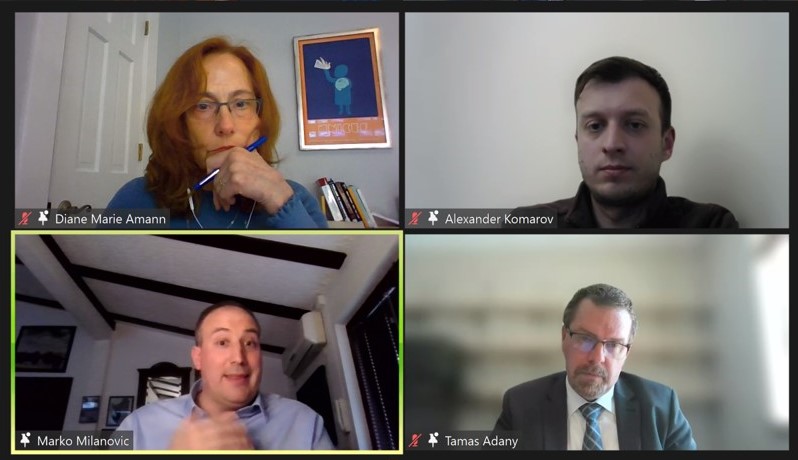
Professor Amann took part in a panel entitled “Prosecution,” along with Marko Milanovic, Professor of Public International Law at the University of Nottingham School of Law in the United Kingdom and Oleksandr Komarov of the Ukrainian Catholic University Law School. Moderating was Tamás Ádány, Fulbright Visiting Professor at Notre Dame Law this semester, and also Head of the Department of International Law at Pázmány Péter Catholic University in Budapest, Hungary.

Discussed in their panel were legal frameworks and forums that hold potential for providing measures of accountability for violations of international law reported since Russia’s February 24, 2022, invasion of Ukraine. These include the illegal resort to armed force – that is, the crime of aggression – as well as atrocity crimes committed once the armed conflict had begun. (Related prior posts here, here, here, and here.)

Participants in the online conference’s two other panels examined additional aspects of the Ukraine-Russia conflict; namely, challenges to the collective security structure, and the use of economic sanctions by states and international organizations.

Georgia Law Professor Diane Marie Amann keynotes 2022 ESIL Research Forum in Glasgow, Scotland

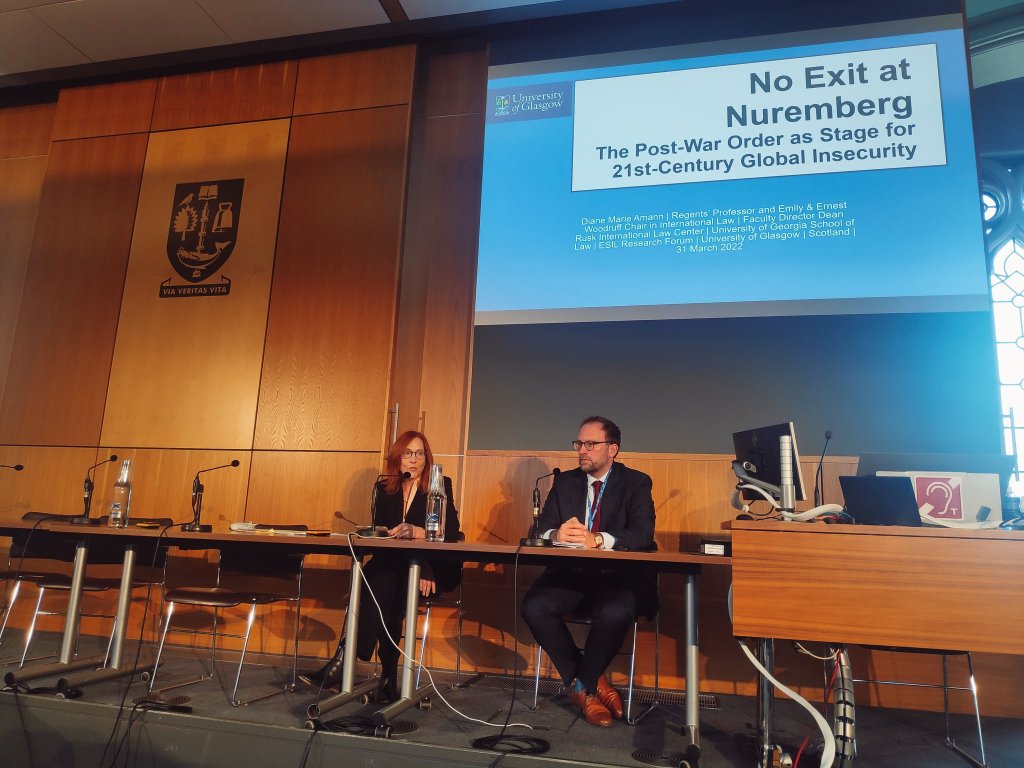
No Exit at Nuremberg: The Postwar Order as Stage for 21st-Century Global Insecurity” is the title of the keynote address that University of Georgia School of Law Professor Diane Marie Amann delivered Thursday at the University of Glasgow, Scotland, thus opening the 2022 Research Forum of the European Society of International Law. Her topic dovetailed with the forum’s overall theme, “International Law an Global Security: Regulating an Illusion?”

Introducing Amann – who is Regents’ Professor of International Law, Emily & Ernest Woodruff Chair in International Law, and Faculty Co-Director of the Dean Rusk International Law Center – was Glasgow Law Professor Christian J. Tams, Director of the Glasgow Centre for International Law & Security.

Amann framed her talk around two artefacts of the period immediately after World War II, when the 1945-46 Trial of Major War Criminals was unfolding before the International Military Tribunal at Nuremberg, Germany: the play that Jean-Paul Sartre entitled Huis Clos but that is known in English as Vicious Circle or No Exit; and the front page of a French newspaper that referred not only to that play, but also to food shortages, the East-West threat spurred by the advent of nuclear weapons, and the IMT trial. She then linked the military, economic, political, and human security threads these artefacts raised to current events including conflicts in Ukraine and elsewhere.