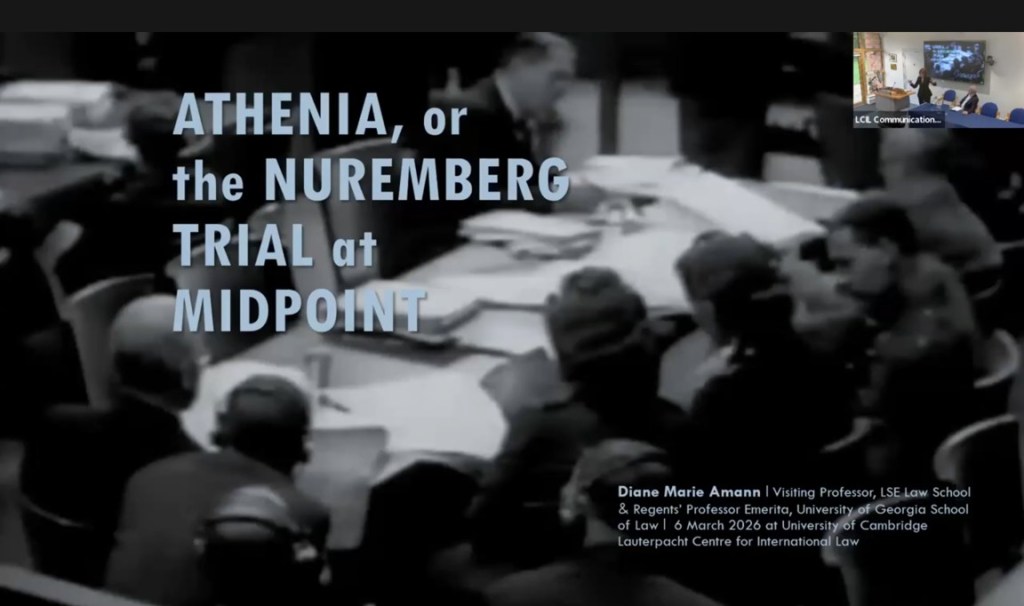
University of Georgia School of Law Professor Emerita Diane Marie Amann recently presented “Athenia, or the Nuremberg Trial at Midpoint” at the Lauterpacht Centre for International Law, University of Cambridge, United Kingdom.
Amann focused on events 80 years ago this spring, when the landmark Trial of Major War Criminals before the International Military Tribunal was at its halfway point. The British prosecution team’s evidence against German naval officers, as well as certain witnesses called by the French and Soviet prosecution teams, were featured.
Lauterpacht Centre Fellow John Barker chaired the lunchtime lecture, which may be viewed on YouTube or listened to via Spotify, Apple, and Captivate podcasts.
Amann, who is Regents’ Professor Emerita and Emily & Ernest Woodruff Chair in International Law Emerita at Georgia Law, served for many years as a Faculty Co-Director of our Dean Rusk International Law Center. She is writing a book on lawyers and other women professionals at the first Nuremberg trial.
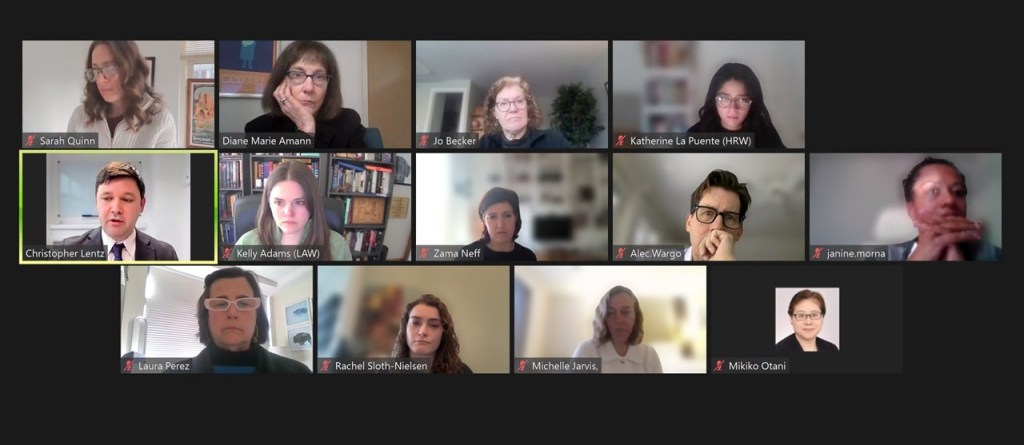
We at the University of Georgia School of Law Dean Rusk International Law Center were honored to host a recent two-part workshop intended to advance consideration of harms against children in a future crimes against humanity treaty.
Expanding that draft to include children’s concerns – specifically, by enumerating the recruitment and use of children as a standalone crime against humanity – was the aim of the Working Group on a Standalone Crime of Recruitment & Use of Children under the Crimes Against Humanity Treaty which our Center hosted. As explained by a briefing paper circulated before the first workshop:
Estimates indicate that a staggering 473 million children (or 18.9% of the global child population) live in conflict-affected areas and are at heightened risk of being recruited by State and non-State actors alike. The physical and developmental harms resulting from child recruitment and use can be severe and often long-lasting. Children may suffer death, physical injuries, or permanent disabilities because of combat, and many experience serious psychological trauma from being forced to commit or witness acts of violence. Even those not directly involved in combat are also at risk of attack due to their perceived association with armed actors. Recruited girls and boys are also frequently subjected to rape, sexual slavery, forced marriage, and other forms of sexual violence. For most children, recruitment also interrupts or ends their schooling, limiting future opportunities for sustainable livelihoods and civic participation. The harms experienced by recruited children are comparable in nature and gravity to other crimes against humanity enumerated in the Draft Articles.
Diane Marie Amann, who is Regents Professor Emerita, Emily & Ernest Woodruff Chair in International Law, and a former Center Faculty Co-Director at Georgia Law, was a co-convenor of the Working Group, along with Zama Neff, Executive Director of the Children’s Rights Division of Human Rights Watch, Laura Perez, Adjunct Professor at the Columbia University School of International & Public Affairs, and Janine Morna, Researcher on Children at the Amnesty International Crisis Response Programme.
Amann examined legacies of the year-long war crimes trial which took place soon after World War II in Nuremberg, Germany, before an International Military Tribunal established by Britain, France, the Soviet Union, and the United States. After discussing some lesser known aspects, such as the roles of persons not affiliated with one of those four Allied states, Amann considered contemporary legacies of the landmark trial.
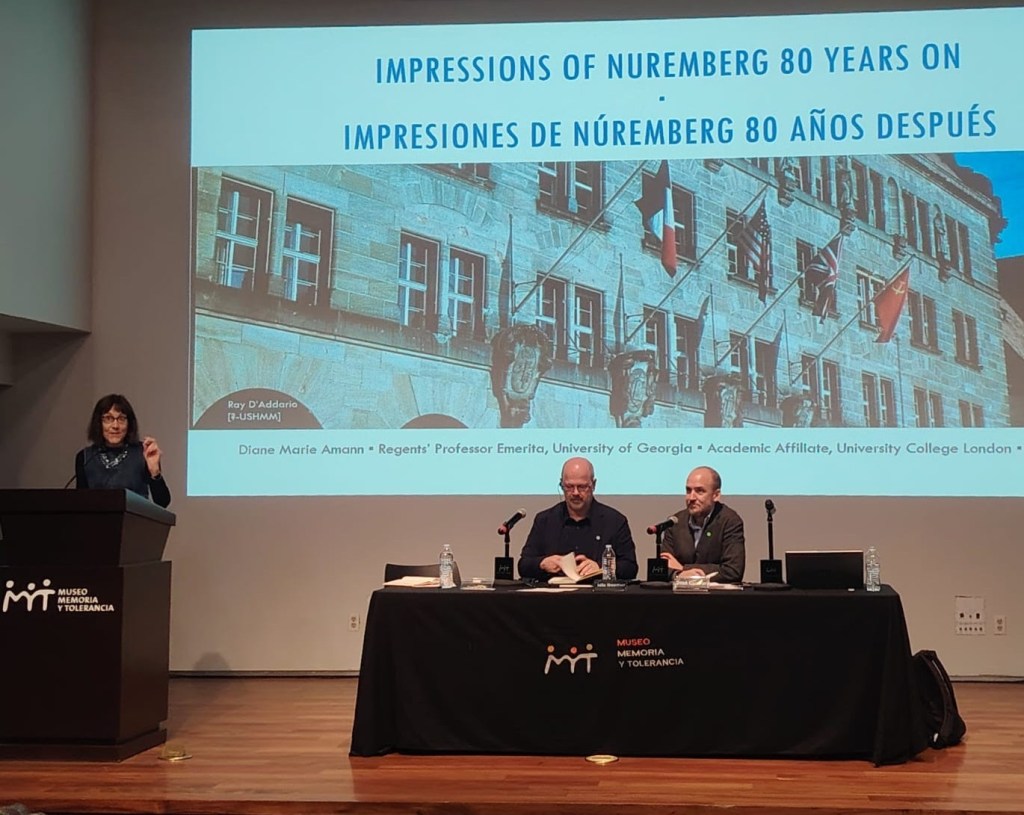
The University of Texas at Dallas joined the Museo Memoria y Tolerancia in cosponsoring the two-day conference.
Amann, who is Regents’ Professor Emerita and Emily & Ernest Woodruff Chair in International Law Emerita at Georgia Law, served for many years as a Faculty Co-Director of our Dean Rusk International Law Center. At present she is an Academic Affiliate at University College London Faculty of Laws.
University of Georgia School of Law Professor Diane Marie Amann discussed her research on child-taking at a side event occurring during the 24th annual Assembly of States Parties of the International Criminal Court, held in early December at The Hague in The Netherlands.
In addition to Professor Amann, additional panelists included: Hala Turjman, Independent Institution on Missing Persons in the Syrian Arab Republic: Alla Perfetska, Voices of Children; and Ikhlass Ahmed Altaher Eisa, Strategic Initiatives for Women in the Horn of Africa. Ukraine’s Ambassador to The Netherlands, Andriy Kostin, provided opening and closing remarks, and Wayne Jordash KC, president of the Global Rights Compliance Foundation, moderated the panel.
Amann is Regents’ Professor of International Law, Emily & Ernest Woodruff Chair in International Law, and a Faculty Co-Director of our Dean Rusk International Law Center here at Georgia Law. During her current research-intensive semester, she is an Affiliate Academic at University College London Faculty of Laws.
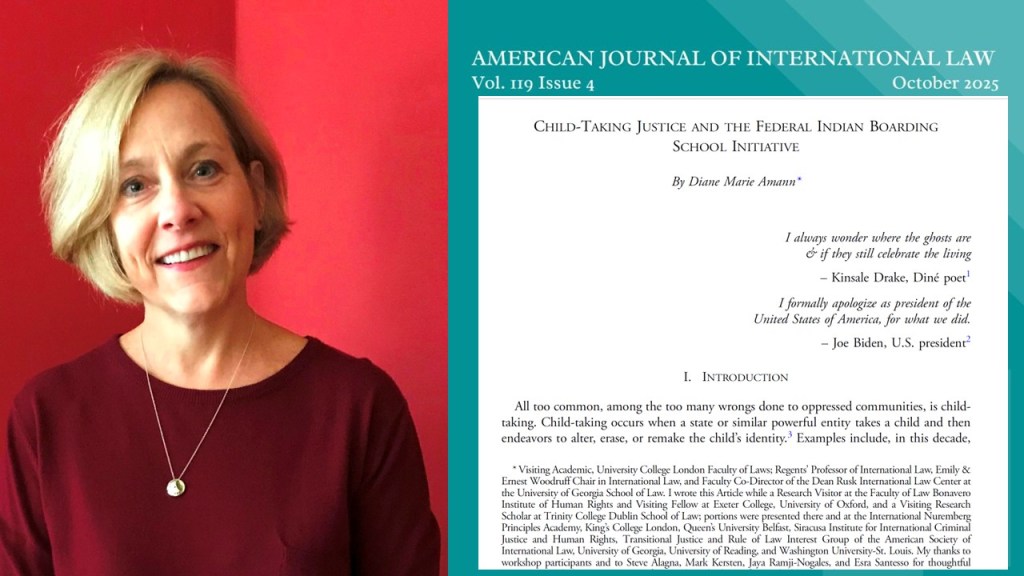
From 2012 to 2021 Amann served as International Criminal Court Prosecutor Fatou Bensouda’s Special Adviser on Children in & affected by Armed Conflict. Her many publications on international child law include two that analyze the long-standing criminal phenomenon by which a state (or other powerful entity) takes a child and then endeavors to alter, erase or remake the child’s identity. These two articles are “Child-Taking Justice and the Federal Indian Boarding School Initiative,” 119 American Journal of International Law 629 (2025), and “Child-Taking,” 45 Michigan Journal of International Law 305 (2024).
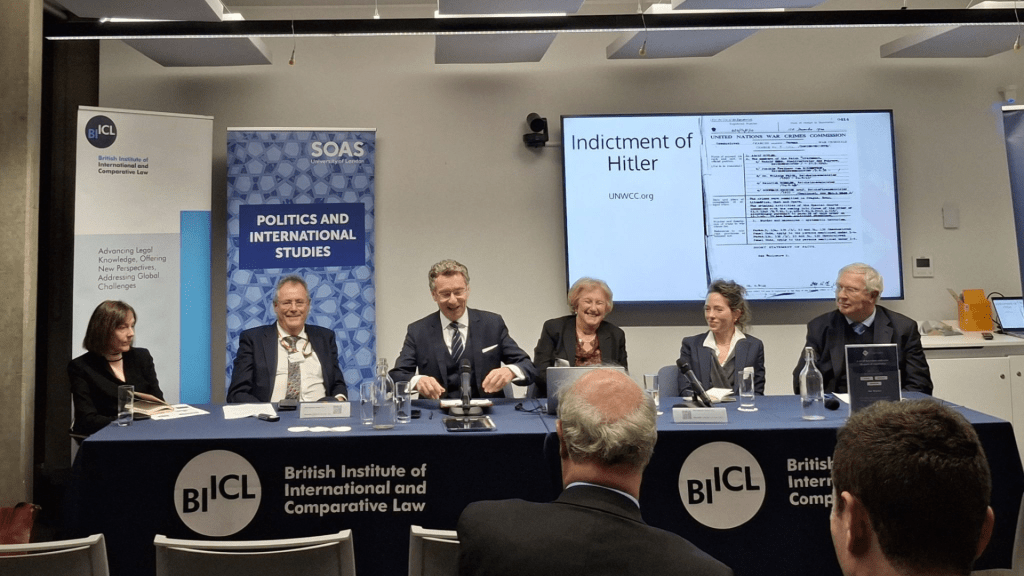
Her talk opened “80 Years On: The Legacy of the Nuremberg Trials for Accountability,” a panel of experts convened to analyze the midtwentieth-century trials project. The panel also looked to contemporary developments in international relations and international criminal justice – not least, to the Nuremberg precedent which permitted international criminal prosecutions of heads of state and other governmental leaders. A full video of the panel can be found here.
Besides Professor Amann (pictured above left), panelists included (l to r): Dan Plesch, Professor of Diplomacy & Strategy at SOAS University of London; Christoph Safferling, Director of the International Nuremberg Principles Academy and Professor of Law at the Friedrich-Alexander-Universität Erlangen-Nürnberg; as moderator, International Criminal Court Judge Joanna Korner CMG KC; Kirsty Sutherland, international barrister at 9BR Chambers, London; and Sir Howard Morrison KCMG CBE KC, former Judge on the International Criminal Court. (LinkedIn photo credit)
Amann is Regents’ Professor of International Law, Emily & Ernest Woodruff Chair in International Law, and a Faculty Co-Director of our Dean Rusk International Law Center here at Georgia Law. During her current research-intensive semester, she is an Affiliate Academic at University College London Faculty of Laws. She has published several essays on the Nuremberg era and is writing a book on lawyers and other women professionals at that first trial.
Amann is Regents’ Professor of International Law, Emily & Ernest Woodruff Chair in International Law, and a Faculty Co-Director of our Dean Rusk International Law Center here at Georgia Law. During her current research-intensive semester, she is a Visiting Academic at University College London Faculty of Laws.
This new publication continues scholarly research that Amann first explored in her article “Child-Taking,” 45 Michigan Journal of International Law 305 (2024), and that she has presented at many universities and other learned societies in the United States, Ireland, and the United Kingdom.
The focus of this article is the 2022–2024 Federal Indian Boarding School Initiative undertaken the U.S. Executive Branch. The article chronicles this three-year process, which included sessions with survivors and their descendants, and which resulted in a two-volume report, in an apology by President Joe Biden, and in designation of a national memorial at one of the most notorious school sites. This article examines the initiative as an example of “child-taking justice”; that is, as a process of what is called “transitional justice”, done in an effort to redress the takings of children from their community, followed by efforts to alter, erase, or remake the children’s identities. The initiative shed glaring light on the past history and present effects of a centuries-old practice by which the United States took Indigenous children from their families and forced them to attend residential schools where they were compelled to submit to Westernized and Christianized notions of “civilization.”
Unfolding within the internal constitutional framework of the United States, the U.S. initiative benefited from meaningful engagement with affected communities. This article nonetheless argues for a framing that also addresses external frameworks; to be specific, one that engages fully with applicable international law and lessons learned elsewhere. The argument runs counter to the United States’ longstanding practice of holding international human rights law at arm’s length, while pressing other countries to conform to that law’s strictures. Efforts of a U.S. human-rights-at-home movement have not reversed that trend. Thus the U.S. initiative made only a hesitant overture to international issues and to three countries, Canada, Australia, and New Zealand, with which it claimed kinship. The 2025 inauguration of a President hostile to rights-based justice pointed to limitations of this approach.
Amann, who is Regents’ Professor of International Law, Emily & Ernest Woodruff Chair in International Law, and a Faculty Co-Director of our Dean Rusk International Law Center here at Georgia Law, is a Visiting Academic this semester at University College London Faculty of Laws.
Her commentary on Prosecutor v. Bemba, a 2018 judgment of acquittal by the ICC Appeals Chamber, first appeared as “In Bemba, Command Responsibility Doctrine Ordered to Stand Down.” It then was included in this 2025 Brill Publishers collection, edited by UCLA Law Professor Richard H. Steinberg. Also contributing to the book’s section on the Bemba judgment were attorney Nadia Carine Fornel Poutou and law professors Miles Jackson (Oxford), Michael Newton (Vanderbilt), and Leila Nadya Sadat (Washington University).
“The acceptance of commander’s responsibility is, in effect, acceptance of authority over persons permitted to kill. With that acceptance comes a heavy burden, grown out of practical and moral concerns and reflected in longstanding legal doctrine. At odds with this burden was the judgment of acquittal that the International Criminal Court Appeals Chamber entered in Bemba in 2018. Originally appearing in an online forum, this commentary argues for a statutory construction that better would serve the purposes of the ICC and the command responsibility doctrine.”
The daylong conference will take place on Friday, November 7 in the Larry Walker Room of Dean Rusk Hall at the University of Georgia School of Law. CLE credit is available for both in-person and virtual attendance. Registration information can be found on the conference webpage.
Sponsoring along with GJICL, a student-edited journal established more than 50 years ago, is the law school’s Dean Rusk International Law Center. GJICL Editor in Chief, Casey Smith (J.D. ’26) and Executive Conference Editor Kellianne Elliot (J.D. ’26) worked Georgia Criminal Law Review Editor in Chief Kerolls Gadelrab (J.D. ’26); Professor Jason A. Cade, J. Alton Hosch Professor of Law & Community Health Law Partnership Clinic Director; Center staff Sarah Quinn, Director; Catrina Martin, Global Practice Preparation Assistant; Taher S. Benany, Center Associate Director; and with the GJICL’s Faculty Advisor, Professor Desirée LeClercq, who is Assistant Professor of Law & Faculty Co-Director of the Dean Rusk International Law Center.
Below is the concept note of the conference:
Political and legal developments have precipitated a convergence of the fields of criminal law and immigration law. Now commonly referred to as crimmigration, this merger of previously distinct practice areas already has profoundly reshaped the legal and social terrain for migrants in the United States. While entry and removal decisions remain essentially administrative, enforcement practices and rhetoric increasingly embrace the punitive logic and carceral reach of the criminal legal system, but with fewer due process protections. As new legislation vastly expands detention authorization and other enforcement resources, it seems apparent that the rhetoric and mechanics of crimmigration will continue to dominate immigration policy in the United States for the foreseeable future.
This symposium, jointly sponsored by the Dean Rusk International Law Center, the Georgia Journal of International and Comparative Law, and the Georgia Criminal Law Review, invites scholars, immigration attorneys and judges to engage with these developments. We hope panelists will collectively address a number of important questions, such as the following: How does the new crimmigration landscape impact immigrants and communities in the Southeast and beyond? What new burdens does it put on the judiciary, and what role do federal courts have today in determining and upholding constitutional and statutory protections for migrants? Does the durability and continued expansion of crimmigration pose new challenges for immigration and criminal law attorneys; and, if so, how are the immigration and criminal law bars responding to those challenges? As crimmigration tactics expand, what new legal threats face U.S. citizens, including family members, employers, and immigrant advocates? Does the crimmigration paradigm contend with or obscure the structural forces that drive migration, particularly from the global south? Are there reasons to hope or expect the emergence of alternatives to crimmigration as the governing paradigm for the regulation of immigrants in the United States?
These conversations will occur through three panels and a lunchtime keynote speaker.
The day’s events are as follows:
9:30am | Opening Remarks
Usha Rodrigues, Dean, University Professor & M.E. Kilpatrick Chair of Corporate Finance and Securities Law
9:35am | Panel 1: Introduction to Crimmigration & the Current State of Affairs
Abel Rodríguez, Assistant Professor of Law, Wake Forest Law
Shalini Ray, Associate Professor of Law and Director of Faculty Research, Alabama Law
Gracie Willis, Attorney, National Immigration Project
Moderator: Christian Turner, Associate Professor of Law, University of Georgia School of Law
10:35am | Break
10:45am| Panel 2: The Impact of Crimmigration Policies on Communities and Advocates
Jessica Vosburgh, Senior Staff Attorney, Center for Constitutional Rights
Jenny R. Hernandez, Lead Senior Attorney at Immigration Defense Unit, City of Atlanta Office of the Public Defender
Carolina Antonini, Founding Partner, Antonini & Cohen Immigration Law
Moderator: Elizabeth Taxel, Clinical Associate Professor & Criminal Defense Practicum Director, University of Georgia School of Law
12:00pm | Keynote Introduction
Jason A. Cade, J. Alton Hosch Professor of Law & Community Health Law Partnership Clinic Director, University of Georgia School of Law
12:05 Keynote Address
Judge Ana C. Reyes, United States District Court, District of Columbia
1:00pm | Panel 3: Challenging the Legality of Migration Controls & Envisioning Reform
Daniel I. Morales, Associate Professor of Law; Dwight Olds Chair, The University of Houston Law Center
Rebecca A. Sharpless, Associate Dean for Experiential Learning, Professor of Law, Director, Immigration Clinic, University of Miami School of Law
Emily Torstveit Ngara, Director of Clinical Programs, Associate Clinical Professor and Director, Immigration Clinic, Center for Access to Justice, Immigration Law Clinic, Georgia State University College of Law
Moderator: Jason A. Cade J. Alton Hosch Professor of Law & Community Health Law Partnership Clinic Director, University of Georgia School of Law
2:00 | Closing Remarks
Casey Smith, Editor in Chief, Georgia Journal of International and Comparative Law
University of Georgia School of Law Professor Diane Marie Amann recently gave an online lecture entitled “Justice for Child-Taking and Other Crimes against and affecting Children” as part of “International Criminal Law, Conflict Resolution and Transitional Justice,” the week-long 24th Specialization Course in International Criminal Law for Young Penalists, held in Sicily, at the Siracusa International Institute for Criminal Justice and Human Rights, Italy.
Amann is Regents’ Professor of International Law, Emily & Ernest Woodruff Chair in International Law, and a Faculty Co-Director of our Dean Rusk International Law Center here at Georgia Law. Her Siracusa lecture drew upon her expertise on children, violence, conflict, and justice. Her most recent publication in this field is “Child-Taking,” 45 Michigan Journal of International Law 305 (2024); all her related publications are available here.
Amann is Regents’ Professor of International Law, Emily & Ernest Woodruff Chair in International Law, and a Faculty Co-Director of our Dean Rusk International Law Center here at Georgia Law.
Here’s the abstract for Professor Amann’s article:
“Conventional narratives tend to represent the post-World War II international criminal proceedings as a men’s project, thus obscuring the many women who participated, as lawyers, journalists, analysts, interpreters, witnesses, and defendants. Indeed, two women stood trial before Nuremberg Military Tribunals. This article examines the case of the only woman found not-guilty: Inge Viermetz, who had been an administrator at Lebensborn, the Nazi SS adoption and placement agency. The article outlines the prosecution’s child-taking case against Viermetz, as well as her successful gendered self-portrayal as a conventionally feminine caregiver. With references to Professor Megan A. Fairlie, at whose memorial symposium it was presented, the article concludes by considering contemporary implications of this acquittal at Nuremberg.”



 exchange of notes