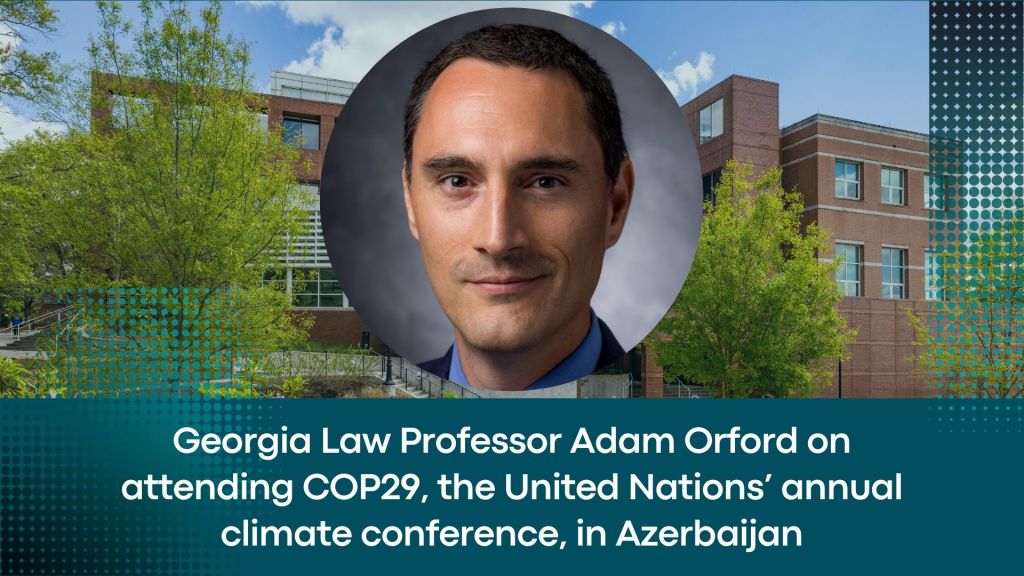
Georgia Law Professor Adam Orford on attending COP29, the United Nations’ annual climate conference, in Azerbaijan

Adam D. Orford, Assistant Professor of Law at the University of Georgia School of Law, participated in the recent 29th Conference of Parties to the United Nations Framework Convention on Climate Change (COP29) in Baku, Azerbaijan. He served as an observer for the American Bar Association. Orford’s interdisciplinary research investigates legal and policy approaches to environmental protection, human health and well-being, and deep decarbonization of the U.S. economy. He also participates in collaborative research initiatives across the University of Georgia, including as lead of the Georgia element of the National Zoning Atlas and as a participant in investigations into the legal, political, environmental and social dimensions of new energy manufacturing and emerging carbon removal technologies.

In his guest post below, Orford summarizes the ABA’s role and the major outcomes at COP29. More detail on this issues can be found in the four COP primers he published at Environmental Law Prof Blog (here, here, here, and here).
ABA’s Role

I participated in COP29 as a delegate for the ABA, which has sent delegates to the climate COPs since 2021. This program followed a 2019 ABA resolution on climate change that urged

“federal, state, local, territorial, and tribal governments, and the private sector, to recognize their obligation to address climate change,”

and called on lawyers to

“engage in pro bono activities to aid efforts to reduce greenhouse gas emissions and adapt to climate change, and to advise their clients of the risks and opportunities that climate change provides.”

The focus of the ABA’s delegations has been to work with other national bar associations to educate the profession about the critical role that lawyers and law associations play in responding to climate change—an issue which may arise unexpectedly, in practices as diverse as environment and energy, human rights, corporate governance, personal injury, real estate development, trusts and estates, municipal management, international trade, and more.

Participating law associations have developed a Climate Registry that is posted on the International Bar Association’s website, providing ready tools to other lawyers and law associations for adopting climate resolutions and other guidance to address climate change. The ABA does not take positions on negotiating outcomes at the COPs, but its delegations work to assist ABA members in understanding the often complex climate COP processes and outcomes.

COP29 Outcomes

As part of my work, I tracked the progress of dozens of negotiations aimed at implementing commitments made by the parties to the UNFCCC and Paris Agreement. Here are some of the most significant outcomes of this year’s negotiations:

A contentious and chaotic COP

Azerbaijan, this year’s host and lead facilitator for the conference’s negotiations, came into COP29 with little climate leadership experience, and it often struggled to maintain trust among the parties.

From remarks praising fossil fuels to open the conference, to procedural maneuvering to achieve controversial results, to protests from many parties that they were not being sufficiency included in negotiations, to delays in the development and circulation of draft negotiating texts, to limited participation from civil society, to relatively disappointing outcomes on many important issues, COP29 highlighted just how difficult climate negotiations have become as the world has continued to warm and countries have fallen behind on taking necessary actions to abate their greenhouse gas emissions.

Disappointing climate finance commitments

This was the year that the parties were required to agree upon a so-called “New Quantified Collective Goal” for climate finance, meaning the amount of annual funding that wealthy developed countries are committed to “mobilizing” for the benefit of poorer developing countries. The prior commitment, $100 billion per year, had only ever been met once, and the actual need is estimated to exceed $1 trillion per year.

After two weeks of contentious debate that included developed countries pushing for expanding contributions from emerging economies and developing countries pushing for $1.3 trillion with a significant public finance component, developed countries only agreed to commit to achieving $300 billion per year—by 2035.

This result was so far below the developing country goals that at one point they walked out of the negotiations entirely in protest.

Procedural machinations to allow carbon credit trading

After years of controversy and delay, the parties at COP29 agreed to finalize the “Article 6 rulebook,” meaning the rules and definitions for international trade in carbon credits originally contemplated by the Paris Agreement in 2015. This outcome was achieved through an irregular procedure, however: A subsidiary implementing body had ratified the rules months before the COP and then provided them to the parties as a take-it-or-leave-it fait accompli. The parties did quickly agree to accept the new rules, but then developed lengthy further guidance intended to promote transparency and environmental integrity in the markets.

Backsliding on the commitment to transition away from fossil fuels

At last year’s COP28 in Dubai, all parties had agreed to include text indicating a goal to “transition away” from fossil fuels as part of the global climate response. However, major oil producers, including especially Saudi Arabia, have since backed away from this commitment, and they worked vigorously throughout COP29 to avoid repeating this language in any form at any point. This opposition nearly derailed several negotiations, and resulted in at least one item being deferred until COP30 next year.

In addition, although countries are supposed to submit their third voluntary climate action plans in February 2025, very few made firm commitments to reduce their climate emissions at COP29—a troubling change from the relatively robust pledges at prior COPs.

Leadership vacuum

COP29 began just days after the U.S. Presidential election. That election’s outcome will have major implications for the trajectory of United States, and therefore global, climate policy.

With the U.S. delegation largely unable to make credible future commitments, there was some speculation that this would provide an opportunity for China to take on a larger global leadership role, particularly in the development of low-carbon energy technologies necessary to respond to climate change. However, China’s most significant efforts at COP29 were quite different:

  • China opposed calls for it to join developed countries and make firm climate finance commitments; and
  • It pushed unsuccessfully to add international trade issues to the negotiating agenda.

With the world’s two largest greenhouse gas emitters both taking a back seat, global climate policy lacks clear leadership at a critical time. 2024 is likely to be the warmest year in human history; and 2025 is likely to be warmer still.

Nonetheless, the COP process remains the most important forum for developing international commitments to climate change response. While imperfect, the parties do continue to make progress—sometimes a little, sometimes a lot—every year.

Many parties are already pointing to the disappointing outcomes of COP29 as the basis for redoubling their efforts to strengthen commitments at future COPs. Next year’s COP30 will be held in Belém, Brazil.

Left: The ABA delegation included (from left to right) Uma Outka, law professor at the University of Kansas; Kamran Jamil, law clerk at SD California and co-chair of the ABA International Law Division young lawyers division; and Adam D. Orford, Assistant Professor at the University of Georgia School of Law. Top Right: COP29 plenary session with Mukhtar Babayev, Minister of Ecology and Natural Resources of the Azerbaijan Republic.

Georgia Law Professor Adam Orford presents at World Congress of Environmental History in Finland

University of Georgia School of Law professor Adam D. Orford recently presented his article “The Oil Pollution Act of 1924: A Centennial Reassessment” and spoke on the panel “Law, History, and the Environment” at the World Congress of Environmental History, hosted at the University of Oulu in Finland. The theme for this year’s conference was “Transitions, Transformations and Transdisciplinarity: Histories Beyond History.”

Below is the paper’s abstract:

This Article examines the social, political, and legislative history of the United States Oil Pollution Act of 1924. A century after its enactment, the nation’s first federal antipollution law remains undeservedly obscure. At the height of the conservative Lochner era, during the conservative Coolidge Administration, with conservative majorities in both houses of Congress, and in the face of opposition from the oil and marine shipping industries, the United States Congress enacted a national law prohibiting oil pollution. How did this happen? Who was involved? And what can be learned about today’s conservative legal and political environment?

This work is part of a larger project to synthesize histories of political conservatism and national environmental legislation in the U.S. prior to the 1970s. The author’s prior work has traced this development back to through the postwar years. This work extends the inquiry further, examining U.S. federal antipollution legislation within the context of the social and political environment of the post-progressive 1920s, with attention to the role of private associations and business interests in promoting the legislation, and of technological feasibility in ultimately securing passage while also limiting the law’s scope.

There has not been a major study of this law since the 1980s, providing an excellent opportunity to integrate new historical perspectives – including environmental history and the recognition of political conservatism as an important historical force – as well as newly available archival records.

Orford is an Assistant Professor of Law at the University of Georgia School of Law. His interdisciplinary research investigates legal and policy approaches to environmental protection, human health and wellbeing, and deep decarbonization of the United States economy. He also participates in collaborative research initiatives across UGA, including as the lead of the Georgia element of the National Zoning Atlas and as a participant in ongoing investigations into the legal, political, environmental and social dimensions of new energy manufacturing and emerging carbon removal technologies.

Georgia Law Professor Orford publishes article on blue carbon and the Paris Agreement

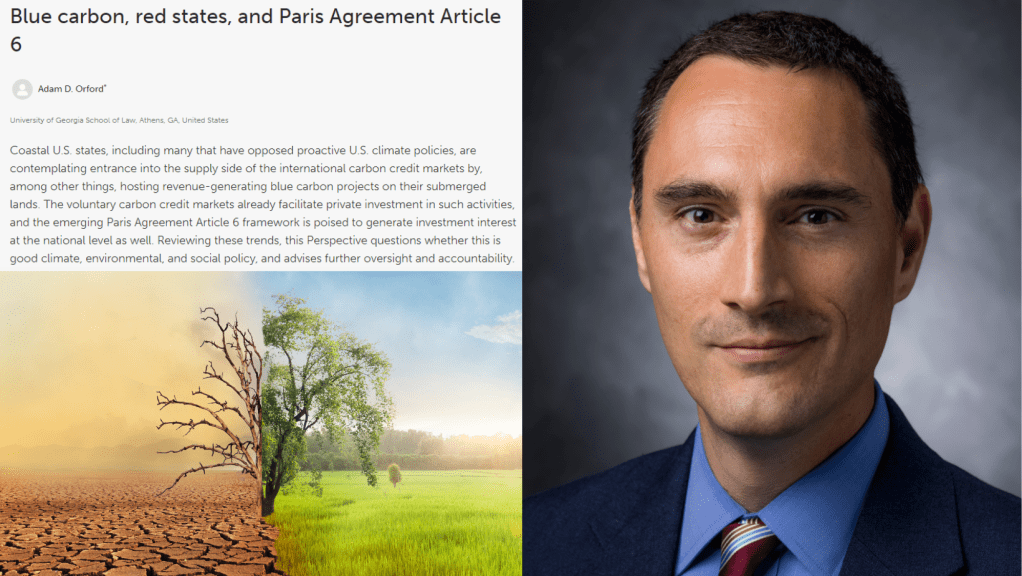
Adam D. Orford, Assistant Professor of Law, recently published “Blue Carbon, red states, and Paris Agreement Article 6” in Frontiers in Climate. This is one of four articles under the research topic “Climate Law and Policy 2023: A Proactive Retrospective on Intergovernmental Strategies.”

From the article’s abstract:

Coastal U.S. states, including many that have opposed proactive U.S. climate policies, are contemplating entrance into the supply side of the international carbon credit markets by, among other things, hosting revenue-generating blue carbon projects on their submerged lands. The voluntary carbon credit markets already facilitate private investment in such activities, and the emerging Paris Agreement Article 6 framework is poised to generate investment interest at the national level as well. Reviewing these trends, this Perspective questions whether this is good climate, environmental, and social policy, and advises further oversight and accountability.

Orford joined the University of Georgia School of Law in the fall of 2021. His interdisciplinary research investigates legal and policy approaches to environmental protection, human health and wellbeing, and deep decarbonization of the United States economy. He also participates in collaborative research initiatives across UGA, including as the lead of the Georgia element of the National Zoning Atlas and as a participant in ongoing investigations into the legal, political, environmental and social dimensions of new energy manufacturing and emerging carbon removal technologies.

To download the article, please click here.

Georgia Law 2L Erin Nalley shares her Global Externship experience in New Zealand

Today, we welcome a guest post by Erin Nalley, a member of the University of Georgia School of Law class of 2025. Through the Global Externships Overseas (GEO) initiative, Erin was able to extern with the Department of Conservation in Wellington, New Zealand in summer 2023.

When I first landed in New Zealand last summer, I was both exhausted and excited for what the next few months would bring me. I had just finished the University of Georgia School of Law’s Global Governance Summer School, and I was worn out from the travel from Amsterdam to Atlanta to Auckland to my final destination of Wellington, New Zealand. Wellington is where I would spend the rest of my summer as a legal extern with the Department of Conservation through the Global Externships Overseas initiative.

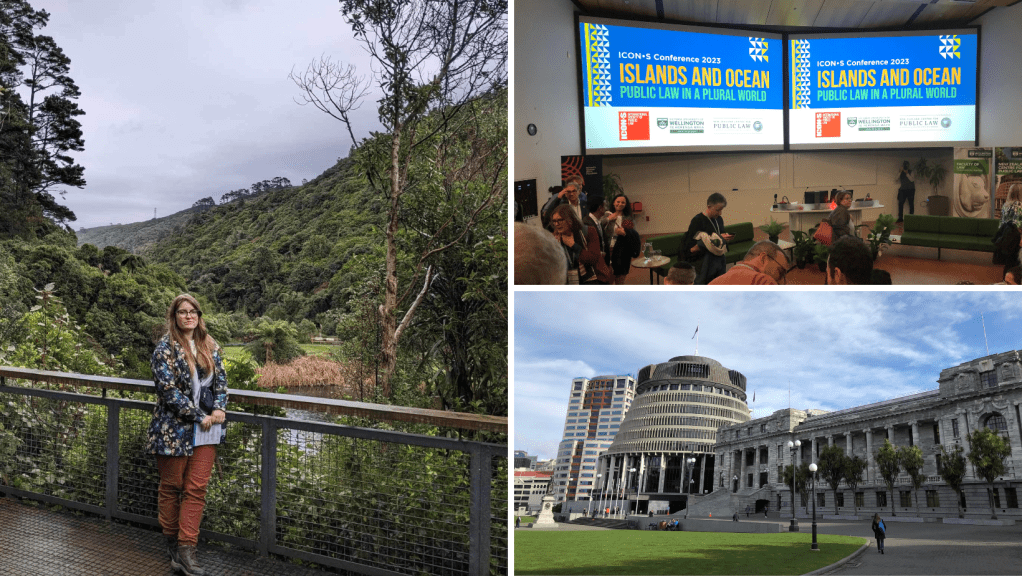
My work in New Zealand involved picking apart the World Heritage Convention text. Specifically, I evaluated what language made the text binding and what policy documents and case law were made binding by the text itself. I also worked with case studies involving New Zealand land that was in conservation under the World Heritage Convention. I worked alongside lawyers within my department, lawyers who worked in foreign affairs, and even those who worked directly with the New Zealand Parliament. I designed my research to act as a guide for the international team at the Department of Conservation to assist in keeping New Zealand in compliance with the World Heritage Convention. As part of my externship, I was able to visit the New Zealand Parliament and observe members debating new legislation. I was also given the opportunity to attend the ICON-S Public International Law conference held in Wellington.

Along with my work experience, I had the opportunity to engage in the culture of my host community. I was in New Zealand during Matariki, the Māori New Year. Here, I saw a haka, a ceremonial performance within the Māori culture that is often performed at important events. I visited the Te Papa Tongarewa Museum and learned about the history and culture of the people of New Zealand. I tried yellow kiwi fruit, manuka honey, Wellington chocolate, and New Zealand pies. I also visited Zealandia, where part of the forest is fenced in to keep predators out and to provide the native birds within the sanctuary a place to thrive and recover their populations. Finally, one of my favorite parts of the trip was a drive to Hobbiton, where they filmed The Shire scenes in Lord of the Rings films. It was surreal being able to step inside a hobbit hole and have a drink at the Green Dragon Inn.

My Global Externships Overseas experience was everything I had hoped for and even more than I expected. I walked away from my 1L summer with significant international legal experience, new cultural understandings and appreciation, and even a tattoo of a New Zealand silver fern, an important indigenous plant that serves as a symbol of the country’s national identity.

***

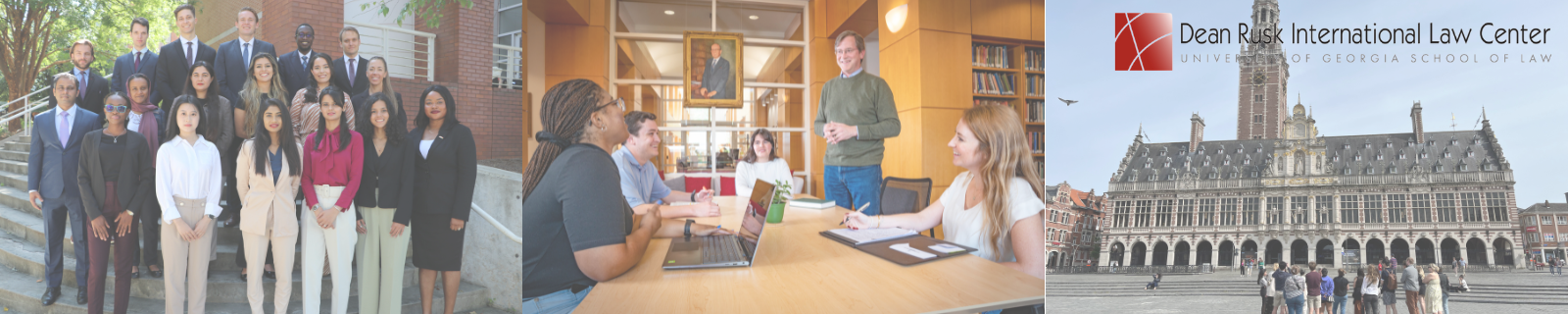
Applications are now open for summer 2024 Global Externships Overseas (GEO). This initiative places University of Georgia School of Law students in four-to-twelve week international placements each summer, where they gain substantive, hands-on experience in diverse areas of legal practice. Over the last fifteen years, more than 200 Georgia Law students have completed a GEO in law firms, government agencies, corporate legal departments, intergovernmental organizations, and nongovernmental organizations around the world. Current 1Ls and 2Ls are encouraged to apply for summer GEOs. All applicants should reference this instructional video for step-by-step information regarding how to create and successfully complete an application for GEOs in UGA’s Study Away Portal by the March 10th deadline. For more information, email: ruskintlaw@uga.edu

Eduardo Conghos (LL.M., ’98), speaks about Argentinian environmental law at UGA Law

Director of GreenCo SA and National University of the South professor Eduardo Conghos (LL.M., ’98) spoke to students at the University of Georgia School of Law last week about environmental law in Argentina and the effects of “constitutional greening” in Latin America. The conversation was moderated by Adam D. Orford, Assistant Professor of Law.

Conghos provided students with historic context for environmental legal developments in Latin America, tracing the global period of “constitutional greening” that stretched from the 1970s through the 90s. Over these two decades, 14 of the 20 countries in Latin America encoded environmental considerations and protections into law. Some common characteristics included protection of natural resources, wildlife, and protected natural areas; a right to the environment; and a right to public participation in environmental processes. Despite these strong constitutional protections for the environment, Conghos noted that the lack of statutory laws created tension between judicial rulings in favor of environmental protection and consistent implementation and oversight of environmental regulations. He used the 2007 Argentinian Supreme Court decision, Mendoza, Beatriz Silvia et al. v. National Government et al. about damages (damages derived from the environmental pollution of the Matanza Riachuelo River) and the rulings that followed it to illustrate this conflict. Students asked Conghos about the reality of the private sector being able to adapt to new environmental regulations and whether arbitration would be the appropriate way to address some of these issues.

Conghos is an environmental lawyer, consultant, and professor based in Buenos Aires, Argentina. He is currently the Director of GreenCo S.A., an environmental consulting business that provides services to both public and private institutions. Conghos is also professor at the National University of the South in Buenos Aires, where he has worked in several faculty positions since 1999. His specialties include environmental legislation and environmental training, skills that he has honed over several decades of experience in both the public and private sectors in Argentina. Dr. Conghos received his LL.M. from the University of Georgia School of Law in 1998, as well as postgraduate degrees from the University of Salamanca, the National University of the South, the University of San Andres, and Buenos Aires University.

Five University of Georgia-based scholars present at 2022 annual conference of the European Society of International Law

Well represented at last week’s annual conference of the European Society of International Law were scholars from the University of Georgia.

Presenting at the conference were 4 professors affiliated with the University of Georgia School of Law – along with one researcher at the University of Georgia Digital Humanities Lab, sponsored by the Willson Center for the Humanities, and two scholars who earned their first degrees at the University of Georgia.

The 2022 ESIL conference took place at Utrecht University in the Netherlands, home institution of a recent Visiting Researcher at the Dean Rusk International Law Center here at Georgia Law, Professor Brianne McGonigle Leyh. Designed to explore the theme “In/Ex-clusiveness of International Law,” the conference began with Interest Group workshops on Wednesday. It concluded on Saturday

University of Georgia scholars’ presentations were as follows:

► Professor Diane Marie Amann (pictured above left) gave an online talk entitled “Absent at the Creation? Women and International Criminal Justice” as part of a Saturday hybrid session exploring “In/Ex-clusiveness of the Legal Construction of Justice.” The presentation drew on her research into the experiences of women professionals at post-World War II international criminal trials. Amann is Regents’ Professor of International Law, Emily & Ernest Woodruff Chair in International Law, and Faculty Co-Director of the Dean Rusk International Law Center here at the University of Georgia School of Law; additionally, she serves on the Coordinating Committee of ESIL’s Interest Group on International Criminal Justice. Also participating on this agora session were scholars from the Netherlands’ University of Amsterdam and Erasmus University, and also from the Irish Centre for Human Rights at the National University of Ireland-Galway.

► Professor Harlan Grant Cohen (second from left), who is Gabriel M. Wilner/UGA Foundation Professor in International Law and Faculty Co-Director of the Dean Rusk International Law Center here at the University of Georgia School of Law, presented twice:

► Professor Melissa J. “MJ” Durkee (center), who is Associate Dean for International Programs, Director of the Dean Rusk International Law Center, and Allen Post Professor here at the University of Georgia School of Law, likewise gave two presentations at the ESIL conference:

  • She presented “The Technology of Inclusion in International Climate Law,” a talk that drew from her forthcoming Yale Journal of International Law article The Pledging World Order, at a Wednesday workshop session entitled “Just Energy Transition – the International Human Rights Law Perspective.” The workshop’s overall title was “In/Ex-clusiveness in the Energy Transition and Climate Action”; host was the ESIL Interest Group on International Environmental Law. Also on Durkee’s panel were scholars from Leiden University in the Netherlands and from the China Institute of Boundary & Ocean Studies and Research Institute of Environmental Law of Wuhan University, China.
  • Durkee explored “The Logics of Inclusion and Exclusion in International Participatory Structures,” at a Thursday workshop entitled “International Organizations, Elites, and Masses: Perspectives on In/Exclusion,” and sponsored by the ESIL Interest Group on International Organizations. Her talk concerned an early-stage project that organizes perspectives on the inclusion and exclusion of nonstate actors in the activities of international organizations. Presenting other papers were scholars from the University of Hong Kong, the University of Melbourne in Australia, Max Planck Institute for Comparative Public Law & International Law in Germany the University of Hamburg in Germany, and the Guangdong University of Foreign Studies in China.

Meanwhile, Professor Tim R Samples (second from right), Associate Professor of Legal Studies at the University of Georgia Terry College of Business who has a courtesy appointment at Georgia Law, took part in three presentations.

  • Professor Samples and Dr. Katie Ireland (right), who recently joined the university’s DigiLab, spoke at two ESIL workshops along with their co-author, Caroline Kraczon, a Georgetown University Law Center 3L who earned her first degrees at the University of Georgia. Their paper, “Terms of Use Agreements and Social Platforms,” discusses their interdisciplinary project based on an original dataset of 75 digital platforms’ terms-of-use and core policies. The trio presented this research at the Wednesday workshop of the International Law & Technology Interest Group, on “Algorithmic and Technological Modes of In-/Exclusion: International Legal Method and Critique,” and also at “‘In/Ex-clusiveness through the Lens of International Business and Human Rights’” the Thursday workshop of the International Business & Human Rights Interest Group.
  • In addition, Samples co-presented Investment Law’s Transparency Gap, an article forthcoming in Cornell International Law Journal, with co-author Sebastian Puerta, a Ph.D. student in Economics at the University of California-Berkeley who earned his first degrees at the University of Georgia. Their work uses predictive modeling to estimate missing claims and awards in investment treaty arbitration. They spoke at a session of ESIL’s International Economic Law Interest Group, “In/ex-cluding Civil Society in Investment Law-making and Arbitration.” Also taking part in this session were scholars from the Institute of International Relations in Czechoslovakia, Ghent University and Université Libre de Bruxelles in Belgium, University of Vienna in Austria, University of Trento in Italy, and Carleton University in Canada.

The European Society’s 2023 annual conference, themed “Is International Law Fair?,” will begin with Interest Group workshops on August 30, and run through September 2, in Aix-en-Provence, France.

Professor MJ Durkee publishes essay on legacy of 1972 Stockholm Declaration in special issue of Georgia Journal of Comparative and International Law

Professor Melissa J. “MJ” Durkee, Associate Dean for International Programs, Director of the Dean Rusk International Law Center, and Allen Post Professor at the University of Georgia School of Law, published “International Environmental Law at Its Semicentennial: The Stockholm Legacy” in 50 Georgia Journal of International and Comparative Law 748 (2022), available at the journal’s website as well as SSRN.

The publication reflects upon issues raised at, the journal’s October 2021 conference, “The 1972 Stockholm Declaration at 50: Reflecting on a Half-Century of International Environmental Law.” (Prior posts and links to panel videos here)

Here’s the SSRN abstract of Professor Durkee’s essay:

“The 1972 United Nations Conference on the Human Environment produced the Stockholm Declaration, an environmental manifesto that forcefully declared a human right to environmental health and birthed the field of modern international environmental law. The historic event powerfully “dramatized . . . the unity and fragility of the biosphere,” sparking a remarkable period of international legal innovation and cooperation on environmental protection in the decades to come.

“The Stockholm Declaration can be rightly celebrated for putting environmental issues on the international legal agenda and driving the development of environmental law at the domestic level around the world. At the same time, the Declaration’s distinctive framing of environmental problems and solutions deeply influenced these abundant subsequent laws, and here its legacy is mixed. This special issue, in celebration of the Georgia Journal of International and Comparative Law’s 50th anniversary volume, evaluates the legacy of the Stockholm Declaration and the legal movement it launched.”

Published in the same journal issue were: “‘In Countless Ways and On an Unprecedented Scale’: Reflections on the Stockholm Declaration at 50” by Rebecca Bratspies, Professor of Law and founding Director of the Center for Urban Environmental Reform at CUNY School of Law; and “Legal Rights for Rivers” by Katie O’Bryan, Lecturer and Member of the Castan Centre for Human Rights Law, Faculty of Law, at Monash University in Australia.

Stockholm Declaration conference: link to video of Shelton keynote and panel on international environmental law’s future

This image has an empty alt attribute; its file name is panel3.png

A superb third panel and keynote speech concluded “The 1972 Stockholm Declaration at 50: Reflecting on a Half-Century of International Environmental Law” conference that we at the Dean Rusk International Law Center and the Georgia Journal of International and Comparative Law at the University of Georgia School of Law hosted on October 8.

Following on our prior posts outlining the first and second parts of our daylong conference, we’re pleased in this post to recap the final segment, video of which is available here. (The full series, meanwhile, is available here.)

It begins with the third panel of the conference, entitled “International Environmental Law’s Future,” and moderated by MJ Durkee, Associate Dean for International Programs, Director of the Dean Rusk International Law Center, and Allen Post Professor at Georgia Law (pictured above, middle right). Joining her were 4 panelists (pictured clockwise from bottom center): Lakshman D. Guruswamy, Nicholas Doman Professor of International Environmental Law at Colorado Law; Jutta Brunnée, Dean, University Professor, and James Marshall Tory Dean’s Chair at the University of Toronto Faculty of Law in Canada; Cymie Payne, Associate Professor in the Department of Human Ecology and the School of Law, Rutgers University; and Rebecca M. Bratspies, Professor and Director of the Center for Urban Environmental Reform at CUNY Law.

Together, they consider the part of Principle 1 of the Stockholm Declaration that declares:

“[Humankind] bears a solemn responsibility to protect and improve the environment for present and future generations.”

In light of that statement, panelists examined the major successes and failures of the last half-century of international environmental law, and, imagining a “2022 Stockholm Declaration,” they considered how to prioritize environmental protection efforts going forward.

Then follows “Stockholm Plus 50: Glass Half Full, Half Empty, or Shattered?,” the keynote address by Dinah L. Shelton, Manatt/Ahn Professor of International Law Emeritus at George Washington University School of Law. In it, Shelton sounds an urgent call to action to ensure protection from the worst effects of climate change, especially for the most vulnerable populations.

Kimberlee Styple, GJICL Editor-in-Chief, then delivers closing remarks.

Stockholm Declaration conference: link for “Anti-Racism, Decolonization, Environmental Protection” panel video

This image has an empty alt attribute; its file name is panel2.png

High-level speeches and other events at COP26, the 26th UN Climate Change Conference of the Parties now under way in Glasgow, Scotland, underscores the timeliness of “The 1972 Stockholm Declaration at 50: Reflecting on a Half-Century of International Environmental Law” conference that we at the Dean Rusk International Law Center and the Georgia Journal of International and Comparative Law at the University of Georgia School of Law hosted on October 8.

And so, following on last week’s post outlining the first part of our daylong conference, we’re pleased in this post to recap the second segment, video of which is available here. (The full series, meanwhile, is available here.)

Featured in this segment is the day’s second panel, “Anti-Racism, Decolonization and Environmental Protection,” moderated by Harlan G. Cohen, Gabriel M. Wilner/UGA Foundation Professor in International Law and Faculty Co-Director of the Dean Rusk International Law Center at Georgia Law (pictured above, top right). Joining him were 4 panelists (pictured clockwise from middle right): Sumudu Anopama Atapattu, Director of Research Centers and Senior Lecturer at Wisconsin Law; Robin Bronen, Executive Director of the Alaska Institute for Justice; Usha Natarajan, Edward W. Said Fellow at Columbia University; and Sarah Riley Case, Boulton Junior Fellow at McGill University Faculty of Law in Canada.

Together, they consider the part of Principle 1 of the Stockholm Declaration that declares:

“In this respect, policies promoting or perpetuating apartheid, racial segregation, discrimination, colonial and other forms of oppression and foreign domination stand condemned and must be eliminated.”

In view of that statement, panelists ask inter alia: whether and to what extent the substantive protections of international environmental law addresses environmental racism; whether and to what extent indigenous peoples, racial and ethnic minorities, or formerly colonized peoples can access, use, or affect the development of international environmental law; and whether and to what extent international environmental law has incorporated the concept of consent by affected communities.

Stay tuned for our video recap of the final conference segment.

Stockholm Declaration conference: link available to video of conference start, including panel on rights-based approach

Miss the opportunity to see our “The 1972 Stockholm Declaration at 50: Reflecting on a Half-Century of International Environmental Law” live on October 8?

No worries: We at the Dean Rusk International Law Center and the Georgia Journal of International and Comparative Law, University of Georgia School of Law, are happy to provide videolinks.

This daylong conference addressed, in the words of MJ Durkee, the Georgia Law faculty member who conceptualized it,

“one of the foremost challenges of our time: What the international community can do about the crises facing our environment and the link between environmental health and human flourishing.”

Durkee, who is Associate Dean for International Programs, Director of our Dean Rusk International Law Center, and Allen Post Professor, further noted the timeliness of the conference:


“The Stockholm Declaration, in addition to launching the field of international environmental law 50 years ago, was also among the first to articulate the idea of a human right to a healthy environment, and to elevate this as a matter of world concern. Just today, in Geneva, the UN Human Rights Council has been deliberating over a resolution recognizing that this human right to a healthy environment has matured into an internationally recognized human right.”

This image has an empty alt attribute; its file name is panel1.jpg

Also in this segment is the first of three panels, entitled “The Rights-Based Approach to Environmental Protection,” and featuring a global array of panelists: Nnimmo Bassey, Director, Health of Mother Earth Foundation, pictured at bottom center; Tyler Giannini, Clinical Professor and Co-Director of the Harvard Human Rights Program and the International Human Rights Clinic at Harvard Law, top right; Kate Mackintosh, Executive Director, Promise Institute for Human Rights, UCLA Law, middle left; Katie O’Bryan, Lecturer, Monash University, Australia, middle right; and moderator Diane Marie Amann, Regents’ Professor of International Law, Emily & Ernest Woodruff Chair in International Law and Faculty Co-Director of the Dean Rusk International Law Center at Georgia Law, top left.

Her welcome, as well as introductory remarks from Georgia Law Dean Peter B. “Bo” Rutledge and Eva Hunnius Ohlin, Senior Advisor for Energy and Environment at the Embassy of Sweden in Washington, D.C., appear in the first of three conference video segments, available here.

Principle 1 of the Stockholm Declaration begins:

“Man has the fundamental right to freedom, equality and adequate conditions of life, in an environment of a quality that permits a life of dignity and well-being …”

Considering that claim in relation to “humankind,” panelists explored a range of issues, including: the utility, or not, of the rights-based approach; comparison of the rights-based approach with others, including the rights of nature and harmony with nature; and the recent civil-society promulgation of a definition of the international crime of ecocide, with the aim of amending the 1998 Rome Statute of the International Criminal Court to include this crime.

Interested in other segments of our Stockholm conference? Stay tuned.

(Update: The full series of links is available here.)