Best of luck to Georgia Law’s 2018 Jessup International Law Moot team

The 2018 Georgia Law Jessup team, from left: Roger Grantham, Lyddy O’Brien, Allie Gowens, Jennifer Cotton, and Ben Torres

Members of our University of Georgia School of Law team are competing this week in New Orleans regional rounds of the Philip C. Jessup International Law Moot Court Competition. They’re part of a 59-year-old tradition, in which law students enact the presentation of arguments before the International Court of Justice, the Hague-based judicial organ of the United Nations.

In New Orleans and in cities across the globe, teams from more than 645 law schools, representing 95 countries, are arguing this year’s Jessup dispute, Case Concerning the Egart and the Ibra (People’s Democratic Republic of Anduchenca v. Federal Republic of Rukaruku).

We at Georgia Law’s Dean Rusk International Law Center have enjoyed working with this talented team of students throughout this academic year, and we wish them the best of luck in this year’s contest.

In passing: David Caron (1952-2018)

The sudden news of the passing of my dear friend and colleague, Dr. David Caron, fills me with sad thoughts and happy memories.

Years ago, when I was starting out in international law, David – then a chaired professor at Berkeley, the law school an hour’s drive from my own – was a pillar of support. He was the 1st scholar to accept my invitation to speak at the 1st conference I organized, anchoring debate on “Reconstruction after Iraq” and publishing in our Cal-Davis journal an important analysis of claims commissions as a transitional justice tool.

Warm and witty, David once sent me a handwritten note of thanks for the “lovely bouquet” of pre-tenure reprints he’d received from me.

Both of us transplants from Back East, David and I shared an enthusiasm for California and enjoyed helping to cultivate a close-knit Left Coast international law community – even as we took part in events and activities across the globe.

David’s achievements truly are too numerous to mention. Among many other things, he was an inspiring President of the American Society of International Law, from 2010 to 2012. About the time he completed that term, he took emeritus status at Berkeley, and he and his wife, Susan Spencer, embarked on new adventures – 1st as Law Dean at King’s College London.  (A distinguished international arbitration specialist (see GAR obituary here), he had practiced at London’s 20 Essex Street Chambers since 2009. David, a proud graduate of the U.S. Coast Guard Academy, also was a noted expert on the law of the sea.) In 2016, he was appointed a member of  the Iran-United States Claims Tribunal.

It was in this last capacity that I last saw David. The Global Governance Summer School sponsored by my current institution, the Dean Rusk International Law Center at the University of Georgia School of Law, brought us to The Hague not many months ago. The highlight of our legal-institution briefings was the half-day we spent as David’s guests in the lovely mansion that houses this 37-year-old claims tribunal. (It was not his 1st visit with Georgia Law students; David took part in our International Colloquium in 2008, and in the ASIL Midyear Meeting we hosted in 2012.)

With breaks for tea and biscuits – David was ever the gracious host – our students were treated to a candid discussion between David and Dr. Hossein Piran, Senior Legal Adviser. The two had served as tribunal law clerks years earlier, and the respect they showed one another provided an invaluable lesson about the promise of civil discourse and of the pacific settlement of international disputes.

That lesson is a most fitting way to commemorate David’s passing.

Pictured above, during our June 2017 visit to the Iran-U.S. Claims Tribunal, front from left: Ana Morales Ramos, Legal Adviser; Hossein Piran, Senior Legal Adviser; Kathleen A. Doty, Director of Georgia Law’s Dean Rusk International Law Center; David Caron, Tribunal Member; and Georgia Law Professor Diane Marie Amann, Faculty Co-Director of the Dean Rusk International Law Center. Back row, students Nicholas Duffey, Lyddy O’Brien, Brian Griffin, Wade Herring, Jennifer Cotton, Evans Horsley, Casey Callaghan, Kristopher Kolb, Nils Okeson, James Cox, and Ezra Thompson. This tribute is cross-posted from Diane Marie Amann.

Fitting tribute for Georgia Law Prof. Louis B. Sohn (1914-2006): conference and plaque in Lviv, city of his birth

Since arriving at the University of Georgia School of Law in 2011, I have had the very great honor of holding the Emily & Ernest Woodruff Chair in International Law – a chair established decades ago to welcome the renowned international lawyer and academic, Louis B. Sohn (prior posts). Professor Sohn’s record of achievement as an author and teacher, and his public service as well, is an inspiration. Indeed, his oil portrait greets me whenever I step a few doors from my office and into the Louis B. Sohn Library on International Relations, both situated in our law school’s Dean Rusk International Law Center.

Peter Trooboff, Senior Counsel at Covington & Burling, Washington, D.C., and former President of the American Society of International Law, speaks at the ceremony unveiling Sohn’s plaque, affixed to a building in Lviv where Sohn once lived. Thanks for this photo are due to ASIL President-Elect Sean Murphy, who attended the ceremony along with Trooboff and another former ASIL President, Lori Fisler Damrosch.

I was thus very pleased to contribute, along with many others (including some of my Georgia Law colleagues), to the recent commemoration of Professor Sohn in the city of his birth: Lviv, Ukraine, known as Lwów, or Lemberg, and located in Poland, when he was born there on March 1, 1914. As detailed in Philippe Sands‘ masterful 2016 book, East West Street, the city was home not only to Sohn, but also to two other 20th C. giants of international law, Hersh Lauterpacht (1897-1960) and Raphael Lemkin (1914-2006).

The commemoration took place last November in Lviv. Featured were a workshop and conference, a multimedia art performance, and the unveiling of 3 plaques, each honoring one of these sons of Lviv.

Sohn’s plaque, depicted below, includes a photo, short bio, and 1981 quote of Sohn, in two languages/alphabets. The English version says:

Louis B. Sohn

1914-2006 Lemberg/Lwów-Washington, D.C.

graduate of law faculty and diplomatic science of Jan Kazimierz University (now Lviv University); renowned international lawer, professor at Harvard University, University of Georgia and George Washington University; President, American Society of International Law (1988-1990); participant in drafting the United Nations Charter and the U.N. Convention on the Law of the Sea

To deny the existence of an international law of human rights at this time is no longer defensible (1981)

1932-1935 Lived in this building

This plaque has been made possible with the support of the City of Lviv, the Center for Urban History, family, friends and colleagues

(Cross-posted from Diane Marie Amann)

Professor Amann publishes AJIL essay on ICJ’s nuclear weapons rulings

Professor Diane Marie Amann‘s most recent publication appears in the latest print edition of the American Journal of International Law, in the section that analyzes recent judgments. Entitled “International Decisions: Obligations Concerning Negotiations Relating to Cessation of the Nuclear Arms Race and to Nuclear Disarmament,” it may be found at 111 AJIL 439 (2017).

The essay sets forth key aspects of 3 judgments (available here) that the International Court of Justice issued in October 2016 – as well as the response to those rulings by one party, the United Kingdom. It offers thoughts on potential future nuclear disarmament efforts. (It went to press before adoption of one such effort, the 2017 Treaty on the Prohibition of Nuclear Weapons, which at this writing has 3 states parties and 53 signatories, none of them nuclear weapons states.)

Here at the University of Georgia School of Law, Amann holds the Emily & Ernest Woodruff Chair in International Law and serves as Faculty Co-Director of the Dean Rusk International Law Center. Her article, which also forms part of Georgia Law’s Dean Rusk International Law Center Research Paper Series at SSRN, may be downloaded at this SSRN link.

Here’s the abstract:

“In a trio of decisions, the International Court of Justice rejected the applications in which the Republic of the Marshall Islands claimed that three large states known to possess nuclear weapons, India, Pakistan, and the United Kingdom, had breached their international obligations to undertake and conclude negotiations leading to nuclear disarmament. This essay discusses those decisions, as well as the United Kingdom’s subsequent limitation of the circumstances under which it will accept the ICJ’s jurisdiction over such complaints. This development, coupled with the Court’s own narrowing of circumstances in which such an application will be accepted, make the likelihood of an eventual ruling on the nuclear disarmament issue quite remote.”

“International Law and Global Governance in a Turbulent World” to be explored at Georgia Law-Leuven Centre conference, June 29 in Belgium

“International Law and Global Governance in a Turbulent World” is the title of the daylong conference we’ll be co-presenting later this month at the University of Leuven in Belgium.

Set for Thursday, June 29, 2017, the conference will be held in Auditorium Zeger Van Hee at Leuven’s College De Valk (Law School, pictured below), Tiensestraat 41, Leuven. It is free and open to the public; register no later than June 27 here.

The conference also is a component of the Global Governance Summer School that we at the Dean Rusk International Law Center, University of Georgia School of Law, are presenting in partnership with the Leuven Centre for Global Governance Studies at the University of Leuven. Co-Directors are Georgia Law Associate Dean Diane Marie Amann and the Leuven Centre’s Director, Law Professor Jan Wouters. (prior post) Applications for the summer school are still being accepted here.

Here’s the June 29 conference concept:

“This conference aims to discuss some of the main challenges faced by contemporary international law and global governance in a time of crises. The conference starts with an exploration of the main challenges inherent to the enforcement of universal values such as human rights. Unlike in many other fields, legal standards are well-established and are the object of a broad, sometimes even universal consensus. Yet, not a single day passes without more of less grave violations of such standards in one or the other part of the world. The conference will then also focus on the difficulties to come up with a consensus on the rule of law at the global level. Starting from an analysis of the diversity in the ways the rule of law has been understood across time and geography, the conference will address some of the main challenges to the rule of law within the European Union and at the United Nations level. Finally the conference will also address the risks for the emergence of trade wars in a context of rising protectionism. Questions such as the future of multilateral and bilateral trade agreements will be discussed in light of the changes in the US foreign trade policy and the rising skepticism of citizens vis-à-vis further liberalization of international trade.”

These issues will be explored within the following framework:

  • Panel 1: Global Governance of Human Rights. How to enforce universal values in contested world?
  • Panel 2: Global Governance of Democracy and Rule of Law in international perspective.
  • Panel 3: Global Economic and Trade Governance in Protectionist Times. Will we see the emergence of trade wars in the coming years?

A transatlantic array of speakers will take part. Confirmed so far are Georgia Law Professors Diane Marie Amann and Harlan G. Cohen, and from Leuven, Anna-Luise Chané and Dr. Matthieu Burnay, along with scholars from numerous other institutions: Dr. Tom Pegram, University College London, England; Dr. Katrien Meuwissen, European Association of National Human Rights Institutions; Professor Daniela Piana, University of Bologna, Italy; Professor Petra Bard, Central European University, Budapest, Hungary; Professor Laurent Pech, Middlesex University, London, England; Professor Miles Kahler, American University School of International Service, Washington, D.C.; Professor John Kirton, University of Toronto Munk School of Global Affairs, Canada; and Mr. Tomas Baert, Head of Unit, Trade Strategy, European Commission, Brussels, Belgium.

We hope to see you there; more information here and here.

Un petit part de la part de la planète

This essay, reflecting on yesterday’s presidential announcement of intent to withdraw from the Paris Agreement on climate change,  is cross-posted from the website of Georgia Law Professor Diane Marie Amann)

Do Your Part,” Allied posters proclaimed during World War II. Women were urged to join the U.S. Army Auxiliary to work at defense plants, families were pressed to keep farms producing, and all were advised to keep their mouths shut. This coming-together defeated Axis enemies and gave rise to unprecedented postwar intergovernmental cooperation.

That 72-year-old global infrastructure is under threat. Last week saw fractious meetings at NATO headquarters (where I’m due to bring students later this month) and Taormina (just 75 miles north of the Siracusa summer school where I was then teaching). Today it’s the President’s invocation of the provision permitting U.S. withdrawal, in about 4 years, from the 2015 Paris Agreement on climate change, to which 195 – nearly all – the countries in the world have agreed.

The news spurs reflection on the very small part I played in the development of the Paris Agreement.

As with most international accords, this one did not happen on the spur of the moment. Rather, countries had engaged in consultations and negotiations for years before the summit. France was especially active, eager to accomplish something significant in October-November 2015, when it would host COP21, the 21st Conference of the Parties to the 1992 U.N. Framework Convention on Climate Change.

Thus in June 2015 I joined French and American colleagues at a symposium entitled “Le Changement climatique, miroir de la globalisation (Climate Change, Mirror of Globalization),” a pre-summit preparatory meeting whose cosponsors included the Collège de France and Fondation Charles Léopold Mayer pour le Progrès de l’Homme. Our interventions aided thinking about the impending summit.

My own contribution, “Le changement climatique et la sécurité humaine,” reprised a chapter published in Regards croisés sur l’internationalisation du droit : France-États-Unis (Mireille Delmas-Marty & Stephen Breyer eds., 2009). As indicated in the English version, “Climate Change and Human Security,” the essay demonstrated that litigation would not proved a fruitful method for combatting climate change. It thus advocated a human security approach, one drawn from U.S. legal traditions like the 1941 Four Freedoms speech of President Franklin Delano Roosevelt and the 1945 Statement of Essential Human Rights of the American Law Institute.

The essay concludes:

“Emphasis on state duty carries with it an assumption that legislative and executive officials will assume their obligation to avoid harm from occurring. Such officials may not assume, as seems the wont of some who operate under a litigation model, that they may act as they wish unless and until a court steps in to order some belated and imperfect sanction for the wrongs they have committed. A state that endeavors to achieve human security, moreover, is likely to fashion comprehensive, before-the-fact remedies. That is preferable even in isolated cases; in other words, we would rather have an agent of the state eschewed torture than have to compensate a victim after she has suffered state torture. This comprehensive, before-the-fact framework is even more preferable with regard to human insecurities that have communitywide, even planetary consequences – to name one, the threat to human security posed by climate change.”

Theories like these undergird the agreement reached in fall 2015. They yet may maintain a firm hold in these next 4 years.

Honors for Georgia Law’s international law curriculum and initiatives

Delighted to share the news that the just-released 2018 US News rankings place the international law curriculum here at the University of Georgia School of Law at No. 18 in the United States.

We’re situated just below the University of Pennsylvania, and 5 slots higher than last year.

The achievement is due in no small part to:

► The enthusiastic support and hard work of everyone affiliated with Georgia Law’s 39-year-old Dean Rusk International Law Center – stellar faculty, staff, students, graduates, and friends;

► The scholars, practitioners, and policymakers, from all over the world, who have contributed to our events – conferences and lectures, as well as our International Law Colloquium Series;

► Our valued partnerships, with Georgia Law student organizations; with institutions like the Leuven Centre for Global Governance at Belgium’s University of Leuven; with organizations like the International Committee of the Red Cross, the American Society of International Law, the American Branch of the International Law Association, IntLawGrrls blog, Global Atlanta, the World Affairs Council of Atlanta, the Atlanta International Arbitration Society, and the Planethood Foundation; with professional groups including the Georgia Asian and Pacific American Bar Association and the Vietnamese American Bar Association; with university units like the School of Public & International Affairs, the Department of Comparative Literature, the African Studies Institute, the Institute for Native American Studies, the Latin American & Caribbean Studies Institute, and the Willson Center for Humanities & Arts.

With thanks to all, we look forward to continue strengthening our initiatives in international, comparative, transnational, and foreign relations law – not least, preparation of Georgia Law students to practice in our 21st C. globalized legal profession.

Professor Harlan Cohen, Georgia Law’s newest chair in international law

cropcohen_harlan_columns2012Our new year begins with a new chaired professor in international law.

Georgia Law Professor Harlan G. Cohen was named the inaugural holder of the Gabriel M. Wilner/UGA Foundation Professorship in International Law in a university press release issued just before the holiday break.

Cohen has been a vital member of our international law curriculum since joining the Georgia Law faculty in 2007. His courses include international law, global governance, international trade, international business transactions, and U.S. foreign affairs and national security law, and human rights, and he is widely published on those topics.

Recognition of his expertise and prominence in the field is evident: Cohen is Managing Editor of AJIL Unbound, the online platform of the American Journal of International Law, and his service to the American Society of International law includes membership on ASIL’s Executive Council, co-chairing the 106th Annual Meeting and ASIL-Southeast, and membership on the Executive Committee of ASIL’s International Legal Theory Interest Group. Cohen also has co-chaired the Junior International Law Scholars Association and is an elected member of the American Law Institute.

His role in promoting the work of our Dean Rusk International Law Center includes mentoring globally minded students, leading the International Law Colloquium, inviting speakers and organizing conferences, and serving as faculty advisor to the Georgia Journal of International & Comparative Law. These mentorship and advising roles are like those undertaken by the namesake of the new chair: Gabriel M. Wilner (1938-2010), whose long career on Georgia Law’s faculty included service as Associate Dean and holder of the Kirbo Chair of Law. The professorship was created through a gift from Kenneth Klein, a former student of Wilner who is a partner at Mayer Brown in Washington, D.C., and matching funds from the UGA Foundation.

In the words of Georgia Law Dean Peter B. “Bo” Rutledge:

“Harlan has established his reputation as an intellectual leader in international law. His appointment as the inaugural holder of the Wilner/UGA Foundation Professor in International Law will help further the law school’s commitment to providing our students with a strong foundation that will assist them as they join the legal profession in law, business or public service – in the United States as well as abroad. The law school is grateful to our alumnus Ken Klein and the UGA Foundation for their support of this professorship.”

Founder of IntLawGrrls extends invitation to blog’s 10th Birthday Conference, March 3 at Georgia Law

image001

Why IntLawGrrls?

The need for an online forum giving voice to women who work in international law and policy began to take shape 10 years ago this autumn.

An issue of the day was Guantánamo; specifically, what was the United States to do now that the U.S. Supreme Court, in a June 2006 decision in Hamdan v. Rumsfeld, had ruled President George W. Bush’s military commissions unconstitutional?

Many women had worked, spoken, or written on GTMO – not only in law review articles, but also in court pleadings. I was one of them, having published “Guantánamo” in the Columbia Journal of Transnational Law in 2004 and served in 2006 as principal author of the amicus brief in Hamdan filed jointly by the National Institute of Military Justice and the Bar Association of the District of Columbia.

And yet, when Congress convened post-Hamdan hearings, witness after witness was exclusively male. Worse still, the perspectives these men advanced by no means covered the spectrum – no surprise given that all of them had served in the Executive Branch of the U.S. government, and only one staked any claim to expertise in human rights law. Nothing approximating either a nongovernmental or feminist perspective surfaced in those sessions on Capitol Hill.

News accounts of such manels got me thinking about launching a blog.

Opinio Juris, founded in November 2004, had revealed an international law community rife with readers and contributors. But posts by women were few, as was then and remains today the case on digital platforms. I imagined that a blog open only to women might attract women – that women would see it as both an invitation and an obligation to contribute. Going pink would set a strong contrast with OJ‘s baby-blue image.

The name? “IntLaw” was easy, and for obvious reasons.

“Grrls” was obvious too. The spelling’s angry “grr” owes much to the circa-1990s Riot Grrrls; the concept, to the Guerrilla Girls, a group that since 1985 has been wreaking feminist havoc in the male-dominated art world. (Years later, we would recognize Pussy Riot, a band-turned-movement that, like Guerrilla Girls, remains active.)

dowomenhavetobenaked2005smallrgbAs the Guerrilla Girls’ website recalls:

“They assumed the names of dead women artists and wore gorilla masks in public, concealing their identities and focusing on the issues rather than their personalities.”

And so did IntLawGrrls. Well, not the gorilla masks (at least not in public). But in the infant months after our birth-day on March 3, 2007, each of us assumed the name of a foremother as our pseudonym, and posted in her honor. I was Gráinne Ni Mháille, or Grace O’Malley, the Irish pirate who also would be embraced by contributors Fionnuala Ní Aoláin and Gráinne de Búrca. A charter contributor, Beth Van Schaack, took the name of her distant relative, Eleanor Roosevelt. It will come as little surprise to learn that others followed suit in honoring ER, who remains our blog’s proto-foremother. Another early contributor, Jaya Ramji-Nogales, posted in the name of the 19th Century Indian queen Lakshmi Bai.

A half-dozen months and scores of contributors later, we ‘Grrls began posting in our own names, though we continued to name foremothers both in introductory posts and in an honor roll posted online. Kathleen A. “Kate” Doty, for example, thus paid homage to Queen Lili‘uokalani, the last monarch of Hawai‘i.
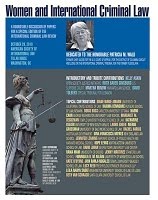
clearerwicl_posterOver time, Beth, Jaya, Kate, and I evolved into the editors of IntLawGrrls. Our collaboration included hosting a conference at Tillar House, the American Society of International Law headquarters, and publishing a special issue of the International Criminal Law Review, dedicated to Judge Patricia M. Wald, on “Women and International Criminal Law.” We worked together through December 2012, when the blog took a couple-months’ hiatus and then revived. It’s been wonderful to watch the replenishment of energy and contributors at this new URL, thanks to Cecilia Marcela Bailliet and many others.

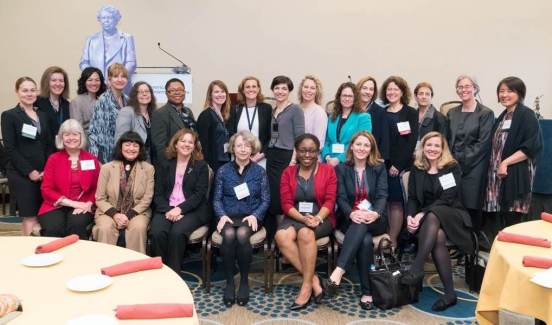
Then as now – nearly 10 years, hundreds of contributors, and thousands of posts later – IntLawGrrls mentors new voices and fosters community among contributors at all stages of their careers. Our periodic group photos are evidence of that. (At top is our photo from last spring’s ASIL annual meeting, when IntLawGrrl Betsy Andersen, 2d from right in top row, earned the Prominent Woman in International Law Award.)

To celebrate our utterly unexpected achievement, we’re throwing a party.
georgiawill_logoBeth, Jaya, Kate, and I have reunited to organize IntLawGrrls! 10th Birthday Conference. We welcome all of our vast IntLawGrrls community to join us on Friday, March 3, 2017 – on the precise date of our 10th birthday – at my home institution, the Dean Rusk International Law Center, University of Georgia School of Law, Athens, Georgia USA, which is hosting as part of our Georgia WILL initiative.

Details and our call for papers are available at our conference website and in the item Jaya posted last week. Suffice it to say that we welcome proposals, in English, French, or Spanish, from all in our community. Topics may include any issue of international, comparative, foreign, or transnational law or policy. We especially welcome contributions from subfields traditionally dominated by men. Academics and practitioners, students and professors, advocates and policymakers alike are most welcome to submit.

We’re planning a plenary aimed at getting us through the next several years – title is “strategies to promote women’s participation in shaping international law and policy amid the global emergence of antiglobalism” – and we hope to organize a few more according to participants’ interests. We look forward to an opportunity to network, to meet old friends and make new ones, to celebrate our accomplishments and lay plans for greater achievements in the coming decade.

I thank all of you for your support of our efforts this last decade, and look forward to seeing many of you here in March.

‘Nuff said.

(Cross-posted from IntLawGrrls blog, and written in personal capacity, as blog’s founder)

ICC Office of Prosecutor invites public comment on draft Policy on Children

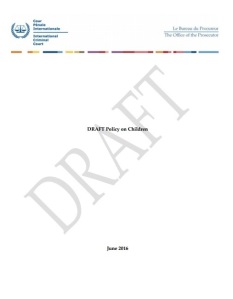
draftpolicyIt is my great honor to note today’s release for public comment of the draft Policy on Children of the International Criminal Court Office of the Prosecutor.

Since my December 2012 appointment as Prosecutor Fatou Bensouda’s Special Adviser on Children in and affected by Armed Conflict, I’ve had the privilege of helping to convene consultations and taking part in the construction of this draft Policy. As part of that process, as noted on page 11 of the draft, we at the Dean Rusk International Law Center, University of Georgia School of Law, were honored in October 2014 to host the Prosecutor, members of her staff, and nearly 2 dozen other experts from academic, nongovernmental groups, and intergovernmental organizations. Our “Children & International Criminal Justice” conference featured a morning public plenary and Prosecutor’s keynote (pictured below), followed by an afternoon of closed-door breakout sessions. (Proceedings from that event, to appear in our Georgia Journal of International & Comparative Law, are nearing publication.)

Addressed in the draft Policy, which spans 37 pages, are:

► Overarching concerns, such as the nature of a child and childhood, the experiences of children in armed conflict and other contexts within the jurisdiction of the ICC, and how the Rome Statute of the ICC and other documents treat crimes against and affecting children; and

► Practical concerns, such as how the Office of the Prosecutor engages with children, in all aspects of its work, including preliminary examination, investigation, charging, prosecution, sentencing, reparations, and external relations.

As stated in the press release accompanying today’s publication:

In highlighting the importance of the Policy, Prosecutor Bensouda stated: “when I assumed 8_events2the role of Prosecutor in June 2012, one of the principal goals I set for the Office was to ensure that we pay particular attention not only to ‘children with arms’, but also ‘children affected by arms.’ This Policy demonstrates our firm commitment to closing the impunity gap for crimes against or affecting children, and adopting a child-sensitive approach in all aspects of our work bearing in mind their rights and best interests. It is also our hope that the Policy, once adopted, will serve as a useful guide to national authorities in their efforts to address crimes against children.”

The Office welcomes public comment on the draft. Such comments should be e-mailed to OTPLegalAdvisorySection@icc-cpi.int, no later than Friday, August 5, 2016.

Following revisions based on the comments, the Office of the Prosecutor expects to publish the final Policy on Children in November of this year.

(Cross-posted from Diane Marie Amann)