 Visitors to Tillar House, the Washington, D.C., headquarters of the American Society of International Law, were treated yesterday to a superb overview of emerging security challenges by the U.S. State Department lawyer who leads that portfolio, Mallory Stewart. I was proud both to have Georgia Law’s Dean Rusk International Law Center cosponsor, and also to serve as discussant for this important event. This post and another tomorrow will outline the proceedings. (For the event video, see here.) Today’s post consists of my opening remarks, which aimed to to reacquaint the audience with to the role that our Center’s namesake, Dean Rusk, played in building the arms control framework within which Stewart and her colleagues work.
. . .
Everyone knows, of course, about Dean Rusk and Vietnam – of his role in championing a foreign conflict that claimed more than a million American and Vietnamese lives between 1965 and 1974. Everyone knows, too, of his pivotal role in averting nuclear catastrophe during the Cuban Missile Crisis of 1962, when Rusk famously said,
“We are eyeball to eyeball, and the other fellow just blinked.”
What may be less well known – or been forgotten – is likewise significant. That is Rusk’s role in the design and implementation of the international arms control regime that has prevailed since the United States dropped atomic bombs on Japan seven decades ago. An Army officer who served in Asia and then in the War Department in D.C., Rusk, like many of his generation, did not fault the military decision. Yet in his memoir, As I Saw It, he wrote (p.122):
“[W]e made a mistake with the Manhattan Project from its inception. We should have built in a political task force to consider the ramifications of using the bomb.”
That position is consistent with Rusk’s own work, first as a State Department diplomat who championed the United Nations, NATO, and other multilateral postwar efforts, and ultimately as the head of that Cabinet department, for the entirety of the Kennedy and Johnson administrations.
As Secretary of State, Rusk oversaw the establishment of the U.S. Arms Control and Disarmament Agency, a forerunner of the Bureau for which our principal speaker, Mallory Stewart, now works. Moreover, Rusk was instrumental in the drafting, negotiation, conclusion, or implementation of at least seven major arms control treaties.
 One was the 1963 Limited Test Ban Treaty, about which Rusk wrote (p. 259):
“[A]fter the Cuban missile crisis, it was important to demonstrate that the United States and Soviet Union could coexist. The test ban required careful and extensive negotiations, but we and they did sign a major agreement on the heels of the most horrendous crisis the world has seen. … Such is the legacy of what President Kennedy felt was his proudest achievement.”
The other treaties were the Antarctic Treaty, the Outer Space Treaty, the Treaty of Tlatelolco, the Nuclear Non-Proliferation Treaty, the Seabed Arms Control Treaty, and the Anti-Ballistic Missile Treaty. Many of them remain at the core of the U.S. arms control portfolio to this day. Yet with the same modesty that pervades his memoir, Rusk wrote (p. 353):
“On the whole, our record on arms control under Lyndon Johnson was respectable.”
He did allow himself a light pat on the back (p.353):
“In reviewing the accomplishments of the Kennedy-Johnson years, I claim only one for myself: that with the agreements negotiated and our constant talking with the Soviets, my colleagues and I helped add eight years to the time since a nuclear weapon has been fired in anger.”
Rusk’s commitment to extending that time continued long after he left government, in 1969, and joined the faculty at the University of Georgia School of Law. Professor Rusk spoke often about arms control, with students, with the larger community, and with the stream of colleagues who consulted with him at his new home. Indeed, as late as 1985 – less than a decade before his death – Rusk welcomed to Athens, Georgia, former British Prime Minister Edward Heath, former Secretary of Defense McGeorge Bundy, former Secretary of State Alexander Haig, and others for a televised discussion entitled “Forty Years Since Hiroshima: What Next for Mankind?”
Rusk’s 1990 memoir returned to that question. In the final chapter, entitled “Dean Rusk’s Message to the Young,” he wrote (p. 630):
“Your generation will discover in the decades ahead whether mankind can organize a durable peace in a world in which thousands of megatons are lying around in the hands of frail human beings. A world in which collective security – what my generation used to try to curb the obscenity of war – is withering away, and we are not even discussing what shall take its place.”
We are here today to put the lie to that last line – that is, to discuss those very issues of global security. I look forward to Ms. Stewart’s remarks.
(Tomorrow: Outline of Mallory Stewart’s remarks. Credit for photo at top, of Rusk signing the Outer Space Treaty; credit for photo above of Rusk, standing just to the left of the portrait as President Kennedy signs the Limited Test Ban Treaty)

 Ambassador Rivkin spoke about the Trans-Pacific Partnership Agreement (TPP) that was signed on February 4, 2016 in New Zealand, but has yet to be approved by Congress. Ambassador Rivkin stressed the ways the TPP would benefit Atlanta businesses, in particular those exporters of: transportation equipment; non-electrical machinery; computer and electronic products; chemicals; processed foods; electrical equipment, appliances and components; the agricultural sector generally. He further stressed that the the TPP is unique and good for U.S. businesses because it sets rules for state-owned enterprises, has a chapter dedicated to small and medium sized businesses, and addresses intellectual property and data flow, labor standards, and the environment. His remarks inspired a lively conversation with the audience, who represented a cross-section of the Atlanta business community.
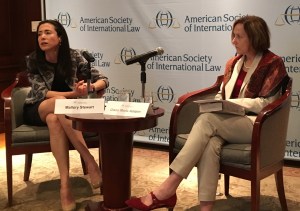 At first blush, today’s security challenges may seem familiar. Yet they are new – emerging, in U.S. State Department parlance – because of the novel ways in which those challenges present themselves.
 This week in D.C.: In their first days volunteering at the Annual Meeting of the American Society of International Law, our
 ► Georgia Law Professor
  ► Joining Professor Chapman will be Oxford Law’s
  exchange of notes