Georgia Law Professor Assaf Harpaz publishes article on the U.N. Framework Tax Convention

University of Georgia School of Law assistant professor Assaf Harpaz published an article titled “The U.N. Framework Tax Convention: Can It Bridge the North-South Divide?” in the tax publication Tax Notes International.

In this article, Harpaz explains the key issues being addressed in the U.N. framework convention on international tax cooperation, including the global north-south divide and its role in the multilateral process.

The article’s abstract is as follows:

The United Nations recently concluded the second session of negotiations on terms of reference for a framework convention on international tax cooperation. The framework convention presents an opportunity to multilaterally address pressing global tax issues. Its goal is to “strengthen international tax cooperation and make it fully inclusive and more effective.”

The extensively negotiated terms of reference make several substantive commitments, including the fair allocation of taxing rights; tax evasion and avoidance by high-net worth individuals; sustainable development; mutual administrative assistance in tax matters; tax-related illicit financial flows; and prevention and resolution of tax disputes.

The ongoing multilateral effort brings the promise of a more equitable international tax regime. However, support for the U.N.’s work and the substantive issues identified has been sharply divided along global north-south lines. A successful U.N. process will need to acquire legitimacy from both the developed superpowers and the developing countries that have historically been excluded from international tax policymaking decisions.

The article explains the key issues being addressed in the U.N. framework convention on international tax cooperation, including the global north-south divide and its role in the multilateral process.

Assaf Harpaz joined University of Georgia School of Law as an assistant professor in summer 2024 and will teach classes in federal income tax and business taxation. Harpaz’s scholarly focus lies in international taxation, with an emphasis on the intersection of taxation and digitalization. He explores the tax challenges of the digital economy and the ways to adapt 20th-century tax laws to modern business practices.

Kannan Rajarathinam (LL.M., ’88) speaks about the future of the United Nations at UGA Law

University of Georgia School of Law alumnus Dr. Kannan Rajarathinam (LL.M., ’88) spoke to students last week about the future of the United Nations in a multipolar world in a lecture entitled, “The UN at a Crossroads.”

Rajarathinam used his decades of experience working at the UN to frame his central question of what lies ahead for the international organization. Founded in 1945, the UN’s main focus over the past 80 years has remained the same: to provide all nations with the opportunity to work together to find shared solutions to shared challenges. From supporting refugees to providing food and vaccines globally, the UN has many ongoing campaigns that realize this vision.

One area where he felt the UN had been particularly successful is in building awareness of and consensus around the global challenge of climate change. He noted that the UN has led over twenty conferences on climate change, and, as a direct result of their commitment to this topic, climate security is a top concern for many western nations. Although there is still much work to be done, Rajarathinam stated that shared solutions, like a fund being developed to aid the Global South in managing the disproportionately-felt effects of climate change and technology-sharing to establish renewable energy systems worldwide, are more likely to find consensus due to the inclusive design of the UN.

There are many challenges to the UN’s role in the new multipolar landscape, including the emergence of regionally-focused forums like BRICS and the G20, international development initiatives like China’s Belt and Road Initiative, and ongoing conflicts like Russia’s invasion of Ukraine and the Israel-Hamas war. Rajarathinam believes that the ability of the UN to offer all 193 Member States from India to Nauru an equal vote is its main strength in withstanding this contemporary power shift. He concluded his talk by observing that, now that we are entering into a multipolar global landscape, no one country has the ability to control history anymore – and that, as a result, the world will be more colorful.

After his afternoon lecture, Rajarathinam met with current LL.M. students to discuss his career in the UN. Students shared their backgrounds and professional aspirations and were able to get advice from Rajarathinam and his wife, Usha.

Rajarathinam recently retired after nearly three decades of UN peace keeping and political work in the former Yugoslavia, Cyprus, Afghanistan, Iraq, Sudan and Somalia. Prior to the UN, he briefly practiced and taught law in India. A commentator of international and political affairs in India, he is the author of two political biographies of Indian leaders and his next work, on the political history of his state of Tamil Nadu in India is due next summer.

Georgia Law Professor MJ Durkee presents on inclusion and exclusion in international organization rulemaking at OECD-Leuven Centre roundtable

Professor Melissa J. “MJ” Durkee, Associate Dean for International Programs, Director of the Dean Rusk International Law Center, and Allen Post Professor here at the University of Georgia School of Law, presented yesterday in an online roundtable forum co-sponsored by the Organisation for Economic Co-operation and Development and the Leuven Centre for Global Governance Studies at KU Leuven, a premier university in Belgium.

Durkee spoke on “Inclusion and Exclusion of For-Profit Stakeholders in IO Rulemaking: Considerations and Pathways” in the roundtable, the overall theme of which was “Improving Inclusiveness of International Organization Rule-Making.” Other presenters included academics and practitioners based not only in the United States and Belgium, but also Czechoslovakia, France, Germany, Italy, the Netherlands, Norway, Poland, Spain, and the United Kingdom.

The forum took place in preparation for an edited volume to be published by the Secretariat of the OECD, a Paris-based international organization to which nearly forty countries, including the United States, belong.

The Leuven Centre and Georgia Law’s Dean Rusk International Law Center are partners in an annual Global Governance Summer School in Belgium and the Netherlands.

Global Governance Summer School students attend RECONNECT conference on democracy and the rule of law in the European Union

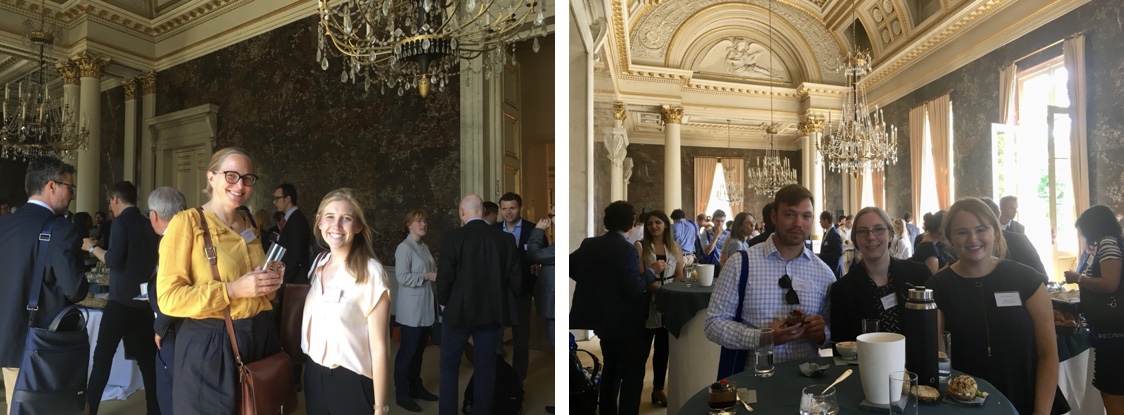
LEUVEN & BRUSSELS – The morning opened with an introduction to the European Union, presented by Michal Ovadek, a research fellow at the Leuven Centre for Global Governance Studies. An expert in the European Union legislative process, he provided an overview of the European Union architecture, and outlined the primary challenges to democracy in Europe. The session was designed to prepare students to participate fully in the rest of the day’s activities: a conference devoted to a research project aimed at reinvigorating core values of the European Union.

From left, Gamble Baffert, Charles Wells, Leila Knox, Emily Doumar, Maria Lagares Romay, Blanca Ruiz Llevot, Steven Miller, Alicia Millspaugh, and Briana Blakely.

The RECONNECT: Reconciling Europe with its Citizens through Democracy and the Rule of Law project, established by the Leuven Centre for Global Governance Studies, is supported by funds from the EU’s Horizon 2020 Research & Innovation programme. As part of the larger project, the Leven Centre convened the International Conference on Democracy and the Rule of Law in the EU. It gathered experts to discuss contemporary challenges to European Union integration, including judicial independence and rule of law, free press, and democratic institutions in countries like Poland and Hungary.

The conference took place in the Brussels’ beautiful Academy Palace, and opened with a welcome by Professor Jan Wouters (left), Co-Director of the Global Governance Summer School.

The conference featured keynote remarks by Daniel Keleman, Professor of Political Science and Law and Jean Monnet Chair in European Union Politics at Rutgers University, and Koen Lenaerts, President of the Court of Justice of the European Union (right). Two policy roundtables also featured perspectives from academics and advocates from around Europe on democracy and rule of law in the European Union, respectively.

From left, Kathleen Garnett, Holly Stephens, Steven Miller, Alicia Millspaugh, Emily Snow.

Georgia Law professors Harlan Cohen, Melissa J. Durkee featured in latest AJIL

Scholarship by 2 members of the international law faculty here at the University of Georgia School of Law is featured in the latest edition of the peer-reviewed American Journal of International Law, the premier publication of the century-old American Society of International Law. Specifically, volume 113, issue 2 includes works by:

Harlan Cohen, Gabriel M. Wilner/UGA Foundation Professor in International Law and Faculty Co-Director of the Dean Rusk International Law Center here at the University of Georgia School of Law and a member of the AJIL Board of Editors. He published a an Editorial Comment featured on the issue’s cover and entitled “What is International Trade Law For?” (pp. 326-46), as well as a review of Not Enough: Human Rights in an Unequal World, a 2018 Harvard University Press book by Samuel Moyn (pp. 415-19).

Melissa J. Durkee, a J. Alton Hosch Associate Professor of Law. She too published a book review, of Lawmakers: International Organizations in the Crafting of World Markets, a 2017 Cambridge University Press volume by Susan Block-Lieb and Terence C. Halliday (pp. 422-28).

How will current and future conflicts test 2016 ICRC Commentary?

It’s our pleasure today to publish this post by Chanel Chauvet, a member of the Georgia Law Class of 2018 who serves as a Student Ambassador at our Dean Rusk International Law Center. This past summer, Chanel (below left) completed a summer course on international humanitarian law at Leiden Law School’s Grotius Centre for International Legal Studies at The Hague, Netherlands. While there, she accompanied Georgia Law Associate Dean Diane Marie Amann, who serves as the Special Adviser to International Criminal Court Prosecutor Fatou Bensouda on Children in & affected by Armed Conflict, at an NGO consultation on the draft Policy on Children, set for final release this autumn. In today’s post, one in a series on our recent conference on international humanitarian law, Chanel writes:

chanel_dianeicc1I feel honored to be able to attend the University of Georgia School of Law, not only for the premier education, but also for the incredible opportunities that are extended to students.

Most recently, the law school’s Dean Rusk International Law Center and Georgia Journal of International & Comparative Law, in conjunction with the International Committee of the Red Cross, coordinated “Humanity’s Common Heritage,” a conference on the 2016 ICRC Commentary on the First Geneva Convention. Organizers included Associate Dean Diane Marie Amann, Professor Harlan Cohen, and Kathleen Doty, the Center’s Director of Global Practice Preparation. Leading experts visited UGA Law to discuss this new development in the field of international humanitarian law, or IHL.

jean-marie-henckaertsFollowing introductions, the keynote speaker and UGA Law alumnus, Dr. Jean-Marie Henckaerts (right) delivered his lecture. To begin the conference, the Dean of University of Georgia School of Law, Peter “Bo” Rutledge, had given an introductory speech, in which he emphasized that UGA Law is a “home” to students and alumni. Personally, I thought it was great to have a distinguished alumnus working within the field of IHL return to our “home” to enrich the UGA Law community.

Dr. Henckaerts discussed three themes: his background; the foundations of international humanitarian law; and the process and methodology of updating the Commentaries to the four Geneva Conventions. This updating is needed, he said, because of advancements in technology and other forms of warfare that have developed since the Commentaries were last updated more than a half-century ago. The effort is significant because of its influence in enhancing the understanding of contemporary international law.

Background

syria-water-aleppo-boy

Aleppo, Syria, 2015 (credit for ICRC photo)

Regarding his background, Dr. Henckaerts serves as the main editor to the Commentaries, and the Legal Adviser at the ICRC. A private organization that was established in 1863, the ICRC consists of 1,500 staff members in 80 different countries. They work to promote and implement IHL, in addition to other initiatives, such as assisting and protecting persons in and affected by armed conflicts. One of the ICRC’s most recent efforts to support this goal involved delivering water in Syria, a country currently plagued with an ongoing non-international armed conflict. Dr. Henckaerts noted that aside from the fact that water is a basic human need, it is also important to prevent the spread of disease.

Foundations

International humanitarian law essentially governs all aspects of war by regulating hostilities and protecting certain groups of people, including civilians and prisoners of war. It finds its basis in the four Geneva Conventions adopted in 1949, which are among some of the very few treaties that have been universally ratified or acceded to. I have listed below the primary purposes of each of the Geneva Conventions and the first two Additional Protocols:

  • GC 1: Conditions of the sick and wounded, medical personnel, medical units, medical transports, emblems, armed forces, rules on the missing, rules on the dead
  • GC 2: Conditions of the ship-wrecked and armed forces at sea
  • GC 3: Treatment of prisoners of war
  • GC 4: Protection of civilians in times of war

Additional Protocol I, which governs international armed conflicts, or IACs, and Additional Protocol II, which governs non-international armed conflicts, or NIACs, are also primary sources of international humanitarian law. These treaties are somewhat less regarded, though, demonstrated by the fact that they have not been ratified by all states.

According to Dr. Henckaerts, the value of 2016 ICRC Commentary on the First Geneva Convention is that it will serve as a tool and reference source on various topics of international humanitarian law.

Process & methodology

Jean S. Pictet (1914-2002),former ICRC Vice President, President of the Juridical Section and Director of General Affairs (photo credit)

With respect to the process and methodology of revising the Commentaries to the first Geneva Convention, he emphasized that the revision process was collaborative in nature. It was an effort between ICRC representatives and other IHL experts throughout the world to update the “Pictet Commentaries,” the Commentaries created shortly after the 1949 Geneva Conventions were adopted. Interestingly enough, the updated 2016 Commentary reflects diverging views extracted from various consultations between the experts.

Dr. Henckaerts also acknowledged that the Commentary cannot be regarded as the ultimate authority on the Geneva Conventions for a number of reasons:

  • First, states parties have not contributed to the clarification of the Commentaries. By the same token, there has not been a concerted public effort by any state to contribute its input to the updated Commentaries.
  • Second, the quality of the research and writing will determine the 2016 Commentary’s position of authority on the first Geneva Convention.

With regard to the process going forward, Dr. Henckaerts reported that the ICRC working group has both begun the revision process on the second Geneva Convention and implemented a timeline to complete the Commentaries to the remaining two Geneva Conventions.

Following this keynote address was a panel of IHL experts including Oxford Law Professor Dapo Akande, Emory Law Professor Laurie Blank, Major-General Blaise Cathcart, the Judge Advocate General of the Canadian Armed Forces, and New York University Law Professor Ryan Goodman. They offered their critiques on the 2016 Commentary. One question they asked was left unanswered: How did the ICRC determine that the Commentaries needed to be updated?

Other questions, posed by Professor Goodman, related to how the Commentaries would address the concept of transnational NIACS, and what would be the implications of this classification within the cyber realm. To illustrate this ideam he asked how the Commentaries would address people, spread across different states, who organized a coalition in the online realm and used cyber weapons.

There also seemed to be an overarching theme of the discussion. It centered on whether the Geneva Conventions should be interpreted through an originalist or an evolutionist perspective. The 2016 ICRC Commentary has provided enough deference to the original Commentaries, but it has evolved in a sense, in order to properly address the technological advances and military developments since the inception of the original Commentaries.

In any event, it is safe to say that all of the experts are curious to see how the current and future conflicts will test the 2016 ICRC Commentary.

For more information regarding the role of the Commentaries, please click here.

Georgia Law Professor Milot calls on global drugs regulators to focus on athlete health, not punishment

Milot profileSports doping is much in the news with the start of the Olympics and Paralympics at Rio de Janeiro, Brazil. Numerous commentators call for stricter regulations; staking out a different position is Georgia Law Professor Lisa Milot, formerly a high-level junior cyclist and now a scholar on law and performance-enhancing drugs. In a Vice Sports article by Patrick Hruby entitled “The Drugs Won: The Case for Ending the Sports War on Doping,” Milot says:

“Athletes are risk-takers. There’s no way to get to the international level of sports without being willing to put your body on the line on a regular basis.”

The article discusses Milot’s position, advanced in her 2014 article “Ignorance, Harm, and the Regulation of Performance-Enhancing Substances,” published in the Harvard Journal of Sports & Entertainment Law. She argues that regulators should concentrate on reducing the harm from substances, rather than banning them altogether. She tells Hruby:

“What we should be doing now is gathering information in order to understand how these substances work on healthy bodies. Focusing on that, rather than punishment.”

On punishment, current news indicates that even international organizations charged with regulating global sports appear to disagree:

► The Montreal-based World Anti-Doping Agency, “established in 1999 as an international independent agency composed and funded equally by the sport movement and governments of the world,” issued a report calling for a blanket ban on Russian athletes at the Olympic Games, which opened Friday and go through August 21.

► The International Olympics Committee, the 122-year-old organization headquartered in Lausanne, Switzerland, has taken a much more measured approach, banning some but by no means all such athletes.

► The International Paralympic Committee, based in Bonn, Germany, banned Russia’s team en masse from its event, set to begin on September 7, no long after the Olympic Games wrap up.

► Meanwhile, athletes from a host of countries have been cited for positive drug tests, or tarred with suspicion that their achievements have been chemically enhanced.

This tangle makes both Hruby’s article and Milot’s scholarship must-reads.