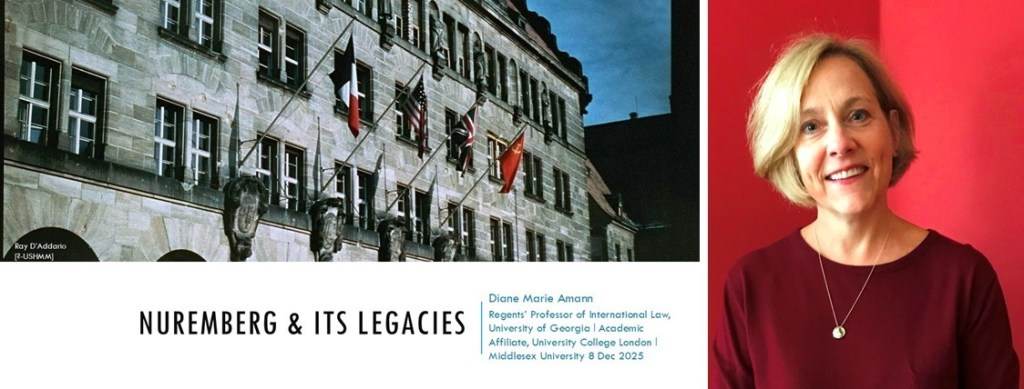
Georgia Law Professor Diane Marie Amann presents on Nuremberg trial at London’s Middlesex University

University of Georgia School of Law Professor Diane Marie Amann recently presented “Nuremberg and Its Legacies” as part of a doctoral students’ seminar at Middlesex University School of Law in London.

Amann provided an overview of the year-long post-World War II war crimes trial held in Nuremberg, Germany, before an International Military Tribunal established by Britain, France, the Soviet Union, and the United States. After discussing how the 1945-1946 trial unfolded, she considered the continued impact of the trial with regard to issues like the death penalty, the abolition of government leaders’ immunity from prosecution, and the international law duty to refuse to obey illegal orders.

Leading the two-day seminar were Middlesex Law professors William A. Schabas and Giulia Pecorella.

Amann is Regents’ Professor of International Law, Emily & Ernest Woodruff Chair in International Law, and a Faculty Co-Director of our Dean Rusk International Law Center here at Georgia Law. During her current research-intensive semester, she is an Affiliate Academic at University College London Faculty of Laws. She has published several essays on the Nuremberg era and is writing a book on lawyers and other women professionals at that first trial.
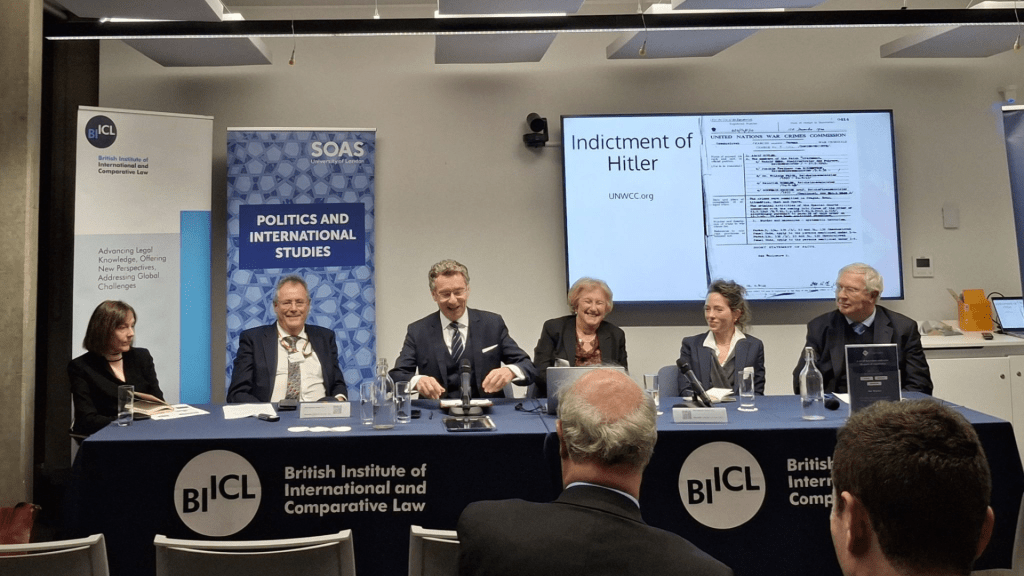
Georgia Law Professor Diane Marie Amann presents on Nuremberg trial at British Institute of International & Comparative Law

University of Georgia School of Law Professor Diane Marie Amann presented “International Military Tribunal Nuremberg 1945-1946,” an overview of the first post-World War II international criminal trial, at the British Institute of International & Comparative Law in London.

Her talk opened “80 Years On: The Legacy of the Nuremberg Trials for Accountability,” a panel of experts convened to analyze the midtwentieth-century trials project. The panel also looked to contemporary developments in international relations and international criminal justice – not least, to the Nuremberg precedent which permitted international criminal prosecutions of heads of state and other governmental leaders. A full video of the panel can be found here.

Besides Professor Amann (pictured above left), panelists included (l to r): Dan Plesch, Professor of Diplomacy & Strategy at SOAS University of London; Christoph Safferling, Director of the International Nuremberg Principles Academy and Professor of Law at the Friedrich-Alexander-Universität Erlangen-Nürnberg; as moderator, International Criminal Court Judge Joanna Korner CMG KC; Kirsty Sutherland, international barrister at 9BR Chambers, London; and Sir Howard Morrison KCMG CBE KC, former Judge on the International Criminal Court. (LinkedIn photo credit)

Cosponsoring the panel along with BIICL were the Robert H. Jackson Center and the International Nuremberg Principles Academy.

Amann is Regents’ Professor of International Law, Emily & Ernest Woodruff Chair in International Law, and a Faculty Co-Director of our Dean Rusk International Law Center here at Georgia Law. During her current research-intensive semester, she is an Affiliate Academic at University College London Faculty of Laws. She has published several essays on the Nuremberg era and is writing a book on lawyers and other women professionals at that first trial.
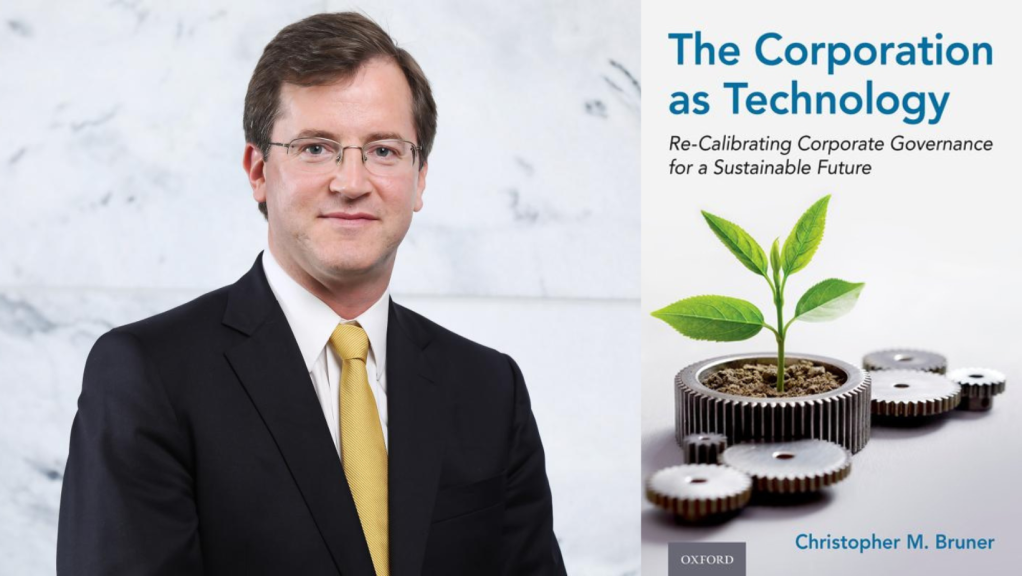
Georgia Law Professor Christopher Bruner featured in Insurance Day

University of Georgia School of Law professor Christopher M. Bruner was featured in Insurance Day, published by London-based Lloyd’s List Intelligence. The article by Ben Margulies, titled “Can the UK Capture Captives?,” discusses the UK government’s effort to create a competitive captive insurance regime.

Bruner shared his thoughts on the factors that make a jurisdiction attractive for establishing captive domiciles, suggesting that smaller jurisdictions can offer fast and flexible policymaking processes. Their small size “makes co-ordination much easier among all the relevant public and private constituencies and it renders their commitment to attractive regulatory structures more credible. They’re highly dependent on these service offerings economically and the market knows it.” London, however, offers competitive advantages in its own right. “London’s main advantage is the extraordinary breadth and depth of corporate and financial services offerings in one place,” Bruner explains. “It’s the ultimate one-stop shop, including in risk management, which provides a strong foundation in the form of pre-existing professional and regulatory know-how.”

Christopher M. Bruner is the Stembler Family Distinguished Professor in Business Law at the University of Georgia School of Law and serves as a faculty co-director of the Dean Rusk International Law Center.

Georgia Law Professor Bruner presents at London School of Economics and Political Science (LSE)

Christopher M. Bruner, Stembler Family Distinguished Professor in Business Law and Faculty Co-Director of the Dean Rusk International Law Center, presented his book, The Corporation as Technology: Re-Calibrating Corporate Governance for a Sustainable Future (Oxford University Press 2022) at the London School of Economics and Political Science (LSE) in June.

Below is a description of the book:

Recent decades have witnessed environmental, social, and economic upheaval, with major corporations contributing to a host of interconnected crises. The Corporation as Technology examines the dynamics of the corporate form and corporate law that incentivize harmful excesses and presents an alternative vision to render corporate activities more sustainable.

The corporate form is commonly described as a set of fixed characteristics that strongly prioritize shareholders’ interests. This book subverts this widely held belief, suggesting that such rigid depictions reinforce harmful corporate pathologies, including excessive risk-taking and lack of regard for environmental and social impacts. Instead, corporations are presented as a dynamic legal technology that policymakers can re-calibrate over time in response to changing landscapes.

This book explores the theoretical and practical ramifications of this alternative vision, focusing on how the corporate form can help secure an environmentally, socially, and economically sustainable future.

UGA Professor Ramnath discusses book, “Boats in a Storm: Law, Migration, and Decolonization in South and Southeast Asia, 1942–1962” at law school

Kalyani Ramnath, Assistant Professor in the Department of History at the Franklin College of Arts & Sciences and Assistant Professor (by courtesy) at the University of Georgia School of Law, recently discussed her first book (detailed in previous post here) at an event organized by the Dean Rusk International Law Center. Joining Ramnath in conversation about Boats in a Storm: Law, Migration, and Decolonization in South and Southeast Asia, 1942–1962 (Stanford University Press, 2023) were Diane Marie Amann, Regents’ Professor, Emily & Ernest Woodruff Chair in International Law, and Co-Director of the Dean Rusk International Law Center, and Laura Phillips-Sawyer, Jane W. Wilson Associate Professor in Business Law.

Below is a description of Ramnath’s book:

Drawing on archival materials from India, Sri Lanka, Myanmar, London, and Singapore, Kalyani Ramnath narrates how former migrants battled legal requirements to revive prewar circulations of credit, capital, and labor, in a postwar context of rising ethno-nationalisms that accused migrants of stealing jobs and hoarding land. Ultimately, Ramnath shows how decolonization was marked not only by shipwrecked empires and nation-states assembled and ordered from the debris of imperial collapse, but also by these forgotten stories of wartime displacements, their unintended consequences, and long afterlives.

Ramnath received her Ph.D. in history from Princeton University in 2018, and was a Prize Fellow in Economics, History, and Politics at the Center for History and Economics at Harvard University from 2018 – 2021. She also holds a bachelor’s degree in arts and law (B.A., LL.B. (Hons.) (JD equivalent) from the National Law School of India University (NLSIU) and a master’s degree in law (LL.M.) from the Yale Law School.

UGA Law professor Diane Marie Amann and UCL Professor Martins Paparinskis

UGA Law Professor Amann presents “Child-Taking and the International Criminal Arrest Warrant” at University College London Faculty of Laws

University of Georgia School of Law Professor Diane Marie Amann, an expert on child and human rights, international criminal law, and the laws of war, presented a lecture entitled “Child-Taking and the International Criminal Arrest Warrant” at University College London Faculty of Laws in June.

News that the International Criminal Court is seeking the arrest of Russia’s President, Vladimir Putin, and Child Rights Commissioner, Maria Lvova-Belova, drew attention to the war crimes charged: “unlawful deportation of population (children)” and “unlawful transfer of population (children) from occupied areas.” Professor Amann’s lecture examined these and similar crimes, which she labels “child-taking.” International child-taking trials date to the Nuremberg tribunals, and have continued in modern forums like the ICC. Court records demonstrate that child-taking is no minor crime. Its present gravity and future consequences are heavy; so too, the prosecutorial burdens of securing indictments, conviction, and redress.

This presentation was chaired by UCL Professor of Public International Law, Martins Paparinskis.

Amann is the Regents’ Professor of International Law, the Emily & Ernest Woodruff Chair in International Law, and a Faculty Co-Director of the Dean Rusk International Law Center.