“Crimmigration as Paradigmatic Migration Control in the United States: Exploring the Impact on Communities, Courts, and Attorneys” November 7 Georgia Journal of International and Comparative Law and Georgia Criminal Law Review annual conference

This year’s annual conference of the Georgia Journal of International and Comparative Law will present “Crimmigration as Paradigmatic Migration Control in the United States: Exploring the Impact on Communities, Courts, and Attorneys“. The conference will be offered jointly by the GJICL and the Georgia Criminal Law Review.

The daylong conference will take place on Friday, November 7 in the Larry Walker Room of Dean Rusk Hall at the University of Georgia School of Law. CLE credit is available for both in-person and virtual attendance. Registration information can be found on the conference webpage.

Sponsoring along with GJICL, a student-edited journal established more than 50 years ago, is the law school’s Dean Rusk International Law Center. GJICL Editor in Chief, Casey Smith (J.D. ’26) and Executive Conference Editor Kellianne Elliot (J.D. ’26) worked Georgia Criminal Law Review Editor in Chief Kerolls Gadelrab (J.D. ’26); Professor Jason A. Cade, J. Alton Hosch Professor of Law & Community Health Law Partnership Clinic Director; Center staff Sarah Quinn, Director; Catrina Martin, Global Practice Preparation Assistant; Taher S. Benany, Center Associate Director; and with the GJICL’s Faculty Advisor, Professor Desirée LeClercq, who is Assistant Professor of Law & Faculty Co-Director of the Dean Rusk International Law Center.

Below is the concept note of the conference:

Political and legal developments have precipitated a convergence of the fields of criminal law and immigration law. Now commonly referred to as crimmigration, this merger of previously distinct practice areas already has profoundly reshaped the legal and social terrain for migrants in the United States. While entry and removal decisions remain essentially administrative, enforcement practices and rhetoric increasingly embrace the punitive logic and carceral reach of the criminal legal system, but with fewer due process protections. As new legislation vastly expands detention authorization and other enforcement resources, it seems apparent that the rhetoric and mechanics of crimmigration will continue to dominate immigration policy in the United States for the foreseeable future. 

This symposium, jointly sponsored by the Dean Rusk International Law Center, the Georgia Journal of International and Comparative Law, and the Georgia Criminal Law Review, invites scholars, immigration attorneys and judges to engage with these developments. We hope panelists will collectively address a number of important questions, such as the following: How does the new crimmigration landscape impact immigrants and communities in the Southeast and beyond? What new burdens does it put on the judiciary, and what role do federal courts have today in determining and upholding constitutional and statutory protections for migrants? Does the durability and continued expansion of crimmigration pose new challenges for immigration and criminal law attorneys; and, if so, how are the immigration and criminal law bars responding to those challenges? As crimmigration tactics expand, what new legal threats face U.S. citizens, including family members, employers, and immigrant advocates? Does the crimmigration paradigm contend with or obscure the structural forces that drive migration, particularly from the global south? Are there reasons to hope or expect the emergence of alternatives to crimmigration as the governing paradigm for the regulation of immigrants in the United States? 

These conversations will occur through three panels and a lunchtime keynote speaker. 

The day’s events are as follows:

9:30am | Opening Remarks

Usha Rodrigues, Dean, University Professor & M.E. Kilpatrick Chair of Corporate Finance and Securities Law

9:35am | Panel 1: Introduction to Crimmigration & the Current State of Affairs

  • Abel Rodríguez, Assistant Professor of Law, Wake Forest Law
  • Shalini Ray, Associate Professor of Law and Director of Faculty Research, Alabama Law
  • Gracie Willis, Attorney, National Immigration Project
  • Moderator: Christian Turner, Associate Professor of Law, University of Georgia School of Law

10:35am | Break

10:45am| Panel 2: The Impact of Crimmigration Policies on Communities and Advocates 

  • Jessica Vosburgh, Senior Staff Attorney, Center for Constitutional Rights
  • Jenny R. Hernandez, Lead Senior Attorney at Immigration Defense Unit, City of Atlanta Office of the Public Defender
  • Carolina Antonini, Founding Partner, Antonini & Cohen Immigration Law
  • Moderator: Elizabeth Taxel, Clinical Associate Professor & Criminal Defense Practicum Director, University of Georgia School of Law

12:00pm | Keynote Introduction

Jason A. Cade, J. Alton Hosch Professor of Law & Community Health Law Partnership Clinic Director, University of Georgia School of Law

12:05     Keynote Address

Judge Ana C. Reyes, United States District Court, District of Columbia

1:00pm | Panel 3: Challenging the Legality of Migration Controls & Envisioning Reform

  • Daniel I. Morales, Associate Professor of Law; Dwight Olds Chair, The University of Houston Law Center
  • Rebecca A. Sharpless, Associate Dean for Experiential Learning, Professor of Law, Director, Immigration Clinic, University of Miami School of Law
  • Emily Torstveit Ngara, Director of Clinical Programs, Associate Clinical Professor and Director, Immigration Clinic, Center for Access to Justice, Immigration Law Clinic, Georgia State University College of Law
  • Moderator: Jason A. Cade J. Alton Hosch Professor of Law & Community Health Law Partnership Clinic Director, University of Georgia School of Law

2:00 | Closing Remarks

Casey Smith, Editor in Chief, Georgia Journal of International and Comparative Law
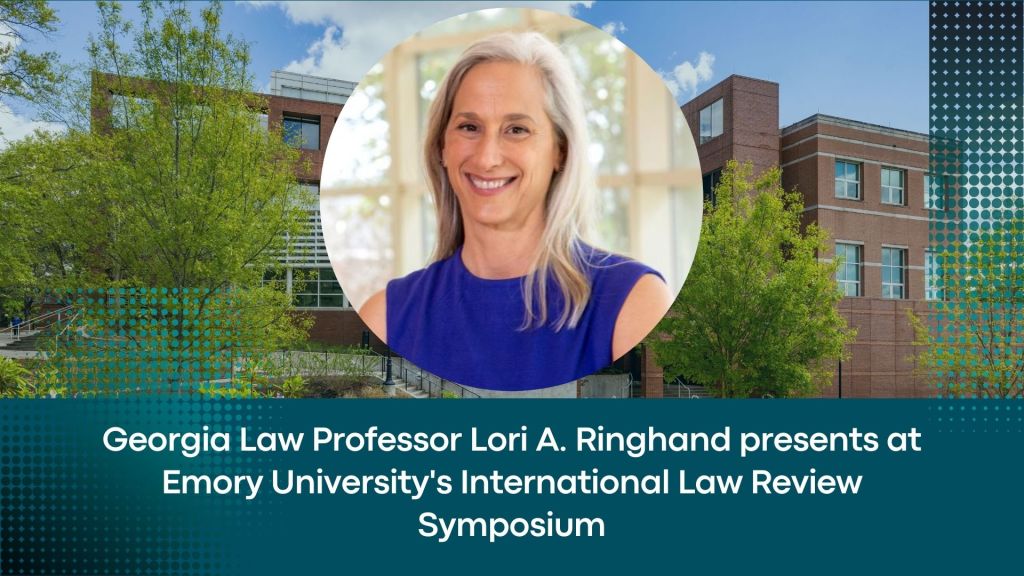
Georgia Law Professor Lori A. Ringhand presents at Emory University’s International Law Review Symposium

Earlier this month, University of Georgia School of Law Professor Lori A. Ringhand presented “First Amendment Restrictions on Non-citizens’ Engagement in Campaign Spending” at the Emory International Law Review symposium “Migration, Law, and Justice: The Evolving Role of International and U.S. Policies.” The event was held at the Emory University School of Law.

This year’s symposium focused on critical issues in immigration law and policy as they relate to international law. They explored the following three topics:

  • The Role of International Law in U.S. Immigration Decisions
  • Human Rights Obligations and the Treatment of Migrants
  • Legal Pathways to Citizenship: Challenges and Opportunities

Ringhand teaches courses on constitutional law and election law. She is a nationally known Supreme Court scholar and the author of two books about the Supreme Court confirmation process: Supreme Court Confirmation Hearings and Constitutional Change (with Paul M. Collins) published by Cambridge University Press; and Supreme Bias: Gender and Race in U.S. Supreme Court Confirmation Hearings, (with Christina L. Boyd and Paul M. Collins), forthcoming Fall 2023 with Stanford University Press. She also is the co-author of Constitutional Law: A Context and Practices Casebook, which is part of a series of casebooks dedicated to incorporating active teaching and learning methods into traditional law school casebooks. Ringhand also publishes extensively on election law related issues, and was awarded a Fulbright Distinguished Chair Award at the University of Aberdeen in Scotland to explore  the different approaches to campaign finance regulation taken by the United States and the United Kingdom.

Georgia Law Professor Cade featured in The Atlanta Journal-Constitution

University of Georgia School of Law Associate Dean & Hosch Professor Jason A. Cade was recently featured in The Atlanta Journal-Constitution regarding the Southern Poverty Law Center’s Southeast Immigrant Freedom Initiative. The article titled “For migrants in Georgia, fighting deportation will become harder. Here’s why.” was written by Lautaro Grinspan and published 6/26/24. 

As stated in the article:

“Detained immigrants in Georgia tend to be held in remote areas, cut off from society, making it really difficult for them to access representation or have contact with family. [The Southern Poverty Law Center’s Southeast Immigrant Freedom Initiative] was essentially the only resource that existed to help them, and they did excellent work,” said Jason Cade, a professor at the University of Georgia School of Law, in a statement.

Jason A. Cade is Associate Dean for Clinical Programs and Experiential Learning, J. Alton Hosch Professor of Law & Community Health Law Partnership Clinic Director. In addition to overseeing the law school’s 11 in-house clinics and 7 externship programs, Cade teaches immigration law courses and directs the school’s Community Health Law Partnership Clinic (Community HeLP), in which law students undertake an interdisciplinary approach to immigrants’ rights through individual client representation, litigation, and project-based advocacy before administrative agencies and federal courts.

Read the full article here. Additional information about the Community HeLP Clinic can be found here.

UGA Professor Ramnath discusses book, “Boats in a Storm: Law, Migration, and Decolonization in South and Southeast Asia, 1942–1962” at law school

Kalyani Ramnath, Assistant Professor in the Department of History at the Franklin College of Arts & Sciences and Assistant Professor (by courtesy) at the University of Georgia School of Law, recently discussed her first book (detailed in previous post here) at an event organized by the Dean Rusk International Law Center. Joining Ramnath in conversation about Boats in a Storm: Law, Migration, and Decolonization in South and Southeast Asia, 1942–1962 (Stanford University Press, 2023) were Diane Marie Amann, Regents’ Professor, Emily & Ernest Woodruff Chair in International Law, and Co-Director of the Dean Rusk International Law Center, and Laura Phillips-Sawyer, Jane W. Wilson Associate Professor in Business Law.

Below is a description of Ramnath’s book:

Drawing on archival materials from India, Sri Lanka, Myanmar, London, and Singapore, Kalyani Ramnath narrates how former migrants battled legal requirements to revive prewar circulations of credit, capital, and labor, in a postwar context of rising ethno-nationalisms that accused migrants of stealing jobs and hoarding land. Ultimately, Ramnath shows how decolonization was marked not only by shipwrecked empires and nation-states assembled and ordered from the debris of imperial collapse, but also by these forgotten stories of wartime displacements, their unintended consequences, and long afterlives.

Ramnath received her Ph.D. in history from Princeton University in 2018, and was a Prize Fellow in Economics, History, and Politics at the Center for History and Economics at Harvard University from 2018 – 2021. She also holds a bachelor’s degree in arts and law (B.A., LL.B. (Hons.) (JD equivalent) from the National Law School of India University (NLSIU) and a master’s degree in law (LL.M.) from the Yale Law School.

UGA Professor Ramnath publishes first book, “Boats in a Storm: Law, Migration, and Decolonization in South and Southeast Asia, 1942–1962”

Kalyani Ramnath, Assistant Professor in the Department of History at the Franklin College of Arts & Sciences and Assistant Professor (by courtesy) at UGA Law, is publishing her first book, Boats in a Storm: Law, Migration, and Decolonization in South and Southeast Asia, 1942–1962, with Stanford University Press.

Below is a description of the book:

For more than century before World War II, traders, merchants, financiers, and laborers steadily moved between places on the Indian Ocean, trading goods, supplying credit, and seeking work. This all changed with the war and as India, Burma, Ceylon, and Malaya wrested independence from the British empire. Set against the tumult of the postwar period, Boats in a Storm centers on the legal struggles of migrants to retain their traditional rhythms and patterns of life, illustrating how they experienced citizenship and decolonization. Even as nascent citizenship regimes and divergent political trajectories of decolonization papered over migrations between South and Southeast Asia, migrants continued to recount cross-border histories in encounters with the law. These accounts, often obscured by national and international political developments, unsettle the notion that static national identities and loyalties had emerged, fully formed and unblemished by migrant pasts, in the aftermath of empires.

Drawing on archival materials from India, Sri Lanka, Myanmar, London, and Singapore, Kalyani Ramnath narrates how former migrants battled legal requirements to revive prewar circulations of credit, capital, and labor, in a postwar context of rising ethno-nationalisms that accused migrants of stealing jobs and hoarding land. Ultimately, Ramnath shows how decolonization was marked not only by shipwrecked empires and nation-states assembled and ordered from the debris of imperial collapse, but also by these forgotten stories of wartime displacements, their unintended consequences, and long afterlives.

On September 21 at 4:00 pm, at the University of Georgia Zell Miller Learning Center, a book release and reception will be held in honor of Professor Ramnath’s work. This event is open to the public.

In court and in Congress, Georgia Law clinics continue efforts on behalf of immigrant women alleging abuse, retaliation while in ICE detention

University of Georgia School of Law clinics’ faculty and students have continued to press forward– both in court and in Congress – in challenges they have brought on behalf of women clients who are challenging the abuses they endured while in U.S. immigration detention.

As previously posted, Georgia Law’s Community HeLP Clinic and First Amendment Clinic have pursued administrative, judicial, and advocacy paths in support of women who had been in the custody of U.S. Immigration and Customs Enforcement (ICE) at the Irwin Detention Center, a privately run facility in south Georgia. While there, the women were subjected to nonconsensual, gynecological and other medical procedures; those who spoke out were met with retaliatory acts, including attempted or actual removal from the United States.

For more than two years, the Georgia Law clinics have represented some of these women in judicial and administrative proceedings. Associate Dean Jason A. Cade, Director of the Community HeLP Clinic, and Professor Clare R. Norins, Director of the First Amendment Clinic, are among co-counsel in Oldaker v. Giles, a class action complaint pending before Judge W. Louis Sands, U.S. District Court for the Middle District of Georgia. Assisting them have been Staff Attorney Kristen Shepherd, Legal Fellow Lindsey Floyd, and many law students.

The Oldaker litigation took a new turn last Monday, when Judge Sands granted a contested motion and thus added two new named plaintiffs, both of them represented by the Georgia Law clinics.

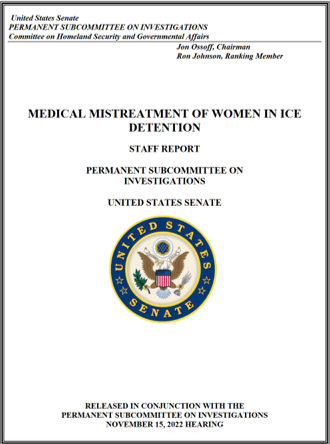
Congressional action occurred earlier last month, when the Senate’s Permanent Subcommittee on Investigations held a hearing on “Medical Mistreatment of Women in Ice Detention,” on November 15 at the Dirksen Senate Office Building in Washington, D.C.

That same day, the subcommittee – led by its Chairman, Sen. Jon Ossoff (D-Georgia), and Ranking Member, Sen. Ron Johnson (R-Wisconsin), simultaneously released a 103-page Staff Report (pictured above) based on its 18-month investigation of the issue. The report recounted many incidents on which the Oldaker suit is based, and further incorporated information provided by six plaintiffs, one of them represented by the Georgia Law clinics. Among other key findings, the report stated that:

  • The women detainees “appear to have been subjected to excessive, invasive, and often unnecessary gynecological procedures” by one of the center’s physicians; and
  • ICE “did not employ a thorough vetting process,” and, before hiring the physician in question, “was not aware of publicly available information regarding medical malpractice suits” and other complaints against him.

Georgia Law clinic joins in publishing advisory for immigrant detainees

The Community Health Law Partnership Clinic at the University of Georgia School of Law and four other law school clinics have published a lengthy practice advisory intended to assist immigrants currently or previously held at Irwin County Detention Center in Georgia.

The practice advisory is designed to help them in seeking damages, stays of removal, and long-term immigration relief based on the abuse they suffered at the detention center (prior posts). It thus provides detailed instructions on how to: file claims under the Federal Tort Claims Act; request stays of removal from the U.S. Immigration and Customs Enforcement (ICE); file complaints with the U.S Department of Homeland Security Office of Civil Rights and Civil Liberties; and apply for U Visas.  

Taking part in this effort at the Georgia Law were Jason A. Cade, Associate Dean for Clinical Programs & Experiential Learning, J. Alton Hosch Professor of Law, and Director of the Community HeLP Clinic, Staff Attorney Kristen Shepherd, and 3L Frederick King.

Joining them were the Boston University School of Law Immigrants’ Rights & Human Trafficking Program, Columbia Law School Immigrants’ Rights Clinic, Harvard Law School Immigration & Refugee Clinical Program, Texas A&M School of Law Immigrant Rights Clinic, and National Immigration Project of the National Lawyer’s Guild. These and other entities have been collaborating on behalf of the Irwin detainees, including in ongoing litigation in Oldaker v. Giles, a consolidated habeas petition and class action complaint filed in the U.S. District Court for the Middle District of Georgia. 

Georgia Law clinics’ advocacy helps client secure U.S. citizenship

https://upload.wikimedia.org/wikipedia/commons/6/64/Us_flag_with_eagle.jpg

Years of advocacy by two clinics at the University of Georgia School of Law recently helped secure U.S. citizenship for a longtime immigrant client.

The earliest work with the client was undertaken by the Jane W. Wilson Family Justice Clinic, as at that time the client was facing severe domestic abuse. Working under the supervision of Clinical Assistant Professor Christine M. Scartz, then-student Eric Abney, a member of the Georgia Law Class of 2020, secured a 12-month family violence protective order and successfully negotiated a resolution that gave the client exclusive possession of the marital residence and a vehicle, sole child custody, and child support.

After the client had gained this measure of safety and stability, the client then was referred to Georgia Law’s Community Health Law Partnership Clinic for further advocacy. Working under the supervision of Jason A. Cade, Associate Dean for Clinical Programs & Experiential Learning, Amy Buice and Carter A. Thomas, members of the Classes of 2019 and 2020, respectively, used the Violence Against Women Act to ensure the client retained permanent residency without having to rely on her abusive former-partner. Subsequently, 3L Ansley Whiten helped the client file an application for naturalization, while 2L Luis Gomez prepared her for the naturalization interview; both were supervised primarily by Kristen Shepherd, the Community HeLP Clinic’s Staff Attorney.

The client became a U.S. citizen in April 2021, on her birthday.

Georgia Law clinics share in national CLEA Award for work on behalf of immigrant women who endured abuse, retaliation while in ICE detention

Efforts on behalf of immigrant women detained in a U.S. immigration center have earned national recognition for the Community HeLP Clinic and First Amendment Clinic here at the University of Georgia School of Law.

The Georgia Law clinics will share that recognition – the 2021 Clinical Legal Education Association Award for Excellence in a Public Interest Project – with law clinics at Harvard, Columbia, Texas A&M, and Boston universities.

The CLEA Award will be presented online 12 noon-1 pm Eastern Friday, April 30, as part of the annual Conference on Clinical Education of the Association of American Law Schools.

The clinics’ project confronted abuse of immigrant women while in the custody of U.S. Immigration and Customs Enforcement (ICE) at the Irwin Detention Center, a privately run facility in south Georgia. As previously posted, the women there were subjected to nonconsensual, medically unindicated, or invasive gynecological procedures. Those who spoke out about abuses faced accelerated deportation proceedings, solitary confinement, and other acts of retaliation. The project has pursued several administrative, judicial, and advocacy avenues, including ongoing litigation of Oldaker v. Giles, a consolidated habeas petition and class action complaint filed in the U.S. District Court for the Middle District of Georgia.

The Project’s efforts have resulted in the release of nearly all 80 women in ICDC, as well as over 200 men, and stays of deportation for most of the Oldaker plaintiffs.

Leading the project on behalf of Georgia Law were Jason Cade (above right), Associate Dean for Clinical Programs & Experiential Learning, J. Alton Hosch Professor of Law, and Director of the Community HeLP Clinic, and Clare Norins (above left), Clinical Assistant Professor and Director of the First Amendment Clinic. Also taking part in this team effort were 3L students Raneem Ashrawi, Frederick King, Julia Griffis, and Anish Patel, 2L students Thomas Evans, Paige Medley, and Davis Wright, First Amendment Clinic Legal Fellow Samantha Hamilton, Community HeLP Clinic Staff Attorney Kristen Shepherd, and administrative associate Sarah Ehlers.

Other collaborators included non-profits, private firms, legislative advocates, and community organizers.

Georgia Law Appellate Litigation Clinic students ask for asylum and withholding of removal in 11th Circuit oral argument

The U.S. Court of Appeals for the Eleventh Circuit heard arguments this week in an asylum and immigration case prepared by a team of students in the University of Georgia School of Law Appellate Litigation Clinic.

Georgia Law 3L Maddie Conkel argued on behalf of the petitioner in Case No. 19-15144, Denis Aguilera Fernandez v. Garland. On account of the Covid-19 pandemic, Conkel’s argument was delivered online to a panel composed of Eleventh Circuit Judges William H. Pryor Jr., Jill A. Pryor, and Ed Carnes (audio here).

In earlier proceedings both the Immigration Judge and the Board of Immigration Appeals agreed that the Clinic’s client – whom Cuban police had detained and beaten repeatedly over two years in an effort to prevent him from protesting the Cuban government – was “thoroughly credible.”  They further agreed that his mistreatment, though “severe and regrettable,” did not rise to the level of “persecution,” and that he had no reasonable fear of future persecution.

Conkel’s argument sought reversal of the resulting denials of asylum and withholding of removal. Georgia Law 3L Sarah Nelson helped Conkel prepare for the argument, and several other students helped the Clinic brief the case. 

The Eleventh Circuit panel is now deliberating.