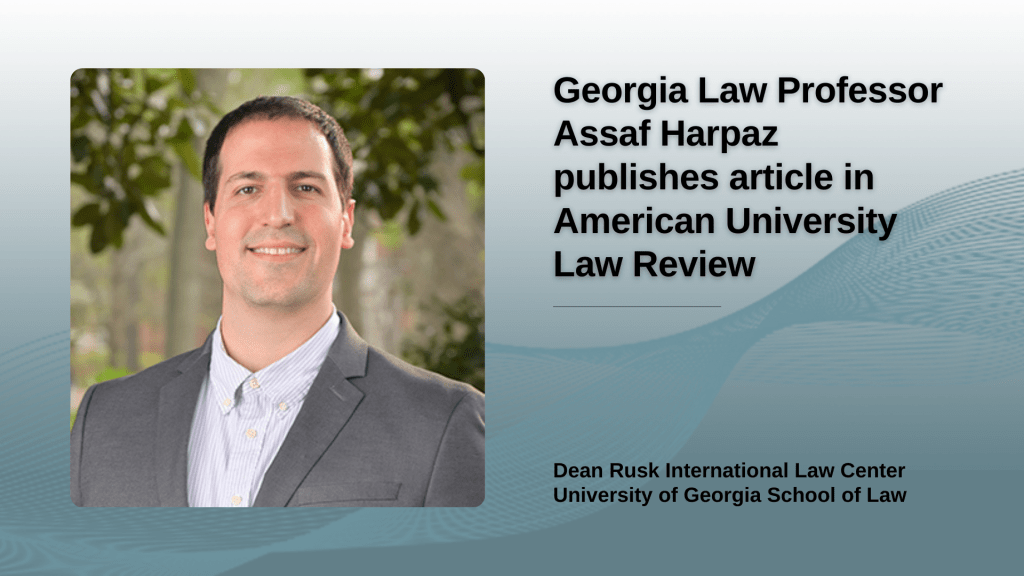

University of Georgia School of Law Professor Assaf Harpaz published “Global Tax Wars in the Digital Era” in the American University Law Review (Vol. 75, 2025). The article explores the global conflict over tax governance, particularly the tensions between OECD-led Global North countries and the UN-backed Global South. It argues for a shift toward source-based taxation that would allow countries to tax online businesses that have a “significant economic presence” without a physical one.
The article’s abstract can be found below:
The digital economy fundamentally disrupts international tax principles that rely on physical presence. When a business earns income abroad, the country of residence (where the taxpayer resides) and the country of source (where income is generated) both have legitimate, competing claims to tax that income. The international tax system tends to favor residence-based taxation. The source country has the right to tax business profits only if the enterprise carries on a permanent establishment within its borders, which typically requires physical presence. The permanent establishment standard becomes flawed in a digital economy where profit shifting practices are abundant and businesses no longer need a physical presence in the location of their online consumer markets.
An upcoming United Nations Framework Convention on International Tax Cooperation recognizes these challenges and is overwhelmingly supported by Global South economies. However, the Global North has historically dominated the international tax regime through the Organization for Economic Co-operation and Development (OECD), informally known as the “World Tax Organization.” A U.N. framework convention creates potential conflict in international tax policymaking and would need to bridge the underlying North-South divide.
This Article explores the “tax wars” surrounding the leadership for global tax governance, contrasting the taxing powers and interests of the OECD-led Global North with those of the U.N.-backed Global South. It argues for a shift toward source-based taxation by revisiting the permanent establishment standard. To achieve this, the Article promotes a significant economic presence doctrine that would expand the permanent establishment criteria to include online businesses. This proposal addresses longstanding inequities and is increasingly warranted in a digital economy that does not depend on physical presence.
Harpaz joined the University of Georgia School of Law as an assistant professor in summer 2024 and teaches classes in federal income tax and business taxation. Harpaz’s scholarly focus lies in international taxation, with an emphasis on the intersection of taxation and digitalization. He explores the tax challenges of the digital economy and the ways to adapt 20th-century tax laws to modern business practices.


Walter Hellerstein