Georgia Law Professor Diane Marie Amann participates in discussion on statehood hosted by the World Affairs Council of Atlanta

University of Georgia School of Law Professor Diane Marie Amann served as a panelist in a recent webinar hosted by the World Affairs Council of Atlanta entitled “Defining Statehood: Law, Legitimacy, and Global Power”. Amann was joined in conversation by fellow panelist Gëzim Visoka, Associate Dean for Research in the Faculty of Humanities and Social Sciences and Associate Professor of Peace and Conflict Studies, and moderator Rickey Bevington, President of the World Affairs Council of Atlanta.

Below is a description of the webinar from the event’s webpage:

What Does It Mean to Be a State in the 21st Century? 

The definition of statehood remains one of the most complex and contested questions in international law and global politics. While the 1933 Montevideo Convention offers a four-part framework—population, territory, government, and capacity for international relations—real-world statehood is shaped just as much by recognition, legitimacy, and geopolitical power. 

In today’s multipolar world, where contested territories, partial recognition, and non-state actors challenge traditional norms, how do we define what it means to be a state?

A recording of the webinar can be accessed here.

Amann is Regents’ Professor of International Law and holds the Emily & Ernest Woodruff Chair in International Law at the University of Georgia School of Law. Also serving as a Faculty Co-Director of the Dean Rusk International Law Center, she is a former Associate Dean for International Programs & Strategic Initiatives. During summer and fall 2025, she is in the United Kingdom serving as a Visiting Academic at University College London Faculty of Laws.
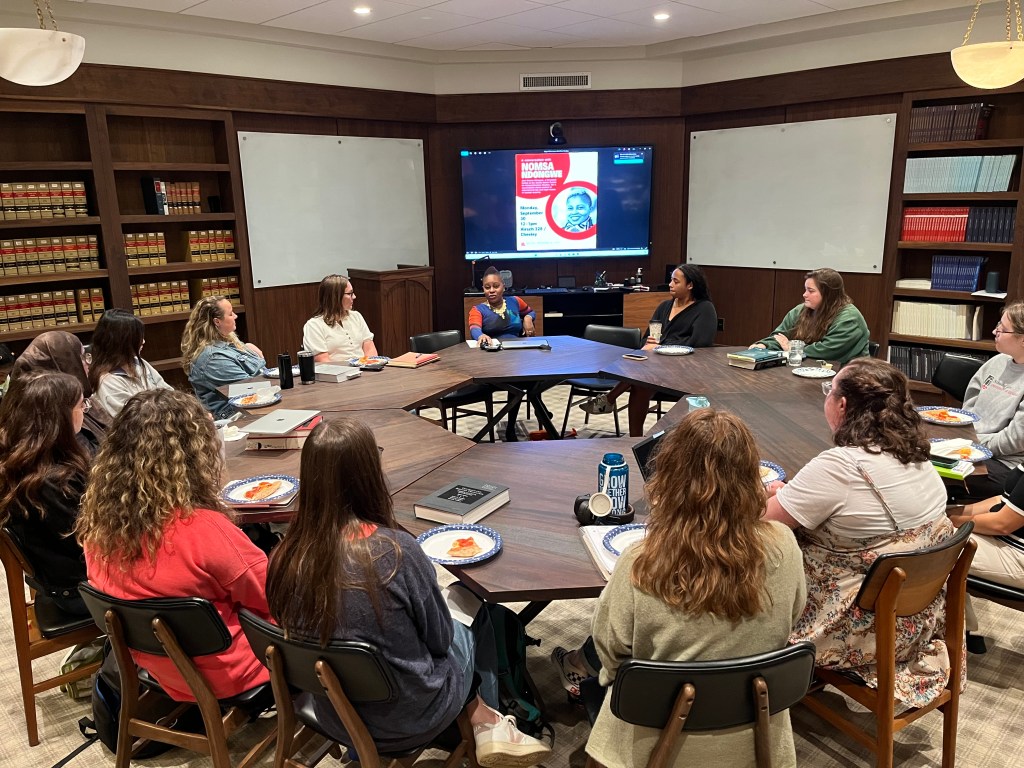
Nomsa Ndongwe, Research Fellow at the James Martin Center for Nonproliferation Studies, speaks at Georgia Law

James Martin Center for Nonproliferation Studies (CNS) Research Fellow Nomsa Ndongwe spoke to students about careers in international law and contemporary security challenges this week at the University of Georgia School of Law.

Ndongwe discussed her own career trajectory and current work in nonproliferation at CNS. She identified several skills aspiring international lawyers can work towards in law school, including learning languages and developing subject matter expertise. Ndongwe championed the importance of professional networking, building relationships with peers, and making use of the resources available to students at Georgia Law, like the Career Development Office and the Dean Rusk International Law Center. She also answered student questions about the use of artificial intelligence in international law, current proceedings in international courts, and global nuclear security challenges.

Ndongwe is a Co-founder of the WCAPS West Coast Chapter, and an N-Square Innovators Network Fellow 2020 – 2021. As of January 2022, she co-leads the CNS Young Women in Nonproliferation Initiative, is a School of International Futures Mentor 2023, and served as a Girl Security mentor. She is also a part of the P5 –Young Professionals Network (YPN) 2022-2023 cohort. She has a Master of Arts in Nonproliferation, Terrorism Studies, and Financial Crime Management from the Middlebury Institute of International Studies. She obtained her first degree, an LLB Single (Hons) degree at Brunel University, and her Postgraduate Diploma in Legal Practice (LPC) from the University of Law in Guildford, UK.

Previously, she served as diplomat for the Zimbabwe Permanent Mission to the United Nations Office at Geneva, focusing mainly on the Disarmament portfolio and International Telecommunication Union (ITU). Nomsa is a featured non-proliferation panelist/moderator for the Ploughshares Foundation, Harvard Belfer Center, Trinity College DC, United Nations Office for Disarmament Affairs (UNODA) New York, Naval Postgraduate School, United Nations Institute for Disarmament Research (UNIDIR), N Square Innovators Network and Royal United Services Institute (RUSI).

Georgia Law Professor Assaf Harpaz publishes article on the U.N. Framework Tax Convention

University of Georgia School of Law assistant professor Assaf Harpaz published an article titled “The U.N. Framework Tax Convention: Can It Bridge the North-South Divide?” in the tax publication Tax Notes International.

In this article, Harpaz explains the key issues being addressed in the U.N. framework convention on international tax cooperation, including the global north-south divide and its role in the multilateral process.

The article’s abstract is as follows:

The United Nations recently concluded the second session of negotiations on terms of reference for a framework convention on international tax cooperation. The framework convention presents an opportunity to multilaterally address pressing global tax issues. Its goal is to “strengthen international tax cooperation and make it fully inclusive and more effective.”

The extensively negotiated terms of reference make several substantive commitments, including the fair allocation of taxing rights; tax evasion and avoidance by high-net worth individuals; sustainable development; mutual administrative assistance in tax matters; tax-related illicit financial flows; and prevention and resolution of tax disputes.

The ongoing multilateral effort brings the promise of a more equitable international tax regime. However, support for the U.N.’s work and the substantive issues identified has been sharply divided along global north-south lines. A successful U.N. process will need to acquire legitimacy from both the developed superpowers and the developing countries that have historically been excluded from international tax policymaking decisions.

The article explains the key issues being addressed in the U.N. framework convention on international tax cooperation, including the global north-south divide and its role in the multilateral process.

Assaf Harpaz joined University of Georgia School of Law as an assistant professor in summer 2024 and will teach classes in federal income tax and business taxation. Harpaz’s scholarly focus lies in international taxation, with an emphasis on the intersection of taxation and digitalization. He explores the tax challenges of the digital economy and the ways to adapt 20th-century tax laws to modern business practices.

Georgia Law Professor Desirée LeClercq presents at 2nd annual Trade and Public Policy Network Conference in Oxford

University of Georgia Assistant Professor of Law & Faculty Co-Director of the Dean Rusk International Law Center, Desirée LeClercq, presented at the 2nd annual Trade and Public Policy Network Conference in Oxford, England. LeClercq’s work was entitled: “Enforcement of the United States-Mexico-Canada Agreement Rapid Response Mechanism.”

Desirée LeClercq joined the University of Georgia School of Law as an assistant professor in summer 2024 and currently teaches International Trade and Workers Rights, International Labor Law, International Law, and U.S. Labor Law. She serves as a faculty co-director of the Dean Rusk International Law Center and as the faculty adviser for the Georgia Journal of International and Comparative Law.

Georgia Professor Christopher Bruner publishes in the Journal of Law and Political Economy

University of Georgia School of Law professor Christopher M. Bruner published an article titled “National Identity and Economic Development in Market-Dominant Small Jurisdictions” in UC Berkeley’s peer-reviewed Journal of Law and Political Economy.

A working paper version of the article was previously presented at the symposium on “Law, Identity, and Economic Development in the Post-Colonial Era: The Case of the Northern Atlantic and Larger Caribbean Regions,” hosted by the Princeton School of Public and International Affairs. For more information, please see our previous post.

Below is an abstract of the article:

Small jurisdictions that are globally competitive in providing cross-border financial services—market-dominant small jurisdictions (MDSJs)—occupy fascinating and unique positions in global markets, reflecting the complexity of their linkages with major economies. This article explores how the distinctive features of MDSJs highlight important dimensions of the relationship between national identity and economic development. I review literatures that aim to explain how jurisdictions behave in the economic context, focusing on concepts of nationalism, national identity, and nation branding, and how such phenomena might impact one another. I then assess their application to the relationship between national identity and economic development in MDSJs, where realities of size and geography prompt substantial outward orientation and incentivize innovations in law and finance to service economic activity largely occurring elsewhere. The article culminates with a vivid case study—the role of national identity in developing, marketing, and maintaining Bermuda’s outsized role in global insurance markets.

Christopher M. Bruner is the Stembler Family Distinguished Professor in Business Law at the University of Georgia School of Law and serves as a faculty co-director of the Dean Rusk International Law Center.

Georgia Law Professor Amann a Research Visitor at Oxford’s Bonavero Institute of Human Rights

Georgia Law Professor Diane Marie Amann is in the United Kingdom during this Fall 2024 semester, serving as a Research Visitor at the Bonavero Institute of Human Rights, Oxford University Faculty of Law.

The faculty sponsor for Amann’s visit is Professor Dapo Akande. Oxford’s Chichele Professor of Public International Law and a member of the U.N. International Law Commission, he has just been nominated as the UK candidate for election to the International Court of Justice.

Amann, who is Regents’ Professor, Emily & Ernest Woodruff Chair in International Law, and Faculty Co-Director of the Dean Rusk International Law Center here at the University of Georgia School of Law, held the same Oxford post during another research-intensive semester, Spring 2018.

She plans to pursue her scholarship related to women professionals who played roles in international criminal trials after World War II and also her work on child rights, especially as they relate to armed conflict and similar violence.

As a Research Visitor, she also will have the opportunity to take part in Bonavero Institute activities, and will benefit from Oxford’s libraries, seminars and lectures, and other offerings.

The Bonavero Institute was founded in 2016 as a unit of the Oxford Faculty of Law, under the direction of Professor Kate O’Regan, a former judge on the Constitutional Court of South Africa.

Georgia Professor Desirée LeClercq to present at WTO’s Annual Public Forum in Switzerland

Assistant Professor Desirée LeClercq will present at the World Trade Organization’s (WTO) 2024 Public Forum. The theme for this year’s forum is Re-globalization: Better Trade for a Better World, described below:

Since the WTO’s inception in 1995, global trade has rapidly expanded and become increasingly interconnected. The international trading system has helped lift 1.5 billion people out of absolute poverty and unlocked new opportunities for businesses, workers and consumers. At the same time, the gains from trade have not always been shared equally. This needs to change.

As the WTO celebrates its 30th anniversary, the 2024 Public Forum will look to the future, exploring how re-globalization can help make trade more inclusive and ensuring that its benefits reach more people.

LeClercq will present research under the United States-Mexico-Canada agreement’s dispute settlement provisions and their effects on vulnerable workers in Mexico.

The WTO 2024 Public Forum also discussed the TradeExperettes’ report: Ten “Quick Wins” for Re-globalization and Resilience in Trade. LeClercq authored “Quick Win No. 3: Empower all workers to ensure a fair, equitable and sustainable trade policy,” which urges greater inclusion of non-union workers at the trade bargaining table.

Desirée LeClercq joined the University of Georgia School of Law as an assistant professor in summer 2024 and currently teaches International Trade and Workers Rights, International Labor Law, International Law, and U.S. Labor Law. LeClercq’s scholarly focus lies in international and labor law. She also serves as a faculty co-director of the Dean Rusk International Law Center and as the faculty adviser for the Georgia Journal of International and Comparative Law.

Georgia Law Professor Kannan Rajarathinam (LL.M. ’88) publishes book

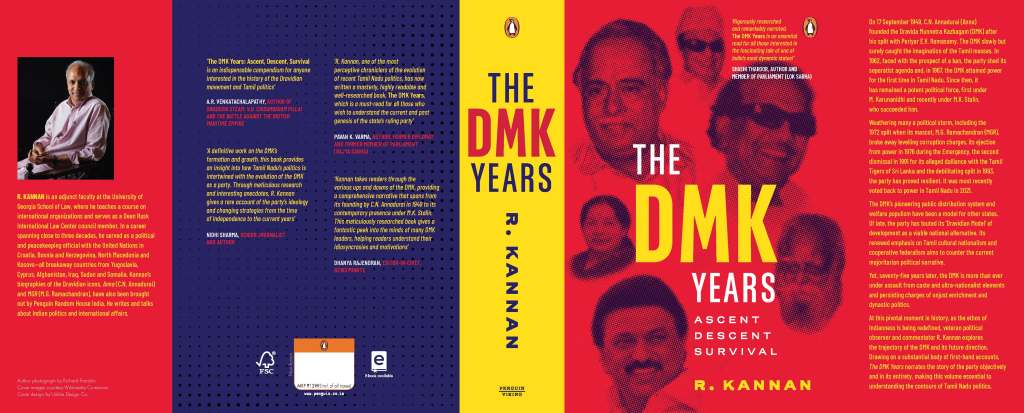
University of Georgia School of Law alumnus and adjunct professor Kannan Rajarathinam (LL.M. ’88) recently published a book, The DMK Years: Ascent, Descent, Survival (India Viking, 2024). The ‘DMK Years’ tells the story of how India’s democracy has accommodated the cultural nationalist aspirations of the Tamils. It also tells the seventy-five-year story of the DMK and the state of Tamil Nadu, once separatist but now India’s second-most prosperous state.      

Below is a full description of the book:

India has twenty states and eight union (federal territories). In April 2023, it became the world’s most populated country. It has 22 official languages, numerous ethnicities and people of all faiths.  

Uniting a country as vast and diverse as India is a herculean task. However, India’s democracy, which was adopted after the 1947 Partition, has shown remarkable resilience. The country’s quasi-federal constitution was designed with unity in mind, recognizing and valuing the diverse population as a key component of its unity.

Yet, India’s unity has not been without its challenges. The restive border states of Kashmir and Punjab are well known. However, there have been other less well-known challenges to the Indian Union. One such was from Tamil Nadu, the southernmost state where the sub-nationalist Dravida Munnetra Kazhagam (DMK) or Dravidian Progressive Federation espoused separation since its founding in 1949.

As the DMK grew into a significant political force, the Indian Centre brought forward the Sixteenth Amendment to the Constitution in 1962, banning any secessionist advocacy—even by peaceful means. The DMK dropped its demand and, in five years, became the ruling party in the state of Tamil Nadu. Since then, it has alternated in power there with its breakaway party, the All India Anna DMK, and has been part of the federal coalition for eighteen years.

The ‘DMK Years’ tells the story of how India’s democracy has accommodated the cultural nationalist aspirations of the Tamils. It also tells the seventy-five-year story of the DMK and the state of Tamil Nadu, once separatist but now India’s second-most prosperous state.      

Kannan Rajarathinam is an adjunct professor at the University of Georgia School of Law teaching a course on International Organizations. Between 1993 and 2022, he served the United Nations in various capacities, including senior political affairs officer, head of office, senior planning and coordination officer, chief civil affairs officer, and legal officer from Afghanistan to Bosnia and Herzegovina. Before joining the UN, he briefly taught at the University of Madras in India as a guest faculty member and junior professor and practised law. Presently, he serves on the Dean Rusk International Law Center Advisory Council.

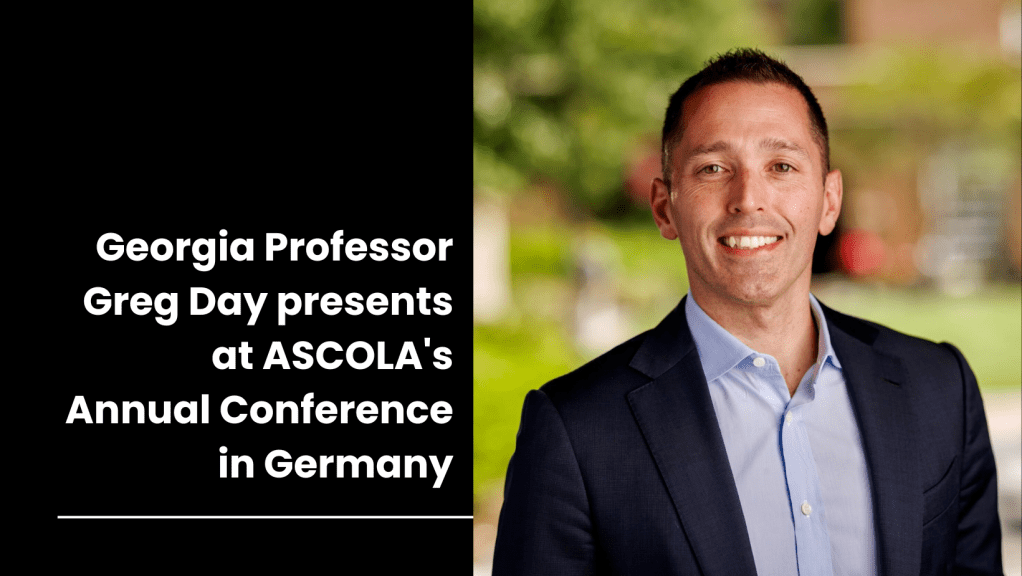
Georgia Professor Greg Day presents at ASCOLA’s Annual Conference in Germany

University of Georgia Associate Professor of Legal Studies Greg Day recently presented research at the 19th American Society for Competition Law (ASCOLA) Annual Conference in Würzburg, Germany. The conference brings together about 120 scholars doing research in competition law, economics or policy from all over the world. 

Greg Day is an Associate Professor of Legal Studies at the Terry College of Business and holds a courtesy appointment in the School of Law. He is also an Affiliated Fellow at Yale Law School’s Information Society Project as well as the University of North Carolina’s Center for Information, Technology, and Public Life. His research has primarily focused on the intersection of competition, technology, innovation, and privacy as well as the disparate impact of anticompetitive conduct.

Georgia Law Professor Bruner presents at London School of Economics and Political Science (LSE)

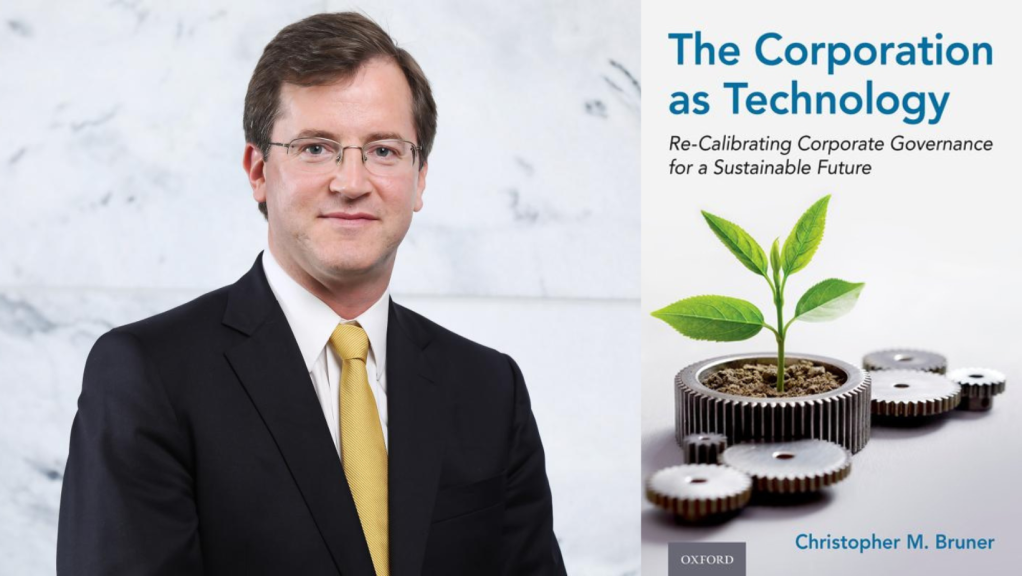
Christopher M. Bruner, Stembler Family Distinguished Professor in Business Law and Faculty Co-Director of the Dean Rusk International Law Center, presented his book, The Corporation as Technology: Re-Calibrating Corporate Governance for a Sustainable Future (Oxford University Press 2022) at the London School of Economics and Political Science (LSE) in June.

Below is a description of the book:

Recent decades have witnessed environmental, social, and economic upheaval, with major corporations contributing to a host of interconnected crises. The Corporation as Technology examines the dynamics of the corporate form and corporate law that incentivize harmful excesses and presents an alternative vision to render corporate activities more sustainable.

The corporate form is commonly described as a set of fixed characteristics that strongly prioritize shareholders’ interests. This book subverts this widely held belief, suggesting that such rigid depictions reinforce harmful corporate pathologies, including excessive risk-taking and lack of regard for environmental and social impacts. Instead, corporations are presented as a dynamic legal technology that policymakers can re-calibrate over time in response to changing landscapes.

This book explores the theoretical and practical ramifications of this alternative vision, focusing on how the corporate form can help secure an environmentally, socially, and economically sustainable future.