Professor Burch presents on class actions at global conference in Israel

burch-profileA leading Georgia Law expert on complex litigation, Professor Elizabeth Chamblee Burch, recently presented on the subject at an international conference at the Tel Aviv University Faculty of Law in Israel.

Entitled “Fifty Years of Class Actions – A Global Perspective,” the 2-day conference brought together scholars not only from the United States and Israel, but also from Australia, Canada, Chile, Germany, Hong Kong, Italy, and the Netherlands.

Professor Burch, who holds the Charles H. Kirbo Chair of Law at the University of Georgia School of Law, spoke on the topic of “Publicly Funded Objectors.” Commenting on her paper was Dr. Eran Taussig, an attorney and lecturer at several universities in Israel.

Here’s the abstract:

On paper, class actions run like clockwork. But practice suggests the need for tune-ups: judges still approve settlements rife with red flags, and professional objectors may be more concerned with shaking down class counsel than with improving class members’ outcomes. The lack of data on the number of opt-outs, objectors, and claims rates fuels debates on both sides, for little is known about how well or poorly class members actually fare. This reveals a ubiquitous problem: information barriers confront judges, objectors, and even reformers.

Rule 23’s answer to information barriers is to empower objectors. At best, objectors are a partial fix. They step in as the adversarial process breaks down in an attempt to resurrect the information-generating function that culture creates. And, as the proposed changes to Rule 23’s handling of objectors reflect, turmoil exists over how to encourage noble objectors that benefit class members while staving off those that namely seek rents from class counsel.
Yet, this concern about screening the bad from the good has distracted us from both the bigger question and the true challenge. The bigger question is how we ensure that judges have the necessary information (and incentive) to monitor the attorneys and ensure that the settlement is fair when the adversarial system breaks down. And the real challenge is how we confront the intense regulatory struggle that arises anytime private actors perform public functions.

Addressing the public-private challenge can generate possibilities for overcoming information deficits. Our class-action scheme is not the only one that relies on private actors to perform public functions: citizens privately fund political campaigns, and private lobbyists provide research and information to lawmakers about public bills and policies. Across disciplines, the best responses to those challenges have often been to level up, not down. As such, this Essay proposes a leveling up approach to address judges’ information deficit such that they can better perform their monitoring role. By relying on public funds to subsidize nonprofit objectors’ information-gathering function, we can disrupt private class counsel’s disproportionate influence.

U.S. immigration law subject of timely article by Professor Jason A. Cade

cade_profileAn especially timely account of U.S. immigration law has just been published by Georgia Law’s expert on the subject, Professor Jason A. Cade.

Entitled “Judging Immigration Equity: Deportation and Proportionality in the Supreme Court,” the article  examines the Supreme Court’s deportation and immigration enforcement jurisprudence over the last 15 years, arguing that the Court’s decisions have been increasingly animated by a proportionality norm.

Here’s the abstract:

Though it has not directly said so, the United States Supreme Court cares about proportionality in the deportation system. Or at least it thinks someone in the system should be considering the justifiability of removal decisions. As this Article demonstrates, the Court’s jurisprudence across a range of substantive and procedural challenges over the last fifteen years increases or preserves structural opportunities for equitable balancing at multiple levels in the deportation process. Notably, the Court has endorsed decision makers’ consideration of the normative justifiability of deportation even where noncitizens have a criminal history or lack a formal path to lawful status. This proportionality-based lens helps unify the Court’s seemingly disparate decisions regulating the immigration enforcement system in recent years. It also has implications for deferred action enforcement programs such as the DACA program implemented by President Obama in 2012. The Court’s general gravitation toward proportionality analysis in this field is sound. Nevertheless, there are drawbacks to the Court’s approach, and the cases are probably best seen as signals to the political branches that the deportation system remains in dire need of wide-ranging reform.

The article, which appears at 50 UC Davis Law Review 1029 (2017), is available here.

1st Amendment Professorship to Sonja West, globally noted media law expert

cropsonja_lawrencefulbrighthu13oct16Very pleased to note the appointment of Georgia Law Professor Sonja R. West, an internationally recognized expert in media law,  the inaugural holder of the Otis Brumby Distinguished Professorship in First Amendment Law. News of the position, which is shared by the law school and the University of Georgia Grady College of Journalism and Mass Communication, came in a university press release issued just before the holiday break.

Of her appointment, Georgia Law Dean Peter B. “Bo” Rutledge said:

“Sonja is a distinguished scholar in media law, and it is fitting that she be named to this professorship, which is devoted specifically to teaching and research about the First Amendment.”

As noted in a previous Exchange of Notes post, last October West represented Georgia Law in Budapest, Hungary, where she:

► Spoke on “Improving Press Coverage of the Courts through Communication” at the European Judicial Conference on Courts and Communication.

► Met with Budapest-based alums and representatives from the Hungarian-American Fulbright Commission, with whom she discussed Georgia Law’s Master of Laws (LL.M.) degree.  West’s at that meeting the photo above; to her immediate left is Dr. Jessica Lawrence, who earned her J.D. from Georgia Law and now is a Lecturer at Budapest’s Central European University. Surrounding them are Fulbright representatives: at far left, Krisztina Kováts, and to the right of West, Dr. Károly Jókay, Körtvélyesi Zsolt, and Molnár Gábor.

► Visited the law faculty at Pázmány Péter Catholic University. In fact, West has accepted an invitation to return to that Budapest university in June, to take part in a Free Speech/Media Law Discussion Forum.

Georgia Law’s International Law Colloquium returns for Spring 2017

intl_law_colloquiumThe International Law Colloquium, a time-honored tradition at the University of Georgia School of Law, returns this spring semester with another great lineup of global legal experts.

Led by our newest holder of an international law professorship, Harlan G. Cohen (prior posts), this 3-credit course consists of presentations of substantial works-in-progress on a variety of international law topics by prominent scholars from other law schools. Since the series began in 2006, students have read and written reaction papers on the scholars’ manuscripts, and then discussed the papers with the authors in class. Other Georgia Law and university faculty often have joined in these dialogues.

We at the Dean Rusk International Law Center are pleased to support this colloquium, thanks to the work of Kathleen A. Doty and Britney Hardweare, respectively, our Center’s Director of and Administrative Assistant for Global Practice Preparation.

Presenting at the Spring 2017 Colloquium are:

photo

◄ January 20: Duncan B. Hollis, Associate Dean for Academic Affairs and James E. Beasley Professor of Law at Philadelphia’s Temple University Beasley School of Law, Constructing Norms for Global Cybersecurity.

kingsbury► January 27: Benedict Kingsbury, Murry & Ida Becker Professor of Law and Director of the Institute for International Law and Justice at New York University School of Law, Contested Megaregulation: Global Economic Ordering After TPP.

todres◄ February 3: Jonathan Todres, Professor of Law, Georgia State University College of Law, Human Rights Education: Traversing Legal and Geographical Boundaries.

jain► February 10: Neha Jain, Associate Professor of Law and McKnight Land-Grant Professor, University of Minnesota Law School, Radical Dissents at International Criminal Courts.

puig◄ February 24: Sergio Puig, Associate Professor of Law and Director of the International Economic Law and Policy Program at the University of Arizona James E. Rogers College of Law, Blinding International Justice.

donde► March 15: Professor Javier Dondé Matute (LLM 1998) of the National Institute of Criminal Sciences, Mexico City, Mexico, a Spring 2017 Georgia Law Visiting Scholar, Criminal Responsibility as a Founding Principle of International Criminal Law.

durkee◄ March 24: Melissa J. Durkee, Assistant Professor of Law, University of Washington School of Law, The Global Norms Market.

achiume► March 31: Professor E. Tendayi Achiume, Assistant Professor of Law, UCLA School of Law, International Law and Xenophobic Anxiety.

Professor Harlan Cohen, Georgia Law’s newest chair in international law

cropcohen_harlan_columns2012Our new year begins with a new chaired professor in international law.

Georgia Law Professor Harlan G. Cohen was named the inaugural holder of the Gabriel M. Wilner/UGA Foundation Professorship in International Law in a university press release issued just before the holiday break.

Cohen has been a vital member of our international law curriculum since joining the Georgia Law faculty in 2007. His courses include international law, global governance, international trade, international business transactions, and U.S. foreign affairs and national security law, and human rights, and he is widely published on those topics.

Recognition of his expertise and prominence in the field is evident: Cohen is Managing Editor of AJIL Unbound, the online platform of the American Journal of International Law, and his service to the American Society of International law includes membership on ASIL’s Executive Council, co-chairing the 106th Annual Meeting and ASIL-Southeast, and membership on the Executive Committee of ASIL’s International Legal Theory Interest Group. Cohen also has co-chaired the Junior International Law Scholars Association and is an elected member of the American Law Institute.

His role in promoting the work of our Dean Rusk International Law Center includes mentoring globally minded students, leading the International Law Colloquium, inviting speakers and organizing conferences, and serving as faculty advisor to the Georgia Journal of International & Comparative Law. These mentorship and advising roles are like those undertaken by the namesake of the new chair: Gabriel M. Wilner (1938-2010), whose long career on Georgia Law’s faculty included service as Associate Dean and holder of the Kirbo Chair of Law. The professorship was created through a gift from Kenneth Klein, a former student of Wilner who is a partner at Mayer Brown in Washington, D.C., and matching funds from the UGA Foundation.

In the words of Georgia Law Dean Peter B. “Bo” Rutledge:

“Harlan has established his reputation as an intellectual leader in international law. His appointment as the inaugural holder of the Wilner/UGA Foundation Professor in International Law will help further the law school’s commitment to providing our students with a strong foundation that will assist them as they join the legal profession in law, business or public service – in the United States as well as abroad. The law school is grateful to our alumnus Ken Klein and the UGA Foundation for their support of this professorship.”

Join Wald, Dudziak, many more at IntLawGrrls conference here: Call for papers deadline extended to Jan. 9

With thanks to all of you who’ve already submitted proposals for IntLawGrrls! 10th Birthday Conference here at the University of Georgia School of Law, we’re pleased both to extend the call for papers deadline till Monday, January 9, and to report on how the conference is shaping up:

► Festivities will begin on Thursday, March 2, 2017. That afternoon, from 3:30 to 5 p.m., Georgia Law’s Women Law Students Association will host the 35th annual Edith House Lecture, featuring Judge Ketanji Brown Jackson, U.S. District Court for the District of Columbia. Our conference will open the same evening, at 7 p.m. at Ciné, with a screening of “500 Years,” Pamela Yates’ documentary about Guatemala set to premiere at the January 2017 Sundance Film Festival. Following the screening will be a conversation with Yates, the film’s director and an IntLawGrrls contributor, and with the producer, Paco de Onís.

► A feature of the next day – the Friday, March 3 Research Forum – will be a plenary panel on “strategies to promote women’s participation in shaping international law and policy amid the global emergence of antiglobalism.” Among the speakers of this still-in-formation panel will be these IntLawGrrls contributors:

  • waldHonorable Patricia M. Wald, who’s currently serving by Presidential appointment on the Privacy and Civil Liberties Oversight Board, and who’s career has included service as a Judge on the International Criminal Tribunal for the former Yugoslavia and as Chief Judge of the U.S. Court of Appeals for the District of Columbia Circuit;
  • dudziakEmory Law Professor Mary Dudziak, a legal historian of the post-World War II era and the new President of the Society for Historians of American Foreign Relations Law; and
  • bvsConference co-organizer and Stanford Law Visiting Professor Beth Van Schaack, an expert in international criminal law and the laws of war and former Deputy to the Ambassador-at-Large for War Crimes Issues in the Office of Global Criminal Justice of the U.S. Department of State.

► Filling the balance of Friday, March 3 (before, that is, our evening conference dinner) will be Research Forum presentations by panelists drawn from our call for papers. We’re delighted to extend the deadline for such proposals till Monday, January 9 – and to report that several dozen proposals already have been submitted (and many already accepted, on a rolling basis).

  • They’ve come not only from the United States – California, Connecticut, Florida, Illinois, Indiana, Massachusetts, New York, Ohio, Pennsylvania, and Washington, D.C. – but also, in keeping with our global reach, from Canada, France, Hong Kong, Switzerland, and the United Kingdom.
  • Expertise is multidisciplinary – among those submitting are policymakers, clinicians and center directors, NGO representatives, students, and professors, in law, psychology, history, political science/international relations, anthropology.
  • Topics are global, too, treating issues in Africa, Asia, the Americas and Caribbean,  and Europe: the economy (comparative corporate law, corporate social responsibility, international trade); the environment (environmental protection, climate change, gender empowerment); rights (human rights, reproductive rights, women’s rights); humanitarian law and peace and security (genocide, global and human security, terrorism, lethal autonomous weapons); international organizations (enforcement mechanisms like the International Criminal Tribunal for the former Yugoslavia and the International Criminal Court, plus U.N. responsibility related to the Haiti cholera outbreak);  international law theory (role of civil society, feminist approaches to international law (in French and English); law enforcement (policing youth, evidence-gathering); armed conflict/postconflict (reparations, the Cold War); and sex and gender (women’s participation in international judging, warfare, and religious practice, as well as issues related to sexual and gender-based violence).

We welcome your participation, too. Click for more information and to submit a proposal.

(Cross-posted from IntLawGrrls)

Georgia Law scholar quoted in EJIL: Talk! symposium on ICC, gender justice

politicsWhat a welcome surprise to read words I penned a few years ago quoted-within-a-quote in a post today at EJIL: Talk! To be precise, Washington & Lee Law Professor Mark Drumbl wrote:

“Gender justice initiatives at the ICC remain entwined with other advocacy movements. Notable in this regard is the push for children’s rights. The pairing of women’s rights with children’s rights – while perhaps seeming somewhat odd – does reflect the historical association, in Diane Marie Amann’s words (cited by Chappell), of ‘women and children as bystanders, beings not fully conscious of the world around them’ within the Grotian Weltanschauung.”

The quote, from my essay “The Post-Postcolonial Woman or Child,” appears in Drumbl’s contribution to a terrific EJIL: Talk! symposium analyzing The Politics of Gender Justice at the International Criminal Court (Oxford University Press 2015), an important book by Louise A. Chappell (below right), Professor and Australian Research Council Future Fellow, School of Social Sciences, University of New South Wales, Sydney, Australia.

chappellChappell (who, like Drumbl, is an IntLawGrrls contributor) traces her subject through chapters that “represent,” “recognize,” “redistribute,” and “complement” gender justice at the ICC, an institution that “nested” “gender advocacy,” as Drumbl puts it in his review, entitled “Gender Justice and International Criminal Law: Peeking and Peering Beyond Stereotypes.” He adds: “In short: her superb book is a must-read.”

Joining Drumbl in this symposium are:

► An opening post by EJIL: Talk! Associate Editor Helen McDermott, a post-doctoral Research Fellow in law and armed conflict in the Oxford Martin School Programme on Human Rights for Future Generations at the University of Oxford, England.

► An introduction by Chappell, who is due to close the conversation later this week (latter post now available here).

“Beyond a Recitation of Sexual Violence Provisions: A Mature Social Science Evaluation of the ICC” by Patricia Viseur Sellers, who serves as the International Criminal Court Prosecutor’s Special Adviser for Prosecution Strategies, is a Visiting Fellow at Kellogg College, Oxford University, and the former Legal Advisor for Gender and Acting Senior Trial Attorney at the International Criminal Tribunal for the Former Yugoslavia.

“Gender Justice Legacies at the ICC” by yet another IntLawGrrls contributor, Valerie Oosterveld, Associate Dean (Research and Graduate Studies), Associate Professor, and Deputy Director of the Centre for Transitional Justice and Post-Conflict Reconstruction, University of Western Ontario Faculty of Law, London, Ontario, Canada.

To crib from Drumbl’s post, the series is a must-read.

(Cross-posted from Diane Marie Amann)

Travel grants to help students and early-career persons take part in IntLawGrrls! 10th Birthday Conference

1029_3

A scene from IntLawGrrls’ last conference, “Women in International Criminal Law,” October 29, 2010, at the American Society of International Law

Delighted to announce that we will be able to make it easier for some students or very-early-career persons whose papers are accepted for “IntLawGrrls! 10th Birthday Conference” to take part in this daylong celebration.

Thanks to the generosity of the Planethood Foundation, we have established a fund that will provide small grants to help defray the costs of travel to and accommodation at our conference, to be held March 3, 2017, at the Dean Rusk International Law Center, University of Georgia School of Law, Athens, Georgia USA. The law school is hosting as part of its Georgia Women in Law Lead initiative.

We’re pleased too to announce two additional conference cosponsors: the American Society of International Law and ASIL’s Women in International Law Interest Group (WILIG).

As detailed in our call for papers/conference webpage and prior posts, organizers Diane Marie Amann, Beth Van Schaack, Jaya Ramji-Nogales, and Kathleen A. Doty welcome paper proposals from academics, students, policymakers, and advocates, in English, French, or Spanish, on all topics in international, comparative, foreign, and transnational law and policy.

In addition to paper workshops, there will be at least one plenary panel, on “strategies to promote women’s participation in shaping international law and policy amid the global emergence of antiglobalism.”

The deadline for submissions will be January 1, 2017. Students or very-early-career person who would like to be considered for one of these grants to help defray travel costs are asked to indicate this in their submissions. Papers will be accepted on a rolling basis – indeed, we’ve already received several – so we encourage all to submit as soon as they are able.

For more information, see the call for papers or e-mail doty@uga.edu.

(Cross-posted from IntLawGrrls)

Founder of IntLawGrrls extends invitation to blog’s 10th Birthday Conference, March 3 at Georgia Law

image001

Why IntLawGrrls?

The need for an online forum giving voice to women who work in international law and policy began to take shape 10 years ago this autumn.

An issue of the day was Guantánamo; specifically, what was the United States to do now that the U.S. Supreme Court, in a June 2006 decision in Hamdan v. Rumsfeld, had ruled President George W. Bush’s military commissions unconstitutional?

Many women had worked, spoken, or written on GTMO – not only in law review articles, but also in court pleadings. I was one of them, having published “Guantánamo” in the Columbia Journal of Transnational Law in 2004 and served in 2006 as principal author of the amicus brief in Hamdan filed jointly by the National Institute of Military Justice and the Bar Association of the District of Columbia.

And yet, when Congress convened post-Hamdan hearings, witness after witness was exclusively male. Worse still, the perspectives these men advanced by no means covered the spectrum – no surprise given that all of them had served in the Executive Branch of the U.S. government, and only one staked any claim to expertise in human rights law. Nothing approximating either a nongovernmental or feminist perspective surfaced in those sessions on Capitol Hill.

News accounts of such manels got me thinking about launching a blog.

Opinio Juris, founded in November 2004, had revealed an international law community rife with readers and contributors. But posts by women were few, as was then and remains today the case on digital platforms. I imagined that a blog open only to women might attract women – that women would see it as both an invitation and an obligation to contribute. Going pink would set a strong contrast with OJ‘s baby-blue image.

The name? “IntLaw” was easy, and for obvious reasons.

“Grrls” was obvious too. The spelling’s angry “grr” owes much to the circa-1990s Riot Grrrls; the concept, to the Guerrilla Girls, a group that since 1985 has been wreaking feminist havoc in the male-dominated art world. (Years later, we would recognize Pussy Riot, a band-turned-movement that, like Guerrilla Girls, remains active.)

dowomenhavetobenaked2005smallrgbAs the Guerrilla Girls’ website recalls:

“They assumed the names of dead women artists and wore gorilla masks in public, concealing their identities and focusing on the issues rather than their personalities.”

And so did IntLawGrrls. Well, not the gorilla masks (at least not in public). But in the infant months after our birth-day on March 3, 2007, each of us assumed the name of a foremother as our pseudonym, and posted in her honor. I was Gráinne Ni Mháille, or Grace O’Malley, the Irish pirate who also would be embraced by contributors Fionnuala Ní Aoláin and Gráinne de Búrca. A charter contributor, Beth Van Schaack, took the name of her distant relative, Eleanor Roosevelt. It will come as little surprise to learn that others followed suit in honoring ER, who remains our blog’s proto-foremother. Another early contributor, Jaya Ramji-Nogales, posted in the name of the 19th Century Indian queen Lakshmi Bai.

A half-dozen months and scores of contributors later, we ‘Grrls began posting in our own names, though we continued to name foremothers both in introductory posts and in an honor roll posted online. Kathleen A. “Kate” Doty, for example, thus paid homage to Queen Lili‘uokalani, the last monarch of Hawai‘i.

clearerwicl_posterOver time, Beth, Jaya, Kate, and I evolved into the editors of IntLawGrrls. Our collaboration included hosting a conference at Tillar House, the American Society of International Law headquarters, and publishing a special issue of the International Criminal Law Review, dedicated to Judge Patricia M. Wald, on “Women and International Criminal Law.” We worked together through December 2012, when the blog took a couple-months’ hiatus and then revived. It’s been wonderful to watch the replenishment of energy and contributors at this new URL, thanks to Cecilia Marcela Bailliet and many others.

Then as now – nearly 10 years, hundreds of contributors, and thousands of posts later – IntLawGrrls mentors new voices and fosters community among contributors at all stages of their careers. Our periodic group photos are evidence of that. (At top is our photo from last spring’s ASIL annual meeting, when IntLawGrrl Betsy Andersen, 2d from right in top row, earned the Prominent Woman in International Law Award.)

To celebrate our utterly unexpected achievement, we’re throwing a party.

georgiawill_logoBeth, Jaya, Kate, and I have reunited to organize IntLawGrrls! 10th Birthday Conference. We welcome all of our vast IntLawGrrls community to join us on Friday, March 3, 2017 – on the precise date of our 10th birthday – at my home institution, the Dean Rusk International Law Center, University of Georgia School of Law, Athens, Georgia USA, which is hosting as part of our Georgia WILL initiative.

Details and our call for papers are available at our conference website and in the item Jaya posted last week. Suffice it to say that we welcome proposals, in English, French, or Spanish, from all in our community. Topics may include any issue of international, comparative, foreign, or transnational law or policy. We especially welcome contributions from subfields traditionally dominated by men. Academics and practitioners, students and professors, advocates and policymakers alike are most welcome to submit.

We’re planning a plenary aimed at getting us through the next several years – title is “strategies to promote women’s participation in shaping international law and policy amid the global emergence of antiglobalism” – and we hope to organize a few more according to participants’ interests. We look forward to an opportunity to network, to meet old friends and make new ones, to celebrate our accomplishments and lay plans for greater achievements in the coming decade.

I thank all of you for your support of our efforts this last decade, and look forward to seeing many of you here in March.

‘Nuff said.

(Cross-posted from IntLawGrrls blog, and written in personal capacity, as blog’s founder)

Between the Law of Force and the Law of Armed Conflict

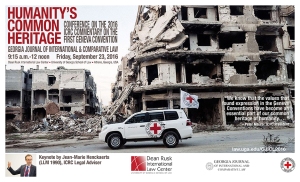
adhaque_img“Between the Law of Force and the Law of Armed Conflict” by Adil Ahmad Haque, originally published on Just Security Blog on October 13, 2016. We are grateful for permission to reprint this as part of our series inspired by “Humanity’s gjicl_confposterCommon Heritage,” our recent conference on the 2016 ICRC Commentary on the First Geneva Convention. The author, Rutgers Law Professor Haque, was a conference participant; this post is the 3d of 3 he prepared soon after the conference. He writes:
Last week, I argued in favor of the ICRC’s position that if one state uses armed force in the territory of another state then an international armed conflict (IAC) arises between the two states, unless the territorial state consents to that use of force. Accordingly, the treaty and customary law of IAC protects the civilian population of the territorial state as well as the armed forces of the intervening state. For example, on this view, the customary law of IAC applies to US operations in Syria, while Additional Protocol I (to which the US is not a party) applies to UK operations in Syria.

Importantly, the ICRC’s approach applies even if the target of the armed force is an organized armed group operating on the territory­—but not under the control—of the territorial state. Accordingly, the treaty and customary law of non-international armed conflict (NIAC) may also apply to such uses of armed force, for example, by governing the targeting and detention of armed group members.

In this post, I’ll respond to some criticisms of the ICRC’s position. Along the way, I’ll make some more general comments on the relationship between the law of force (jus ad bellum) and the law of armed conflict (jus in bello).

Here on Just Security, Sean Watts and Ken Watkin have criticized the ICRC’s position (see here, here, and here). Perhaps the most sustained critique of the ICRC’s position comes from Terry Gill, in a recent article for International Law Studies. There is much to admire in Gill’s article (indeed, I recently assigned it to my students). However, I found his criticisms of the ICRC’s position unpersuasive.

First, Gill rejects “the argument that non-consensual military intervention automatically constitutes a violation of sovereignty and is therefore directed against the territorial State” on the grounds that the intervention may be a lawful exercise of self-defense or may be authorized by the UN Security Council.

This objection seems misdirected. The ICRC does not refer to a violation of sovereignty but instead to an interference or intrusion into the territorial state’s sphere of sovereignty. By definition, a violation of sovereignty is unlawful. In contrast, an interference or intrusion into a state’s sphere of sovereignty may lawful or unlawful. According to the ICRC, an armed interference or intrusion into a state’s sphere of sovereignty—whether lawful or unlawful—will trigger an armed conflict with that state. More on this below.

Second, and relatedly, Gill writes that “there is no reason to assume that the classification of an armed conflict is dependent upon— or even influenced by—the question of whether a violation of the ius ad bellum has occurred.”

This objection also seems misplaced. On the ICRC’s view, the classification of an armed conflict does not depend upon the lawfulness or unlawfulness of the use of force, but instead depends on the fact that force is used by one state on the territory of another without its consent.

Of course, if the territorial state consents to the use of force then (i) the use of force is lawful under the jus ad bellum and (ii) there is no armed conflict between the two states. However, the reason that there is no armed conflict between the states is not that the use of force is lawful but rather that there is no conflict between the states, armed or otherwise. There is no dispute, difference, opposition, or hostile relationship between the two states. Put another way, the fact that consent has been given or withheld is independently relevant to both the jus ad bellum and the jus in bello.

In his second post, Watkin writes that the ICRC’s “reliance on State consent, as the basis for conflict categorization, makes it difficult, if not impossible, to separate it from the law governing the recourse to war.” I respectfully disagree.

The jus ad bellum and the jus in bello are independent in the sense that a use of force may be lawful under one body of law but unlawful under the other. A war of aggression may strictly conform to the law of armed conflict, while a war of self-defense may flagrantly violate the law of armed conflict. At the same time, we do not conflate jus ad bellum andjus in bello simply by recognizing that certain factual circumstances (such as consent or non-consent) may be relevant to both bodies of law.

(For example, if one state exercises effective control over part of the territory of another state then this will ordinarily give rise to a belligerent occupation. Of course, if the territorial state consents then there is no belligerent occupation, not because the occupation is lawful but because there is no belligerency. The same logic applies to the use of armed force and the existence of armed conflict.)

Third, Gill notes that “neither the text of the relevant provisions in the Geneva Conventions (Common Articles 2 and 3) nor the original ICRC commentaries thereto contain any reference to violation of sovereignty as a criterion for determining the character of the armed conflict.” Nor does the ICTY’s Tadić judgment, which Gill rightly describes as “the leading judicial decision on the classification of armed conflicts.”

Since the Geneva Conventions do not tell us when an armed conflict between states exists, we must interpret their terms in light of their context, object, and purpose. The original ICRC commentaries state that “[a]ny difference arising between two States and leading to the intervention of members of the armed forces” gives rise to an armed conflict between those states. It is hard to imagine a more serious difference arising between two States than a difference regarding whether one may use armed force on the territory of the other. If such a difference leads to intervention by the armed forces of either state, then an armed conflict automatically arises.

In Tadić, the ICTY stated that “an armed conflict exists whenever there is a resort to armed force between States.” Importantly, “armed force between States” does not require that two states use armed force against one another but instead requires that one state uses armed force against another.

Now we approach the heart of the matter. What does it mean for one state to use force “against” another?  On the ICRC’s view, an armed interference in a state’s sphere of sovereignty is a use of force against that state.

Why invoke the concept of sovereignty in this context? States are legal persons, not physical persons or objects. Strictly speaking, one cannot use physical force against a legal person, such as a state or corporation. One can, however, use physical force against a physical entity—a person, place, or object—over which a legal person has legal rights. There is nothing else that physical force against a legal person could sensibly mean. On this approach, physical force is used against a state when physical force is used against a physical entity within that state’s sphere of sovereignty. There is nothing else that physical force against a state could sensibly mean.

Fourth, and most importantly, Gill identifies several examples involving extraterritorial force targeting armed groups in which “the States concerned [n]either verbally [n]or factually conduct themselves as if they were involved in an armed conflict, even though they may not have consented to the interventions and may have considered them a violation of their sovereignty (irrespective of whether they did constitute such violations).” These examples include military operations by the United States inside Pakistan and Yemen; by Turkey inside Iraq; by Kenya inside Somalia; and by Colombia inside Ecuador.

Admirably, Gill allows that “the lack of hostilities between the intervening and territorial States in these examples may be in whole or in part due to other factors.” But what should we make of the fact that these states may not claim to be in armed conflict with one another?  Is the absence of such claims, or the denial of such claims, “subsequent practice in the application of the treaty [in this case, the Geneva Conventions] which establishes the agreement of the parties regarding its interpretation?”

In my view, state silence is inherently ambiguous. Accordingly, we should consider only the explicit legal opinions of states that the law of IAC applies or does not apply. For example, Syria might announce that it is not in an IAC with the UK and that, accordingly, UK forces captured in Syria are not entitled to combatant immunity for acts preceding their capture. The UK would no doubt respond with its own legal opinion, based on its own classification of the conflict and identification of applicable legal rules.

Until subsequent practice establishes the agreement of the parties to the Geneva Conventions (that is, of all states) regarding their interpretation in such cases, we should interpret the terms of the Conventions in light of their object and purpose. As I discussed in my previous post, the object and purpose of the law of IAC is the protection of civilians, civilian objects, and combatants from hostile foreign states. As the ICRC puts it:

it is useful to recall that the population and public property of the territorial State may also be present in areas where the armed group is present and some group members may also be residents or citizens of the territorial State, such that attacks against the armed group will concomitantly affect the local population and the State’s infrastructure. For these reasons and others, it better corresponds to the factual reality to conclude that an international armed conflict arises between the territorial State and the intervening State when force is used on the former’s territory without its consent.

Strangely, in his first post on Just Security, Watkin objects that, by adverting to this factual reality, the ICRC “prioritizes form over substance” because the harm to civilians “may be a mere possibility.” Instead, Watkin suggests that conflict categorization should be based on “an assessment of what actually happens.” On this view, it seems that we will not know what law applies to a use of force until after the use of force is carried out. Among other things, we will not know which legal protections civilians enjoy until it is too late. This seems like an unattractive view.

For his part, Gill acknowledges that “an intervention may impact portions of a State’s population or its national resources,” but writes that

when a population and public property are under the control of an [organized armed group] and not under the effective control of the territorial State, they can no longer be identified with that State for purposes of determining the legal constraints on the conduct of hostilities. In the event the intervening State’s action resulted in occupation of territory, this would change the situation and trigger the regime pertaining to IACs.

Watkin seems to make a similar claim in his first post on Just Security.

Strikingly, Gill provides no support for the first sentence, which is hardly self-evident. Indeed, the first sentence seems to implicitly concede that persons and public property under the effective control of the territorial State can be identified with that State for purposes of conflict classification. Accordingly, if a member of an armed group travels through an area under the effective control of the territorial state then an attack in that area, potentially impacting nearby persons and property, would seem to constitute an attack on the state itself.

Moreover, the second sentence seems to undermine the first. According to Gill, territory under the control of an armed group remains sufficiently identified with the territorial state such that, if the intervening state occupies part of that territory, then an IAC arises between the two states. However, according to Gill, territory under the control of an armed group is not sufficiently identified with the territorial state such that, if the intervening state uses force on that territory, then an IAC arises between the two states. Since control never passes back to the territorial state, it is hard to see the legal or logical basis for this apparently incongruous result.

Finally, Gill observes that “most [academic] authorities take the position that the classification of armed conflicts primarily (but not exclusively) turns on the nature of the parties . . . .” In my view, it begs the question to say that, in the cases under discussion, the two states are not parties to an armed conflict. After all, if the ICRC is correct, then the two states are parties to an armed conflict.

In this post, I have tried to address the most substantial criticisms of the ICRC’s position. No doubt, other objections have been and will be raised. We should expect no less. The controversy that the ICRC’s position has elicited is, perhaps, the best evidence that conflict classification remains highly relevant to the legal regulation of armed conflict.