
Whose Armed Conflict? Which Law of Armed Conflict?

adhaque_img“Whose Armed Conflict? Which Law of Armed Conflict?” by Adil Ahmad Haque, originally published on Just Security Blog on October 4, 2016. We are grateful for permission to reprint this as part of our series inspired by “Humagjicl_confposternity’s Common Heritage,” our recent conference on the 2016 ICRC Commentary on the First Geneva Convention. The author, Rutgers Law Professor Haque, was a conference participant; this post is the 2d of 3 he prepared soon after the conference. He writes:
When one state, say, the United States, uses military force on the territory of another state, say, Syria or Pakistan, without the consent of that state, what legal rules constrain that use of military force?  What if the attacking state does not target the armed forces or institutions of the other state but instead targets an organized armed group (say, ISIL or the Taliban) operating in the other state?

According to the International Committee of the Red Cross (ICRC) 2016 Commentary on the First Geneva Convention, if one state uses military force on the territory of another state then the use of force triggers an international armed conflict (IAC) between the two states, unless the territorial state consents to the use of force.  Accordingly, the law of IAC applies to, and constrains, all such uses of force.

Importantly, the law of IAC applies even if the intervening state exclusively targets an organized armed group operating in the territorial state. If there is a non-international armed conflict (NIAC) between the intervening state and the armed group then the law of NIAC may apply in parallel.

The ICRC’s position has attracted substantial criticism, including on Just Security (see here, here, and here).  I hope to respond to some of these criticisms in a future post.  For now, I will try to explain why I find the ICRC’s view persuasive.  This post, like my previous one, emerged from a terrific recent event at the University of Georgia School of Law that examined a number of issues raised by the Commentary.

Before we begin, let’s remember why the question is worth asking, and why the answer matters.  Conflict classification can seem dry and technical, but it affects both protection and accountability in armed conflict.

First, the treaty law of IAC is far more detailed and robust than the treaty law of NIAC.  Most importantly, the Geneva Conventions and Additional Protocol I are far more protective of both civilians and combatants than either Common Article 3 or (with respect to internal conflict) Additional Protocol II.

Second, the customary law of IAC remains distinct from the customary law of NIAC, though the gap has certainly narrowed since the 1990s. For its part, the ICRC identifies 23 customary rules applicable in IAC but not in NIAC. States that take a more conservative approach to customary international law may conclude that the gap between IAC and NIAC remains even wider than the ICRC maintains.

Finally, the Statute of the International Criminal Court recognizes 34 war crimes in IAC but only 19 war crimes in NIAC. Notably, the Statute recognizes knowing violation of the proportionality rule as a war crime when committed in IAC but not when committed in NIAC.

To fix ideas, consider the following scenario:

No Consent: State A launches an airstrike against organized armed group G on the territory of State T, foreseeably killing several civilians. State T exercises no control over group G, but also does not consent to State A’s strike.

According to the Commentary, State A’s strike triggers an IAC with State T to which the law of IAC applies.  If there is, in addition, a NIAC between State A and group G then these two conflicts occur in parallel.

(Note that conflict classification does not depend on the lawfulness of State A’s attack under the jus ad bellum. For these purposes, it does not matter whether State A is lawfully defending itself against an armed attack by group G or unlawfully using military force to eliminate a possible future threat.)

In my view, the ICRC’s position fully reflects the text, object, and purpose of the Geneva Conventions and their Additional Protocols. An international armed conflict is a dispute (‘conflict’) between states (‘international’) involving the use of military force (‘armed’).  It is hard to imagine a more serious dispute between states than a dispute regarding the use of military force by one on the territory of the other.

Indeed, States adopted the law of IAC in order to protect their civilians and armed forces from extraterritorial force by foreign states. States using force beyond their borders may not recognize many legal, ethical, or political constraints on their conduct. Accordingly, when State A uses force on the territory of State T, we need the law of IAC to protect the civilian population of State T from the military operations of State A and (as we shall see) to protect the armed forces of State A from criminal prosecution by State T.

In contrast, States adopted the law of NIAC primarily to regulate internal armed conflicts within their own territory.  States using force on their own territory may feel constrained by domestic law, human rights law, concern for their own citizens, and internal politics. Accordingly, the need for robust protection by the law of armed conflict may have seemed less urgent.

The alternative view—that no IAC exists and that the law of IAC does not apply—seems deeply implausible.

First, the law of NIAC may not apply either.  On the prevailing view, including that of the ICRC, the law of NIAC applies only to protracted armed confrontations between state armed forces and organized armed groups or between such groups.  If group G is not organized in the right way, or if fighting between State A and group G is not sufficiently intense, then a gap in protection would exist that no state would accept.  (As Just Securityreaders know, I partially reject the prevailing view and partially disagree with the ICRC on this point.)

Second, it is hard to believe that states would want legal protection for their civilians from foreign forces to depend on what those foreign forces choose to target.  If an intervening state targets the armed forces of the territorial state then civilians may receive robust protection under Additional Protocol I.  In contrast, if an intervening state targets an organized armed group then civilians may receive only the minimal protections of Common Article 3 (which, arguably, does not regulate the conduct of hostilities at all).  Defenders of the alternative view must explain why states would accept such limited protection for their civilians from foreign forces in such cases.

Third, in internal NIACs, states may be constrained in their treatment of their citizens by human rights law and by domestic law.  In contrast, in cross-border cases, IHL is the primary (though not exclusive) constraint on the intervening state’s conduct.  Accordingly, in cross-border cases, we should not rely on the law of NIAC to provide civilians with the level of protection envisioned by the parties to the Geneva Conventions and Protocols.

In my view, the customary law of NIAC now offers civilians protection comparable to that offered by the customary law of IAC.  However, in my view, we should interpret Common Articles 2 and 3 of the Geneva Conventions in light of the customary law of NIAC as it existed when those treaties were adopted and entered into force.  At that time, no state would have relied on the customary law of NIAC to protect their civilians from foreign states operating on their territory without their consent.

Fourth, the alternative view exposes the forces of the intervening state to criminal prosecution by the territorial state.  There is no combatant immunity in NIAC and, on the alternative view, there is no IAC.  It follows that, if State T captures State A’s pilot, then State T may prosecute the pilot for killing its civilians under State T’s domestic criminal law even if the strike did not violate the targeting rules of the customary law of NIAC.

In my view, State T’s capture of the pilot may itself trigger an IAC between the two states, such that the law of IAC would regulate his detention.  However, the strike occurred prior to capture and therefore, on the alternative view, before an IAC began.  Hence, the pilot would not be entitled to combatant immunity with respect to the strike.  Since combatant immunity exists to protect combatants from prosecution by foreign states for acts that do not violate the law of armed conflict, it is hard to see why states would deny their own forces such protection in such cases.

Finally, the alternative view seems ad hoc.  If one state uses military force against anything else in another state—citizens, state armed forces, or foreign visitors, private property, state institutions, or refugee camps—then it seem clear that an IAC exists and that the law of IAC applies.  Defenders of the alternative view must justify carving out an exception to this general rule for strikes directed at armed groups.  Given the evident need to protect civilians from the intervening state, and to protect captured combatants from the territorial state, such a justification seems hard to imagine.

For these reasons, I favor the ICRC’s position over the alternative view.  The use of force by one state on the territory of another should be constrained by the law of IAC, even if that force targets an organized armed group on that territory, unless the territorial state consents to that use of force.  As mentioned earlier, the ICRC’s position has attracted criticism, some of which I hope to address in a future post.

Triggers and Thresholds of Non-International Armed Conflict

adhaque_img“Triggers and Thresholds of Non-International Armed Conflict” by Adil Ahmad Haque, originally published on Just Security Blog on September 29, 2016. We are grateful for permission to reprint this as part of our series inspired by gjicl_confposter“Humanity’s Common Heritage,” our recent conference on the 2016 ICRC Commentary on the First Geneva Convention. The author, Rutgers Law Professor Haque, was a conference participant; this post is the 1st of 3 he prepared soon after the conference. He writes:

When and where does the law of non-international armed conflict apply?  Since most contemporary armed conflicts are fought between states and organized armed groups, or between such groups, these are important questions for both international lawyers and policy makers.  The answers may affect the jurisdiction of U.S. military commissions, the detention of Taliban commanders and ISIL members, legal constraints on Saudi-led military operations in Yemen, and accountability for war crimes in Syria.

In this post, I’ll discuss the trigger and threshold of non-international armed conflict (NIAC). My point of departure is the much-discussed 2016 Commentary on the First Geneva Convention recently released by the International Committee of the Red Cross (ICRC).  The University of Georgia School of Law recently hosted a fantastic event examining a number of issues raised by the Commentary, including the duty to “ensure respect” for the Convention by other Parties, incidental harm to sick and wounded combatants, and the classification of conflicts.  This post grows out of that rich discussion.

The ICRC’s Commentary clearly states that an international armed conflict (IAC) “can arise when one State unilaterally uses armed force against another State even if the latter does not or cannot respond by military means.”  Accordingly, the law of armed conflict constrains the first use of armed force by one state against another.  Let’s call this a unilateral trigger.

In addition, “there is no requirement that the use of armed force between the Parties reach a certain level of intensity before it can be said that an [international] armed conflict exists.”  Accordingly, minor skirmishes between state armed forces, or the capture of a single soldier, “would spark an international armed conflict and lead to the applicability of humanitarian law.” Let’s call this a nominal threshold.

Unfortunately, the Commentary is not so clear with respect to non-international armed conflict.  The Commentary endorses the view that NIACs “are protracted armed confrontations occurring between governmental armed forces and … one or more armed groups, or between such groups.”  This passage, as well as some cited authority, seem to suggest a bilateral trigger, requiring “armed clashes,” “combat zones,” or, simply, “fighting.”

The Commentary also states that, for the law of NIAC to apply, “[t]he armed confrontation must reach a minimum level of intensity.”  Read alongside the Commentary’s discussion of IAC, it seems that this “minimum level of intensity” would not be met by minor skirmishes or by the capture of a single soldier or fighter.

The Commentary seems to accept a unilateral trigger and nominal threshold for IAC (quadrant 1) but a bilateral trigger and significant threshold for NIAC (quadrant 4).

screen-shot-2016-09-29-at-10-31-17-am

In my view, we should accept a unilateral trigger and nominal threshold for both IAC and NIAC.

First, if an armed group is sufficiently organized, then a first use of armed force by or against that group should trigger a NIAC.  Consider the following case:

Daesh:  Daesh fighters pour over the Syria-Iraq border, killing Iraqi civilians, capturing Iraqi territory and taking over Iraqi government institutions.  Iraqi forces flee, offering no resistance.

If we accept a bilateral trigger for NIAC, then the law of armed conflict does not apply until Iraqi forces “respond[s] by military means,” resisting Daesh’s advance.  Until that time, Daesh fighters do not violate the law of armed conflict or commit war crimes.  This result seems deeply unattractive.  Although the Daesh fighters violate Iraqi criminal law, it seems hard to accept that they do not violate the law of armed conflict.

Now consider the following scenario:

Consent:  State A attacks organized armed group G on the territory of State T, with the consent of State T.  There is no pre-existing armed conflict between State A and group G.  State A does not take feasible precautions in attack and recklessly kills many civilians.

If we accept a bilateral trigger for NIAC, then the law of NIAC does not apply until group G responds with military force, resulting in “armed clashes.”  Since State T consents, the law of IAC does not apply either.  It follows that State A does not violate the law of armed conflict or commit war crimes.  This result seems intolerable.

Importantly, human rights law may not be sufficient to protect civilians or armed forces in cross-border cases like those described above.  On most views, human rights law does not apply to the conduct of non-state armed groups that do not yet exercise territorial control and fulfill government-like functions.  Moreover, according to some militarily active states, human rights law does not constrain extraterritorial lethal targeting by state armed forces.  Yet, in my view, such conduct should be constrained by international law.

We should also accept only a nominal intensity threshold for NIAC.  Consider the following case:

Capture:  Members of organized armed group G mistakenly cross the unmarked border between State T, in which they normally operate, and State A.  They encounter a unit of State A’s soldiers, and a minor skirmish ensues.  No one is killed, but one group member is captured by the soldiers while one soldier is captured by the group and taken back across the border into State T.

In this case, it seems that both the group member and the soldier should be entitled to humane treatment under Common Article 3 of the Geneva Conventions.  Moreover, if there are civilians present when the skirmish occurs, then it seems that the conduct of the skirmish should be constrained by customary rules including distinction, precautions, and proportionality  If those rules are flagrantly violated, then those violations should amount to war crimes.

In my view, if an organized armed group has the capacity to sustain military operations then any military operation by or against that group should be constrained by the law of armed conflict.  The organization and capacity of the group is sufficient to distinguish military operations by or against the group from “internal disturbances and tensions, such as riots, isolated and sporadic acts of violence and other acts of a similar nature.”

Some might worry that applying the law of armed conflict to first uses of low intensity force will displace or reduce the protections of human rights law.  Fortunately, that is not the case.  Even during armed conflict, states may choose not to derogate from their ordinary human rights obligations.  Alternatively, derogation may be strictly required only with respect to certain measures, or only in certain parts of a state’s territory, or only in certain situations, even if the law of armed conflict provides additional constraints on all acts with a sufficient nexus to the conflict.

Most importantly, killings that are not prohibited by the law of NIAC may be prohibited by human rights law.  In particular, “[w]here military necessity does not require parties to an armed conflict to use lethal force …, but allows the target for example to be captured rather than killed, the respect for the right to life can be best ensured by pursuing this option.”  In situations of armed conflict, the law of NIAC may aid the interpretation of human rights law but does not exhaust the content of human rights law.

Finally, the law of armed conflict cannot authorize what human rights law forbids.  As the ICRC observes elsewhere, “[t]he law relating to the conduct of hostilities is primarily a law of prohibition: it does not authorize, but prohibits certain things.”  Human rights law and the law of NIAC do not conflict with each other but instead complement one another, as both impose constraints on violence rather than licenses to commit violence.  As Additional Protocol II makes clear, human rights law “offer[s] a basic protection to the human person” while the law of NIAC aims “to ensure a better protection for the victims of [] armed conflicts.”

Now available online, chapter on international criminal law & children

I’ve just posted at SSRN the chapter I published at the beginning of the year in The Cambridge Companion to International Criminal Law, edited by Professor William A. Schabas.

The chapter, entitled “Children,” policyaims to look back at developments in the area since World War II, and then to cast a forward glance at the comprehensive approach now under way at the International Criminal Court – where, incidentally, the ICC Office of the Prosecutor Policy on Children will be launched on November 16, 2016. I was privileged to help with drafting in my capacity as Special Adviser to the Prosecutor on this issue. (prior posts) The date coincides with the start of the annual meeting of the ICC Assembly of States Parties.

Here’s the abstract for my article:

cambridgeThis chapter, which appears in The Cambridge Companion to International Criminal Law (William A. Schabas ed. 2016), discusses how international criminal law instruments and institutions address crimes against and affecting children. It contrasts the absence of express attention in the post-World War II era with the multiple provisions pertaining to children in the 1998 Statute of the International Criminal Court. The chapter examines key judgments in that court and in the Special Court for Sierra Leone, as well as the ICC’s current, comprehensive approach to the effects that crimes within its jurisdiction have on children. The chapter concludes with a discussion of challenges to the prevention and punishment of such international crimes.

SSRN e-journals where this abstract may be found (thanks to always-welcome assistance from TJ Striepe of Georgia Law’s Alexander Campbell King Law Library) include the University of Georgia School of Law Legal Studies Research Paper Series and the Dean Rusk International Law Center Research Paper Series.

Critique of ICRC’s 2016 Commentary to Geneva Convention I: Arming medical personnel, loss of protected status

mullIt’s our pleasure to publish this post as part of our series inspired by “Humanity’s Common Heritage,” our recent conference on the 2016 ICRC Commentary on the First Geneva Convention. The author is Nicholas W. Mull, a Columbia Law LL.M. candidate who served till mid-2016 at the Pentagon, as an International & Operational Law Attorney, Head Operational Law Department, U.S. Marine Corps, Office of the Judge Advocate General of the Navy. Mull, a conference participant, writes:

The protected status of medical personnel and their units, transports, and establishments, when addressed by commentators, is typically focused on affirmative duties of combatants not to target medically protected persons and objects. However, equally important is the affirmative duty of medically protected persons to refrain gjicl_confposterfrom “acts harmful to the enemy” and the extent of the right of self-defense. These are the concerns of medical providers in the field at the tactical level that are typically ignored.

These concerns are directly addressed in the ICRC’s recent updated commentary for the first Geneva Convention (GC I). While there are several opinions in the commentary that are, arguably, in error, for brevity, this post will only touch on one tactical concern. The commentary asserts that medical personnel may only carry “light individual weapons” without losing protected status, which is in error for several reasons:

  1. It purports a limit on the type of weapons to be used in self-defense; and
  2. It opines that protected status can be lost by virtue of an act that only presents a remote hypothetical harm to the enemy that can only come to fruition if the medical personnel purposefully engage in offensive hostilities.

As a preliminary issue, it is vital to interpret Article 21 of GC I, which provides for the sole reason by which protected medical personnel and establishments may lose protected status: commission, “outside their humanitarian duties, [of] acts harmful to the enemy.” The operative condition of “harmful to the enemy” requires a purposeful act that in of itself has caused harm to the enemy’s ability to conduct legitimate military operations. This is not to say that it is a high threshold to meet, but merely that it must actually cause a real definable present harm to the enemy and that it is intended to cause such harm, e.g. utilizing a field hospital to shelter “able-bodied combatants.” This standard should also be understood as more expansive than the direct participation in hostilities (DPH) standard used for determining the loss of protected status of civilians, specifically as it includes both direct and indirect actions. The generally expansive nature of this standard necessitated Article 22 of GC I, which covers actions that may not be considered as “acts harmful to the enemy” such as, inter alia, arming medical personnel.

Turning to the issue of arming medical personnel, the updated commentary concludes that medical personnel are only authorized to carry “light individual weapons” and that to possess crew-served weapons (CSW) results in the “loss of specific protection of the military medical unit.” The qualification of “light” and “individual” is a noticeable addition in the 2016 commentary that is absent from the 1952 Pictet Commentary. This addition presents unnecessary danger to medical personnel in contemporary conflicts of which reciprocity can no longer be presumed.

From a textual analysis, Article 22 makes no condition regarding the quality or quantity of the arms that medical personnel may posses; it only presents a limitation on the employment of the weapons for self-defense. Looking to the 1952 Pictet Commentary, it focuses exclusively on the purpose and permissible use of the arms.

Despite the clear meaning of the text of Article 22, which is free from ambiguity, the 2016 commentary draws an inappropriate analogy to Article 13 of Additional Protocol I (AP I), which states that the equipping of civilian medical personnel with “light individual weapons” would not be considered an act harmful to the enemy. Article 13 of AP I was not an attempt to clarify any ambiguity of Article 22, but was instead pertaining to a completely different class of personnel. Further, it is a highly illogical inferential leap to assume that States would want civilians being armed to the same degree as military medical personnel that are subject to the high standards of discipline of a uniformed service.

States must be able to arm their medical personnel to the degree as they see fit to counter the likely threats to medical personnel in a theatre of operations. Certainly, such arms may only be used in self-defense, but to limit medical personnel to side arms and small assault rifles while the enemy or “marauders” attack them with CSW and other anti-material weapons is unjust. commentary-e1458062747572To paraphrase Pictet in his Commentary, it is not proper to require medical personnel to be the sacrificial lamb to unlawful actions of the enemy or criminals.

It is not hard for a combat experienced individual to envision situations in which medical personnel may have a need to defend themselves with CSW and anti-material weapons. For example, field hospitals may be present in a combat zone in which enemy tactics could include suicide vehicle borne improvised explosive devices (SVBIEDs). To personally defend themselves as well as their patients this scenario may require the use of a .50 caliber machine gun—a weapon primarily designed for anti-material purposes—to subdue the imminent threat to life.

Lastly, as previously noted, to lose the protected status medical personnel must purposefully commit an act that in of itself creates a present harm to the enemy. Arming medical personnel with CSW or other heavier weapons as necessary to counter likely threats to save their lives and the lives of their patients does not result in a present harm to the enemy. In fact, the only way it could be a present harm to the enemy is to presume that the medical personnel intend to violate the law by engaging in offensive hostilities. In reality, this only presents a remote hypothetical harm that does not meet the standard of being harmful to the enemy.

armletIt may not be the best policy choice to heavily arm medical personnel for the risk of confusion that can be created as to their protected status, especially if the situation is one in which medical personnel are not displaying Red Cross armlets, as is often the case with U.S. military medical personnel. But, this is ultimately a policy choice that should not be confused with status of law.

GJICL publishes award-winning article

gjiclScholarship published in the Georgia Journal of International & Comparative Law special issue on “Children and International Criminal Justice” has just been named Article of the Year by the U.S. National Section of the Paris-based Association internationale de droit pénal/International Association of Penal Law.

The honoree is Linda A. Malone, the Marshall-Wythe Foundation Professor of Law at William & Mary Law School in Williamsburg, Virginia, for her article entitledlamalo “Maturing Justice: Integrating the Convention on the Rights of the Child into the Judgements and Processes of the International Criminal Court,” 43 Ga. J. Int’l & Comp. L. 599 (2015). The article surveys the status of international child law and offers suggestions on how it may interface with ICC practices.

Professor Malone presented her research at a plenary session (also featuring a keynote by Prosecutor Fatou Bensouda) of the conference that GJICL and the Dean Rusk International Law Center, University of Georgia School of Law, held during the preparatory phase of the ICC Office of the Prosecutor Policy on Children. The final version of the policy will be launched next month at The Hague.

Old Europe and new transnational challenges in latest Georgia Journal of International and Comparative Law

gjicl44_1Issues circling the globe are featured in  Volume 44 Issue 1 of the Georgia Journal of International and Comparative Law, or GJICL, just published and available online.

The volume begins with two articles, by scholars with ties to France, Australia, and New Zealand, as well as the United States:

kingNew Judicial Review in Old Europe, by Alyssa S. King (right)

bermanHuman Rights Law and Racial Hate Speech Regulation in Australia: Reform and Replace?, by Dr. Alan Berman (left)

Four notes, by alums who received their Georgia Law J.D.s in 2016, also appear in the volume:

carrollThe TBT Agreement’s Failure To Solve U.S.–COOL, an analysis of a World Trade Organization dispute respecting country-of-original labeling, by Elinore R. Carroll (right)

domineyEbola, Experimental Medicine, Economics, and Ethics: An Evaluation of International Disease Outbreak Law, by Sara Louise Dominey (left)

singletonBalancing a Right to Be Forgotten with a Right to Freedom of Expression in the Wake of Google Spain v. AEPD, by Shaniqua Singleton (right)

► Regulating Lolicon: Toward Japanese Compliance with Its International Legal Obligations to Ban Virtual Child Pornography, by Cory Lyn Takeuchi

Professor West heads east: Upcoming media law lecture in Budapest

west-profileAmong the many University of Georgia School of Law professors whose work crosses national borders is Sonja R. West (right). In fact, Professor West will be traveling very soon to Hungary, to speak on Thursday, October 13, at the European Judicial Conference on Courts and Communication in Budapest, organized by Bíróság, Hungary’s National Office for the Judiciary.

Her talk, entitled “Improving Press Coverage of the Courts through Communication,” will examine various issues of failed communication between the press and the courts, as well as possible solutions.

It’s a topic well within her expertise. Professor West teaches courses in constitutional law, media law, and the Supreme Court at Georgia Law. Starting this spring, she will also teach media law at the university’s Grady College of Journalism, where she recently received a joint appointment. Her work on has been published in the reviews of Harvard, UCLA, Michigan law schools, among others. In recognition of her scholarship, the National Communication Association just awarded her its 2016 Franklyn S. Haiman Award for Distinguished Scholarship in Freedom of Expression.

She’s also has written for media outlets like Slate. Her other accomplishments include service as a law clerk to Supreme Court Justice John Paul Stevens and work as journalist in Illinois, Iowa, and Washington, D.C.

In addition to taking part in the judicial conference, Professor West plans to meet with Budapest-based alums of Georgia Law, and also with representatives from the Hungarian-American Fulbright Commission and faculty from the law faculty at Pázmány Péter Catholic University.

Role of “commentaries” key to significance of ICRC project

The role of “commentaries” in the shaping of contemporary international law proved a recurring question in the just-concluded morning public plenary of today’s conference, “Humanity’s Common Heritage: 2016 Commentary on the First Geneva Convention.”

img_0266First broaching the issue was the keynote, Jean-Marie Henckaerts (right). A Georgia Law alumnus, he’s the Legal Adviser at the International Committee of the Red Cross who’s leading the ICRC’s multiyear effort to produce 21st C. commentaries on the meaning of the core instruments of international humanitarian law; that is, the four Geneva Conventions of 1949 and their subsequent Protocols Additional. Joining him were participants in the panel that followed: speakers Major-General Blaise Cathcart, Judge Advocate General of the Canadian Armed Forces, NYU Law Professor Ryan Goodman, Emory Law Professor Laurie R. Blank, and Oxford Law Professor Dapo Akande, plus the moderator, yours truly, Associate Diane Marie Amann. I’ve the honor of serving as director of the Dean Rusk International Law Center at the University of Georgia School of Law, which is sponsoring the event along with the ICRC and the Georgia Journal of International & Comparative Law.

Soon to appear in print, the 2016 Commentary is available online here. At that website, the 2016 Commentary is situated alongside an earlier version, published in the 1950s by ICRC jurist Jean Pictet – and there’s a rub.

“Commentaries are not unusual,” Henckaerts remarked, adding that tomes exist commenting on nearly all the world’s treaties. Though true, the observation pretermits the sui generis status of the author of the 2016 Commentary – the ICRC, since 1863 a Geneva-based private organization that has led developments related to the shaping and compliance with international humanitarian law.

The earlier volumes “are ‘capital C,’ or maybe all caps,” Blank said. Others agreed, pointing not only to the ICRC’s unique status, but also to the fact that the Pictet commentaries  occurred when the intentions of the negotiating states parties – to quote Goodman, “what the framers had in mind” – were well within memory. Continuing her analogy, Blank said she regarded the 2016 effort as a “small c” commentary –  an extraordinary collection of expert analysis, but not exactly the same thing” as the Pictet effort.

Akande broadened the conversation, examining the ICRC commentaries within the context of public international law and treaty interpretation. Pictet’s work may enjoy “unjustifiable authority,” he said, adding that the constitutive nature of the new effort might outweigh any resulting loss of authoritative status. He then called upon the ICRC consistently to be “upfront” about how and why it arrived at its interpretive conclusions.

The points provoked multiple questions: How are treaties to be interpreted? What individuals or entities have authority to engage in interpretation? What weight do interpretations of states parties deserve – and with regard to universally ratified treaties like these, which states parties? What weight to a private organization like the ICRC? Nongovernmental organizations? And what about the victims of armed conflict – do their voices matter in this interpretive effort, and if so, how can victims be given voice?

The search for answers to these and many other questions continues this afternoon. In 3 consecutive closed sessions, about 2 dozen experts are discussing: (1) the Common Article 1 obligation to “ensure respect” for the Geneva Conventions; (2) protection of the wounded, sick, and other specially protected persons; and (3) classification of armed conflict.

“Humanity’s Common Heritage”: Georgia Law-ICRC conference on Geneva Conventions Commentaries

gjicl_confposter

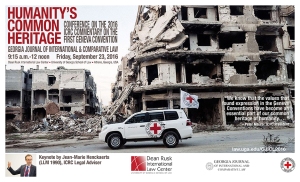
Humanity’s Common Heritage – norms codified in international humanitarian law treaties to which all countries of the world belong – will be the topic of a conference this Friday, September 23, at the University of Georgia School of Law in Athens, Georgia.

The conference title derives from this observation about those treaties, the four 1949 Geneva Conventions, by Peter Maurer, President of the International Committee of the Red Cross:

“We know that the values that found expression in the Geneva Conventions have become an essential part of our common heritage of humanity, as growing numbers of people around the world share a moral and legal conviction in them. These contradicting realities challenge us to act: to react to the suffering and violations of the law, and to prevent them from occurring in the first place.”

At the core of this daylong event will be the Commentaries on which the ICRC is now working. Published online earlier this year was the initial Commentary, covering the Convention (I) for the Amelioration of the Condition of the Wounded and Sick in Armed Forces in the Field, as well as the articles common to all 4 Conventions. (Prior posts here, here, and here.) Experts will examine this 2016 Commentary and its role in the development, promotion, and implementation of contemporary international humanitarian law.

thumbnail_p1130913We’re honored that the Georgia Law alumnus leading that project, Geneva-based ICRC legal adviser Jean-Marie Henckaerts (LLM 1990), will keynote our conference, and also that the ICRC is cosponsoring the conference, along with our Center and our Georgia Journal of International & Comparative Law. This student-run review, which celebrates its 45th anniversary this year, will publish papers by the assembled experts and Georgia Law student rapporteurs.

akandeDr. Henckaerts will be part of a public panel from 9:15 a.m.-12 noon in Georgia Law’s Hatton Lovejoy 0042401-14ABCourtroom. Speaking in that morning session will be: Oxford Law Professor Dapo Akande; Emory Law Professor Laurie R. Blank; Major-General Blaise Cathcart, Judge Advocate General of the Canadian Armed Forces; New York University Law Professor Ryan Goodman; and cathcartmoderator Diane Marie ryan_goodman_photo_horizontalAmann, Associate Dean for International Programs & Strategic Initiatives and Emily & Ernest Woodruff Chair in International Law at Georgia Law, and also the International Criminal Court Prosecutor’s Special Adviser on Children in & affected by Armed Conflict.

Joining them in closed sessions during the afternoon will be additional international humanitarian law experts experts: Georgia Law Professor Harlan G. Cohen; Houston College of Law Professor Geoffrey S. Corn; American University Law Professor Jennifer Daskal; Jonathan Davis, a University of Georgia international affairs graduates and U.S. Department of State Attorney-Advisor; Kathleen A. Doty, our Center’s Director of Global Practice Preparation; Julia Grignon, Université Laval Law; Rutgers Law Professor Adil Haque; Christopher Harland, Legal Adviser at the ICRC’s Washington, D.C., office; Eric Jensen, U.S. Department of Defense; Michael Meier, U.S. Army Judge Advocate General Corps; Naz K. Modirzadeh, Harvard Law; Nicholas W. Mull, U.S. Marine Corps Judge Advocate General Corps (ret.); Vanderbilt Law Professor Michael A. Newton; Sasha Radin, U.S. Naval War College; Professor James K. Reap (JD 1976) of the University of Georgia, who’s just been named to the State Department’s Cultural Property Advisory Committee; Georgia State Law Professor Shana Tabak; and Creighton Law Professor Sean Watts.

Full description and details about the conference here.

Georgia Law Professor Milot calls on global drugs regulators to focus on athlete health, not punishment

Milot profileSports doping is much in the news with the start of the Olympics and Paralympics at Rio de Janeiro, Brazil. Numerous commentators call for stricter regulations; staking out a different position is Georgia Law Professor Lisa Milot, formerly a high-level junior cyclist and now a scholar on law and performance-enhancing drugs. In a Vice Sports article by Patrick Hruby entitled “The Drugs Won: The Case for Ending the Sports War on Doping,” Milot says:

“Athletes are risk-takers. There’s no way to get to the international level of sports without being willing to put your body on the line on a regular basis.”

The article discusses Milot’s position, advanced in her 2014 article “Ignorance, Harm, and the Regulation of Performance-Enhancing Substances,” published in the Harvard Journal of Sports & Entertainment Law. She argues that regulators should concentrate on reducing the harm from substances, rather than banning them altogether. She tells Hruby:

“What we should be doing now is gathering information in order to understand how these substances work on healthy bodies. Focusing on that, rather than punishment.”

On punishment, current news indicates that even international organizations charged with regulating global sports appear to disagree:

► The Montreal-based World Anti-Doping Agency, “established in 1999 as an international independent agency composed and funded equally by the sport movement and governments of the world,” issued a report calling for a blanket ban on Russian athletes at the Olympic Games, which opened Friday and go through August 21.

► The International Olympics Committee, the 122-year-old organization headquartered in Lausanne, Switzerland, has taken a much more measured approach, banning some but by no means all such athletes.

► The International Paralympic Committee, based in Bonn, Germany, banned Russia’s team en masse from its event, set to begin on September 7, no long after the Olympic Games wrap up.

► Meanwhile, athletes from a host of countries have been cited for positive drug tests, or tarred with suspicion that their achievements have been chemically enhanced.

This tangle makes both Hruby’s article and Milot’s scholarship must-reads.