GJICL publishes “Children and International Criminal Justice” issue

gjicl43_3

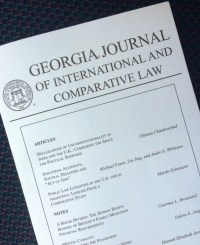
Very pleased to announce that papers from a Georgia Law conference “Children & International Criminal Justice” have just been published by our Georgia Journal of International & Comparative Law.

The conference was cosponsored by Dean Rusk International Law Center and the Georgia Law Project on Armed Conflict & Children, as well as the university’s African Studies Institute, the Planethood Foundation, and the American Society of International Law-Southeast.

About 2 dozen experts came to Athens, Georgia, from as far as Doha and Kinshasa, to discuss the topic at hand. In so doing, they assisted in the preparation of the International Criminal Court Office of the Prosecutor Policy on Children. As detailed in recent posts, available here and here, the public comment period for the draft of that Policy continues through August 5, 2016, with launch of the final document set for mid-November.

bensouda_me2_28oct14cropA keynote speech by ICC Prosecutor Fatou Bensouda (at right) highlighted our conference, and the text of her speech headlines the edition. Other writings link the work of the ICC to the 1989 Convention of the Rights of the Child, examine the experiences of children in armed conflict and similar situations. Student rapporteurs’ accounts of expert breakout sessions additionally treat a range of issues. All these papers contributed significantly to the Policy process.

The edition concludes with students’ notes apart from the conference; one of these, for which I was honored to serve as faculty adviser, examines the issue of child marriage.

Here, in full, is the table of contents for Volume 43, issue 3, with PDF links to each article:

Children and International Criminal Justice Conference

“Convening Experts on Children and International Criminal Justice,” by yours truly, Diane Marie Amann (above, at left), Associate Dean for International Programs & Strategic Initiatives and Emily & Ernest Woodruff Chair in International Law, and also Prosecutor Bensouda’s Special Adviser on Children in & affected by Armed Conflict

“Children and International Criminal Justice,” by Fatou Bensouda (above, at right), Prosecutor of the International Criminal Court

malone“Maturing Justice: Integrating the Convention on the Rights of the Child into the Judgments and Processes of the International Criminal Court,” by Linda A. Malone (right), Marshall-Wythe Foundation Professor of Law and Founding Director of the Human Security Law Center, William & Mary Law School

drumblm“Children, Armed Violence and Transition: Challenges for International Law & Policy,” by Mark Drumbl (left), Class of 1975 Alumni Professor of Law and Director of the Transnational Law Institute at Washington & Lee University School of Law

“Child Protection in Times of Conflict and Children and International Criminal Justice,” by Kerry L. Neal neal(right), Child Protection Specialist, Justice for Children, UNICEF, New York

“Expert Workshop Session: Regulatory Framework,” by Ashley Ferrelli, Eric Heath, Eulen Jang, and Cory Takeuchi (all Georgia Law graduates, who were members of GJICL)

“Expert Workshop Session: Child Witnesses: Testimony, Evidence, and Witness Protection,” by Chelsea Swanson, Elizabeth DeVos, Chloe Ricke, and Andy Shin (now Georgia Law graduates, all then were members of GJICL)

“Expert Workshop Session: The Global Child,” by Haley Chafin, Jena Emory, Meredith Head, and Elizabeth Verner (all Georgia Law graduates, who were members of GJICL)

Student Notes

“Changing the Game: The Effects of the 2012 Revision of the ICC Arbitration Rules on the ICC Model Arbitration Clause for Trust Disputes,” by Colin Connor

“Water, Water Everywhere, But Just How Much is Clean?: Examining Water Quality Restoration Efforts Under the United States Clean Water Act and the United States-Canada Great Lakes Water Quality Agreement,” by Jill T. Hauserman

“REACHing for Environmental and Economic Harmony: Can TTIP Negotiations Bridge the U.S.-EU Chemical Regulatory Gap?,” by Ashley Henson

“Child Marriage in Yemen: A Violation of International Law,” by Elizabeth Verner

(Cross-posted from Diane Marie Amann)

Henckaerts on “Locating the Geneva Conventions Commentaries in the international legal landscape”

Jean-Marie-HenckaertsIt is an honor to publish a post by our distinguished alumnus, Dr. Jean-Marie Henckaerts (LLM 1990). Based in Geneva, he is Legal Adviser in the Legal Division of the International Committee of the Red Cross and Head of the project to update the Commentaries on the 1949 Geneva Conventions and the Additional Protocols of 1977. We posted on the launch of the Commentary to the 1st Convention back in March, and are pleased to announce that on September 23, we’ll host an experts’ conference examining that volume. Proceedings to be published in our Georgia Journal of International & Comparative Law, for which Dr. Henckaerts served as Associate Editor while a Georgia Law student. We republish his post today courtesy of 3 blogs cosponsoring a series of posts on the topic, Opinio Juris, Intercross, and Humanitarian Law & Policy. Dr. Henckaerts writes:
Norms of international law develop through the adoption of treaties or through the formation of customary rules based on State practice and opinio juris. The treaty rules of international humanitarian law (IHL) are first and foremost contained in the Geneva Conventions and their Additional Protocols. In parallel, a body of customary rules govern the conduct of armed conflicts today. In 2005, the ICRC released a Study aimed at identifying customary IHL rules; it formulated 161 rules of IHL which have achieved, according to State practice compiled by the ICRC, customary status.

The ICRC Commentaries, like other commentaries, purport to clarify the meaning of treaty rules in order to facilitate their implementation: they are concerned with norm interpretation as opposed to norm identification. All laws, no matter how detailed they are, have to be interpreted when being applied. International treaties, such as the Geneva Conventions, are no different. A commentary’s purpose is to offer such interpretations and indicate where a question is not entirely settled. By their nature, they cannot amend the law.

Because the 1949 Geneva Conventions were drafted in such a way as to make them easily comprehensible by belligerents, their rules already offer a degree of specificity and practicality – see the detailed rules governing the protection of prisoners of war in the Third Convention. Yet, the scope or meaning of some of their provisions may also require further clarification – see the lack of detail governing the Conventions’ scope of application. Time had come to provide an up-to-date interpretive guide to the Conventions, to better address today’s humanitarian challenges.

Applying the rules on treaty interpretation to the Geneva Conventions

According to the 1969 Vienna Convention on the Law of Treaties, a treaty must be interpreted

“in good faith in accordance with the ordinary meaning to be given to the terms of the treaty in their context and in the light of its object and purpose”

(Art. 31(1)). The ‘object and purpose’ of the Conventions to respect and protect those affected by armed conflict while taking into consideration military necessity, has been a constant and leading compass throughout the research and drafting of the new Commentary on the First Geneva Convention (GCI). The ‘context’ to be considered for treaty interpretation comprises not only the text of the treaty, but also its preamble and annexes. As a supplementary means of interpretation (Art. 32), the preparatory work has been particularly important, when no recent practice on a topic could be found.

The Vienna Convention also reflects and foresees the need to take account the passing of time when interpreting treaties. Art. 31(3) provides that recourse may be had to

“subsequent practice in the application of the treaty which establishes the agreement of the parties regarding its interpretation”.

Other subsequent practice – for example conduct by one or more (but not all) Parties in the application of the treaty after its conclusion – may also be relevant as a supplementary means of interpretation. The weight of such practice may depend on its clarity and specificity, as well as its repetition. In the case of the Geneva Conventions, such practice – identified for example through military manuals, national legislation, case-law, reports of practice and official statements – has proved particularly useful in confirming or determining the meaning of a rule. ICRC experience and scholarly writings have also proved useful in informing the interpretation of the Conventions.

Pursuant to Art. 31(3) of the Vienna Convention, the Commentary also took into account other

“relevant rules of international law applicable in the relations between the parties”.

These include customary IHL and the three Additional Protocols, as well as other relevant branches of international law. In particular, human rights law, international criminal law and refugee law were still in their infancy when the Pictet commentary was being drafted but they have grown significantly in the meantime. In this regard, the development of case-law from international courts and tribunals since the 1990s also had to inform an up-to-date interpretation of IHL treaty rules.

An ICRC Commentary, resulting from a collaborative process

Where does the legitimacy of the ICRC to interpret the Conventions stem from? First, the ICRC benefits from a legal legitimacy as guardian and promoter of IHL, a role it was formally entrusted with by the international community through the Statutes of the International Red Cross and Red Crescent Movement, adopted by all States parties to the Geneva Conventions. Ensuring a coherent interpretation of the law is essential to enhance respect for it, and hence is at the core of the ICRC mandate. Second, the ICRC possesses an operational legitimacy, drawing from more than 150 years of experience in assisting and protecting those affected by armed conflicts, but also in engaging with weapon bearers to promote and disseminate IHL. Third, throughout the years, the ICRC has accumulated knowledge in material form: the ICRC archives have documented the practice of State and non-State actors, as well as its own. This wealth of experience and access to these materials sets the ICRC in a unique position to capture interpretations of IHL treaty rules.

At the same time, the updated Commentaries are far from an exclusively “ICRC” product. While they have been commissioned by the institution and edited by its staff lawyers, and include ICRC interpretations, they also incorporate an unprecedented level of external inputs, both in terms of process and substance. The Commentaries are the result of a collaborative process, involving external contributors as authors and reviewers. This allowed the new Commentary to take into account a wide range of perspectives, from different parts of the world, and to reflect main diverging views.

I am convinced that continuous efforts to interpret the law in a coherent manner is essential to ensure that the humanitarian spirit of the Geneva Conventions is carried forward into today’s conflicts. It is the ICRC’s hope that the new Commentaries will, like the Pictet Commentary, be a leading interpretative compass; but its ultimate authority will depend on its quality and relevance for practitioners and academics. The updated Commentaries should not be seen as the final word on the meaning of IHL treaty provisions, but rather as a picture of how the rules are interpreted today, and a contribution to continuing efforts to refine our understanding of the law and how it can best mitigate the effects of contemporary armed conflicts.

syria-crisis-1140x620

View of destruction in downtown Homs, Syria; photo courtesy of International Committee of the Red Cross. ©Jerome Session/Magnum Photos for ICRC

A world of issues addressed in new edition of Georgia Journal of International & Comparative Law

IMG_1031Four more than 4 decades, important articles on international, transnational, and comparative law and policy have found a publication home at Georgia law’s Georgia Journal of International and Comparative Law. Volume 43 Issue 2, the latest edition of GJICL, has just been released and is available online.

The volume begins with three articles, by five scholars from Asia, Europe, and South America:

31th_chintan

Declarations of Unconstitutionality in India and the U.K.: Comparing the Space for Political Response, by Chintan Chandrachud (left), candidate for Ph.D. in Law, University of Cambridge, England

faureIndustrial Accidents, Natural Disasters and “Act of God”, by: Professor Michael Faure (right), Professor of Comparative & International Environmental Law at Maastricht University’s Maastricht European Institute for Transnational Legal Research and Professor of Comparative Private Law & Economics at the Rotterdam Institute of Law and Economics, Erasmus liuSchool of Law, both in the Netherlands; Dr. Liu Jing (left), postdoctoral researcher in Research Institute of Environmental Law, School of Law, Center of Cooperative Innovation for Judicial Civilization, Wuhan University, China, and Behavioral Approach of Contract & Tort at Erasmus andriUniversity Rotterdam; and Dr. Andri Wibisana (right), Lecturer at the Faculty of Law Universitas Indonesia in Jakarta

oynPublic Law Litigation in the U.S. and in Argentina: Lessons From A Comparative Study, by Professor Martín Oyhanarte (left), Professor of Law at Universidad Austral and Universidad del Salvador  in Buenos Aires, Argentina

Three Notes, by alums who received their Georgia Law J.D.s in 2015, also appear in the volume:

broussardA House Divided: The Human Rights Burden of Britain’s Family Migration Financial Requirements, by Courtney L. Broussard (right), Staff Attorney, U.S. Court of Appeals for the Eleventh Circuit

jangMental Capacity: Reevaluating the Standards, by Eulen E. Jang (left), PSJD Fellow, National Association for Law Placement, Washington, D.C.

jarrellsHistory, TRIPS, and Common Sense: Curbing the Counterfeit Drug Market in Sub-Saharan Africa, by Hannah Elizabeth Jarrells (right), Associate Attorney at the Atlanta law firm of Ferrer Poirot Wansbrough Feller Daniel & Abney
Global legal research online at SSRN

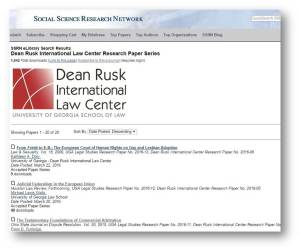
ssrn_shadowAs 2015-16 nears its close, we mark one of the new partnerships on which we embarked this academic year. In October, we began posting news of our scholarship at the Dean Rusk International Law Center Research Papers, a series in the vast Legal Scholarship Network of SSRN, the Social Science Research Network.

Our series highlights scholarly production at the University of Georgia Law, including writings by Georgia Law faculty and Center staff, as well as works appearing in our Georgia Journal of International & Comparative Law and other publications. All the contributions discuss issues of international, comparative, transnational, and foreign affairs law and policy. The series thus augments the decades-old tradition by which the Dean Rusk International Law Center serves Georgia Law’s nucleus global research, education, and service.

Among the works published to date:

► The Testamentary Foundations of Commercial Arbitration, 30 Ohio State Journal on Dispute Resolution (2015), by Dean Peter B. “Bo” Rutledge

► The Death of Deference and the Domestication of Treaty Law, Brigham Young University Law Review (forthcoming), by Professor Harlan Grant Cohen

► Judicial Federalism in the European Union, Houston Law Review (forthcoming), by Professor Michael Lewis Wells

Enforcing Immigration Equity, 84 Fordham Law Review 661 (2015), by Professor Jason A. Cade

A Hitchhiker’s Guide to the OECD’s International VAT/GST Guidelines, 18 Florida Tax Review 589 (2016), by Professor Walter Hellerstein

► Securing Child Rights in Time of Conflict, ILSA Journal of International & Comparative Law (forthcoming), by Associate Dean Diane Marie Amann

Toward Peace with Justice in Darfur: A Framework for Accountability, 18 U.C. Davis Journal of International Law and Policy 1 (2011), by Kathleen A. Doty, our Center’s Associate Director for Global Practice Preparation

View the papers are available online here or, even better, receive new postings through e-mail distribution by subscribing here.

D.C. bound, for ASIL Annual Meeting

SONY DSC

Students, faculty, and staff at Georgia Law are heading this week to Washington, D.C. – members and Academic Partner of the American Society of International Law, bound for ASIL’s 110th Annual Meeting.

It’s always a special time of year for us at the Dean Rusk International Law Center, given our long tradition with the Society – not least because Louis B. Sohn, our inaugural Emily & Ernest Woodruff Chair in International Law, served as an ASIL President. In his honor, the Center has awarded Louis B. Sohn Professional Development Fellows to our 1 LLM, 1 MSL, and 3 JD students who will volunteer at the meeting. They’re pictured above, standing tall with the portrait of Professor Sohn which overlooks our Center’s Louis B. Sohn Library on International Relations.  The Sohn Fellows are, from left, Hannah Mojdeh Williams, Victoria Aynne Barker, Katherine Nicole Richardson, Deborah Nogueira Yates, and Bradley C. Bowlin.

Also ASIL bound are:

copydianeDiane Marie Amann, Georgia Law’s Associate Dean for International Programs & Strategic Initiatives, current holder of the Emily & Ernest Woodruff Chair in International Law, and a former Vice President of the Society. Amann, who leads our Center, will take part in a panel discussion of the new International Committee of the Red Cross Commentary on the First Geneva Convention at 2 p.m. Wednesday, March 30. Her talk is a forerunner to a planned Georgia Journal of International & Comparative Law conference on the Commentary, to be held on Friday, September 23, 2016.

????????????????????????????????????

► Georgia Law Professor Harlan Cohen, who serves on ASIL’s Executive Council and as Managing Editor of its AJIL Unbound.

SONY DSC

Kathleen A. Doty, our Center’s Associate Director for Global Practice Preparation, and a past Attorney-Editor at ASIL. Formerly an attorney in the Office of the General Counsel, U.S. Department of the Navy, Doty also serves as Chair of ASIL’s Nonproliferation, Arms Control, and Disarmament Interest Group, also known as NACDIG. In that capacity, she’ll be moderating a panel entitled The Emergence of Cyber Deterrence: Implications for International Law, from 11 a.m. to 12:30 p.m. on Thursday, March 31. Speakers will be Gary Brown, Professor of Cyber Security at the Marine Corps University; Jonathan E. Davis, Attorney-Adviser, Office of the Legal Adviser, U.S. Department of State; and Tara McGraw Swaminatha, Of Counsel at the Washington office of DLA Piper LLP. Here’s the panel description, as set out at page 37 of the Annual Meeting Program:

“Military and civilian policymakers increasingly stress the importance of deterring other nations from engaging in computer network exploitation and attacks against the United States. Resulting from the behavior of China, Iran, and North Korea respecting offensive cyber capabilities, deterrence features prominently in the new Department of Defense cyber strategy, the response of the Obama administration to high profile attacks, and the Congressional debate around cyber issues. This panel will explore the emergence of cyber deterrence, and new trends in cyber security generally, as they relate to international law. Some important areas of concern include: how the emphasis on deterrence might affect the law on State responsibility, non-intervention, counter-measures, and the use of force; whether moving to strengthen cyber deterrence requires changing the permissive nature of international law on espionage; what new norms might be needed to support and stabilize cyber deterrence, such as confidence-building measures, arms control rules, and norms on escalation control; and how the emergence of cyber deterrence might affect other cyber issues important in international law, including Internet governance, digital commerce, and human rights. The session will also analyze what international legal lessons might be learned from nuclear and non-nuclear contexts where States have adopted deterrence strategies.”

See you there!