UGA Professor Ramnath discusses book, “Boats in a Storm: Law, Migration, and Decolonization in South and Southeast Asia, 1942–1962” at law school

Kalyani Ramnath, Assistant Professor in the Department of History at the Franklin College of Arts & Sciences and Assistant Professor (by courtesy) at the University of Georgia School of Law, recently discussed her first book (detailed in previous post here) at an event organized by the Dean Rusk International Law Center. Joining Ramnath in conversation about Boats in a Storm: Law, Migration, and Decolonization in South and Southeast Asia, 1942–1962 (Stanford University Press, 2023) were Diane Marie Amann, Regents’ Professor, Emily & Ernest Woodruff Chair in International Law, and Co-Director of the Dean Rusk International Law Center, and Laura Phillips-Sawyer, Jane W. Wilson Associate Professor in Business Law.

Below is a description of Ramnath’s book:

Drawing on archival materials from India, Sri Lanka, Myanmar, London, and Singapore, Kalyani Ramnath narrates how former migrants battled legal requirements to revive prewar circulations of credit, capital, and labor, in a postwar context of rising ethno-nationalisms that accused migrants of stealing jobs and hoarding land. Ultimately, Ramnath shows how decolonization was marked not only by shipwrecked empires and nation-states assembled and ordered from the debris of imperial collapse, but also by these forgotten stories of wartime displacements, their unintended consequences, and long afterlives.

Ramnath received her Ph.D. in history from Princeton University in 2018, and was a Prize Fellow in Economics, History, and Politics at the Center for History and Economics at Harvard University from 2018 – 2021. She also holds a bachelor’s degree in arts and law (B.A., LL.B. (Hons.) (JD equivalent) from the National Law School of India University (NLSIU) and a master’s degree in law (LL.M.) from the Yale Law School.
UGA Law Professor Bruner presents “Managing Fraud Risk in the Age of AI” at the National University of Singapore (NUS)

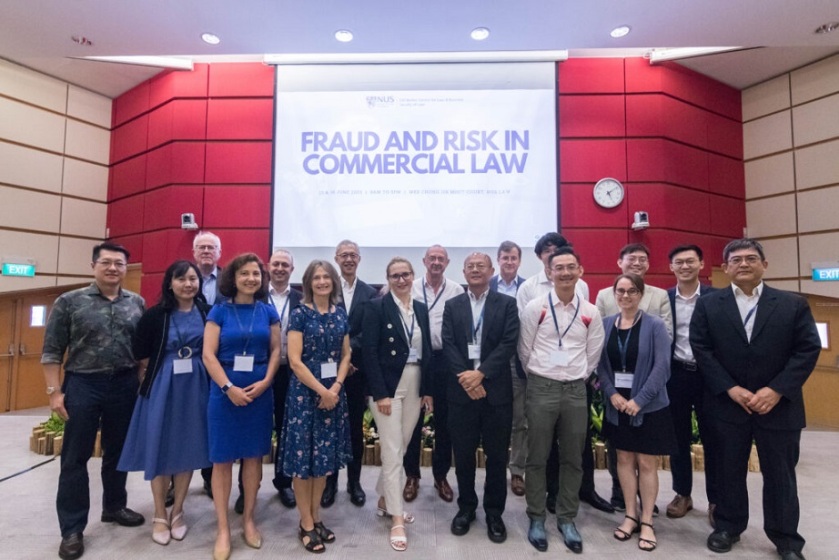
Professor Christopher Bruner, the Stembler Family Distinguished Professor in Business Law and a newly appointed Faculty Co-Director of the Dean Rusk International Law Center, presented “Managing Fraud Risk in the Age of AI” at the National University of Singapore (NUS) in June.

Bruner’s talk was part of a conference titled Fraud and Risk in Commercial Law, organized by Professors Paul Davies (University College London) and Hans Tjio (NUS) and hosted by the EW Barker Centre for Law & Business at the NUS Faculty of Law.

Below is Bruner’s presentation abstract:

Artificial Intelligence (AI) applications are widely expected to revolutionize every dimension of business. This paper explores current and potential impacts of AI on corporate management of fraud risk in both operational and compliance contexts. Much attention has been paid to the operational efficiencies that AI applications could enable in numerous industry settings, and such systems have already become central to a range of services in certain industries – notably finance. Heavy reliance on algorithmic processes can be expected to give rise, however, to a range of risks, including fraud risks. New forms of internal fraud risk, emanating from intra-corporate actors, as well as external fraud risk, emanating from extra-corporate actors, are already placing greater demands on the compliance function and requiring greater corporate investment in responsive AI capacity to keep pace with the evolving risk management environment. At the same time, these developments have already begun to prompt reevaluation of conventional legal theories of fraud that took shape, in commercial and financial contexts alike, by reference to human actors, as opposed to algorithmic processes.

The paper begins with an overview of growing operational reliance upon increasingly sophisticated AI applications across various industry settings, reflecting the increasingly data-intensive nature of modern business. It then explores forms of internal and external fraud risk that may arise from efforts to exploit weaknesses in operational AI, which efforts may themselves involve sophisticated deployment of malicious extra-corporate AI applications – ‘offensive AI’, as the cyber security industry describes it. This can in turn be expected to require responsive corporate efforts in the form of ‘defensive AI’, and the paper describes burgeoning efforts along these lines, as well as the increasing pressure to devote substantial resources and managerial attention to these dynamics that may arise from both corporate law and commercial realities. Finally, the paper analyzes shortcomings of conventional legal theories of fraud in this context. Here the paper assesses the difficulty of applying concepts such as deception, scienter, reliance, and loss causation to algorithmic processes lacking conventional capacity for intentionality and defying conventional explanation as to how inputs and outputs logically relate – a reflection of the AI ‘black box’ problem. The paper concludes with proposals to reform corporate oversight duties to incentivize managerial attention to these issues, and to reform conventional legal theories of fraud to disincentivize malicious AI applications.

New Cambridge corporate law, governance, and sustainability handbook coedited by Georgia Law Professor Christopher Bruner

Cambridge University Press has just published a handbook co-edited by Professor Christopher Bruner, the Stembler Family Distinguished Professor in Business Law here at the University of Georgia School of Law.

Entitled The Cambridge Handbook of Corporate Law, Corporate Governance and Sustainability, the 700-plus-page book consists of 50 chapters, by 60 contributors from around the world.

Bruner and his co-editor, Professor Beate Sjåfjell of the University of Oslo in Norway, wrote the introduction and conclusion, which establish the conceptual framing for the project, and each also contributed substantive chapters. Bruner’s is chapter 36, “Leaders or Laggards? Corporate Sustainability In Hong Kong And Singapore.”

The book received some strong endorsements, including from senior officials in the European Commission; the Executive Director of the Aspen Institute’s Business & Society Program; a world-leading climate scientist; and prominent law and business scholars from around the world. It features forewords by Mervyn King, an emeritus professor and judge in South Africa who is a global leader in sustainability-oriented reporting, and Vanderbilt Law Professor Margaret Blair, an economist and co-author of one of the more prominent theories of corporate governance.

The Handbook is available here.

Georgia Law Professor Christopher Bruner takes part in financial regulation conference in Singapore

Christopher Bruner, Stembler Family Distinguished Professor in Business Law here at the University of Georgia School of Law, took part in two panels at a conference entitled “Financial Services Law and Regulation in Singapore.” Hosting the February 28-March 1 conference was the Centre for Banking & Finance Law at the National University of Singapore Faculty of Law.

On the conference’s 1st day, Bruner presented on “Development of Financial Services in a Globalising Financial World,” focusing his remarks on the framework developed in his 2016 Oxford University Press book, Re-Imagining Offshore Finance. (prior post). Bruner also participated in the reflections panel that concluded the conference.

Occasioning the conference was the the publication of Financial Services Law and Regulation (Academy Publishing, 2019), edited by Dora Neo, Hans Tjio, and Luh Luh Lan, and featuring Singapore-based contributors. Professor Bruner and others from abroad provided global and comparative context.

Georgia Law Professor Bruner, Cambridge corporate governance book co-editor, presents at Oslo conference

Professor Christopher M. Bruner took part last week in a Norway conference leading to a new Cambridge University Press book he is co-editing.

Bruner, who is J. Alton Hosch Professor of Law at the University of Georgia School of Law and member of our Dean Rusk International Law Center Council, together with his co-editor, University of Oslo Law Professor Beate Sjåfjell, introduced, moderated, and concluded the symposium for the Cambridge Handbook of Corporate Law, Corporate Governance and Sustainability (forthcoming 2019).

Bruner also presented a draft chapter, on Hong Kong and Singapore.

The symposium, which brought together scholars from around the world who were invited to contribute to the Handbook following a competitive call for papers, was held at the University of Oslo Faculty of Law March 12-14.