Georgia Law Appellate Litigation Clinic secures final relief for client in case invoking Convention Against Torture

The U.S. Board of Immigration Appeals has granted relief to the petitioner in Arellano Herrera, a case on which the Appellate Litigation Clinic at the University of Georgia School of Law has worked for over two years.

As detailed in prior posts here and here, in September 2020, Georgia Law students in the Clinic briefed and argued the case, Arellano Herrera v. Barr, to a panel of the U.S. Court of Appeals for the Ninth Circuit. Their argument turned on the non-refoulement, or non-return, obligations the United States took on when it ratified the 1984 Convention Against Torture, or CAT. Two months later, the appellate court held that the Board of Immigration Appeals incorrectly had applied the clear error standard when reversing the Immigration Judge’s decision to grant petitioner’s request for withholding of removal.

Subsequently, on remand before the Board of Immigration Appeals, the Clinic argued that the Immigration Judge did not clearly err in findings key to the CAT-based claim:

  • 1st, that if returned to Mexico, the petitioner would more likely than not be tortured by cartel members, with the acquiescence of one or more public officials; and
  • 2d, it would be unreasonable to expect the petitioner to relocate within Mexico in order to avoid that torture.

A Board of Immigration Appeals panel has just agreed, thus reinstating the Immigration Judge’s original decision and, as a result, finally affording the petitioner the relief she long had sought.

The Clinic team included 3 students, since graduated from Georgia Law: Jason N. Sigalos, Mollie M. Fiero and John Lex Kenerly IV. They worked under the supervision of Thomas V. Burch, the Clinic’s Director, and Anna White Howard, the Clinic’s Counselor in Residence.

Dean Rusk International Law Center hosts “International Law and the Ukraine-Russia Conflict,” featuring Georgia Law Professors Amann, Cohen, and Durkee

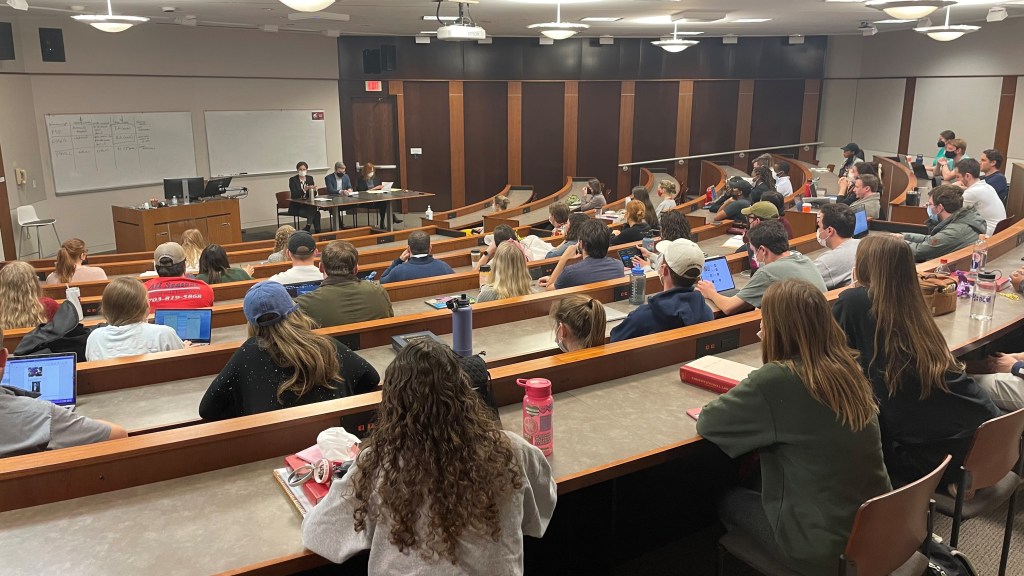
Nearly a hundred members of the University of Georgia School of Law community took part Wednesday in “International Law and the Ukraine-Russia Conflict,” a forum hosted by our Dean Rusk International Law Center and presented by three international law experts on the law school’s faculty.

The armed conflict began on February 24, 2022, when Russian military troops invaded the neighboring state of Ukraine, entering the latter country at points on its northern, eastern, and southern borders. At this writing just a week later, thousands of persons, civilians and combatants alike, reportedly had been killed, and, according to UN High Commissioner for Refugees Filippo Grandi, more than a million Ukrainians had been forcibly displaced.

At Wednesday’s forum, each of the three Georgia Law professors first offered a brief overview of a particular aspect of the armed conflict:

  • Our Center’s Director, Melissa J. “MJ” Durkee, who is also Associate Dean for International Programs and Allen Post Professor, began by outlining the international rules that have outlawed aggressive war – that is, one country’s unjustified invasion of another – since the adoption of the 1945 Charter of the United Nations. She explained why reasons that Russia has put forward do not constitute legally valid justifications for the invasion, and further emphasized the threat that Russia’s actions place on the international rules-based order that came into being after the Allied victory in World War II. In so doing, Durkee cited a UN General Assembly resolution, adopted Wednesday by a huge majority of votes, which condemned Russia’s actions as violative of this order.
  • Next came Harlan Grant Cohen, who is Gabriel M. Wilner/UGA Foundation Professor in International Law and one of our Center’s 2 Faculty Co-Directors. Cohen focused on economic sanctions that have been levied against Russia in the last week, by individual countries including the United States and also by international organizations including the European Union. While noting that these types of economic actions had been developed in response to Iran’s nuclear program, Cohen stressed that the extent and impact of the sanctions already imposed against Russia is unprecedented.
  • Then followed our Center’s other Faculty Co-Director, Diane Marie Amann, who is also Regents’ Professor of International Law and Emily & Ernest Woodruff Chair in International Law. She addressed international humanitarian law, the body of law concerned with the ways that armies and armed groups actually conduct the war. She underscored that this body of law concerns itself with all sides of the conflict, regardless of who started the conflict: fighters on either side may be found liable for violations, and thus charged with war crimes. Amann concluded with a look at forums already engaged to review legal issues arising out of the war, among them the European Court of Human Rights, International Criminal Court, and International Court of Justice.

The forum concluded with a lively and wide-ranging question-and-answer period.

Georgia Law team places 2d in US championship, preparing for upcoming international rounds in Jessup Moot

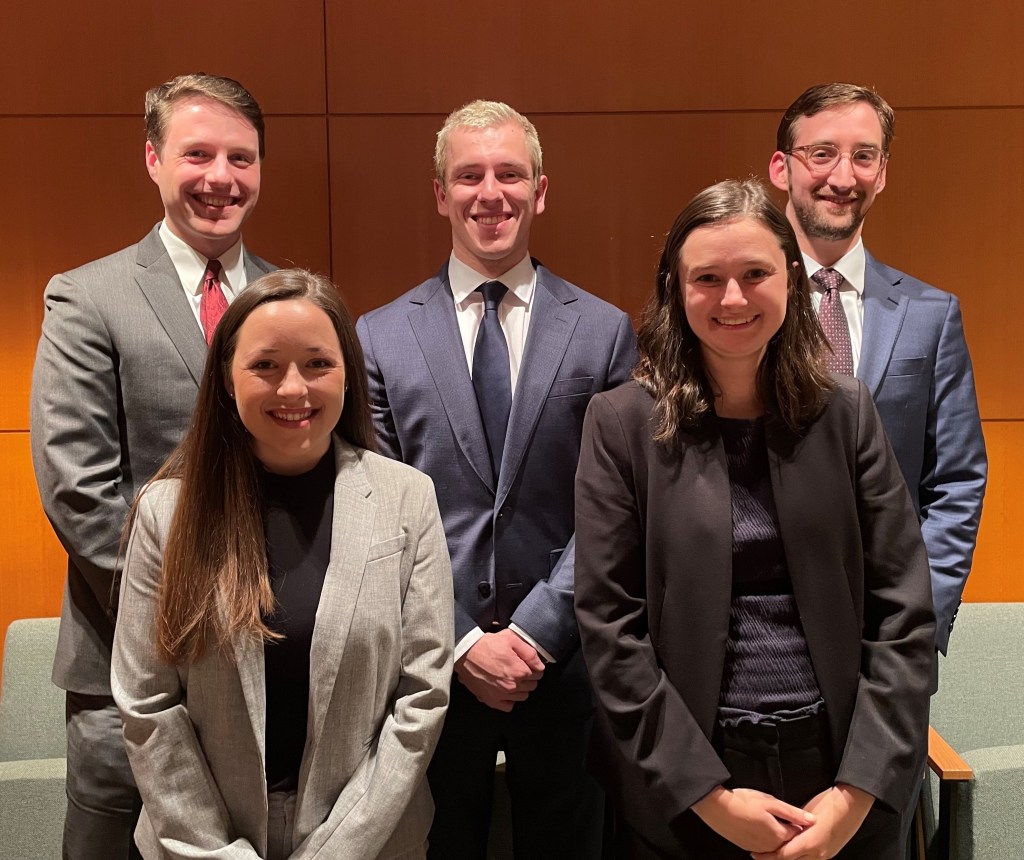
Proud to announce that a team of talented University of Georgia School of Law students competed Sunday in the US National Championship of the Philip C. Jessup International Law Moot Court Competition. Although it lost to Harvard after having defeated many others among the 84 American teams that competed, the team’s success earned it an invitation to compete in the International Rounds set to begin in late March.

The team members are 2Ls Millie Price, Courtney Robinson, Caleb Grant, James Stewart, and Alex Krupp (pictured above, clockwise from lower right). Robinson won recognition as the 4th best overall oralist, and Stewart as the 14th best, in the US tournament. Leading the team were 3L coach Courtney Hogan and faculty advisor/coach Anna White Howard, both themselves former Jessup advocates.

The team benefited from moots and other assistance by many members of the Georgia Law community, including: Professor Melissa J. “MJ” Durkee, Associate Dean for International Programs and Director of the law school’s Dean Rusk International Law Center, and Professors Diane Marie Amann and Harlan Grant Cohen, the Center’s Faculty Co-Directors; Georgia Law Dean Peter B. “Bo” Rutledge; Kellie Casey, Director of Advocacy; Anne Burnett, Foreign and International Law Librarian; Professors Nathan S. Chapman, Rob McNiff, and Lori A. Ringhand; and alums, Judge Ben Cheesbro, Ellen Clarke, and Erik Chambers.

The Jessup is the world’s largest moot court competition, with upwards of 3,500 students, from more than a hundred countries, competing. Their teams prepare briefs and give oral arguments as if they were appearing before the International Court of Justice, the judicial arm of the United Nations which adjudicates international law disputes between sovereign nation-states. The Washington, D.C.-based International Law Students Association is the primary host, with the law firm of White & Case sponsoring the International Rounds as well as some national competitions.

Georgia Law coursework begins for inaugural class of students seeking Graduate Certificate in International Law

Graduate Certificate in International Law students tour Hirsch Hall at the University of Georgia School of Law Friday, in anticipation of the new semester beginning this week.

This New Year marks the arrival of the inaugural class of Graduate Certificate in International Law students here at the University of Georgia School of Law.

Through the initiative of the law school’s Dean Rusk International Law Center, postgraduate students from other disciplines within the university will earn this academic certificate following their successful completion, in classes alongside J.D., LL.M., and M.L.S. students, of fifteen credit hours chosen from among the law school’s rich comparative, transnational, and international law curriculum; courses include Public International Law, International Human Rights, International Trade Law, Immigration Law, International Law Colloquium, and Global Governance.

The seven students comprising the first class include:

  • Four doctoral students: from the School of Public and International Affairs, Alma Bajramović, a Ph.D. candidate who is researching conflict and conflict resolution, with a focus on the Balkans; from the Mary Frances Early College of Education, Leslyn Beckles, candidate for a Ph.D. in Learning, Leading, and Organization Development, whose research concentrates on women political leaders in the Caribbean; and from the Franklin College of Arts and Sciences, Isaac Torres, a Ph.D. candidate in Bioinformatics who examines artificial intelligence and statistical models to address complex biology problems, and Jasmine Underwood, a Ph.D. candidate in Sociology interested in gender, development and social change, and political sociology.
  • Three master’s students, all from the School of Public and International Affairs: Megan Gerken and Nelson Millan Nales, both pursuing Master of Public Administration degrees, and Michael Sway, a candidate for the Master of International Policy degree.

Details on application of and matriculation toward the Graduate Certificate in International Law are available here and by contacting the initiative’s administrator, Sarah Quinn, Associate Director for Global Practice Preparation at the Dean Rusk International Law Center, squinn[at]uga.edu.

Georgia Law 3L Davis Wright on his externship in Virginia: “My time at NATO helped me grow as an aspiring lawyer, law student, and person.”

Pleased today to welcome this post by University of Georgia School of Law student Davis Wright, who describes his just-completed his Fall 2021 externship in Norfolk, Virginia, in the legal department of HQ SACT, a leading unit of the North Atlantic Treaty Organization. This externship is administered by our law school’s Dean Rusk International Law Center in partnership with NATO Allied Command Transformation. Davis arrived at Georgia Law with a background in international relations and politics, having competed in Model United Nations and worked for a member of the Dáil Éireann. His experiences at Georgia Law have included service as a Dean Rusk International Law Center Student Ambassador and J.D.-to-LL.M. liaison. He is due to receive his J.D. degree this May, and then to begin practice as an Associate at the Atlanta office of Jones Day.

Working in the Office of the Legal Advisor at the North Atlantic Treaty Organization (NATO) Headquarters Supreme Allied Commander Transformation (HQ SACT) in Norfolk, Virginia, was an exciting and rewarding experience. In the time I was at HQ SACT I grew substantially, in personal, academic, and professional aspects.

Personal growth

During the time I spent at HQ SACT, I was exposed to a diverse range of ideas and people. While the Chief Legal Advisor at HQ SACT is American, there is a French Legal Advisor, a Dutch Legal Advisor, and a Turkish intern. All of these interactions were valuable to me as I was exposed to cultural and legal perspectives from their home nations. 

My interactions at the office likewise gave me exposure to a diverse set of views on a variety of topics, ranging from the insignificant, such as musical preferences, to the significant, such as views on the war in Afghanistan and NATO’s involvement in it. These new friendships, and sometimes deep discussions, helped me grow as a person and challenged my views and perspective of the world.

Academic growth

As one part of my externship at HQ SACT, I participated in a once-a-week seminar course with Georgia Law Professor Diane Marie Amann, who is a Faculty Co-Director of the Dean Rusk International Law Center. We discussed a variety of topics through weekly readings on different areas of international law. Highlights included the role of the legal advisor in armed conflict, rules of engagement, and immunities of international organizations in domestic courts. Most of these subjects were new to me, and the weekly seminar helped build my knowledge and challenge my perspective on different international legal issues.

I am especially pleased that I was encouraged to lead the discussions in this seminar and to select readings for subjects that I find of interest. This encouragement to be curious and take a leading role also helped me grow academically.

Professional growth

The experience at HQ SACT was completely new for me as I had never before worked in the national security sector or for an international organization. My time in the legal office was largely split into two categories, as follows:

  • Legal assistance: During the mornings I was assigned to legal assistance work. This is essentially all the support elements that the office provides to both civilian and military personnel at HQ SACT. This work varies depending on who walks through the door, but includes a large amount of immigration work.  These experiences provided me an appreciation of the multitude of legal issues that foreign personnel face during their time in the United States. Additionally, these experiences provided me valuable client interaction that will assist my future career.
  • Legal projects: In the afternoons I worked on projects for the legal advisors. These projects varied considerably. For example, I had the opportunity to work on an overhaul to the general terms and conditions throughout HQ SACT and its subordinate commands, and to research whether NATO information is protected under U.S. laws against espionage. These projects all challenged me and provided an opportunity to make a substantial impact during my time at HQ SACT.  

In short, my time at NATO helped me grow as an aspiring lawyer, law student, and person. I am sure I will use the experiences I have gained so far at NATO in my future career.

I am extremely grateful that the Dean Rusk International Law Center and the University of Georgia School of Law allowed me to partake in this unique experience. Specifically, I would like to thank the Center’s Associate Director for Global Practice Preparation, Sarah Quinn, and Professor Amann, for their valuable guidance. I would also like to thank everyone at HQ SACT, especially Theresa Donahue, Kathy Hansen-Nord, Monte DeBoer, Butch Bracknell, Mette Hartov, Vincent Grassin, and Muge Karatas.
Stockholm Declaration conference: link to video of Shelton keynote and panel on international environmental law’s future

This image has an empty alt attribute; its file name is panel3.png

A superb third panel and keynote speech concluded “The 1972 Stockholm Declaration at 50: Reflecting on a Half-Century of International Environmental Law” conference that we at the Dean Rusk International Law Center and the Georgia Journal of International and Comparative Law at the University of Georgia School of Law hosted on October 8.

Following on our prior posts outlining the first and second parts of our daylong conference, we’re pleased in this post to recap the final segment, video of which is available here. (The full series, meanwhile, is available here.)

It begins with the third panel of the conference, entitled “International Environmental Law’s Future,” and moderated by MJ Durkee, Associate Dean for International Programs, Director of the Dean Rusk International Law Center, and Allen Post Professor at Georgia Law (pictured above, middle right). Joining her were 4 panelists (pictured clockwise from bottom center): Lakshman D. Guruswamy, Nicholas Doman Professor of International Environmental Law at Colorado Law; Jutta Brunnée, Dean, University Professor, and James Marshall Tory Dean’s Chair at the University of Toronto Faculty of Law in Canada; Cymie Payne, Associate Professor in the Department of Human Ecology and the School of Law, Rutgers University; and Rebecca M. Bratspies, Professor and Director of the Center for Urban Environmental Reform at CUNY Law.

Together, they consider the part of Principle 1 of the Stockholm Declaration that declares:

“[Humankind] bears a solemn responsibility to protect and improve the environment for present and future generations.”

In light of that statement, panelists examined the major successes and failures of the last half-century of international environmental law, and, imagining a “2022 Stockholm Declaration,” they considered how to prioritize environmental protection efforts going forward.

Then follows “Stockholm Plus 50: Glass Half Full, Half Empty, or Shattered?,” the keynote address by Dinah L. Shelton, Manatt/Ahn Professor of International Law Emeritus at George Washington University School of Law. In it, Shelton sounds an urgent call to action to ensure protection from the worst effects of climate change, especially for the most vulnerable populations.

Kimberlee Styple, GJICL Editor-in-Chief, then delivers closing remarks.

Scholarly achievements, vibrant initiatives highlighted in newsletter of Dean Rusk International Law Center, University of Georgia School of Law

For a recap of the year’s research and global practice accomplishments, have a look at the just-published newsletter of the Dean Rusk International Law Center at the University of Georgia School of Law. Features include:

► Welcome to our new professor, Zohra Ahmed, as well as scholarly achievements of our Center Director, Melissa J. Durkee, and our many other globally minded faculty, including Diane Marie Amann, Christopher Bruner, Jason Cade, Harlan G. Cohen, Walter Hellerstein, Thomas Kadri, Jonathan Peters, Peter B. “Bo” Rutledge, and Laura Phillips Sawyer.

► The return of our International Law Colloquium in Spring 2022, a course featuring works-in-progress conversations with authors; this year’s edition will include international law scholars based in Latin America and Europe as well as the United States.

► Recent events, including our day-long conferences on international environmental law and on global healthcare governance cosponsored with the Georgia Journal of International & Comparative Law, our Consular Series of talks with diplomats, presentations by Visiting Scholars and other distinguished lawyers, our cohosting of International Law Weekend South with the American Branch of the International Law Association, and participation in panels at the American Society of International Law and other global meetings, as well as academic and civil-society roundtables.

Initiatives aimed at preparing our J.D. and LL.M. students for global legal practice, including our NATO Externship, our Global Externships, and the Global Governance Summer School we host in partnership with the Leuven Centre for Global Governance at Belgium’s University of Leuven, plus support for internationally minded students’ organizations, journal, and advocacy teams.

The full newsletter is here.

International lawyers, including several Georgia Law graduates, to speak Monday on “Careers in International Law”

We at the University of Georgia School of Law Dean Rusk International Law Center are honored to welcome a group of distinguished attorneys, including several of our graduates, for an online discussion of “Careers in International Law” from 12 noon to 1:30 p.m. this Monday, November 8.

David Hull (JD’84), who is a Partner at the Van Bael & Bellis law firm in Brussels, Belgium, will moderate a panel featuring:

  • H. Vincent Draa (JD’84), Of Counsel, Kochhar & Co. LLC in Chicago
  • Catherine Gordley, Senior Associate at Van Bael & Bellis
  • David Hegwood (JD’83), Senior Advisor for Global Engagement at the U.S. Agency for International Development, based in Rome, Italy

Together, they’ll lead a conversation on global legal practice in a variety of settings, including private law firms, corporate legal departments, and governmental organizations.

Register here to attend the careers session.

Stockholm Declaration conference: link for “Anti-Racism, Decolonization, Environmental Protection” panel video

This image has an empty alt attribute; its file name is panel2.png

High-level speeches and other events at COP26, the 26th UN Climate Change Conference of the Parties now under way in Glasgow, Scotland, underscores the timeliness of “The 1972 Stockholm Declaration at 50: Reflecting on a Half-Century of International Environmental Law” conference that we at the Dean Rusk International Law Center and the Georgia Journal of International and Comparative Law at the University of Georgia School of Law hosted on October 8.

And so, following on last week’s post outlining the first part of our daylong conference, we’re pleased in this post to recap the second segment, video of which is available here. (The full series, meanwhile, is available here.)

Featured in this segment is the day’s second panel, “Anti-Racism, Decolonization and Environmental Protection,” moderated by Harlan G. Cohen, Gabriel M. Wilner/UGA Foundation Professor in International Law and Faculty Co-Director of the Dean Rusk International Law Center at Georgia Law (pictured above, top right). Joining him were 4 panelists (pictured clockwise from middle right): Sumudu Anopama Atapattu, Director of Research Centers and Senior Lecturer at Wisconsin Law; Robin Bronen, Executive Director of the Alaska Institute for Justice; Usha Natarajan, Edward W. Said Fellow at Columbia University; and Sarah Riley Case, Boulton Junior Fellow at McGill University Faculty of Law in Canada.

Together, they consider the part of Principle 1 of the Stockholm Declaration that declares:

“In this respect, policies promoting or perpetuating apartheid, racial segregation, discrimination, colonial and other forms of oppression and foreign domination stand condemned and must be eliminated.”

In view of that statement, panelists ask inter alia: whether and to what extent the substantive protections of international environmental law addresses environmental racism; whether and to what extent indigenous peoples, racial and ethnic minorities, or formerly colonized peoples can access, use, or affect the development of international environmental law; and whether and to what extent international environmental law has incorporated the concept of consent by affected communities.

Stay tuned for our video recap of the final conference segment.

Stockholm Declaration conference: link available to video of conference start, including panel on rights-based approach

Miss the opportunity to see our “The 1972 Stockholm Declaration at 50: Reflecting on a Half-Century of International Environmental Law” live on October 8?

No worries: We at the Dean Rusk International Law Center and the Georgia Journal of International and Comparative Law, University of Georgia School of Law, are happy to provide videolinks.

This daylong conference addressed, in the words of MJ Durkee, the Georgia Law faculty member who conceptualized it,

“one of the foremost challenges of our time: What the international community can do about the crises facing our environment and the link between environmental health and human flourishing.”

Durkee, who is Associate Dean for International Programs, Director of our Dean Rusk International Law Center, and Allen Post Professor, further noted the timeliness of the conference:


“The Stockholm Declaration, in addition to launching the field of international environmental law 50 years ago, was also among the first to articulate the idea of a human right to a healthy environment, and to elevate this as a matter of world concern. Just today, in Geneva, the UN Human Rights Council has been deliberating over a resolution recognizing that this human right to a healthy environment has matured into an internationally recognized human right.”

This image has an empty alt attribute; its file name is panel1.jpg

Also in this segment is the first of three panels, entitled “The Rights-Based Approach to Environmental Protection,” and featuring a global array of panelists: Nnimmo Bassey, Director, Health of Mother Earth Foundation, pictured at bottom center; Tyler Giannini, Clinical Professor and Co-Director of the Harvard Human Rights Program and the International Human Rights Clinic at Harvard Law, top right; Kate Mackintosh, Executive Director, Promise Institute for Human Rights, UCLA Law, middle left; Katie O’Bryan, Lecturer, Monash University, Australia, middle right; and moderator Diane Marie Amann, Regents’ Professor of International Law, Emily & Ernest Woodruff Chair in International Law and Faculty Co-Director of the Dean Rusk International Law Center at Georgia Law, top left.

Her welcome, as well as introductory remarks from Georgia Law Dean Peter B. “Bo” Rutledge and Eva Hunnius Ohlin, Senior Advisor for Energy and Environment at the Embassy of Sweden in Washington, D.C., appear in the first of three conference video segments, available here.

Principle 1 of the Stockholm Declaration begins:

“Man has the fundamental right to freedom, equality and adequate conditions of life, in an environment of a quality that permits a life of dignity and well-being …”

Considering that claim in relation to “humankind,” panelists explored a range of issues, including: the utility, or not, of the rights-based approach; comparison of the rights-based approach with others, including the rights of nature and harmony with nature; and the recent civil-society promulgation of a definition of the international crime of ecocide, with the aim of amending the 1998 Rome Statute of the International Criminal Court to include this crime.

Interested in other segments of our Stockholm conference? Stay tuned.

(Update: The full series of links is available here.)