This symposium invited Catholic, Protestant, and Orthodox scholars to present and discuss papers debating and discussing the role of natural rights in their theological and legal traditions. The papers will be published in the American Journal of Jurisprudence (Oxford University Press).
Chapman currently serves as the law school’s associate dean for faculty development and holds the Cleveland Distinguished Chair of Law. He writes and teaches about constitutional law, especially constitutional rights, and law and religion. Most recently, he is the author, with Michael W. McConnell, of Agreeing to Disagree: How the Establishment Clause Promotes Religious Pluralism and Protects Freedom of Conscience (OUP, 2023).
In the upcoming spring semester, six University of Georgia School of Law students will gain international hands-on learning experience through the Global Externships Overseas (GEO) initiative, administered by the Dean Rusk International Law Center in partnership with the DC Semester in Practice: Micah Booker (J.D. ’27), Aaron Dasher (J.D. ’26), Avery Herman (J.D. ’27), Edmund Kim (J.D. ’27), Sarah Najjar (J.D. ’27), and William Stowers (J.D. ’27). Through their GEOs, students will work abroad in practice areas including international arbitration, M&A, energy and infrastructure, international trade, and cultural heritage law.
Five students will work in private law settings: Booker with extern with LNT & Partners in Hanoi, Vietnam; Herman will extern with Araoz y Rueda in Madrid, Spain, under the supervision of Ainhoa Veiga (LL.M. ’97); Kim and Najjar will extern with KPMG Legal in Ho Chi Minh City, Vietnam, under the supervision of Binh Tran (J.D. ’11); and Stowers will extern with Bodenheimer in Berlin, Germany, under the supervision of Dr. Christof Siefarth (LL.M. ’86).
Dasher has a public interest placement and will extern remotely with the Antiquities Coalition under the supervision of Tess Davis (J.D. ’09).
Stowers has been selected as the recipient of a grant from the Halle Foundation to support his externship in Germany. Based in Atlanta, The Halle Foundation seeks to promote understanding, knowledge and friendship between the people of Germany and the United States. Stowers is the fourth Georgia Law student to receive this grant to support a semester-long GEO in Germany, following Jack Buckelew (J.D. ’25), Pace Cassell (J.D. ’26), and Eleanor Cox (J.D. ’26).
Najjar has been selected as a recipient of the Office of Global Engagement Asia-Georgia Internship Connection Scholarship. This scholarship funds student pursuing credit-bearing internships in southeast Asia for a duration of at least four weeks. Preference is given to students traveling to Cambodia, Indonesia, Japan, South Korea, Laos, Malaysia, Mongolia, the Philippines, Singapore, Taiwan, Thailand, and Vietnam. Posts about past recipients of this scholarship at Georgia Law can be found here and here.
Since spring 2021, fourteen Georgia Law students have participated in semester-long GEOs, an extension of the Center’s existing GEO initiative that is offered jointly between the Center and the law school’s Clinical and Experiential Program. Professor Jessica L. Heywood, Clinical Associate Professor and Washington, D.C., Semester in Practice Director, teaches and directs students externing abroad in partnership with Taher Benany, Associate Director of the Dean Rusk International Law Center, who oversees the GEO initiative. Like Georgia Law’s summer GEOs, semester-long GEOs are legal placements around the world that offer all law students the opportunity to gain practical knowledge and experience in an international setting. They are typically supervised in their work by Georgia Law alumni. Students return to Athens with new colleagues and mentors, legal practice skills that set them apart from their peers, and a deeper appreciation of the global legal profession.
***
The Center is currently accepting applications for fall 2026 semester-long GEOs; all 1L and 2L students are eligible to apply. Applications are due February 15. For more information and to access the application, please email Taher Benany: taher.benany@uga.edu
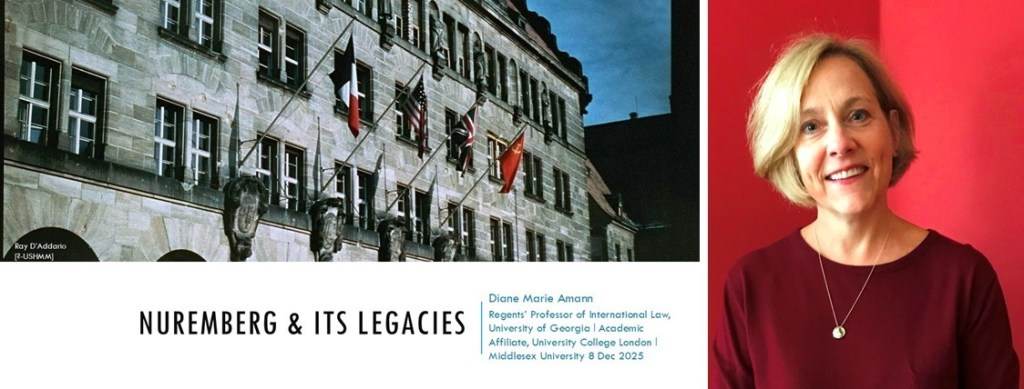
Amann provided an overview of the year-long post-World War II war crimes trial held in Nuremberg, Germany, before an International Military Tribunal established by Britain, France, the Soviet Union, and the United States. After discussing how the 1945-1946 trial unfolded, she considered the continued impact of the trial with regard to issues like the death penalty, the abolition of government leaders’ immunity from prosecution, and the international law duty to refuse to obey illegal orders.
Amann is Regents’ Professor of International Law, Emily & Ernest Woodruff Chair in International Law, and a Faculty Co-Director of our Dean Rusk International Law Center here at Georgia Law. During her current research-intensive semester, she is an Affiliate Academic at University College London Faculty of Laws. She has published several essays on the Nuremberg era and is writing a book on lawyers and other women professionals at that first trial.
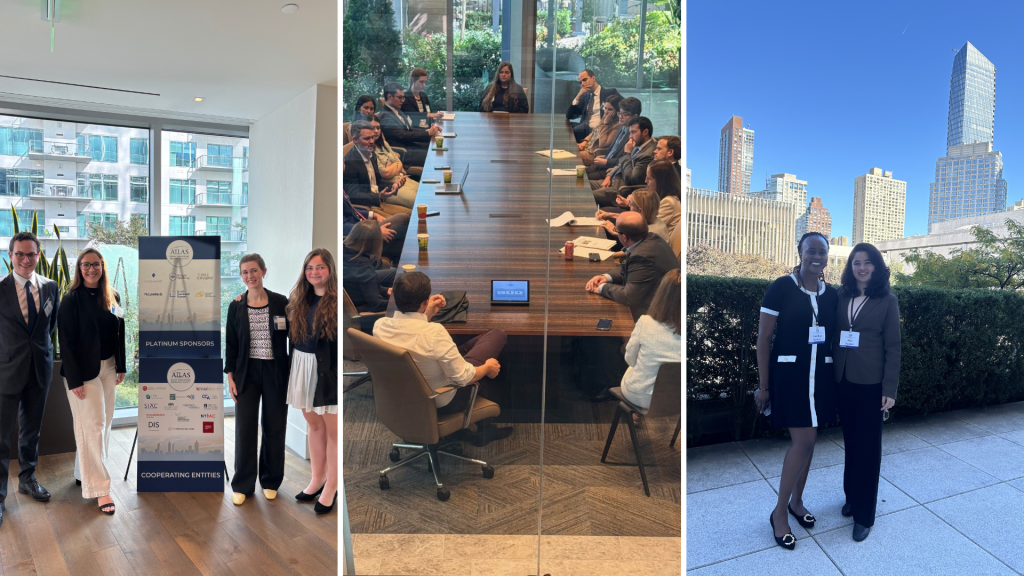
This fall, six University of Georgia School of Law students received Louis B. Sohn Professional Development Fellowships to support their attendance of international law conferences. Named after the inaugural holder of the Emily and Ernest Woodruff Chair in International Law at Georgia Law, Sohn Fellowships enable students to attend professional development opportunities related to international law. The Fellowships are administered by the Dean Rusk International Law Center.
Zhao was selected to be a 2025 Student Ambassador (detailed here). She was one of eight Ambassadors selected nationwide to assist with International Law Weekend.
Ross shared about her favorite panel from the AtlAS annual conference:
I really enjoyed the panel discussion on the impact of tariffs on international arbitration. This panel was addressing tangible issues regarding how businesses, countries, and counsel are adjusting with the current instability surrounding tariffs in the United States. This panel was applying concepts I recently learned about in my International Business Transactions class, including Incoterms and articles of the CISG, and discussing questions of interpretation and application that brought to life what I have been studying in a very real way.
Reflecting on the experience of attending the ABILA ILW, Paudel stated:
This conference has encouraged me to advance my academics and career in international law. Personally, it allowed me to gain hands-on insights on different arenas of international law. Hearing invaluable thoughts of international legal experts, law professors , judges, partners and directors has increased my in-depth knowledge on international law, that I couldn’t have acquired from any written book or article. Professionally, the conference allowed me to build strong networks with the panelists, and participants from other law schools.
Burns noted her biggest takeaway from the ABILA ILW:
My biggest takeaway was an increased confidence in the future of international law. Many, if not all, of the panelists we heard from were exasperated with recent blatant violations of international treaties and a lack of action from international tribunals. Their frustration and insistence on continuing to push for change was inspiring, and they gave me hope that there are still many high-level international professionals who have not thrown in the towel yet.
To read prior posts about Georgia Law students using Sohn Fellowships to attend professional development opportunities, please click here and here.
University of Georgia School of Law Professor Diane Marie Amann discussed her research on child-taking at a side event occurring during the 24th annual Assembly of States Parties of the International Criminal Court, held in early December at The Hague in The Netherlands.
In addition to Professor Amann, additional panelists included: Hala Turjman, Independent Institution on Missing Persons in the Syrian Arab Republic: Alla Perfetska, Voices of Children; and Ikhlass Ahmed Altaher Eisa, Strategic Initiatives for Women in the Horn of Africa. Ukraine’s Ambassador to The Netherlands, Andriy Kostin, provided opening and closing remarks, and Wayne Jordash KC, president of the Global Rights Compliance Foundation, moderated the panel.
Amann is Regents’ Professor of International Law, Emily & Ernest Woodruff Chair in International Law, and a Faculty Co-Director of our Dean Rusk International Law Center here at Georgia Law. During her current research-intensive semester, she is an Affiliate Academic at University College London Faculty of Laws.
From 2012 to 2021 Amann served as International Criminal Court Prosecutor Fatou Bensouda’s Special Adviser on Children in & affected by Armed Conflict. Her many publications on international child law include two that analyze the long-standing criminal phenomenon by which a state (or other powerful entity) takes a child and then endeavors to alter, erase or remake the child’s identity. These two articles are “Child-Taking Justice and the Federal Indian Boarding School Initiative,” 119 American Journal of International Law 629 (2025), and “Child-Taking,” 45 Michigan Journal of International Law 305 (2024).
In the article, Chauvet-Maldonado makes the case that cultural intelligence, or the capability to function effectively across various cultural contexts, is a critical skill for international lawyers. She observes that, in the evolving landscape of international engagement, international lawyers are functioning as “de facto diplomats,” and thus this skillset is more pertinent now than ever. Chauvet-Maldonado provides best practices for organizations preparing international legal actors, including:
Integrate cultural intelligence into the hiring criteria
Provide immersive cultural and legal training
Recruit for diverse perspectives
Establish feedback loops
Mentor for cross-cultural competence
Reward cultural stewardship
Chauvet-Maldonado is an international lawyer working within the Nuclear Nonproliferation Division of Oak Ridge National Laboratory (ORNL) as a Nuclear Nonproliferation Regulatory Specialist. Prior to joining ORNL, she worked as a Nonproliferation Policy and Law Analyst on the Legal Frameworks Team at the Pacific Northwest National Laboratory. She also served as the Permanent Representative to the United Nations Office at Geneva on behalf of the International Association of Jewish Lawyers and Jurists where she advocated before the Human Rights Council and liaised with foreign stakeholders in high-level discussions. Prior to that, she worked in the Law and Policy Forum at the International Committee of the Red Cross headquarters in Geneva, Switzerland, developing the case study supplement accompanying the ICRC’s Guidance Tool on International Humanitarian Law for the Judicial Sector. She also clerked for Honorable Chief Judge Tusan of Fulton County’s Superior Court in Atlanta, Georgia, up until her retirement. Chauvet-Maldonado is a member of the Dean Rusk International Law Center’s Advisory Council.
Bruner is the Stembler Family Distinguished Professor in Business Law at the University of Georgia School of Law and serves as a faculty co-director of the Dean Rusk International Law Center.
University of Georgia School of Law Professor Victoria J. Haneman recently spoke at the RSM Global Legal Conference in Rome, Italy. Her presentation was titled “The Relationship Between Universities and Lawyers” and it explored how law firms can maximize their relationships with local universities in today’s shifting landscape of AI disruption and hyper-politicization.
Haneman joined the University of Georgia School of Law in the fall of 2025 as the holder of the Verner F. Chaffin Chair in Fiduciary Law. Haneman comes to UGA from Creighton University, where she was a member of the law school’s faculty for seven years. In 2023, she was appointed the associate dean for research and innovation. She also held the Frank J. Kellegher Professorship of Trusts & Estates and served as the interim director of the health law program for the 2023-24 academic year. Haneman has a particular interest in tax policy, death care services, industry disruption, emerging markets, and women and the law.
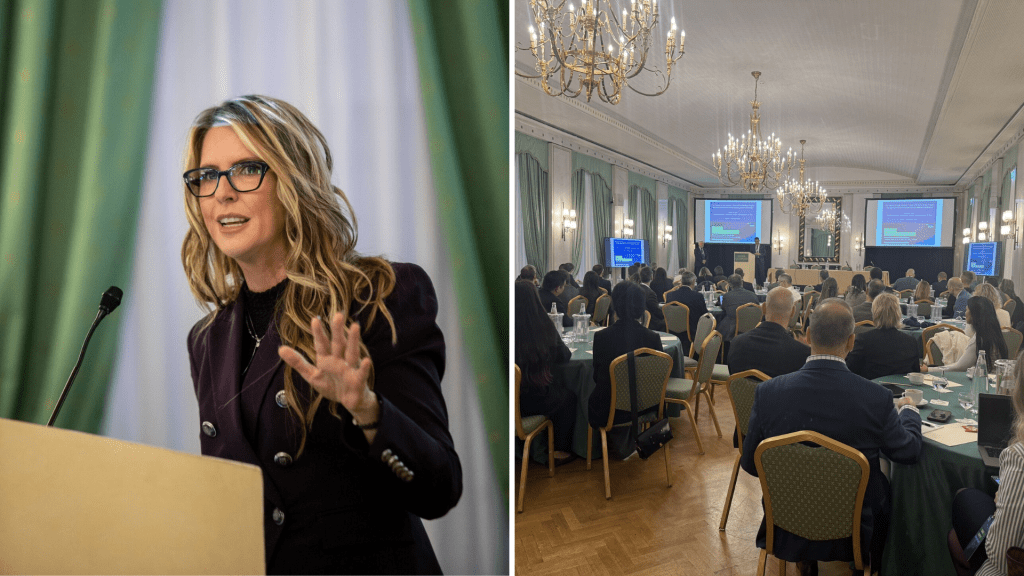
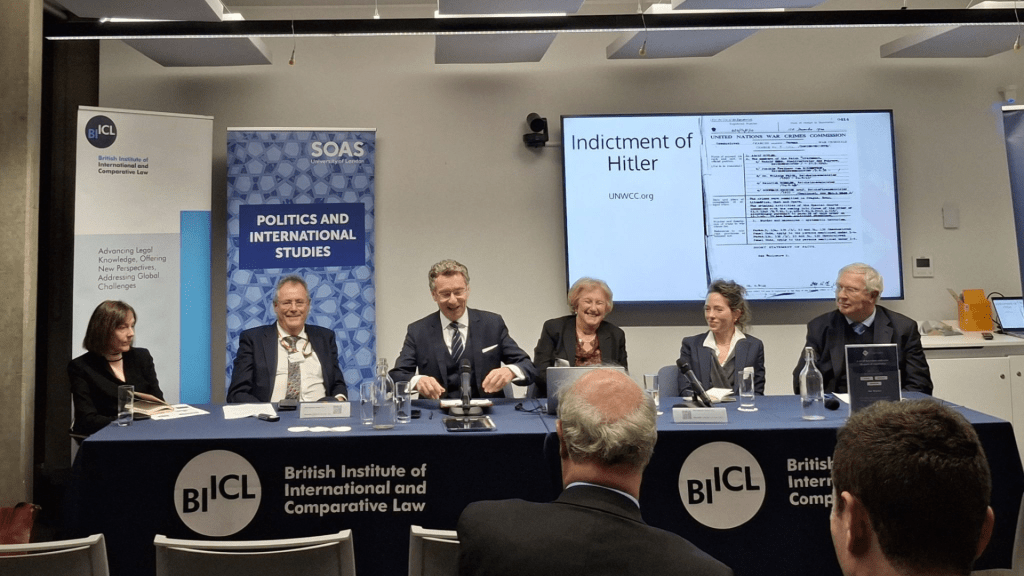
Her talk opened “80 Years On: The Legacy of the Nuremberg Trials for Accountability,” a panel of experts convened to analyze the midtwentieth-century trials project. The panel also looked to contemporary developments in international relations and international criminal justice – not least, to the Nuremberg precedent which permitted international criminal prosecutions of heads of state and other governmental leaders. A full video of the panel can be found here.
Besides Professor Amann (pictured above left), panelists included (l to r): Dan Plesch, Professor of Diplomacy & Strategy at SOAS University of London; Christoph Safferling, Director of the International Nuremberg Principles Academy and Professor of Law at the Friedrich-Alexander-Universität Erlangen-Nürnberg; as moderator, International Criminal Court Judge Joanna Korner CMG KC; Kirsty Sutherland, international barrister at 9BR Chambers, London; and Sir Howard Morrison KCMG CBE KC, former Judge on the International Criminal Court. (LinkedIn photo credit)
Amann is Regents’ Professor of International Law, Emily & Ernest Woodruff Chair in International Law, and a Faculty Co-Director of our Dean Rusk International Law Center here at Georgia Law. During her current research-intensive semester, she is an Affiliate Academic at University College London Faculty of Laws. She has published several essays on the Nuremberg era and is writing a book on lawyers and other women professionals at that first trial.
UGA’s Office of Research, in partnership with the Office of the Provost, provides “pre-seed” funding to facilitate the formation of faculty teams and collaboration around critical areas of research expertise or emerging research topics. The goal is to stimulate large-scale research team formation and position UGA faculty groups to be more competitive in attracting resources for collaborative research, including internal UGA seed grants and ultimately, external grant support.
LeClercq joined the University of Georgia School of Law in 2024 as an assistant professor. She teaches Contracts, International Trade and Workers Rights, International Labor Law, International Law and U.S. Labor Law, and Public International Law. She also serves as a faculty co-director of the Dean Rusk International Law Center and as the faculty adviser for the Georgia Journal of International and Comparative Law.






 exchange of notes